Many facilities overpay on their electric bill every month — and just as many spend money on the wrong fix trying to stop it. Someone sees a low power factor number, orders a capacitor bank, and is surprised when the savings barely move. The problem wasn’t that they acted. It’s that they solved a problem they didn’t actually have.
Power factor and efficiency are separate levers. Both can lower your bill, but through different mechanisms, and pulling the wrong one wastes capital twice — once on the equipment, and again on the savings you never captured. This guide is about matching the fix to the actual cost driver.
What Power Factor Actually Means in a Real Facility
You need just enough vocabulary to make decisions. Here it is.
Your facility draws two kinds of power. Real power (kW) does the work — it spins motors, heats elements, runs lights. Reactive power (kVAR) sustains the magnetic fields in inductive equipment but performs no useful work. Together they make up apparent power (kVA), which is what the utility must supply in total. Power factor is the ratio of real to apparent power: kW divided by kVA. A power factor of 1.0 means every ampere of supplied current is doing useful work. A power factor of 0.8 means a significant share of the power is circulating without producing anything.
That’s the whole foundation. You don’t need the trigonometry to make good decisions here.
What a low power factor actually does to you
Three consequences, each worth understanding on its own.
First, it costs you on the bill. Utilities size their generation and distribution around apparent power, not real power, so many commercial and industrial tariffs charge for it directly.
Second, it consumes capacity you already paid for. When reactive current fills your transformers and feeders, that’s copper and transformer headroom occupied by current that produces no useful output — stranded electrical infrastructure. Many facilities only discover this when they try to add equipment and get told they need a service upgrade they shouldn’t need yet.
Third, it runs hotter. Higher total current means more resistive heating in conductors, connections, and windings. That’s both wasted energy and accelerated wear.
Power factor and efficiency are not the same problem
This is the distinction the whole article turns on.
Efficiency measures how much useful work you extract from each unit of real power consumed. Power factor measures how much of the total supplied current is doing useful work at all. Improving one does not automatically improve the other.
A plant running high-efficiency motors at 0.90 power factor can pay more in demand charges than a plant running older, less efficient motors at 0.98 — even though the first plant burns less real energy. The efficient plant wins on consumption and loses on demand. If you assume “just save energy” handles both sides, you’ll fix the wrong half of the bill. Which lever you reach for depends entirely on which metric is actually broken.
When Poor Power Factor Is Actually Costing You Money
Before you price a single capacitor, find out whether your tariff even charges you for low power factor. Some do heavily. Some barely mention it. That single difference determines whether correction is urgent or irrelevant.
Start with the utility bill, not the capacitor catalog
Power factor penalties appear in a few recognizable forms. Some utilities charge for reactive power directly at a per-kVAR rate. Others bill on apparent power (kVA) rather than real power (kW), so a poor power factor quietly inflates your demand charge with no explicit penalty line item. Some schedules apply a power factor adjustment multiplier to the demand charge. And many industrial rates carry a minimum power factor clause — often 0.85 to 0.95 — with charges triggered when the power factor falls below the threshold.
Your rate schedule sets the urgency. Two otherwise identical facilities on different tariffs can have completely different reasons for acting — or not acting at all. Read the schedule before assuming you have a problem worth solving.
Signs the problem is bigger than the bill
Sometimes the bill looks tolerable, but low power factor is still hurting you — and the evidence is physical rather than financial.
Watch for transformers or feeders operating closer to their limits than the actual load warrants. Watch for connections running hot. Watch for voltage sagging under peak demand. And pay attention if you try to add equipment and discover you can’t without upsizing the service. That last one is a consistent surprise — the inability to grow without a costly upgrade is often a capacity problem caused by reactive current, not a load problem caused by too much real consumption. Correction can free that headroom without a new transformer.
When power factor is not your first priority
Here’s what most articles won’t say: sometimes the right move is to leave power factor alone.
If your tariff carries no meaningful penalty, if your feeders and transformers have comfortable headroom, and if bigger savings are sitting somewhere else — equipment running when nobody needs it, oversized motors loafing at partial load, a control strategy that never got tuned — then correcting power factor is improving a number rather than reducing a cost. The metric gets better, and the bill barely moves.
Spending capital to make a reading look cleaner, when that reading isn’t tied to real money or real capacity pressure, is the exact mistake this article exists to prevent. Diagnose first. If power factor isn’t the cost driver, put your budget where the cost actually lives.
Common Causes of Low Power Factor
When the power factor is low, the causes are similar from facility to facility. Recognizing the pattern tells you a lot before you ever connect a meter.
Motor-heavy facilities are the classic case
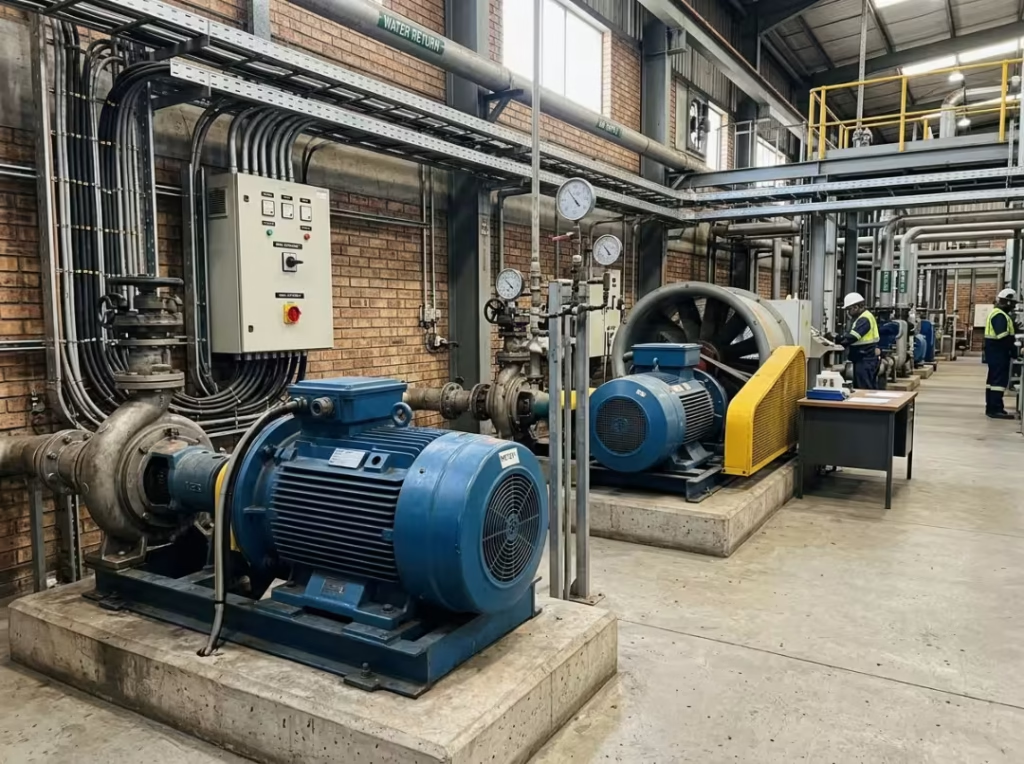
Induction motors are the dominant reason most facilities run poor power factor. Fans, pumps, compressors, conveyors — anything motor-driven draws reactive power to build its magnetic field.
The detail that matters most is operating load. A motor near full load maintains a respectable power factor. That same motor at 40 to 50 percent load sees its power factor collapse because the reactive current remains roughly constant while the real power drops off. Facilities full of oversized or lightly loaded motors don’t just waste energy — they also pull down power factor. If your plant is motor-heavy and much of it runs at partial load, you’ve already found a large part of your answer.
The contributors people miss
Beyond the obvious motor banks, a few quieter culprits add up. Transformers draw reactive power even when lightly loaded or idle. Welders have inherently poor power factor. Older lighting with magnetic ballasts pulls reactive current that modern electronic ballasts don’t. Elevators and other intermittent motor loads contribute in bursts. None of these dominates the way a motor bank does, but check them before assuming the large machines explain everything.
Why modern nonlinear loads complicate the picture
Here’s where the classic capacitor fix starts to break down.
Variable frequency drives, UPS systems, rectifiers, and LED drivers are nonlinear loads. They don’t simply shift the current waveform relative to the voltage — they distort it, injecting harmonics into the system. And that changes what “power factor” actually means.
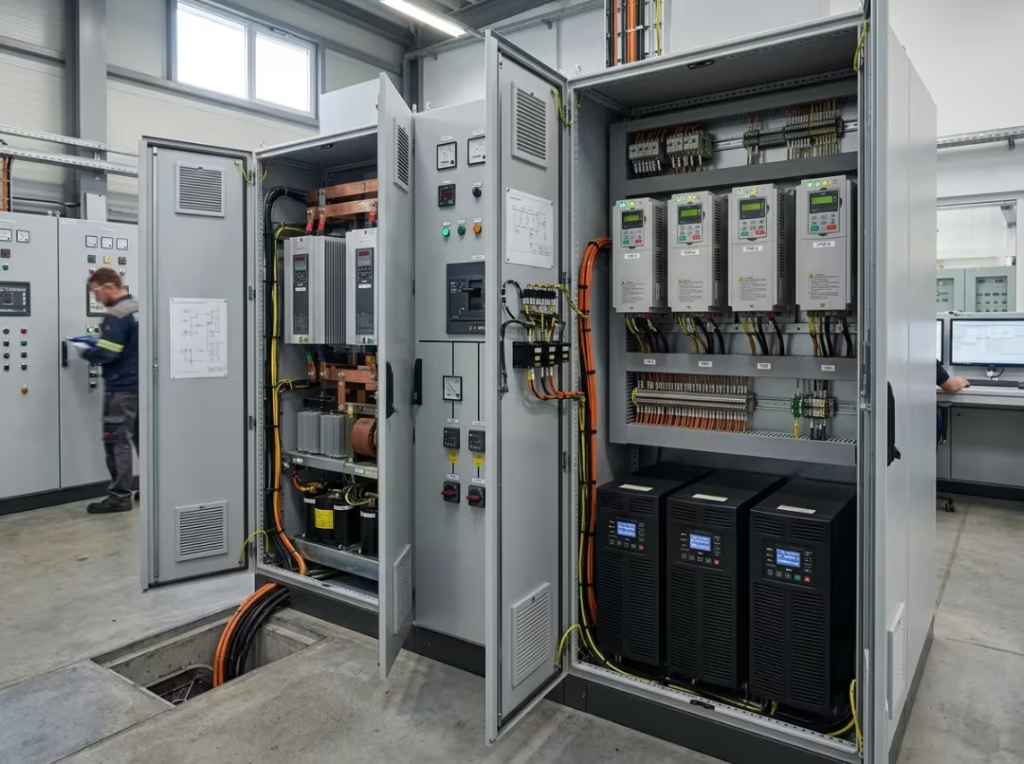
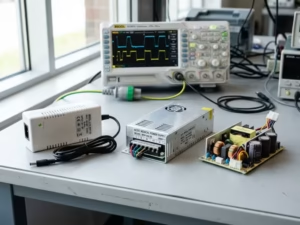
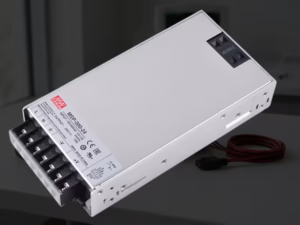
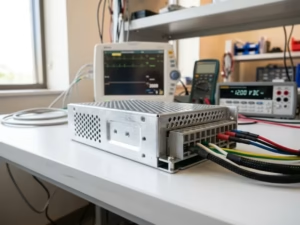
Two distinct things hide under the same term. Displacement power factor describes the phase shift between current and voltage — the classic problem from inductive loads. True power factor accounts for both that phase shift and harmonic distortion. Capacitors correct displacement. They do nothing for the harmonic component, and in a harmonic-rich system they can make things worse. If a large share of your load is drives and switch-mode electronics — including the ITE power supplies commonly found in networking and industrial equipment — your poor true power factor may not respond to capacitors at all — which is exactly why the next step is diagnosis, not an equipment order.
How to Tell Whether You Need Correction, Better Equipment, or Both
Once you suspect a problem, the goal is to confirm and classify it before spending any money. A guess sends you to the wrong solution; a short, structured look sends you to the right one.
Measure at more than one point
A single reading at the utility meter tells you what the utility sees and nothing about where the problem lives inside your building. Measure at the service entrance for the overall picture. Measure at your main distribution panels to identify which zones are worst affected. Measure at large individual loads to identify the specific machines. And capture readings during variable-load and peak periods — power factor that looks fine at 9 a.m. can fall apart when the plant is running at full capacity.
Where and when you measure matters far more than which analyzer you buy.
What a useful audit should reveal
A worthwhile audit answers four questions: what’s your average power factor, when does it drop, which loads are driving it, and is the pattern steady, localized, or highly variable. If you can answer those four, you have what you need to decide — not a procedure manual, just a clear behavioral picture.
Three outcomes, three directions
Most audits fall into one of three categories, each requiring a different response.
A uniformly low power factor across the facility suggests central correction makes sense. A localized problem — one department, one process line — means targeted correction costs less and works better than treating the whole building. A highly variable power factor, especially associated with cycling equipment or nonlinear loads, points to automatic or active solutions — and carries a warning.
Don’t mistake harmonics for a simple capacitor job
If the power factor is variable due to drives and switch-mode loads, adding capacitors can backfire. Capacitors interact with system inductance to form a resonant circuit, and harmonics can excite that resonance — amplifying voltages, overheating capacitors, and accelerating failure. A job that looked straightforward becomes a new power quality problem.
The sequence is non-negotiable: assess harmonics before designing correction. In a harmonic-heavy facility, that assessment is the difference between equipment that serves you for years and equipment you replace in one.
Choosing the Right Power Factor Correction Strategy
Correction isn’t something you pick off a shelf. It’s a match between how your load behaves and what the equipment does well. Get the match wrong, and you either overpay or create new problems.
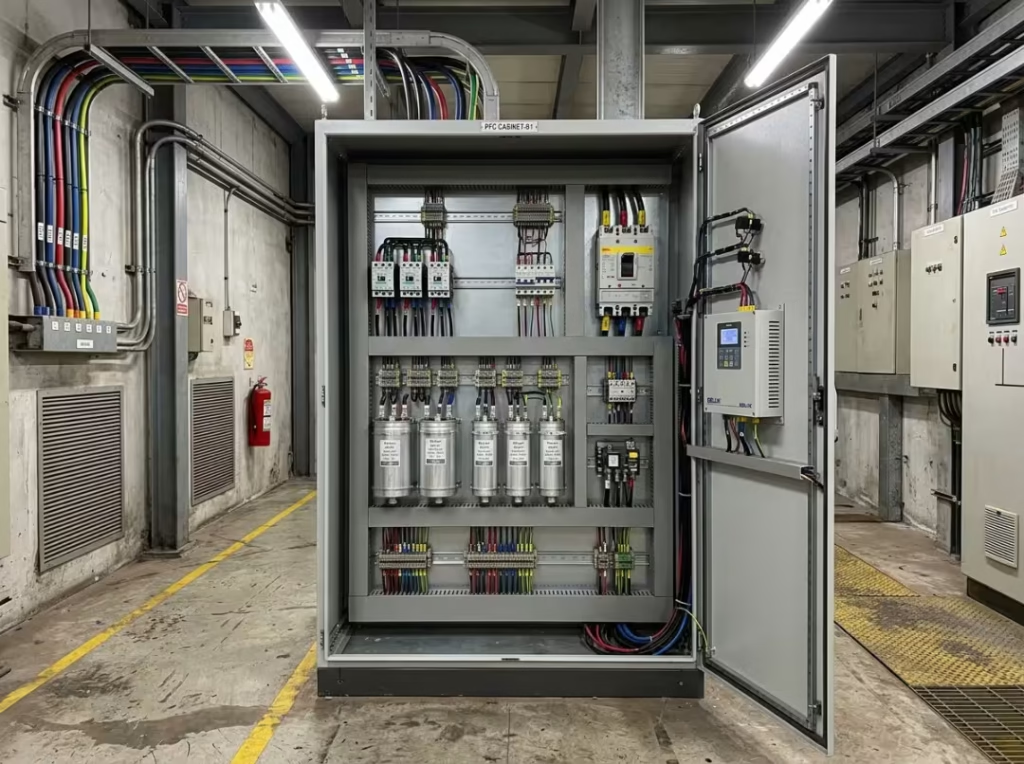
Fixed capacitor banks: for steady, predictable loads
A fixed bank supplies a constant amount of reactive power. When load is continuous and stable, this is the simplest, cheapest option — and the right one. The limitation is built into the name: it’s fixed. When load drops, that same capacitance over-corrects, and at light load it can push you into a leading power factor with its own complications. Fixed banks reward predictable loads and punish variable ones.
Automatic capacitor banks: for facilities that swing
When reactive demand rises and falls throughout the day, an automatic bank switches capacitor steps in and out to track it, holding the power factor near the target across changing conditions. It costs more, and that cost is justified when variability is genuinely high. If your load varies widely, the control pays for itself in avoided over- and under-correction. If the load is stable, you’re buying complexity you won’t use.
Correct at the service entrance, the panel, or the load?
This is the decision most discussions skip — and it changes the outcome more than the choice between fixed and automatic.
Correcting at the service entrance fixes what the utility bills you for. It cleans up the meter number. But it does nothing for current flowing through your internal distribution — every transformer and feeder still carries the reactive load.
Correcting at a distribution panel relieves a specific zone, which helps the upstream path serving that section.
Correcting at the load is technically the strongest approach. Reactive power is supplied where it’s consumed, thereby reducing line losses and freeing capacity along the entire upstream path. The tradeoff is operational: more units, more maintenance points. If the goal is purely to stop a utility penalty, service-entrance correction may be sufficient. If you’re trying to reclaim stranded internal capacity, location isn’t a detail — it’s the point.
When active correction is the better answer
There’s a threshold where capacitors stop being the right tool. In harmonic-rich environments, with rapidly changing loads, or where power quality problems are already present, active solutions earn their higher cost. Active harmonic filters cancel harmonic currents and dynamically correct power factor; drive-level correction addresses the problem at the source. The connection back to the true-versus-displacement distinction is direct — if your poor power factor is largely harmonic in origin, active correction addresses what capacitors simply can’t. Synchronous condensers are used at very large industrial facilities, but for most operations, that’s an edge case.
What overcorrection looks like
More correction is not always better. Add too much capacitance — most easily with fixed banks at light load — and you swing into a leading power factor. That introduces voltage instability, increased equipment stress, and a risk of resonance in harmonic-rich systems. The goal is to land near your target across the real operating range, not to bury the problem under maximum capacitance. Overcorrection trades one set of problems for another.
Efficiency Upgrades That May Matter More Than Power Factor Alone
Correction stops paying for wasted current. Efficiency stops you from needing the energy in the first place. When power factor isn’t your real cost driver, the money usually lives here.
Motors and drives first, if they dominate your load
Motors account for the majority of industrial electricity consumption, which makes them the highest-value target when they dominate your load. Three moves tend to matter most: replace aging standard-efficiency motors with premium-efficiency models; right-size oversized motors running at partial load, where both efficiency and power factor suffer; and add variable-frequency drives to variable-torque applications like fans and pumps, where matching speed to actual demand can cut energy use substantially. If you’re evaluating power supply and drive options for your facility, VFDs also improve power factor at the drive input — which makes them a bridge between the two levers rather than a pure efficiency play.
Harmonic control and power quality cleanup
Line reactors, filters, and careful transformer selection reduce harmonic currents. This is worth doing independently, and it does double duty: cleaning up harmonics protects correction equipment from the resonance and overheating risks already described. The IEEE 519 standard defines acceptable harmonic levels at the utility connection point — know it exists, and design your system against it.
Distribution-side losses still matter
After the big-ticket items, smaller losses accumulate. Loose or corroded connections resist current and generate heat. Unbalanced single-phase loads create neutral current that serves no productive purpose. Equipment operating above rated voltage draws more than necessary and ages faster. Underloaded old transformers burn energy continuously just by being energized. None of this is glamorous, and together these losses are often worth more than people expect.
Fix operations before buying equipment
Sometimes the cheapest win requires no purchase order. Equipment running when nobody needs it, assets operating well below their designed load, schedules set years ago and never revisited, control strategies nobody has touched — these waste real money and require nothing more than focused attention to address. Before specifying any hardware, look honestly at how the facility operates. Correcting operations first also shows you what your actual load profile looks like, making any equipment you eventually buy a better fit.
Which Should You Prioritize First: Power Factor Correction or Efficiency Upgrades?
This is where the diagnosis pays off. You don’t do everything at once — you do whatever returns the most, first.
Start with power factor correction when
The penalties on your bill are real and identifiable. Payback is short. The root cause is clear and stable — a steady motor load with consistently poor power factor, not a chaotic mix of drives and nonlinear equipment. Or you need capacity relief urgently, and correction can deliver it faster and more cheaply than a service upgrade. When those conditions align, correction is often among the fastest-payback upgrades in the building.
Start with efficiency upgrades when
There’s no meaningful power factor penalty on your tariff. Oversized motors or uncontrolled variable loads dominate consumption. The bigger savings come from running things less — cutting runtime, matching speed to demand, shutting down idle equipment. In these cases, correction can wait. Pouring capital into a better power factor reading while your real energy waste goes untouched is exactly the wrong-problem trap.
In many facilities, the right answer is staged
Most operations can’t fund everything simultaneously, and they don’t need to. Audit first, so you know what you’re dealing with. Then take the fast-payback fix — often power factor correction when a real penalty exists — and let those savings help fund the next phase. Then move into deeper efficiency retrofits. If operational waste is clearly your highest cost, reverse the order and start there. The sequence follows the money, not a fixed calendar.
A Practical Decision Framework by Facility Type
Different facilities carry different loads, which shifts where you should look first.
Manufacturing plants. Motors and compressors dominate. Start with a motor management program, add VFDs to variable-torque loads, and correct at the service entrance or on the large individual machines driving the reactive load.
Commercial office buildings. HVAC and lighting lead the load, and power factor penalties are typically milder than in industrial settings. Run a bill analysis before assuming correction is worth it — the savings usually live in lighting upgrades, controls, and HVAC efficiency.
Data centers and power-electronic-heavy sites. Power factor is frequently already high because electronic loads correct much of it at the source. Cooling and power density dominate the cost picture; focus on power quality and UPS efficiency rather than capacitor banks.
Retail, refrigeration, and hospitality. Refrigeration and HVAC lead. Start with compressor efficiency, VFDs on refrigeration systems, and lighting controls.
Before You Spend Money: What a Sound Implementation Plan Looks Like
Insight is worth little without a plan that holds up against your actual electrical system.
Confirm the business case
Start with evidence, not intent. Pull your utility bills, quantify any penalty amounts, review your demand trend, and characterize your load profile. If the financial case isn’t documented, you’re not ready to commit capital.
Design for the actual electrical environment
Design for your real loads, not a clean-sheet assumption. Account for harmonics, load switching profiles, planned expansion, and practical maintenance access. Correction: Sizing for today’s simplified assumptions can fail early in a facility full of drives, or fall short the moment you add a new production line. Accounting for harmonics and future load at the design stage — supported by in-house EMC and validation capabilities — is what separates a system that serves you for years from one that gets replaced.

Monitor after installation
Correction is not install-and-forget. Verify the savings appear on the bill. Watch for power factor drift, which can signal a failing capacitor step, an aging motor, or new equipment that needs its own correction. Re-evaluate when your load changes materially. A correction system that worked on day one can quietly degrade, and monitoring is how you catch it before it costs you again.
Frequently Asked Questions
What is a good power factor for a commercial or industrial building?
A working target is 0.95 or above — that clears most utility thresholds with a comfortable margin. But “good enough” is defined by your tariff. If your rate schedule draws the line at 0.90, chasing 0.99 may return nothing. Let the schedule define the target.
Does low power factor always increase electric bills?
No. It depends on your rate schedule. Some tariffs charge directly for reactive power or bill on apparent power, making low power factor an immediate cost. Others don’t meaningfully penalize it. Check your actual schedule before assuming there’s money to recover.
Can variable frequency drives improve power factor on their own?
Often, yes — many VFDs present a better displacement power factor at their input than an uncontrolled motor would. The caveat is harmonics: drives are nonlinear loads, so while they can help the displacement side, they can worsen true power factor unless harmonic control is designed in alongside them.
When should I use active correction instead of capacitor banks?
When your loads are harmonic-rich or change rapidly, and when power quality problems are already present. Capacitors correct displacement power factor; they can’t address harmonic distortion and may resonate with it. Active harmonic filters handle both, which is why they are more expensive in those environments.
What happens if I install too much power factor correction?
You overshoot into a leading power factor, which can cause voltage instability, increased equipment stress, and a risk of resonance in systems with harmonics. It’s most common with fixed banks at light load. The goal is to land near the target across your real operating range — not to add maximum capacitance.
How do harmonics affect capacitor bank selection?
Significantly. In a harmonic-rich system, capacitors can form a resonant circuit with system inductance, amplifying voltages and overheating the capacitors toward early failure. Assess harmonics before selecting or installing correction equipment — the results may point you to detuned or filtered solutions rather than plain capacitors.
Should I improve the power factor first or replace inefficient motors?
Follow the money. If a real power factor penalty exists and the payback is short, correct first. If there’s no meaningful penalty and your waste is concentrated in oversized motors or excess runtime, right-size and replace the motors first. The question’s headline doesn’t determine the answer — your facility’s cost structure does.
The Bottom Line
The fastest route to a lower electric bill isn’t a better power factor number. It’s identifying which lever is actually draining money and pulling that one.
Start with twelve months of utility bills. Calculate your average power factor. Read the rate schedule and find out whether — and how — it charges you for reactive power. If the penalty is real and the payback is short, power factor correction is often one of the most cost-effective upgrades available. If the penalty is minimal or absent, the capital belongs in efficiency and operational improvements. And before committing to any correction design, assess your harmonics and load variability — because that’s what determines whether capacitors solve your problem or become your next one.