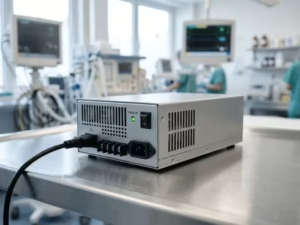
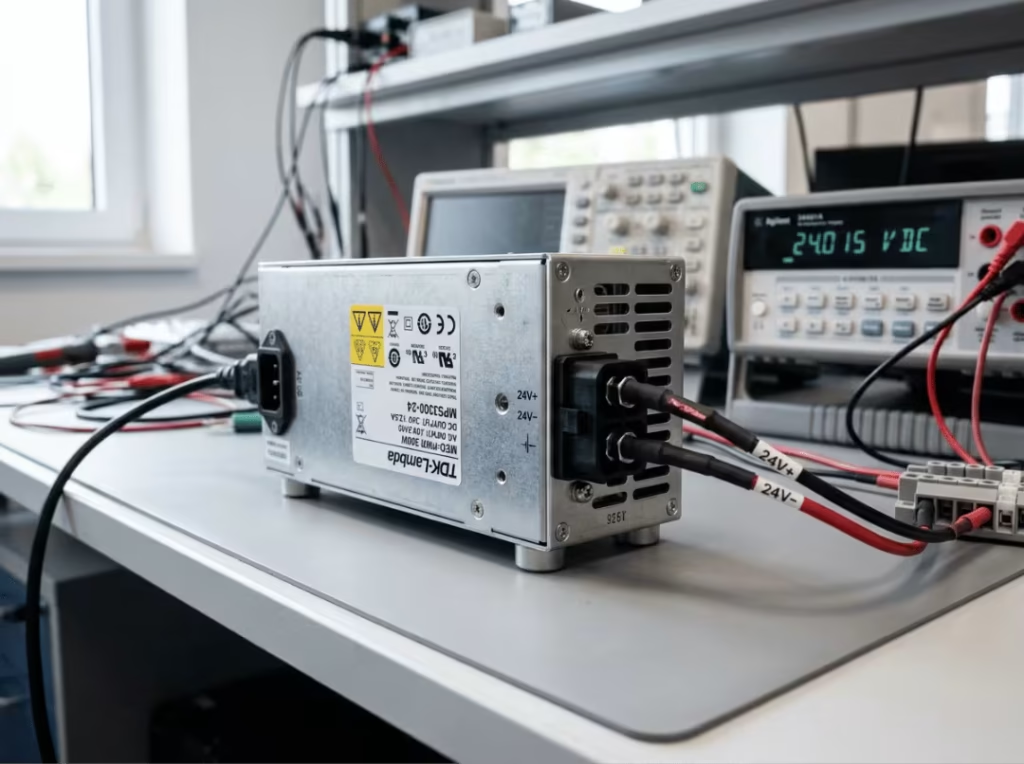
A design team sits three weeks from a certification audit. The device works, the enclosure is tooled, the launch date is locked. Then a reviewer flips to the power supply spec and spots the wrong patient-contact rating on the marking. That single component isn’t certified for direct patient contact — and now the timeline slips while procurement scrambles for a compliant replacement and the test plan gets rewritten.
The power supply earns that scrutiny for one reason: it bridges the mains side and the patient-access side of the device. High voltage comes in on one end, and on the other sits a patient who may be unconscious, wet, or wired to other equipment. That makes it one of the most heavily tested parts in the whole build.
This guide provides 10 criteria for choosing medical-grade power supplies, grouped into 4 decision themes. By the end, you’ll be able to screen any candidate supply, verify a vendor’s claims instead of trusting them, and ask far sharper questions before you commit.
How to Use These Criteria
The ten criteria don’t carry equal weight, and treating them as a flat list is the fastest way to miss what actually matters. Split them into two jobs.
Safety criteria are pass/fail filters. A candidate that fails certification, leakage, or isolation is out — no amount of great pricing or short lead time buys it back in. Run these first and eliminate ruthlessly.
Everything else compares the survivors. Performance, reliability, and continuity criteria are where you weigh trade-offs, break ties, and pick the supply that fits your specific design. The four themes below follow that order: safety and isolation, performance and protection, reliability and environment, and compliance and continuity.
Safety & Isolation — the Pass/Fail Floor
Most audits fail here, so treat this as a filter rather than a comparison. If a supply can’t clear these three criteria, nothing else about it matters.
1. Certification You Can Actually Verify
Two standards define a medical-grade power supply. IEC 60601-1 covers general safety — protection against electric shock, energy hazards, and mechanical failure. IEC 60601-1-2 covers electromagnetic compatibility, meaning the supply won’t emit interference that disrupts nearby equipment and won’t misbehave when it receives interference. A supply certified to one is not automatically certified to the other, and you need both. Check that the certificate references current editions, since older editions phase out on published transition dates and an expired edition can sink your submission.
The term you’ll see most is 2x MOPP — two means of patient protection. It applies when the supply’s output can reach a patient, and it demands two independent layers of protection so a single fault can’t expose the patient to a hazard. 2x MOOP — two means of operator protection — is the lighter requirement, appropriate only when the supply is isolated from patient contact. Specify MOOP where you need MOPP, and you’ve made a classic, expensive mistake.
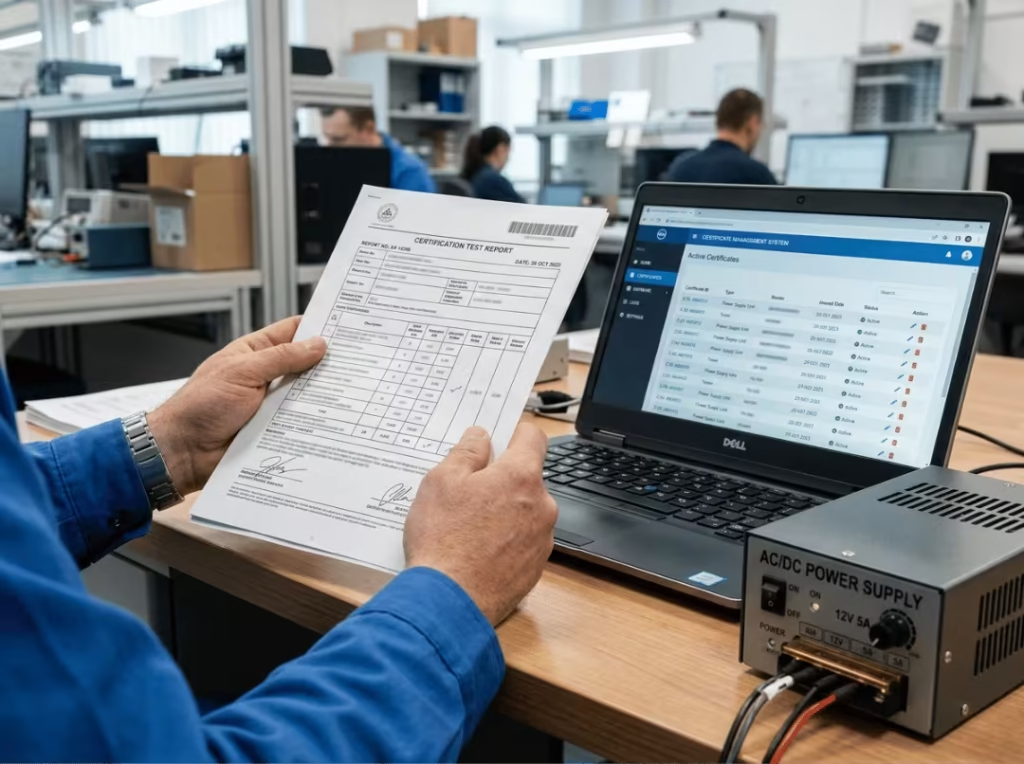
Then verify the claim properly. Don’t accept the PDF a vendor emails you. Pull the certificate number, the issuing body, the exact model number, and the validity date, then confirm all four against the issuer’s own online database. A full IEC 60601-1 certificate from a recognized test house holds up in an audit. A manufacturer’s self-declaration doesn’t — that’s the vendor vouching for itself.
Here’s the trap that catches careful engineers. A vendor sends a legitimate certificate covering a product family. It looks real because it is real. But your specific model variant — the higher-current version, or the one with the different output connector — isn’t listed on it. It passes a glance and fails the audit. Always confirm your exact ordering part number appears on the certificate.
2. Leakage Current and Isolation
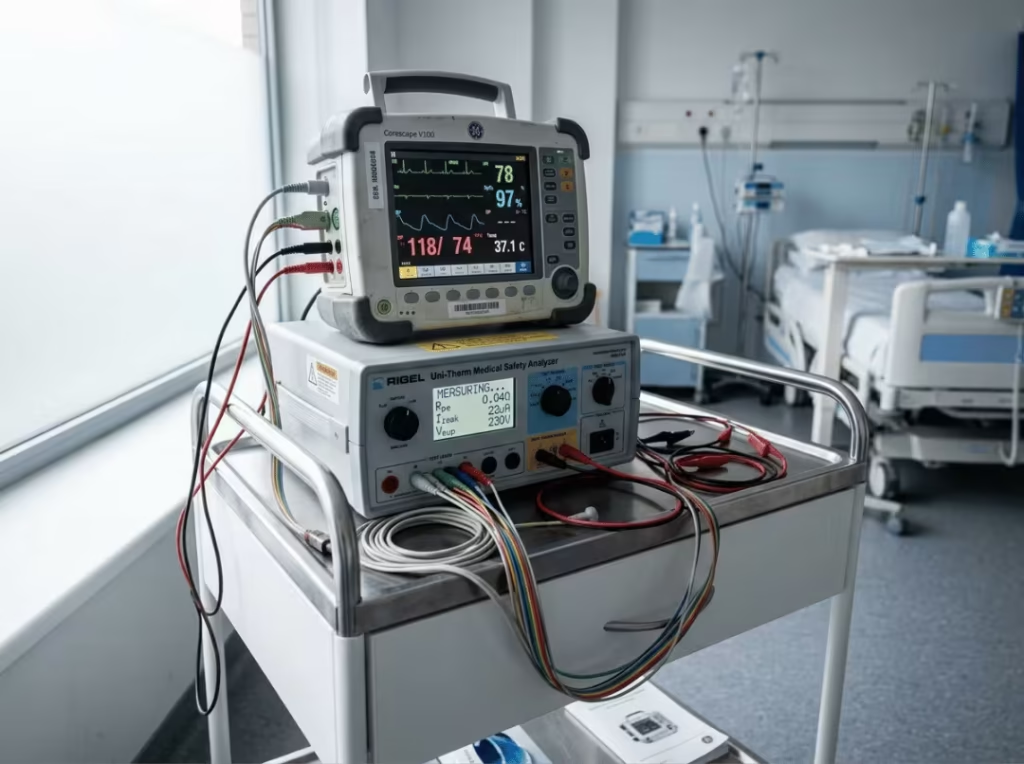
Leakage current is the small current that escapes through insulation toward ground or an accessible surface, and a medical device caps it tightly. Three types matter. Earth leakage flows from the mains to protective earth. Touch current flows through anyone contacting an exposed surface. Patient leakage current flows through a part that contacts the patient — and in most medical designs, this is the one that dominates and the one held to the strictest limit.
Allowable limits shift with the environment. A supply destined for a patient-care area faces far tighter caps than one used in a non-patient-care area, such as a lab or equipment room. Design to the wrong zone and you’ll pass bench testing only to fail formal compliance.
Isolation is how you keep leakage low. Basic isolation is a single protective barrier. Reinforced isolation provides protection equivalent to two independent barriers, so a single failure doesn’t create a hazard — exactly the redundancy 2x MOPP demands. The trade-off is real: pushing leakage lower usually constrains your isolation design and can raise cost.
Picture a portable patient monitor plugged into bedside power, touched by the patient on one side and a clinician on the other. Two current paths to worry about at once. “Low leakage” here isn’t a marketing term — it’s a hard number your isolation architecture must meet under fault conditions, not just in normal operation.
3. Creepage and Clearance
Creepage is the shortest distance along a surface between two conductors; clearance is the shortest distance through the air. Both are measured because current can track across a surface or arc through air, and the weaker of the two sets your safety margin.
Watch the altitude trap: air insulates less at low pressure, so clearances that pass at sea level can fail above 2,000 meters — a real concern for shipping and high-altitude installation. These distances are directly tied to the environmental pollution level and the insulation material group, both of which appear on a proper datasheet.
Performance & Protection — Clean Power Under Real Load
Clearing the safety floor only proves a supply is legal to use. Now you compare survivors on whether they deliver clean, stable power inside your actual device.
4. Protection Features
A serious medical supply ships with a standard set of protections: overcurrent, overvoltage, overtemperature, short circuit, and input undervoltage lockout. Treat these as the baseline, not a feature list.
The questions that separate vendors go deeper. How fast does the supply recover after a short circuit clears? And when a fault trips, does it latch off — staying dead until power cycles — or auto-recover? Neither behavior is universally right; a latching supply is safer for some fault modes, an auto-recovering one keeps critical equipment alive. Match it to your device. Inside a sealed enclosure you can’t easily reach, tighter, more predictable trip control is worth a premium because a nuisance trip means a service call.
5. Electrical Performance Specs That Matter
Read these specs for consequences, not numbers. The input voltage range determines whether a single supply works across your target markets or requires regional variants. Hold-up time keeps the output alive through a brief mains dip — enough of it keeps an infusion pump running through a 10-millisecond drop instead of resetting mid-therapy. Output accuracy determines whether downstream circuits see the expected voltage. Ripple and noise ride on the output and can corrupt sensitive analog measurements. Line and load regulation describe how well the output holds steady as input and demand swing. Efficiency governs heat and running cost.
Construction class matters here too. A Class I supply relies on a protective earth connection through a grounded three-pin plug. A Class II medical power supply uses reinforced insulation instead of an earth connection, suiting a two-pin floating design. Pick the one your device’s grounding scheme actually supports.
6. Thermal Management and Derating Curves
Here’s the point most spec sheets bury: the rated output power only exists inside a narrow ambient temperature window. Above that window, the supply must shed load to protect itself — and the derating curve is the only place that truth shows up.
Learn to read the curve. Output power or current sits on one axis, ambient temperature on the other, and a shaded region marks the safe operating area. The flat portion is where you get full rated power; the sloping portion is where available power falls as temperature climbs. Your job is to find where your real operating temperature lands on that slope.
Cooling method shapes the curve. Conduction moves heat through a mounting surface; convection relies on still air; and forced air uses a fan for the most aggressive cooling. Mounting orientation matters more than engineers expect — lay a convection-cooled supply flat instead of vertical and you choke the airflow it depends on, dragging the whole curve against you.
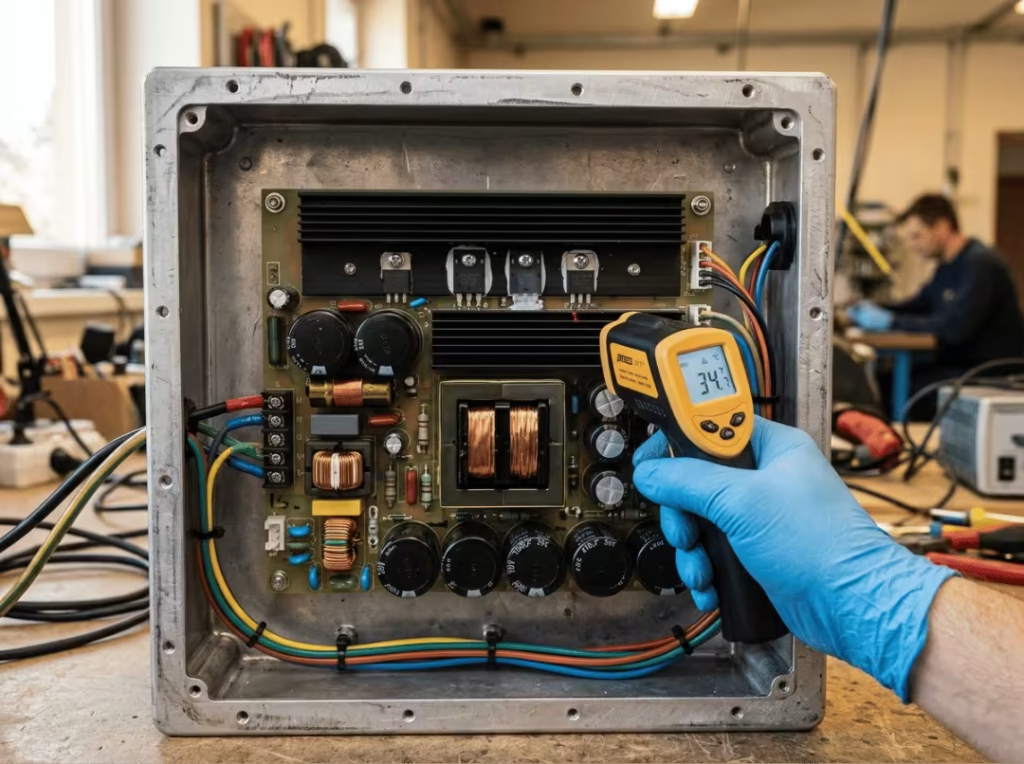
Consider a supply rated for full power on the datasheet. Drop it into a real sealed enclosure where the internal ambient sits at 50 °C, and the curve quietly derates it to 60% of that headline number. You specified full power. You’re getting a little over half. That gap is how thermally sound programs still end up over budget and behind schedule.
Reliability & Environment — Surviving Years in a Sealed Box
A supply can clear every safety test and still fail in the field — quietly, two years after launch. Reliability criteria protect against that slow failure.
7. Reliability and Lifetime Metrics
Two numbers describe a supply’s longevity, and you need both because neither alone tells the whole story. MTBF (mean time between failures) is a statistical rate — it predicts how often a large population of units fails during normal operating life, not how long any single unit lasts. Design life is different: it’s the number of years the supply is engineered to run before wear-out becomes likely. A high MTBF with a short design life means the supply rarely fails early but wears out sooner than your product needs. Read them together.
What actually kills a supply is component aging, and three parts age fastest under heat and current. Electrolytic capacitors dry out, and every 10 °C of extra heat roughly halves their life. Fans wear their bearings and seize. Optocouplers lose transfer efficiency over time, causing the feedback loop to drift. If your enclosure runs hot, these three set your real service life — not the headline MTBF.
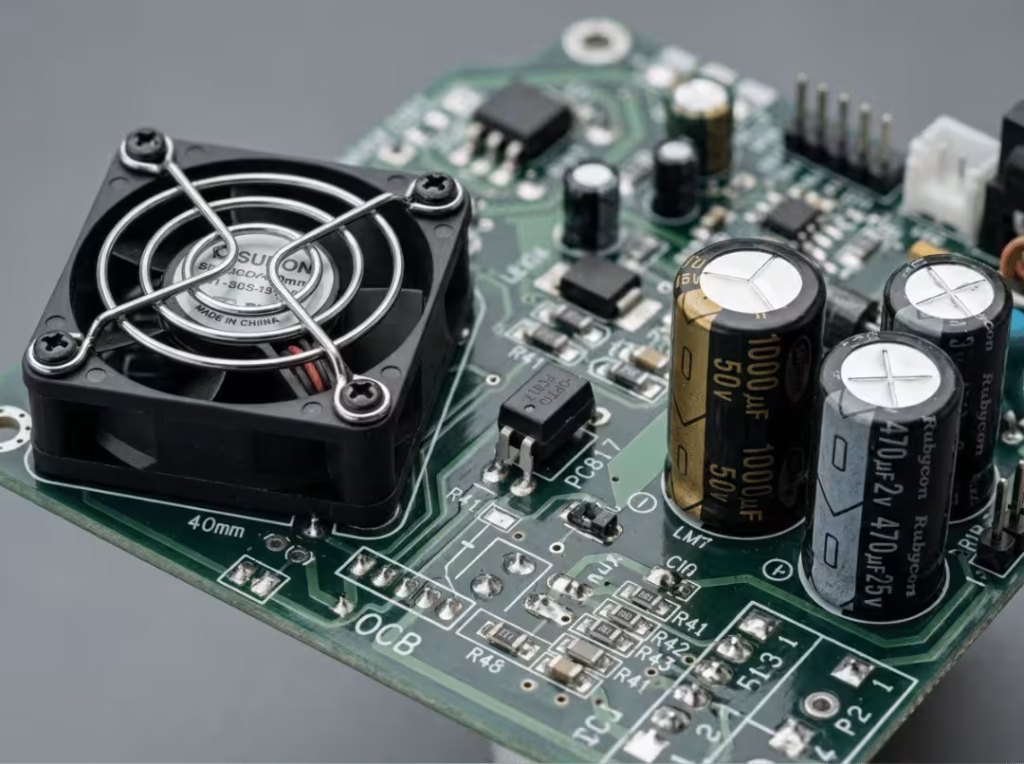
A serious vendor backs the numbers with evidence. Ask for life-cycle test reports and the capacitor ripple-current ratings, then confirm those capacitors are rated for the ripple your load actually generates. A vendor who can’t produce this is quoting a number rather than a tested product.
8. Mechanical and Environmental Fit
Run a quick-verify pass before you fall for the electricals: mounting pattern, overall dimensions, connector type, and maximum component height. Height is the one that catches people — a supply that fits the footprint can still foul a lid.
Confirm the environmental envelope matches your enclosure: operating and storage temperatures, humidity range, and IP rating if the device is exposed to moisture or dust. Potting — filling the unit with resin — earns its cost in vibration, humidity, or wash-down environments, where it guards against ingress and mechanical stress. In a clean, dry, temperature-controlled box, potting only adds weight, cost, and unnecessary thermal resistance.
Compliance & Continuity — What Separates a Vendor From a Partner
This is where a good specification becomes a field-proven relationship. A supply can be electrically perfect and still strand your program if the paperwork is thin or the part disappears mid-lifecycle. Give these two criteria real weight in your evaluation.
9. Regulatory Approvals and Documentation
You’ll see a familiar set of marks, and each means something specific. UL and cUL cover the US and Canadian markets. EN marks align with European harmonized standards. IEC underpins most of them as the international baseline. Regional variants — PSE for Japan, CCC for China — matter the moment you ship into those markets. Confirm the supply carries the marks for every region on your roadmap, not just your first launch country.
The CB scheme saves real time: it lets a manufacturer test once with a single national body and reuse the report to obtain approvals across many participating countries. A supply with a CB report and the right national differences documented is far cheaper to take global than one certified market by market.
Now demand the documentation package before you buy, not after. Four items are non-negotiable. The Declaration of Conformity states which standards the supply meets. The test reports show the actual measured results behind the certificate. The risk management file demonstrates that the manufacturer analyzed and controlled hazards — an increasingly expected requirement in a medical submission. And the change-notification policy tells you whether the vendor will warn you before altering the design. That last one is easy to overlook and expensive to miss: an unannounced component swap can invalidate your certification without a single visible change to the part. If you want to understand what a serious manufacturing and quality assurance setup looks like before shortlisting a vendor, that context helps you ask better questions on-site.
10. Supply Chain and Lifecycle Management
Medical products live in years, often five to ten, while commodity power supplies are designed on a much shorter horizon. That mismatch is where programs get stranded, so evaluate continuity as hard as you evaluate specs.
Ask the questions that decide it. What’s the vendor’s end-of-life notice period — twelve months’ warning, or thirty days? Do they hold regional distributor stock, so you’re not waiting on a single overseas shipment? And does the prototype revision match production — will the unit you qualified be the exact unit that ships at volume, or a quietly revised one? Keep RoHS and REACH confirmation on the list too, since restricted-substance compliance is a market-access requirement, not a nicety. If you’re still building your shortlist, browsing a manufacturer’s full product range early can help you spot which suppliers offer the depth and continuity a long-lifecycle medical program actually needs.
Here’s how the mismatch bites. You launch an eight-year product on a supply that goes end-of-life two years in. There’s no drop-in replacement, so the closest alternative differs enough to require a partial recertification — new test reports, a new submission, engineering time nobody budgeted for, a schedule nobody planned for. The part cost you saved at selection is gone many times over. A longer guaranteed availability window is worth paying for when your product outlives the typical component.
Industrial vs. Medical Power Supply — Side by Side
The same power rating in an industrial and a medical supply can look almost identical on a bench and behave very differently under scrutiny. Here’s what the extra cost buys.
Criterion | Industrial Supply | Medical Supply |
|---|---|---|
Safety standard | ✅ IEC 62368-1 | ✅ IEC 60601-1 |
Patient protection (MOPP) | ❌ Not designed for patient contact | ✅ 2x MOPP available |
Patient leakage current | ❌ Not controlled to medical limits | ✅ Held to strict caps |
EMC standard | ✅ Industrial EMC | ✅ IEC 60601-1-2 (medical) |
Reinforced isolation | ⚠️ Sometimes | ✅ Standard where required |
Documentation depth | ⚠️ Basic | ✅ Full test reports + risk file |
Lifecycle/EOL support | ⚠️ Shorter horizon | ✅ Longer availability common |
Price | ✅ Lower | ❌ Higher |
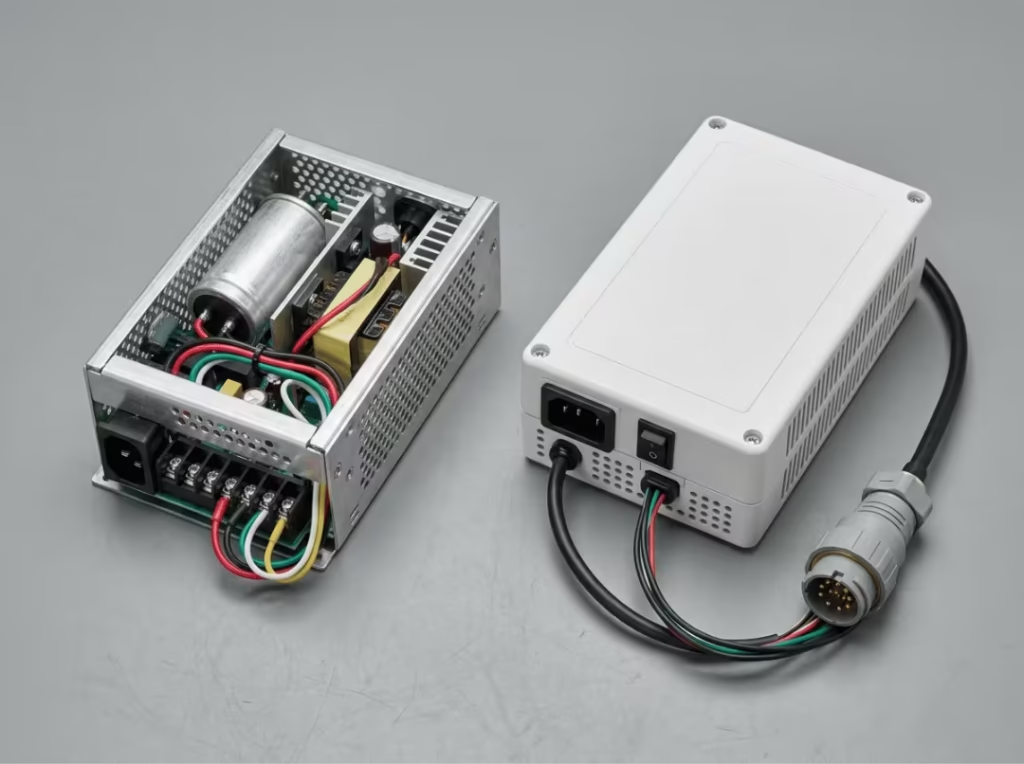
The core switching technology is often similar between the two — sometimes it’s nearly the same circuit. What you pay extra for is the safety margin built into the isolation, the depth of testing behind the certificate, and the documentation effort required to survive an audit. The industrial unit isn’t cheaper because it’s worse engineering; it’s cheaper because it was never tested, documented, or margined for a patient.
Common Selection Mistakes
Five mistakes account for most of the pain, and each one has a predictable cost.
- Trusting a family certificate without checking your exact model. The certificate is real, but your specific variant isn’t listed on it. Cost: a failed audit weeks before launch.
- Mistaking a safety certificate for EMC proof. IEC 60601-1 says nothing about emissions or immunity. Skip pre-compliance and defer EMC to the final audit, and you meet your interference problems when a redesign costs the most.
- Ignoring derating and assuming full power at 50 °C. The datasheet headline is a best-case number. Cost: a supply that overheats or shuts down inside your sealed enclosure, discovered in thermal testing or, worse, in the field.
- Skipping the end-of-life notice period and spare-parts policy. The part vanishes mid-lifecycle with no warning. Cost: an unplanned partial re-certification and a scramble for an alternative.
- Buying on unit price instead of total cost of ownership. The cheap supply hides its real costs — cable assembly, mounting hardware, documentation gaps, re-certification risk. Cost: a bill that lands long after the purchase order closed.
The 10-Criteria Selection Checklist
Use this as a working tool. For each criterion, request the one document or measurement that proves it, then score pass/fail and note anything to follow up. It’s built to compare three shortlisted suppliers side by side.
# | Criterion | What to Request | Pass/Fail | Follow-Up Notes |
|---|---|---|---|---|
1 | Certification | Full IEC 60601-1 certificate, exact model listed | ||
2 | Leakage & isolation | Leakage test data for your patient-care zone | ||
3 | Creepage & clearance | Datasheet distances + altitude rating | ||
4 | Protection features | Fault recovery behavior (latch vs. auto) | ||
5 | Electrical performance | Hold-up time, ripple, regulation figures | ||
6 | Thermal derating | Derating curve at your ambient | ||
7 | Reliability | MTBF + design life + life-cycle report | ||
8 | Mechanical/environmental | Dimensions, IP rating, mounting pattern | ||
9 | Approvals & docs | DoC, test reports, risk file, change policy | ||
10 | Supply chain | EOL notice period + availability window |
Once one candidate leads the sheet, take the next concrete step: buy a single unit, install it in your final enclosure, and run a thermal test — measuring output as you step the ambient up by 10 °C each time. That real-world curve tells you what the datasheet can’t.
Frequently Asked Questions
What makes a power supply medical-grade?
It carries IEC 60601-1 certification for safety and IEC 60601-1-2 for EMC, with leakage current and isolation designed for patient contact. Build quality alone doesn’t qualify an industrial unit — the testing and documentation behind those standards do.
What’s the difference between IEC 60601-1 and IEC 60601-1-2?
The first governs electrical safety; the second governs electromagnetic compatibility. They’re separate approvals, and holding one says nothing about the other.
How do 2x MOPP and 2x MOOP differ?
MOPP is the stricter of the two and is required when the supply can reach a patient. MOOP is enough only when the supply stays isolated from patient contact. Undershooting to MOOP when your design needs MOPP is a costly correction.
What leakage current limit should I design to for a patient-care device?
Target the strictest patient leakage cap for a patient-care area, and prove it under fault conditions rather than just normal operation — that’s the number formal compliance checks.
Can I use a standard industrial power supply in a medical device?
Rarely, and it seldom pays off. Industrial units skip patient-leakage testing and 2x MOPP, and they lack audit-ready documentation, so retrofitting one usually costs more than buying medical-grade upfront.
How do I confirm a certification is still valid?
Cross-check the certificate number, issuing body, exact model, and validity date on the issuer’s own database. Treat any emailed PDF as a starting point, never as proof.
What is hold-up time and when does it matter?
It’s the span over which the output remains within regulation after input power drops. Care about it whenever a brief mains dip can’t be tolerated, as it can reset the device mid-operation — a pump running through therapy is the textbook case.
Which documents should I request before a volume order?
The Declaration of Conformity, the full test reports, the risk management file, and the change-notification policy. The first three prove compliance; the last one keeps a silent design change from breaking it.
Conclusion
Selecting a medical-grade power supply doesn’t end with the datasheet. The safest choice weighs the electrical specs, the safety certificates, and the vendor’s operational track record together — because a supply can be electrically flawless and still fail you on documentation or availability. Run the ten criteria as a filter: cut any candidate that fails on safety or documentation, then let price, lead time, and engineering support decide among the survivors. When the certificate checks out in the issuer’s database, the derating curve holds at your actual ambient, and a sample survives testing in your actual enclosure, your design has its best shot at a clean audit and a reliable life in the field.