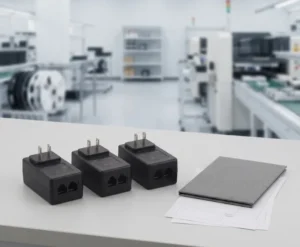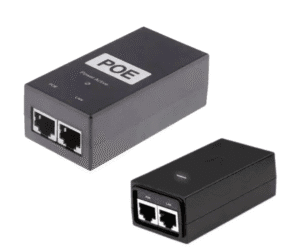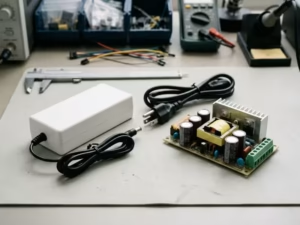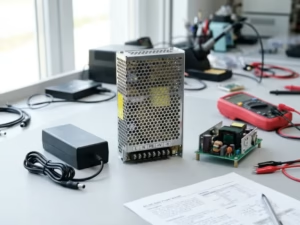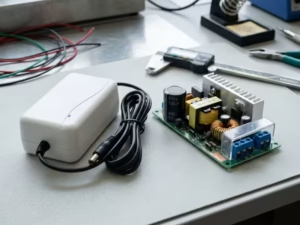
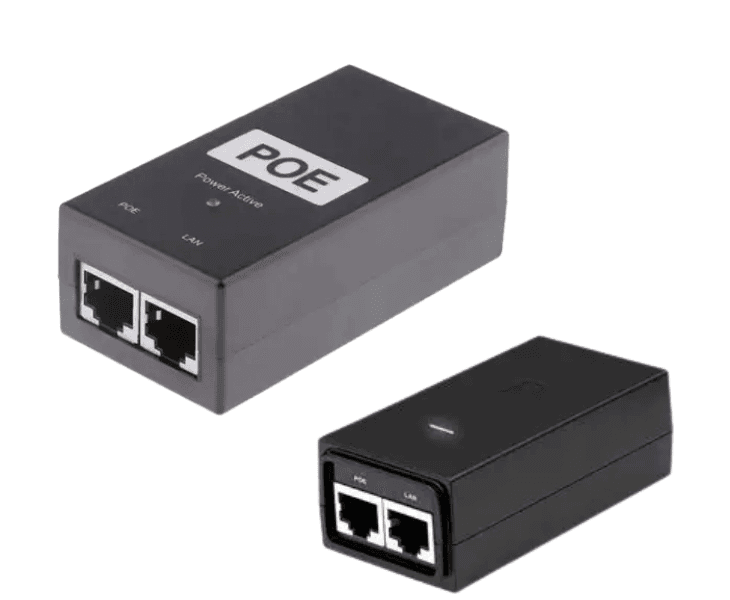
For an OEM, system integrator, or equipment manufacturer, choosing a PoE Adapter should be treated as a component-qualification decision rather than a simple accessory purchase.
A unit can appear suitable on a specification sheet and still create problems later if the powered device, Ethernet interface, operating environment, regulatory target, connector design, or production configuration has not been validated as a complete system. Those problems often surface at the most expensive stages: final compliance testing, pilot production, installation, or after a product has entered the field.
At Quankang, we therefore recommend qualifying a PoE power solution against a defined system envelope before it becomes part of the approved BOM. Our PoE portfolio covers 24W, 35W, 54W, 90W, and 100W options, with IEEE 802.3af/at/bt and Ethernet configurations up to 10Gbps on selected models.
The following seven checks provide a practical framework for engineering, sourcing, quality, and compliance teams preparing a PoE-powered product for production.
1. Define the Acceptance Envelope Before Requesting Samples
Qualification should begin with the powered equipment rather than the adapter catalog.
Before selecting a sample, we recommend defining the device’s normal operating load, maximum load, startup behavior, required PoE mode, Ethernet speed, expected ambient conditions, installation method, cable arrangement, target sales regions, and any mechanical constraints.
The purpose is to create measurable pass/fail conditions.
For example, “we need a 100W adapter” is not yet a complete engineering requirement. A more useful specification identifies the PD requirement, required power at the device interface, acceptable input range, data throughput, connector arrangement, maximum operating temperature, regulatory markets, and mechanical space available.
This distinction also helps procurement teams compare suppliers on the same technical basis rather than comparing nominal wattage and unit price alone.
2. Do Not Treat Nameplate Wattage as the PD Power Budget
One of the most important qualification steps is separating the adapter’s rated output from the power that the powered device can actually use under the applicable PoE architecture.
IEEE-standard PoE involves a Power Sourcing Equipment side and a Powered Device side, with detection, classification, power delivery, cabling, and operating limits forming part of the system. The Ethernet Alliance separates its standards-based certification framework into Gen 1 testing associated with IEEE 802.3af/at and Gen 2 testing associated with IEEE 802.3bt.
For an OEM project, the practical implication is straightforward: do not approve an adapter merely because its wattage number exceeds the nominal consumption of the device.
Qualification should confirm that the exact PSE/PD combination operates correctly under the required PoE standard and under worst-case expected conditions. Cable losses, operating mode, load behavior, and the actual interface architecture all matter.
This is particularly important for higher-power equipment where a small assumption made during initial selection can become a thermal or functional problem later in the project.
| PoE Standard | Maximum Output Power at PSE | Maximum Available Power at PD |
| IEEE 802.3af | 15.4W | 12.95W |
| IEEE 802.3at | 30W | 25.5W |
| IEEE 802.3bt Type 3 | 60W | 51W |
| IEEE 802.3bt Type 4 | 90W | 71.3W |
Under IEEE 802.3af/at/bt, the maximum power available at the PSE output is not the same as the power delivered to the PD. For example, IEEE 802.3bt Type 4 supports up to 90W at the PSE, while the maximum power available at the PD is 71.3W under the standard’s specified conditions. Cable losses and the actual power delivery architecture must therefore be considered when defining the system power budget.
3. Qualify the Data Path Separately From the Power Path
Power capability and Ethernet bandwidth are two different design requirements.
A PoE Adapter can provide adequate electrical power yet still be unsuitable if its Ethernet path does not support the data rate required by the final product. Conversely, selecting a high-data-rate model does not automatically prove that its power architecture fits the PD.
We recommend placing two independent requirements in the qualification specification:
| Qualification item | Question to verify |
| PoE power interface | Does the exact adapter/PD combination meet the required IEEE PoE implementation and load conditions? |
| Ethernet interface | Does the complete link sustain the required 100Mbps, 1G, 2.5G, 5G, or 10G data rate where applicable? |
Our available PoE configurations span different Ethernet capabilities depending on model, so the exact part number should be validated rather than assuming that every adapter in the product family has the same network interface.
You can review the current PoE Adapter series when establishing the initial model shortlist.
During engineering validation, test the adapter with the intended switch or network source, the actual PD, representative Ethernet cable, and the expected traffic profile. This provides much more useful evidence than verifying power output and network connectivity separately on a bench.
4. Test Thermal and Protection Performance in the Real Installation
Datasheet operating temperature is an important screening parameter, but it is not a substitute for testing the adapter in the final system environment.
An adapter installed in an open laboratory environment may behave differently when placed behind an enclosure, inside a cabinet, close to another heat source, or at sustained high load.
We recommend recording ambient temperature together with enclosure temperature and relevant adapter or connector temperatures during validation. Testing should include normal load, expected maximum load, startup, and a representative sustained operating period.
Protection requirements should also be based on the installation risk.
Short-circuit, over-current, over-voltage, over-temperature, and surge capabilities are available across different configurations in our PoE range, but the exact functions vary by model. The correct procurement question is therefore not simply “Does the product have protection?” but “Which protection functions are verified on the exact configuration we intend to purchase?”
This approach prevents a common qualification mistake: turning a family-level feature into a model-level assumption.
5. Build a Compliance Matrix Instead of Collecting Logos
For enterprise and OEM buyers, certification should be managed as a project requirement rather than as a long list of marks on a sales page.
The required evidence depends on where the final equipment will be sold, how the adapter is integrated, and which regulatory requirements apply to the completed product.
Before production release, create a compliance matrix connecting the exact adapter model with the target market, required safety or EMC evidence, available reports, and any testing that still belongs to the finished equipment.
This is especially important when one product family contains several regional or electrical variants. Certification scope can vary by model, so we do not recommend assuming that an approval shown for one configuration automatically covers another.
The same principle applies to PoE interoperability. Standards-based implementation should be verified from technical documentation and testing rather than inferred from marketing terminology alone.
6. Freeze Mechanical and Electrical Details Before Final Validation
In OEM projects, the first sample is often not identical to the configuration that ultimately reaches mass production.
Cable length may change. An RJ45 arrangement may need adjustment. A connector may be repositioned. Output parameters, dimensions, pin definitions, labeling, enclosure details, or installation requirements may also change during integration.
Our customization scope for PoE projects can include output voltage/current, power and efficiency requirements, RJ45 or DC connector and cable configurations, dimensions, pin definitions, and installation requirements.
These changes should be frozen before final design validation whenever they can affect electrical, EMC, thermal, mechanical, or certification performance.
A useful rule for purchasing teams is to avoid approving a generic family name as the production specification. Instead, release an exact configuration that connects the approved sample, drawing, datasheet revision, cable or connector definition, labeling requirements, and relevant compliance documentation.
That reduces ambiguity when the project moves from engineering samples to repeat orders.
7. Qualify the Production Process, Not Only the Golden Sample
A successful engineering sample demonstrates that a design can work. It does not by itself demonstrate that thousands of units can be produced consistently.
This is why production qualification should include manufacturing controls.
Our broader power-supply development and verification system includes DQA verification, EVT/DVT/PVT activities, EMC pre-compliance work, AOI, ICT, testing equipment, and MES/SAP traceability. For a PoE project, the relevant controls should be connected to the characteristics that matter to the customer’s approved specification.
Procurement and quality teams should therefore ask how critical characteristics are tested, how approved revisions are controlled, how batches are identified, and what happens when a component or process change affects the approved configuration.
This is where supplier qualification becomes a business issue rather than only an engineering issue. Consistency between the approved sample and later production lots reduces the probability of repeated validation, line interruptions, unexpected field behavior, and costly engineering investigations.
A Practical PoE Adapter Release Matrix
A cross-functional release matrix can keep engineering and purchasing aligned:
| Gate | Evidence to review | Production release question |
| System definition | PD specification and application requirements | Have operating and worst-case requirements been documented? |
| PoE interface | Exact standard and system test | Has the real PSE/PD combination been verified? |
| Data path | Throughput test with representative hardware | Does the adapter support the required Ethernet link without becoming a bottleneck? |
| Environmental validation | Thermal and protection test records | Does the solution remain within acceptable limits in the actual installation? |
| Compliance | Model-specific certificates/reports and project matrix | Is the documentation suitable for the target market and final equipment? |
| Configuration control | Drawing, cable, connector, pinout and sample revision | Is the mass-production configuration identical to the approved configuration? |
| Manufacturing release | Verification and traceability plan | Can future production lots be controlled against the same acceptance criteria? |
This framework is useful because it creates an auditable reason for approving a component. Purchasing is no longer choosing “the cheapest 90W unit”; it is sourcing a configuration that has already passed the technical and commercial gates needed by the project.
When Should You Evaluate a 35W or a 100W PoE Adapter?
Product wattage remains important, but it should come after system requirements are defined.
For a moderate-power project, a 35W platform may be an appropriate point to begin engineering evaluation. Our current 35W PoE Adapter product page provides the model-level information needed for an initial review.
For higher-power equipment or projects that also require higher Ethernet bandwidth, the PoE100-54A 100W PoE Adapter is another evaluation path. The current product information lists IEEE 802.3af/at/bt support and Ethernet transmission options through 10Gbps for this model.
Neither example should be selected from wattage alone. The release decision should still follow the seven qualification gates above.
How PoE Adapter Qualification Affects ROI
For B2B projects, the purchase price of the adapter is only one part of its economic impact.
A more useful internal ROI calculation considers the engineering and operational costs that a properly qualified component may help avoid. These can include repeated EMC or safety validation, mechanical redesign, additional engineering samples, production interruptions, troubleshooting labor, field service, and managing unnecessary component variants.
A simple project-level model is:
Qualification value = avoided redesign and revalidation cost + avoided production disruption + reduced field-support exposure − additional qualification cost
The values will differ by project, so we do not recommend applying a universal percentage. The important point is that purchasing decisions should be evaluated against lifecycle risk as well as unit cost.
For a device that will remain in production for several years, even a small reduction in avoidable engineering changes can matter more than a minor difference in initial adapter pricing.
FAQ
Can a 100W PoE Adapter automatically power any device rated below 100W?
No. Rated wattage alone does not establish compatibility. The PD interface, IEEE PoE implementation, voltage and power requirements, cable path, connector arrangement, and system behavior must all be verified.
Does a higher Ethernet speed mean I need a higher PoE power standard?
Not necessarily. Ethernet data rate and PoE power capability are separate requirements. Specify both, then verify that the exact adapter supports the required combination.
When does a custom PoE Adapter make sense for an OEM project?
Customization becomes useful when a standard configuration cannot satisfy required output parameters, connector or cable design, pin definitions, dimensions, mechanical installation, or other integration requirements. Those requirements should be identified early so that validation is performed on the intended production configuration rather than on a temporary sample.
What documentation should a procurement team request before production approval?
The document package should match the project, but typically it should establish the exact electrical specification, mechanical configuration, sample or revision identity, applicable compliance evidence, and the information required to control repeat production. The objective is traceability between what engineering approved and what purchasing later orders.
From PoE Adapter Sample to Production-Ready Solution
A PoE Adapter becomes valuable to an OEM project when it is not merely electrically compatible, but qualified, documentable, repeatable, and suitable for the complete system.
At Quankang, we combine PoE product options with engineering customization, EMC-related verification capabilities, DQA processes, production testing, and traceability systems. If you are evaluating a PoE power solution for a new device or replacing an existing component, send us your PD requirements, required data rate, input conditions, mechanical constraints, target markets, and expected production configuration.