Many engineers see “2 x MOPP” on a datasheet and assume the job is done. It usually isn’t.
That little label carries real weight. 2 x MOPP is not a marketing phrase. It’s a patient protection requirement, and it shapes how a power supply handles isolation, testing, and certification.
Get it wrong, and you put both your device approval and your patients at risk.
I’ve spent years helping teams pick the right medical power supply. The same questions come up every time: When do I actually need 2 x MOPP? How do I spot it correctly? And can I trust what the supplier claims?
This article answers all three. You’ll learn when 2 x MOPP matters, how to read it right, and how to verify a claim before you commit.
What 2 x MOPP Actually Means
Let’s break the term down, because each piece tells you something.
MOPP stands for Means of Patient Protection. It’s a safety barrier that keeps dangerous voltage away from anyone connected to the device. Think of it as the wall between wall power and the patient.
The “2 x” part is where it gets serious. It means two independent means of protection, stacked in series. If one barrier fails, the other still stands. A single fault won’t expose the patient. That redundancy is the whole point.
This protection lives on a specific path: the route from mains power to any patient-related part of the device. That’s the path the standard cares about most, and for good reason.
Here’s a common trap. People assume 2 x MOPP just means “double insulation.” It doesn’t. The two barriers must be genuinely independent. If they share a component, or one weakness can knock out both, you don’t really have two means of protection. You have one, dressed up as two.
You’ll also run into two related terms:
They sound similar, but they’re not interchangeable, and mixing them up leads to real problems. I’ll unpack how they differ further down.
For now, hold onto one idea: 2 x MOPP means two separate walls protecting the patient, and both have to stand on their own.
Why 2 x MOPP Exists in the First Place
To understand this rule, you have to think about the patient, not the device.
An operator can feel a shock and pull away. A patient often can’t. They may be sedated, unconscious, or wired directly to the machine for hours. That’s why patient protection sets a higher bar than operator protection. The person at risk has no way to react.
The real danger is leakage current. Every power supply leaks a tiny amount of current. On a normal appliance, you’d never notice it. But route that current through a patient — especially through the chest — and even a small amount becomes dangerous.
Now add a fault. A single component fails, and suddenly that leakage path opens wider. With only one barrier, that fault reaches the patient. With two independent means of protection, the second wall holds. That’s the whole logic behind 2 x MOPP.
The patient contact path is uniquely sensitive for one reason: it bypasses the body’s natural defenses. Dry skin resists current. A catheter or electrode does not.
This is where the applied part classes come in. A Type BF part connects to the patient but not directly to the heart. A Type CF part does — think electrodes touching or entering the cardiac region. CF demands the tightest limits, because current near the heart can trigger fibrillation at levels you’d never feel on your hand.
Picture two devices. A dialysis machine cycles a patient’s blood for hours through a direct connection. A cardiac monitor sits electrode-to-skin, feeding signals from near the heart.
In both cases, one failed barrier is one too many. That constant, direct link is exactly why 2 x MOPP earns its place.

How 2 x MOPP Changes Power Supply Design
Once a project calls for 2 x MOPP, the whole power supply changes shape. You’re no longer building a barrier. You’re building two, and each has to stand on its own. That single requirement ripples through every part of the design.
Let me show you where it lands.
It Reshapes the Transformer First
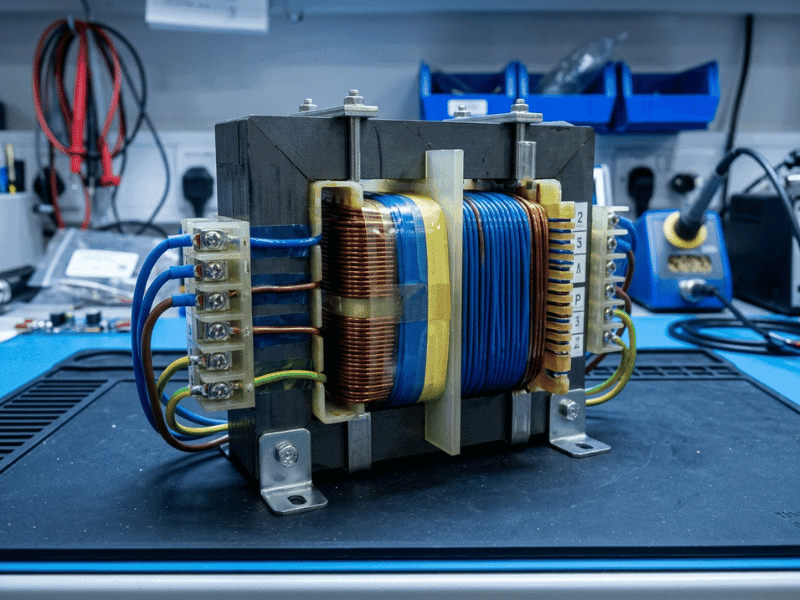
The transformer takes the biggest hit. To hold two independent means of protection, it needs wider spacing between the primary and secondary windings, extra insulation layers, and often taped or triple-insulated wire.
That means a bigger core, more turns of margin, and a more careful build. A transformer that would sail through a basic design suddenly grows in every dimension.
Optocouplers and isolation capacitors follow the same rule. Each part that crosses the isolation gap has to meet the rating on its own. You can’t lean on one component to do two jobs.
Creepage and Clearance Eat Your Board Space
Here’s the part that surprises new designers.
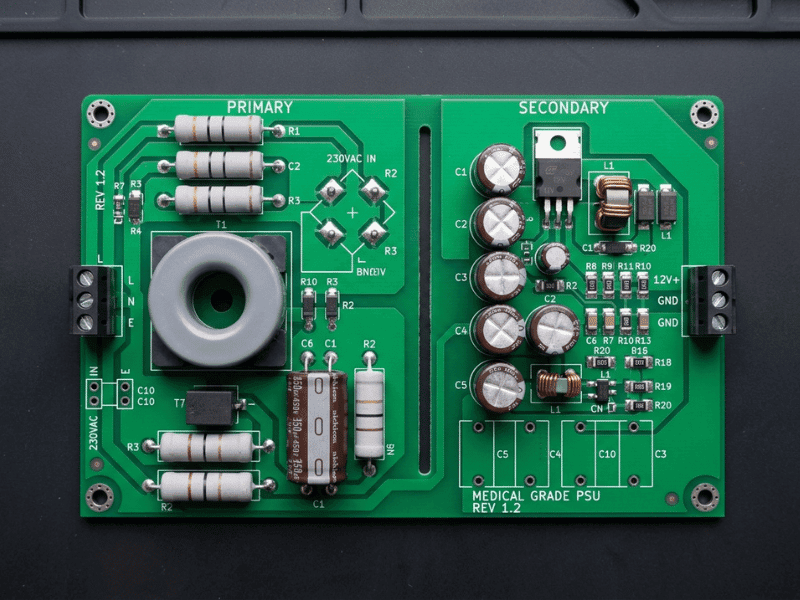
Creepage is the distance current would travel along a surface. Clearance is the distance through open air. For two means of protection, both distances grow — and they grow across every crossing point on the board.
That space has to come from somewhere. Traces move apart. Slots get cut into the PCB. Connectors shift. The layout you sketched for a compact unit starts to spread out, and the enclosure grows with it.
This is why a 2 x MOPP supply rarely looks small. The safety margins simply take up room.
Why Two Barriers Cost More Than One
More insulation, bigger transformers, wider spacing, and tighter leakage control all add up.
The extra material costs money. The larger footprint costs money. And the stricter build discipline — the kind that keeps leakage low even when a component fails — takes more engineering time and testing.
Compared to a 1 x MOPP or a 2 x MOOP design, a 2 x MOPP supply almost always runs larger and pricier. That’s not waste. It’s the price of a second wall that holds when the first one breaks.
Reinforced Insulation Is Not the Same as Two Barriers
This one trips up a lot of teams, so let me be clear.
You can meet 2 x MOPP two ways. The first uses two genuinely separate barriers, stacked so a single fault can’t remove both. The second uses reinforced insulation — a single, heavy-duty barrier engineered to do the work of two.
Reinforced insulation is allowed, and it can save space. But don’t confuse it with the redundancy of two independent means. It’s one wall built strong, not two walls built apart.
Why does the difference matter? Because when you review a supply’s isolation diagram, you need to know which approach the maker chose. Both can be valid. But if you assumed two separate barriers and the design leans on one reinforced layer, your fault-condition thinking has to match reality.
Plan for It Early
The biggest mistake I see is treating 2 x MOPP as a late-stage checkbox.
By then the enclosure is fixed, the board is crowded, and there’s no room left for the spacing the rating demands. Teams end up redesigning under pressure.
Decide the protection level at the start. Give the transformer, the spacing, and the budget room to breathe. A supply built for 2 x MOPP from day one comes together far more smoothly than one forced into it at the end. The same discipline applies whether you’re specifying a standard module or working with a partner on custom power adapters tailored to your device.
2 x MOPP vs. 1 x MOPP vs. 2 x MOOP
Here’s where a lot of good projects go sideways. Three ratings look almost identical on paper, so people treat them as the same thing. They aren’t. Swap one for another, and you can fail certification or, worse, expose a patient.
Let me sort them out.
1 x MOPP gives you one means of patient protection. A single barrier stands between mains power and the patient. It fits lower-risk patient paths, where a single fault won’t lead straight to harm.
2 x MOPP gives you two independent means. Two barriers, stacked, so one failure never removes protection. This is what you need for higher-risk or direct patient contact.
Now the trap: 2 x MOOP. That last “OP” stands for Operator. It offers two barriers, yes, but they guard the person running the device, not the patient. The protection limits sit lower. So a 2 x MOOP supply cannot stand in for 2 x MOPP, no matter how similar the wording looks.
Two more points I hammer with every team.
First, 1 x MOPP is not a discount version of 2 x MOPP. They meet different fault requirements and different test voltages. You can’t upgrade one to the other on paper. They are separate ratings, built to separate rules.
Second, “medical grade” tells you almost nothing. Plenty of supplies carry that phrase and only meet 1 x MOPP or 2 x MOOP. The label sounds reassuring. The rating underneath may not match what your device needs.
So read the exact rating, every time. The words are close. The protection they promise is not.
When a Medical Device Really Needs 2 x MOPP
Let me clear up a myth first. Not every medical device needs 2 x MOPP. Some run perfectly well on 1 x MOPP or 2 x MOOP. Reaching for the highest rating on every project just adds cost, size, and headaches you don’t need.
So how do you decide? Three things guide the call: your applied part classification, your risk analysis, and how the device is actually used.
Start With the Applied Part
Look at what touches the patient. A Type BF part connects to the patient but stays away from the heart. A Type CF part goes to or near the heart — electrodes, catheters, direct cardiac contact.
Type CF sits at the top of the risk ladder. These paths almost always push you toward 2 x MOPP, because current near the heart is dangerous at levels you’d never feel on your skin.
Watch the Contact Pattern
The way a patient meets the device matters as much as the classification.
I pay close attention to three patterns:
- Prolonged contact — the patient stays wired for hours, like on a dialysis machine.
- Direct contact — electrodes or lines touch tissue with no skin barrier.
- Critical monitoring — the device tracks vital signs that clinicians depend on.
The more direct and constant the link, the stronger the case for two barriers.
Let the Risk Analysis Decide
None of this is guesswork. ISO 14971 gives you the framework to weigh each hazard and its likely harm.
Run your device through it. If a single fault could send current into a patient through a sensitive path, two independent means of protection earn their place. If the risk stays low and indirect, a lighter rating may be enough.
Match the protection to the real risk. That’s the judgment call — not a default, and not a marketing checkbox. This is also the point where you draw a firm line between medical and non-medical equipment. A standard ite power supply built for laptops or routers follows a different safety standard entirely and has no business sitting on a patient-connected path.
How to Verify a 2 x MOPP Claim Before You Buy
A datasheet is a starting point, not proof. Anyone can print “2 x MOPP” on a spec sheet. Your job is to confirm the claim holds up before you design it in and lock it down.
Here’s how I check, step by step.
The Datasheet Is Where You Start, Not Where You Stop
Read the exact wording first. You want to see “2 x MOPP” spelled out clearly — not “medical grade,” not “IEC 60601 compliant,” and not a vague nod to safety.
Those softer phrases sound good and prove nothing. A supply can be “medical grade” and only meet 2 x MOOP. So treat the datasheet as a filter: if it won’t state the rating plainly, walk away early.
But even a clear datasheet claim needs backup.
Ask for the CB Report or Certification Scope
This is the document that turns a claim into a fact.
Request the CB test certificate or the certification scope. These come from an accredited test lab, and they list what the supply actually passed. If a supplier can’t produce one, the “2 x MOPP” on the datasheet is just marketing.
Read the scope carefully. Confirm it names 2 x MOPP specifically, and check that it covers the input-to-output path you care about. A certificate that only mentions operator protection tells you what you’re really buying.
Read the Isolation Diagram
The isolation diagram shows you how the supply protects the patient, not just that it claims to.
Look for the barriers between primary and secondary. Two independent means of protection show up as two separate barriers on the mains-to-patient path — each drawn on its own, each rated to stand alone.
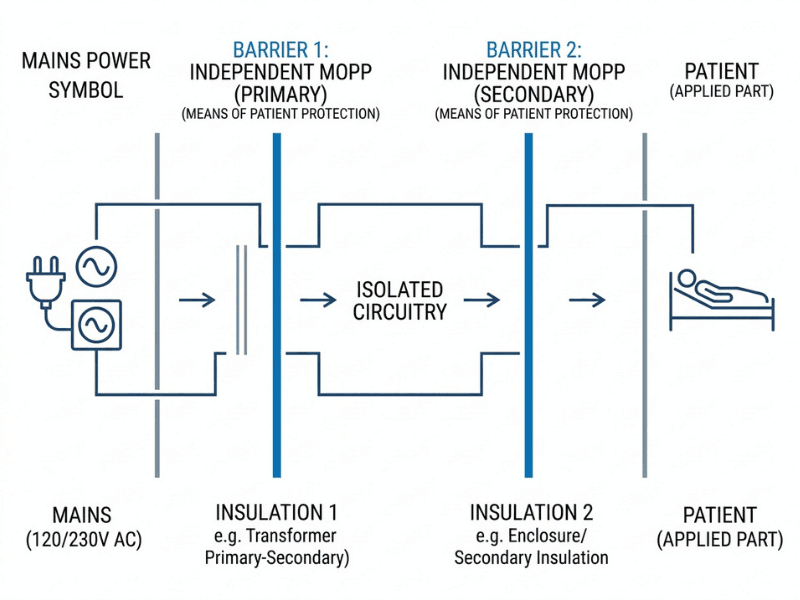
Watch for a shortcut. If the design leans on a single reinforced barrier, that can be valid, but it’s not the same as two independent walls. You need to know which approach the maker chose, because it changes how you reason about a single fault. If the diagram is missing or vague, ask for it. A serious supplier has one ready.
Check the Leakage Current Data
Numbers back up the drawing.
Ask for patient leakage current and earth leakage current figures, measured under both normal and single-fault conditions. Good 2 x MOPP design keeps leakage low even when one component fails. That’s the whole point of the second barrier.
If the leakage data only shows normal-condition values, you’re missing half the story. The fault-condition numbers tell you whether the protection actually holds.
Match the Working Voltage to Your Application
A rating only applies within its tested conditions.
Confirm the isolation was verified at your working voltage, and check any altitude limits. A supply tested for one voltage or one altitude may fall short in your build. This step is quick, and it saves you from a rating that looks right but doesn’t fit.
Questions Worth Asking the Supplier
When I vet a new source, I ask a few direct questions and listen to how fast they answer:
- Can you send the CB report that lists 2 x MOPP?
- Does the certification cover the input-to-output isolation, or only part of it?
- Can I see the isolation diagram with both barriers marked?
- What are the patient and earth leakage figures under single-fault conditions?
- At what working voltage and altitude was the isolation tested?
A good supplier answers these without stalling. If the questions trigger vague replies or a long silence, that tells you as much as any document. Trust the paperwork you can verify — and be wary of the claims you can’t.
Testing Behind a 2 x MOPP Power Supply
Certificates rest on real tests. Knowing what those tests prove helps you read a report with a sharper eye.
Three checks carry the most weight.
Dielectric withstand (hi-pot). This one applies high voltage across the isolation barrier and watches for breakdown. It proves the barrier can hold back mains voltage without arcing through. For 2 x MOPP, each means of protection has to survive this on its own, not lean on the other.
Leakage current measurement. Every supply leaks a little current. This test measures how much reaches the patient path, both under normal use and when a component fails. Low leakage under fault is the whole reason the second barrier exists.
Fault condition testing. This is a mindset as much as a test. You assume one barrier fails, then ask: does the patient stay protected? If a single fault can send current down a sensitive path, the design falls short. Two independent means should always leave one wall standing.
All three trace back to the same purpose. A patient wired to the device can’t pull away from a shock. These tests confirm the protection holds even on a bad day.
One warning I repeat often: passing a single test does not equal 2 x MOPP compliance.
A supply can clear the hi-pot check and still leak too much under fault. It can pass leakage yet lack a truly independent second barrier. Full compliance means every test lines up, together, on the path that matters.
So read the whole report — not just the number that looks good on its own.
Common Mistakes and Misconceptions About 2 x MOPP
The thread running through all five is simple: match the rating to the real risk, and verify every claim before you trust it. Do that, and 2 x MOPP stops being a source of confusion and starts working for you.
What Designers and Procurement Teams Should Do Next
Knowing the theory is one thing. Turning it into a clean project is another. Here’s what each team should do once the reading stops and the work begins.
Design teams, start with the patient. Before you pick a single component, nail down your applied part classification and run your risk analysis. That decision drives everything else. If your device connects to or near the heart, you likely need 2 x MOPP. If the risk stays low and indirect, don’t over-build. Let the analysis set the target, then choose a supply that matches it.
Procurement teams, ask for proof. A datasheet claim is a promise, not a fact. Request the CB report or certification scope, and confirm it names 2 x MOPP on the path you care about. If a supplier stalls or sends only marketing sheets, treat that as your answer. Buy the paperwork, not the phrase.
Plan for space and cost early. A 2 x MOPP supply runs larger, warmer, and pricier than a lighter-rated one. Factor that into your enclosure, thermal budget, and BOM at the start — not after the board is crowded and the case is locked. Late changes cost the most.
Keep your records. Save the isolation diagram, test report, and your risk-analysis rationale in one place. When your regulatory submission lands on a reviewer’s desk, that trail explains why you chose the rating you did — and saves you from rebuilding the argument months later under pressure.
FAQs
Getting 2 x MOPP Right for Your Device
Start with the patient risk, not the datasheet. Confirm your applied part classification and let your risk analysis set the protection level. Then match the power supply’s rating to that need — no lower, no higher than the risk demands.
Once you’ve picked a candidate, don’t trust the marketing line. A clear “2 x MOPP” claim only counts when a CB report and isolation diagram back it up on the path that matters.
Here’s your next step: pull up the isolation diagram and certification scope for your current power supply today. Check that two independent barriers really protect the patient path, and that the paperwork names 2 x MOPP where you need it.