
Introduction
Power over Ethernet (PoE) is a networking technology that allows compatible Ethernet cables to carry both data and electrical power to connected devices. Instead of installing separate cables for network communication and electrical power, PoE enables both functions to be delivered through a single Ethernet connection.
This approach can simplify installation, reduce cabling requirements, and make it easier to deploy network-connected devices in locations where AC power outlets are unavailable or inconvenient to access.
Today, Power over Ethernet is widely used in IP security cameras, wireless access points, VoIP phones, access control systems, IoT devices, and other network-connected equipment. As network devices become more powerful, PoE technologies have also evolved to support higher power requirements through standards such as IEEE 802.3af, IEEE 802.3at, and IEEE 802.3bt.
But how does PoE actually work? What are PSE and PD? How much power can PoE deliver? What is the difference between a PoE switch, PoE injector, PoE adapter, and PoE power supply?
This guide explains how Power over Ethernet works, the differences between PSE and PD, IEEE 802.3af, 802.3at and 802.3bt standards, PoE power levels, power budget calculations, and the differences between PoE switches, injectors, adapters and power supplies. It also provides practical guidance for selecting PoE power solutions for network equipment, OEM products, and system integration projects.
What Is Power over Ethernet (PoE)?
Power over Ethernet, commonly known as PoE, is a technology that enables Ethernet network infrastructure to transmit both data and DC electrical power over the same Ethernet cable.
In a conventional network installation, a device such as an IP camera or wireless access point may require two separate connections:
- An Ethernet cable for data communication
- A separate power cable or AC adapter for electrical power
With PoE, a compatible Ethernet connection can provide both network data and electrical power. This can reduce the need for additional power outlets and simplify installation, especially when devices are installed on ceilings, poles, walls, or other locations where access to mains power is limited.
PoE is commonly used for:
- IP security cameras
- PTZ cameras
- Wireless access points
- VoIP phones
- Access control systems
- IoT gateways
- Network sensors
- Digital signage
- Smart building devices
- Industrial Ethernet equipment
The key advantage of PoE is not simply that it delivers power through Ethernet. Its greater value lies in combining power delivery, network connectivity, and centralized power management within the same infrastructure.
How Does Power over Ethernet Work?
A typical PoE system consists of three main elements:
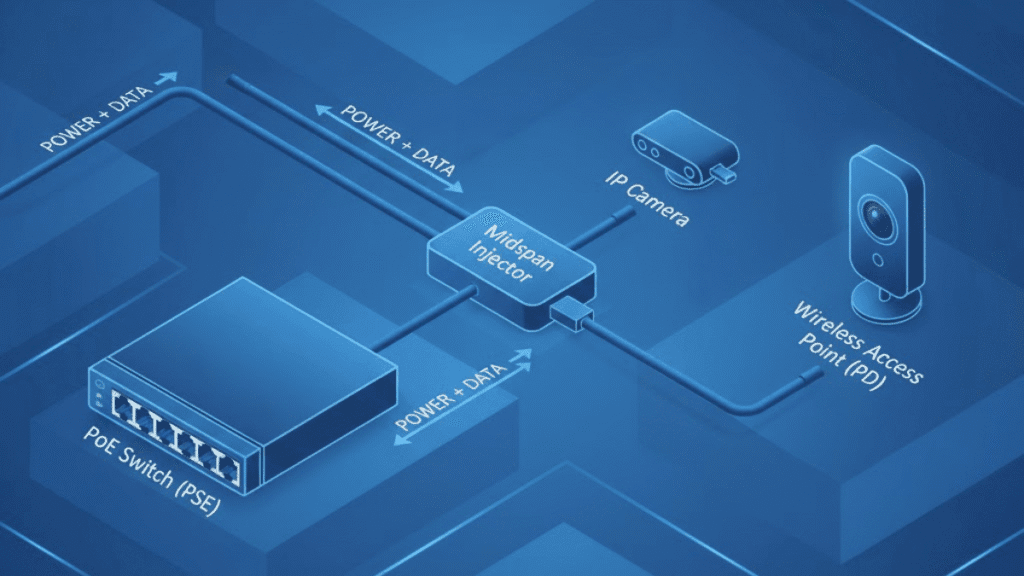
Power Sourcing Equipment (PSE) → Ethernet Cable → Powered Device (PD)
The PSE provides power, while the PD receives power and uses the Ethernet connection for data communication.
1. Power Sourcing Equipment (PSE)
Power Sourcing Equipment, or PSE, is the device that supplies electrical power to the Ethernet connection.
Common types of PSE include:
- PoE switches
- PoE injectors
- Midspans
- Other PoE power sourcing equipment
A PoE switch can provide both data connectivity and power to multiple connected devices. A PoE injector, by comparison, adds PoE power to an Ethernet connection when the existing network switch does not provide PoE.
The choice of PSE depends on the network architecture, number of powered devices, required power level, and available power budget.
2. Powered Device (PD)
A Powered Device, or PD, is the network device that receives power through the Ethernet connection.
Examples include:
- IP cameras
- Wireless access points
- VoIP phones
- IoT devices
- Access control systems
- Network sensors
The PD must be compatible with the relevant PoE technology and power requirements.
3. Ethernet Cable
The Ethernet cable carries both data and power between the PSE and PD.
Depending on the PoE standard and implementation, power can be delivered using the Ethernet cable pairs while maintaining data communication over the same physical connection.
Cable quality, cable length, conductor resistance, connectors, and environmental conditions can all affect power delivery and system performance.
The PoE Power Delivery Process
A compliant PoE system does not simply apply electrical power to every connected Ethernet port.
Instead, a typical PoE power delivery process includes several stages.
Step 1: Detection
The PSE first checks whether a compatible PoE-powered device is connected.
This detection process helps prevent power from being supplied to devices that are not designed to receive PoE power.
Step 2: Classification
After detecting a compatible PD, the PSE can determine the device’s power requirements or class.
This allows the system to allocate power according to the supported PoE standard and available power budget.
Step 3: Power Delivery
Once the PD is identified and the power requirements are established, the PSE supplies power through the Ethernet connection.
At the same time, the Ethernet connection continues to provide network data communication.
Step 4: Power Monitoring
In managed PoE systems, the network equipment can monitor power consumption and manage power allocation across multiple connected devices.
This can be particularly important in large installations where many devices share a limited power budget.
What Are PSE and PD in PoE?
Understanding the difference between PSE and PD is essential when designing or selecting a PoE system.
| Term | Full Name | Function | Examples |
| PSE | Power Sourcing Equipment | Supplies power | PoE switch, PoE injector |
| PD | Powered Device | Receives power | IP camera, WiFi AP, VoIP phone |
The basic power flow is:
AC Input → PoE Power System / PSE → Ethernet Cable → PD
For a successful installation, the PSE must provide sufficient power for the PD while complying with the required PoE standard and electrical specifications.
PoE Standards: 802.3af vs. 802.3at vs. 802.3bt
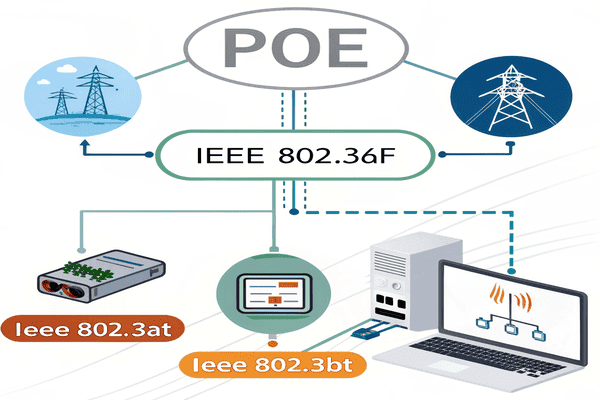
The IEEE 802.3 family of standards defines different PoE technologies and power capabilities.
The most commonly referenced standards include IEEE 802.3af, IEEE 802.3at, and IEEE 802.3bt.
| PoE Technology | IEEE Standard | Maximum PSE Power | Typical Applications |
| PoE | IEEE 802.3af | Up to 15.4W | VoIP phones, basic IP cameras |
| PoE+ | IEEE 802.3at | Up to 30W | PTZ cameras, wireless access points |
| PoE++ / Type 3 | IEEE 802.3bt | Up to 60W | High-performance access points, advanced cameras |
| PoE++ / Type 4 | IEEE 802.3bt | Up to 90W | Higher-power network devices |
These figures should be understood as PSE-side power levels. The amount of power actually available to the powered device can be lower because of power loss in the Ethernet cable and other components.
Therefore, engineers should not select a PoE solution solely by matching the PD’s rated power to the nominal PSE output.
Instead, the complete power path should be evaluated.
How Much Power Can PoE Deliver?
The power available from a PoE system depends on several factors, including:
- PoE standard
- PSE power capability
- PD power classification
- Cable length
- Cable resistance
- Connector losses
- System efficiency
- Available power budget
For example, a PoE system rated for a specific PSE output power may deliver less power to the PD because electrical energy is lost as it travels through the Ethernet cable.
This means that:
PSE output power is not always equal to PD available power.
When selecting a PoE power supply or PoE adapter, engineers should consider the actual power requirement of the powered device and provide sufficient margin for cable and system losses.
For multi-device PoE networks, the total power budget must also be considered.
Example
Suppose a network installation includes:
- 8 IP cameras
- Each camera requires approximately 15W
The theoretical device power requirement is:
8 × 15W = 120W
However, a PoE switch or centralized PoE power system should not necessarily be selected based only on 120W. The designer should also consider:
- Power losses
- Startup power requirements
- Future device expansion
- Operating temperature
- Power supply efficiency
- System reliability requirements
A suitable power budget provides additional capacity rather than operating continuously at the absolute limit.
PoE Power Budget: What You Need to Know
For installations with multiple powered devices, the PoE power budget is one of the most important factors to consider.
A PoE switch may have a total power budget that is shared across multiple ports.
For example, a switch may have:
- 24 PoE ports
- 240W total PoE power budget
Even if each individual port supports a certain PoE standard, the switch may not be able to provide the maximum power level to every port simultaneously.
Therefore, system designers should calculate:
- Number of powered devices
- Power requirement of each device
- Maximum expected power consumption
- Total PoE power budget
- Additional power margin
A simplified calculation is:
Total Required Power = Number of PDs × Average PD Power
A practical design should then include sufficient reserve capacity.
This is particularly important for installations involving high-power devices such as PTZ cameras, high-performance wireless access points, and advanced IoT or industrial equipment.
PoE vs. PoE+ vs. PoE++: Which One Should You Choose?
The correct PoE standard depends primarily on the power requirements of the powered device.
PoE (802.3af)
PoE based on IEEE 802.3af is suitable for relatively low-power devices.
Typical applications include:
- VoIP phones
- Basic IP cameras
- Simple network sensors
PoE+ (802.3at)
PoE+ provides more power than standard PoE and is suitable for devices with higher power requirements.
Typical applications include:
- PTZ cameras
- Wireless access points
- More advanced IP cameras
- Video-enabled communication devices
PoE++ / 802.3bt
IEEE 802.3bt supports higher-power applications and is designed for devices that require more power than earlier PoE standards can provide.
Typical applications include:
- High-performance wireless access points
- Advanced security cameras
- High-power network devices
- Certain IoT and industrial applications
When choosing between PoE, PoE+, and PoE++, always start with the requirements of the powered device and then select a compatible PSE and power solution.
PoE Switch vs. PoE Injector vs. PoE Adapter
Although these terms are sometimes used interchangeably, PoE switches, PoE injectors, and PoE adapters serve different purposes.
PoE Switch
A PoE switch combines:
- Network switching
- Data transmission
- PoE power delivery
It is suitable for installations with multiple PoE-powered devices.
For example, a security system with multiple IP cameras may use a PoE switch to connect and power all cameras through a centralized network device.
PoE Injector
A PoE injector adds power to an Ethernet connection.
It is commonly used when a network switch does not have built-in PoE functionality.
A typical configuration is:
Non-PoE Network Switch → PoE Injector → PoE Device
This approach can be useful when only one or a small number of devices require PoE power.
PoE Adapter
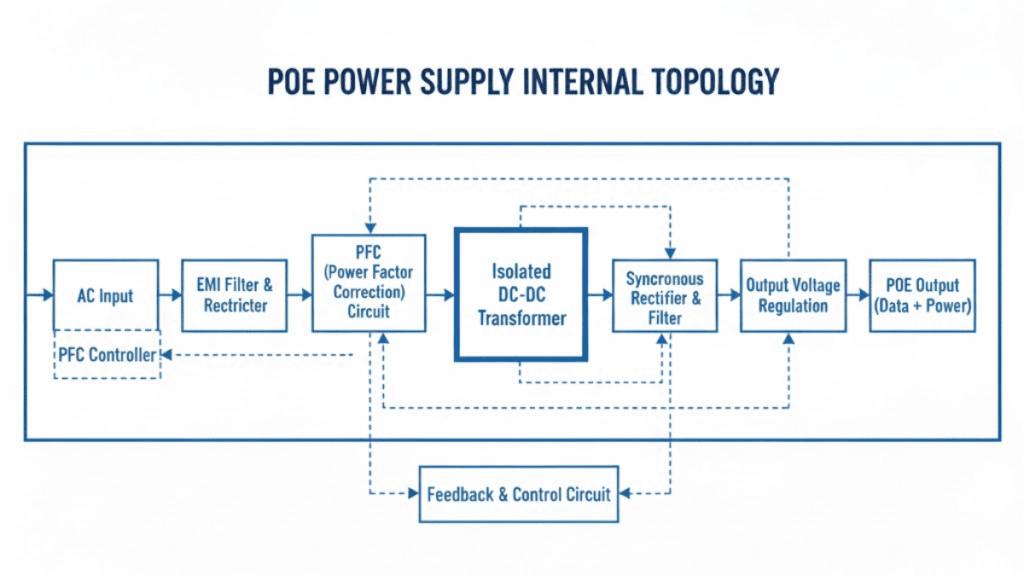
A PoE adapter is a broader term that may refer to a dedicated power conversion or power delivery solution designed to provide PoE power to compatible network equipment.
Depending on the product design, PoE adapters may be used in specific equipment configurations or applications where a dedicated PoE power solution is required.
For OEMs, system integrators, and equipment manufacturers, selecting the right PoE adapter requires careful consideration of:
- Input voltage
- Output voltage
- Output power
- PoE standard
- Efficiency
- Protection functions
- Operating temperature
- Safety and regulatory requirements
PoE Splitter
A PoE splitter separates power and data from a PoE Ethernet connection.
It can be useful when a network device supports Ethernet communication but does not have built-in PoE functionality.
Common Applications of Power over Ethernet
PoE technology is widely used across commercial, industrial, and smart infrastructure applications.
1. IP Security Cameras
PoE is widely used for IP surveillance systems because one Ethernet cable can provide both network connectivity and power.
For more advanced applications, such as PTZ or AI-enabled cameras, the higher power capabilities of PoE+ or PoE++ may be required.
2. Wireless Access Points
Wireless access points are often installed on ceilings or other locations where conventional power outlets may not be convenient.
PoE simplifies deployment by allowing network data and power to be delivered through the same Ethernet cable.
3. VoIP Phones
PoE enables VoIP phones to receive power through the same network connection used for voice and data communication.
This can simplify office network installation and centralized power management.
4. IoT Devices
PoE can support a wide range of connected IoT devices, including sensors, gateways, monitoring systems, and smart building equipment.
The exact PoE solution depends on the device’s power consumption and network requirements.
5. Access Control Systems
PoE can be used in access control applications involving network-connected readers, intercom systems, and security equipment.
6. Smart Buildings
PoE infrastructure can support connected building technologies, including:
- Sensors
- Lighting controls
- Digital signage
- Security systems
- Building management devices
7. Industrial Ethernet
In industrial environments, PoE can simplify the deployment of network-connected equipment.
However, industrial applications may require additional considerations, including:
- Wide operating temperature ranges
- High reliability
- Electrical protection
- Long-term availability
- Environmental requirements
The PoE solution should therefore be selected according to the actual operating conditions and equipment specifications.

What Are the Advantages of Power over Ethernet?
PoE provides several advantages compared with separate power and data connections.
Simplified Installation
Power and data can be delivered through a single Ethernet cable, reducing the need for separate electrical wiring.
Reduced Infrastructure Requirements
PoE can reduce the number of power outlets and dedicated power cables required for compatible network devices.
Flexible Device Deployment
Devices can be installed in locations where traditional AC power may be difficult or expensive to provide.
Centralized Power Management
Managed PoE infrastructure can make it easier to monitor and control power delivery to connected devices.
Easier Maintenance
Centralized power systems can simplify maintenance and troubleshooting, especially in larger network deployments.
Scalable Deployment
PoE systems can be expanded as additional network-connected devices are added.
What Are the Limitations of PoE?
PoE is highly useful, but it is not suitable for every application.
Power Limitations
High-power devices may require more power than standard PoE technologies can provide.
Cable Distance
PoE installations are generally subject to Ethernet transmission distance limitations. Longer distances may require additional network infrastructure or alternative power solutions.
Power Budget
When many devices are connected to a single PoE switch or power system, the total available power budget must be carefully calculated.
Compatibility
The PSE, PD, cable, and other components must be compatible with the intended PoE standard and power requirements.
Environmental Conditions
For industrial or outdoor applications, temperature, humidity, surge protection, and other environmental factors may affect system design.
Recommended PoE Standards by Application
| Application | Recommended PoE Standard | Typical Power |
| IP Camera | 802.3af | 5–12W |
| PTZ Camera | 802.3at | 20–30W |
| Wi-Fi 6 AP | 802.3at / bt | 20–45W |
| AI Camera | 802.3bt | 40–60W |
| VoIP Phone | 802.3af | 5–10W |
| Access Control | 802.3af | 8–15W |
Always confirm the powered device’s actual power requirement and manufacturer’s recommended PoE standard before selecting a PoE switch, injector, or adapter. Providing additional power margin helps ensure stable operation and supports future expansion.
How to Choose the Right PoE Power Supply
Choosing a PoE power supply or PoE adapter requires more than simply matching the output wattage.
Consider the following factors.
1. Determine the Required Power
Start by identifying the actual power consumption of the powered device.
Consider both normal operating power and possible peak or startup requirements.
2. Identify the Required PoE Standard
Determine whether the application requires:
- IEEE 802.3af
- IEEE 802.3at
- IEEE 802.3bt
The selected PSE and power supply should support the required standard.
3. Check Input and Output Requirements
Verify:
- AC input voltage range
- DC output voltage
- Output power
- Current rating
- Frequency requirements
4. Calculate the Power Budget
For multi-device applications, calculate the total expected power demand and ensure the power supply or PoE switch has sufficient capacity.
5. Consider Cable Losses
Cable resistance and transmission distance can affect the power delivered to the PD.
Make sure the selected power solution provides sufficient power margin.
6. Evaluate Operating Conditions
For industrial, outdoor, or demanding environments, consider:
- Operating temperature
- Humidity
- Cooling requirements
- Surge protection
- Overvoltage protection
- Overcurrent protection
- Short-circuit protection
7. Consider Safety and Compliance
Depending on the target market and application, the power supply may need to comply with applicable safety, EMC, and regulatory requirements.
For OEM and system integration projects, compliance requirements should be confirmed early in the product selection process.
8. Consider Long-Term Supply and Customization
For commercial and industrial OEM projects, product availability and long-term supply can be as important as electrical specifications.
A suitable PoE power supply manufacturer should be able to provide:
- Stable production capacity
- Consistent product quality
- Technical support
- Custom specifications
- OEM/ODM capabilities
- Reliable long-term supply
PoE Power Supply Selection Checklist
Before selecting a PoE adapter or PoE power supply, engineers and purchasing teams should verify:
Required PoE standard
Input voltage range
Output voltage
Required output power
Maximum current
Number of powered devices
Total PoE power budget
Cable length
Expected power loss
Operating temperature
Protection functions
Safety and EMC requirements
Required certifications
Product lifetime and reliability
Long-term product availability
OEM/ODM requirements
This checklist can help reduce compatibility issues and prevent under-sizing the PoE power system.
Frequently Asked Questions About Power over Ethernet
Is PoE the same as Ethernet?
No. Ethernet is primarily a networking technology for transmitting data, while PoE adds the ability to deliver electrical power through compatible Ethernet connections.
Can PoE transmit power and data at the same time?
Yes. A compliant PoE system can transmit network data and electrical power through the same Ethernet connection.
Is PoE safe for non-PoE devices?
Compliant PoE systems use detection mechanisms to determine whether a compatible powered device is connected before supplying power. However, equipment should always be selected and installed according to manufacturer specifications.
What is the difference between PoE and PoE+?
PoE generally refers to IEEE 802.3af, while PoE+ refers to IEEE 802.3at. PoE+ supports higher power delivery and is suitable for devices that require more power.
What is the difference between PoE+ and PoE++?
PoE+ is based on IEEE 802.3at, while PoE++ commonly refers to higher-power IEEE 802.3bt solutions. IEEE 802.3bt supports applications requiring more power than earlier PoE standards.
Can I use a PoE injector with a non-PoE switch?
Yes. A PoE injector can add PoE power to an Ethernet connection between a non-PoE network switch and a compatible powered device.
How far can PoE transmit power?
PoE installations are generally designed around standard Ethernet cabling distance limitations. For longer-distance applications, additional network infrastructure or specialized solutions may be required.
How do I choose the right PoE power supply?
Start with the powered device’s required voltage, current, power, and PoE standard. Then consider cable losses, total power budget, operating environment, protection requirements, certifications, and long-term supply needs.
Does PoE require a special Ethernet cable?
PoE requires compatible Ethernet cabling and connectors that meet the requirements of the selected PoE standard and installation. Cable quality and specifications should be considered when designing the system.
Conclusion: Choosing the Right PoE Power Solution
Power over Ethernet has become an important technology for powering and connecting network devices through a unified Ethernet infrastructure.
From IP cameras and wireless access points to VoIP phones, IoT devices, and industrial network equipment, PoE can simplify installation while providing flexible and centralized power delivery.
However, selecting a PoE solution requires more than simply checking whether a device is “PoE compatible.” Engineers and purchasing teams should evaluate the complete system, including:
- PSE capability
- PD power requirements
- IEEE PoE standard
- Available power budget
- Cable losses
- Operating environment
- Protection functions
- Safety and compliance requirements
- Long-term product availability
For applications that require a dedicated PoE power solution, selecting the right PoE adapter or PoE power supply is particularly important. The appropriate solution should match the electrical specifications and PoE requirements of the target equipment while providing sufficient reliability and power margin.
Looking for a PoE adapter or PoE power supply for an ODM/OEM project?
Quankang works with equipment manufacturers, system integrators, and distributors to develop PoE power solutions based on specific electrical, mechanical, thermal, and regulatory requirements.
Depending on your application, customization may include:
- Output voltage and power
- PoE standard
- Connector and cable configuration
- Enclosure and form factor
- Operating temperature
- Protection functions
- Safety and EMC requirements
- OEM/ODM specifications
Contact Quankang to discuss your PoE power requirements and request a customized solution.