The light source is usually the first thing people notice in a lighting product.
The brightness.
The appearance.
The size.
The overall user experience.
But during product development, we often find that another component can have a significant influence on whether the final product performs as expected:
The power adapter.
As LED lighting products continue to become smaller and more integrated, the external AC-DC adapter is facing new challenges.
It needs to fit into limited installation spaces.
It needs to operate reliably over long periods.
And it needs to maintain stable performance under real application conditions.
This is changing the role of the LED power adapter.
It is no longer simply a component selected after the lamp design is completed.
It is becoming part of the overall product design process.
Why are external power solutions becoming more common in LED lighting?
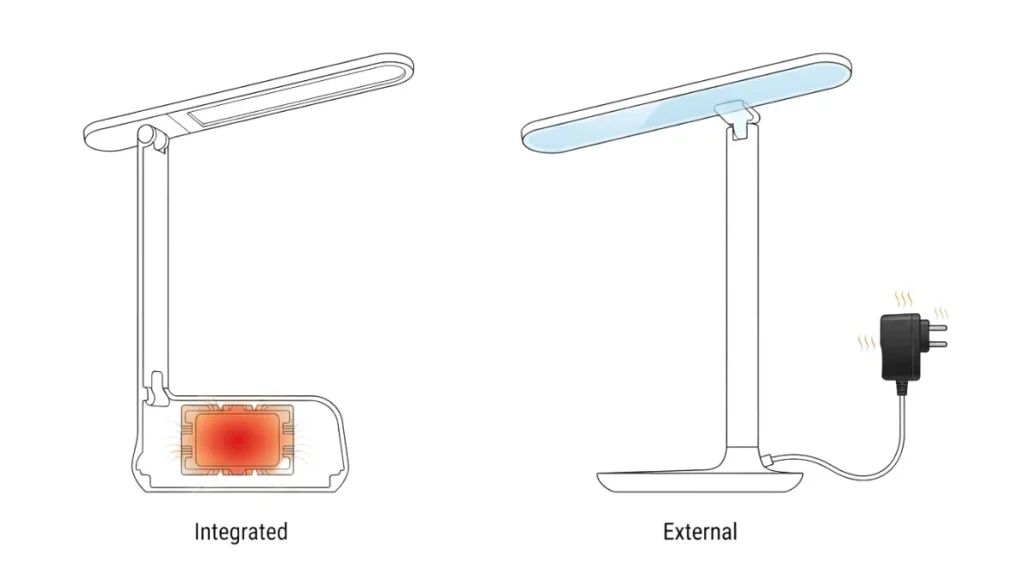
One trend we continue to see in lighting applications is the move toward smaller product designs.
Modern table lamps, decorative lighting, and indoor LED fixtures are expected to deliver better appearance and more functions while occupying less space.
For product designers, this creates a familiar challenge.
More components need to fit into smaller structures, but thermal conditions still need to be considered.
The power conversion stage is one of the areas where heat is generated.
By moving the AC-DC conversion outside the lighting enclosure, designers gain more flexibility in mechanical design and thermal management.
The lamp structure can focus on optical performance and appearance, while the adapter can be designed around power conversion, protection, and reliability.
Why can an adapter with the correct specification still create problems?
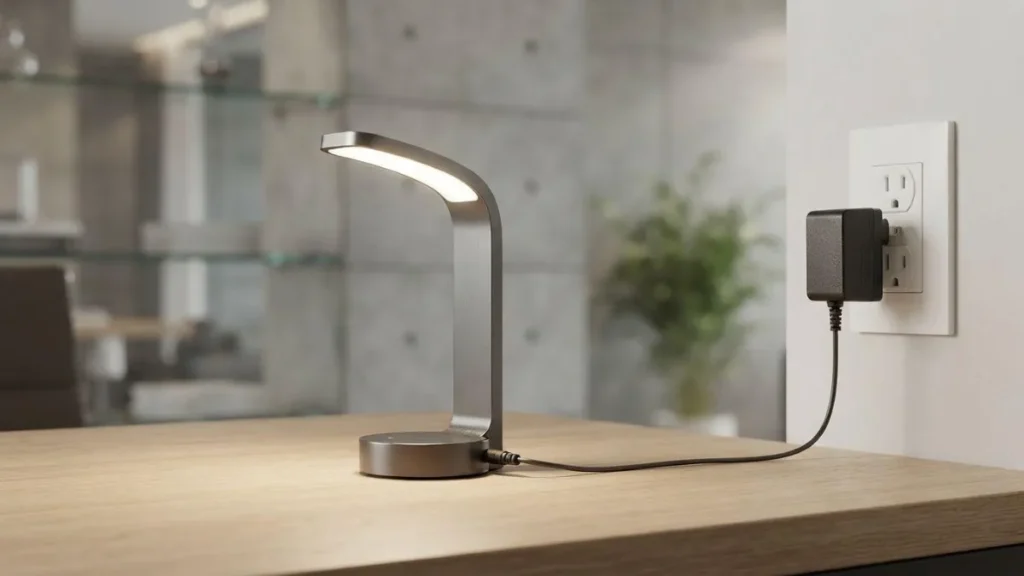
This is a situation that occurs more often than many people expect.
The replacement adapter has the same voltage.
The output power appears sufficient.
The connector matches.
However, after integration into the final product, the operating result may still be different.
The reason is that the adapter specification only describes the electrical capability of the power supply.
It does not describe every condition it will experience after installation.
In a real lighting product, the adapter works together with the LED load, mechanical structure, and operating environment.
A constant voltage LED application and a constant current LED application also require different approaches.
The power solution needs to match the system, not only the numbers printed on the label.
Why does compact lighting design create thermal challenges?
Reducing product size has always been an important direction in lighting design.
However, smaller products also leave less room for thermal management.
An adapter installed in an open test environment may perform differently from the same adapter installed inside a compact lamp structure.
The operating temperature can be affected by:
- available airflow
- surrounding components
- installation position
- continuous operating time
For LED lighting products that are used for several hours every day, thermal performance becomes an important factor in long-term reliability.
This is why power selection cannot be separated from the final product environment.
Why is efficiency important for compact LED applications?
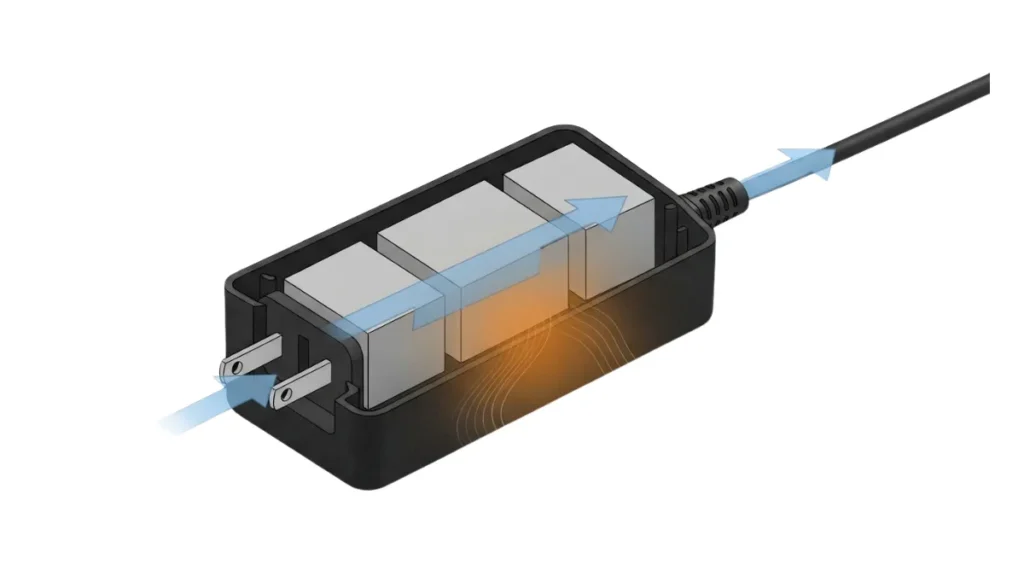
Efficiency is often one of the first specifications considered when comparing power solutions.
However, efficiency is not only related to energy consumption.
It is also related to heat generation.
During AC-DC conversion, the power that is not converted into useful output becomes heat.
In a compact lighting application, this heat has a direct impact on the internal operating environment.
Another consideration is that efficiency values are normally measured under specific test conditions.
Actual performance may vary depending on input voltage, output load, and installation conditions.
For engineers, understanding how the adapter performs in the final application is often more meaningful than looking at a single efficiency number.
Why is choosing the right adapter more than matching power ratings?
During product development, selecting a power adapter is often considered a simple specification task.
However, the actual decision involves balancing several requirements.
The adapter needs to provide suitable output performance.
It needs to fit the mechanical requirements.
It needs to operate reliably within the expected environment.
A higher-rated solution is not always the best solution.
A larger power margin can be useful, but selecting a product far beyond the actual requirement may increase cost and installation difficulty without improving the final product.
The goal is to find the right balance between performance, size, and reliability.
Supporting compact LED applications with the UEL036LCP-E1 series
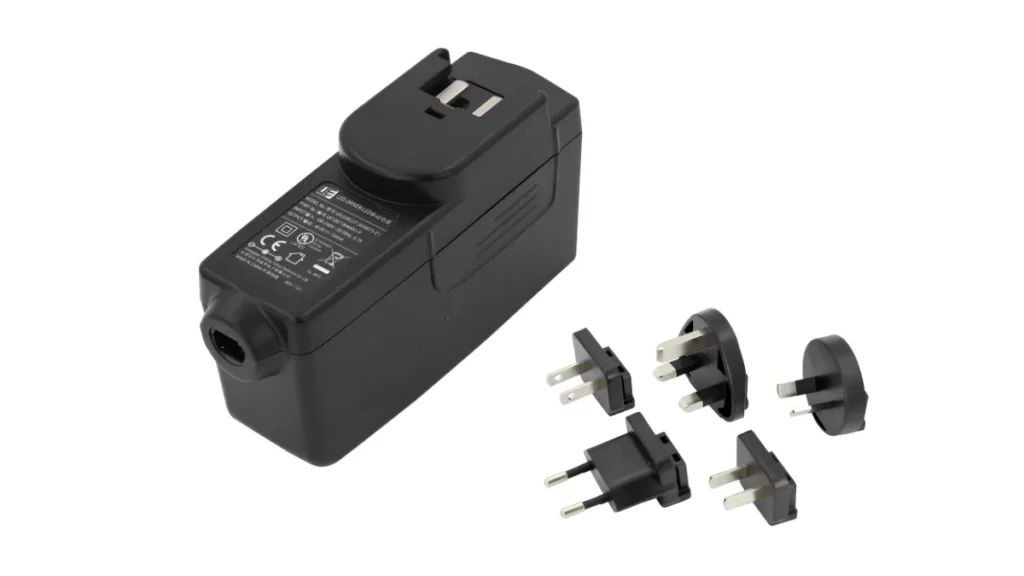
The design considerations above are becoming increasingly important for compact LED lighting products.
To support applications requiring external AC-DC power conversion, UE developed the UEL036LCP-E1 series.
The series supports a universal 90-264VAC input range and provides up to 36W output power.
Available output configurations include:
| Model | Output |
|---|---|
| UEL036LCP-S024150-E1 | 24V / 1.5A |
| UEL036LCP-S036100-E1 | 36V / 1.0A |
| UEL036LCP-S048075-E1 | 48V / 0.75A |
The series achieves up to 88% efficiency and integrates protection functions including:
- short circuit protection
- over current protection
- over voltage protection
- overload protection
With a compact 102mm × 53mm × 36mm form factor, the UEL036LCP-E1 provides flexibility for applications where installation space is limited.
Typical applications include:
- LED table lamps
- decorative lighting
- indoor LED fixtures
The power behind the light
The external AC-DC adapter is usually not the most visible part of a lighting product.
However, it influences many factors that determine the final product experience.
Thermal behaviour.
Reliability.
Long-term stability.
As LED products continue to move toward smaller and more integrated designs, the power solution needs to be considered as part of the product development process.
The light is what users see.
The power system is what helps keep that experience consistent over time.