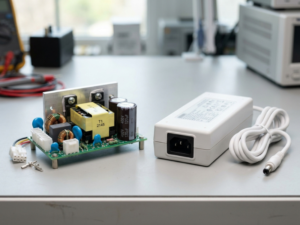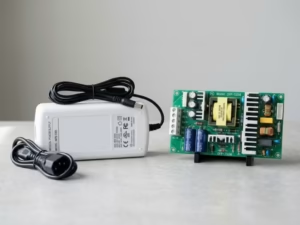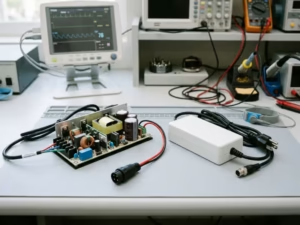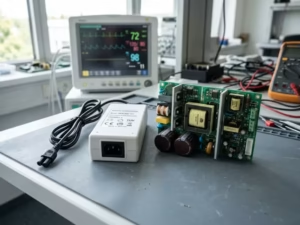
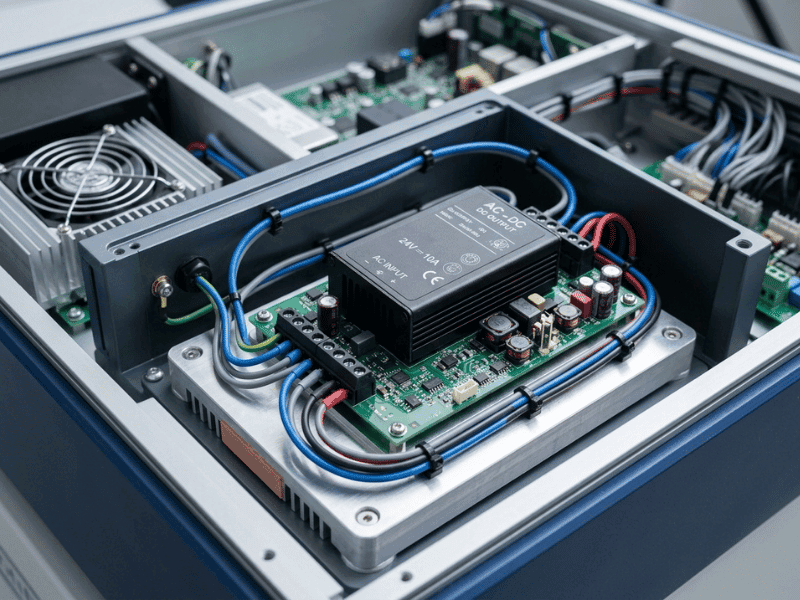
An AC-DC brick power supply is a self-contained, enclosed module that converts AC mains voltage to regulated DC output. Defined by DOSA-standardized footprints (from 1/32-brick to full-brick), these modules integrate the AC front-end, PFC, and isolation transformer into a compact package with a baseplate-cooled, fanless-capable design suited to medical, industrial, and transportation applications.
AC-DC brick power supplies sit at an interesting intersection of packaging constraint and engineering capability. Most engineers encounter them when standard open-frame or enclosed supplies no longer fit—either physically, thermally, or from a certification standpoint. If you’re evaluating whether a brick module belongs in your next design, or you’re a project manager trying to understand what your engineering team is specifying, this guide covers everything you need: how bricks are defined, where they excel, where they fall short, and a step-by-step selection framework to help you choose the right one.
What Is an AC-DC Brick Power Supply?
An AC-DC brick power supply is a fully enclosed, PCB-mountable power module that converts AC mains input—typically 90–264 V AC universal input—to one or more regulated DC output voltages. The term “brick” refers specifically to the physical form factor: a rectangular module with a standardized footprint defined by the Distributed-Power Open Standard Alliance (DOSA), which formalized brick sizing around 2010 to help design engineers source interchangeable modules across multiple vendors.
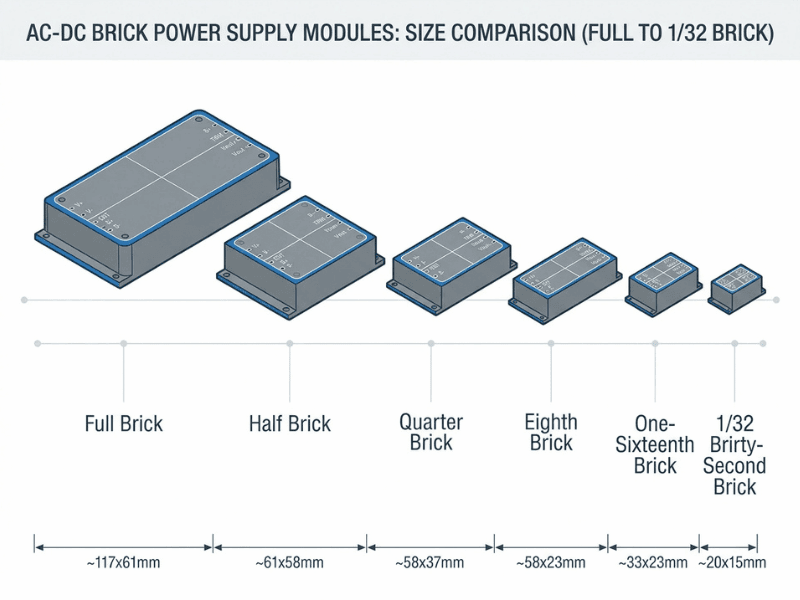
DOSA brick sizes range from full-brick down to 1/32-brick:
Brick Size | Approx. Dimensions (mm) | Typical Wattage Range |
|---|---|---|
Full Brick | 116.8 × 61.0 | 300W – 700W+ |
Half Brick | 61.0 × 57.9 | 100W – 400W |
Quarter Brick | 57.9 × 36.8 | 50W – 150W |
Eighth Brick | 57.9 × 22.9 | 20W – 75W |
1/16 Brick | 33.0 × 22.9 | 10W – 50W |
1/32 Brick | 22.9 × 13.0 | 5W – 30W |
The standardized footprint means a half-brick from one manufacturer can, in principle, be substituted with a half-brick from another—provided the electrical and thermal interface requirements match. In practice, output voltage options, isolation ratings, and protection feature sets vary enough between vendors that direct substitution requires careful validation.
What differentiates an AC-DC brick from a DC-DC brick is the inclusion of the AC front-end circuitry—rectification, EMI filtering (to varying degrees), and often power factor correction (PFC)—inside the same enclosed module. The result is a higher-level building block than a DC-DC converter alone.
From DC-DC to AC-DC: How Brick Power Evolved
The earliest brick power supplies were DC-DC converters, predominantly in the 50 W to 100 W range, used in distributed power architectures (DPA) to step down 48 V bus rails to 12 V, 5 V, or 3.3 V. The form factor proved popular: standardized, PCB-mountable, thermally manageable through baseplate conduction.
As component technology improved—particularly planar transformer design and wide-bandgap semiconductor availability—it became possible to squeeze higher wattage into the same footprint while also integrating more of the AC front-end circuitry into the module itself.
Early AC-DC designs kept bridge rectifiers, PFC stages, and bulk capacitance on the system board as discrete circuitry, then connected to a DC-DC brick for the final conversion. The emergence of fully integrated AC-DC brick modules changed this. System engineers could now replace much of that front-end board space with a single module, adding only the external components—fusing, EMI filtering, and bulk capacitance—specified in the module’s application guideline.
The degree of integration varies across products. Some modules integrate PFC and partial EMI filtering; others are more minimal and require more external support components. The Cincon PDF700S, for example, requires an external EMI filter and bulk capacitor to complete the AC-DC conversion chain. Cincon’s CBM series goes further, including filtering inductors and bulk capacitance inside the module for a more self-contained solution. The lesson for system designers: always consult the specific module’s application note to understand what the module includes—and what it does not.
AC-DC Brick vs. Other Power Supply Form Factors
Before committing to a brick module, it’s worth understanding how it compares to the alternatives. Each form factor reflects a set of design trade-offs rather than a universal hierarchy.
Form Factor | Cooling Method | EMI Filtering | Mechanical Integration | Typical Use Case |
|---|---|---|---|---|
Open-Frame | Forced air or convection | External or minimal | PCB-mounted, no enclosure | Industrial control, cost-sensitive designs |
Enclosed (Fan-Cooled) | Internal fan | Internal | Standalone box | General industrial, benchtop |
External Adapter | Convection | Internal | External cable | Consumer, portable medical, desktop equipment |
AC-DC Brick | Baseplate conduction | Partially or fully internal | PCB-mounted, enclosed module | Medical, sealed industrial, transportation |
Summary judgment: Open-frame supplies offer more output flexibility and lower cost but require enclosure design and airflow management. Enclosed fan-cooled supplies are easier to integrate but introduce mechanical failure risk from the fan. External adapters are the simplest integration path but are constrained in power level and unsuitable for internal mounting. AC-DC brick modules trade customization flexibility and cost for high power density, fanless cooling capability, and robust environmental sealing—making them the preferred choice where space is limited, fans are prohibited, or harsh environments are a factor.
Core Advantages of AC-DC Brick Power Supplies
High Power Density in a Standardized Footprint
Brick modules concentrate substantial power delivery into a small, predictable footprint. A full-brick AC-DC module can deliver 700 W or more from a 116.8 × 61.0 mm package. This matters in system architectures where board real estate is constrained—particularly in rack-mounted equipment, embedded industrial controllers, and portable medical devices.
PCB Integration Without Custom Mechanical Design
Because brick modules mount directly to the PCB using standard through-hole pins or SMT pads (depending on the specific product), they integrate into the system without requiring a dedicated chassis or custom sheet-metal work. This simplifies the overall system architecture and reduces mechanical design effort compared to mounting a standalone enclosed supply.
Baseplate Cooling for Fanless Operation
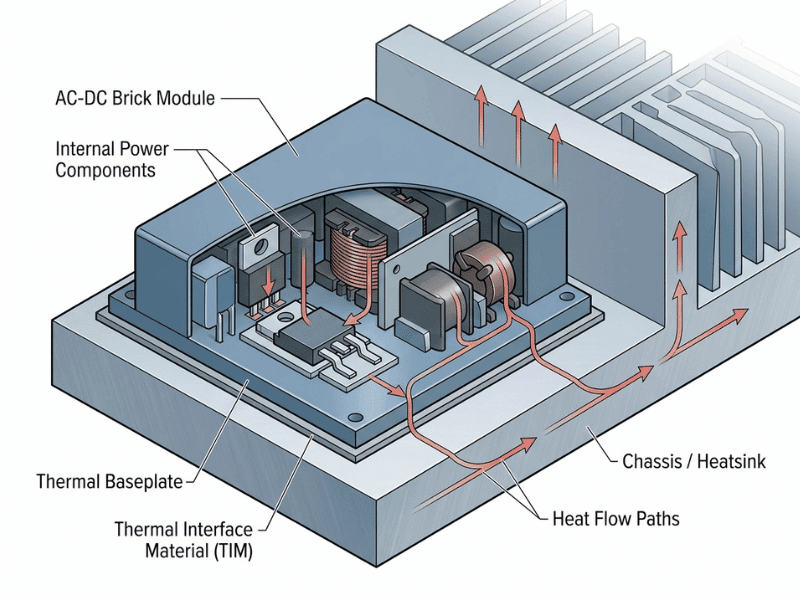
This is the defining thermal advantage of AC-DC brick modules. The aluminum baseplate on the top surface of the module provides a conduction path from the internal components to the system chassis or an external heatsink. When properly interfaced, this allows the module to operate without a fan—critical in sealed enclosures where forced-air cooling is impractical.
With adequate baseplate cooling and chassis thermal management, some modules can sustain operation at case temperatures up to 85 °C, corresponding to internal operating temperatures significantly higher than the 60–70 °C ceiling typical of fan-cooled open-frame supplies. The key variable is the thermal resistance between the module’s baseplate and the ambient heat sink. Engineers need to calculate this path carefully—the module’s datasheet will specify the baseplate-to-case thermal resistance, and the system designer must account for thermal interface material (TIM) conductivity, contact area, and chassis thermal resistance to ambient.

Reliability in Harsh Environments
The encapsulated construction protects internal components from dust, humidity, and mechanical vibration. In applications like transportation electronics, outdoor industrial controllers, or medical equipment operating in clinical environments, this environmental robustness directly extends service life.
Many brick modules are designed to minimize or eliminate electrolytic capacitors internally, relying instead on film capacitors or ceramic capacitors with longer operational lifetimes. This is not a universal design rule—some modules do include electrolytics in specific circuit positions—but where it is implemented, it meaningfully extends the module’s rated MTBF. Verify the specific module’s internal construction with the manufacturer before drawing conclusions about component life.
Thermal Path as a System Architecture Tool
A less-discussed advantage: the baseplate cooling interface can be integrated directly into the system’s thermal management architecture. Rather than treating the power supply as a heat-generating box to be cooled separately, system designers can route heat from the brick module through the same chassis thermal path used for other high-dissipation components. This simplifies thermal management at the system level, particularly in conduction-cooled assemblies like ruggedized military or transportation electronics.
Safety and Protection Features in AC-DC Brick Modules
Input-to-Output Isolation
AC-DC brick modules provide galvanic isolation between the AC input and DC output, implemented through a high-frequency transformer. Isolation voltage ratings typically range from 1,500 V AC to 4,000 V AC or higher, depending on the application and standard.
For medical applications, the relevant standard is IEC 60601-1, which mandates isolation in terms of Means of Patient Protection (MOPP). 2×MOPP isolation—requiring reinforced insulation with leakage current ≤100 µA for patient-contact devices—is the threshold for equipment in direct or indirect contact with patients. Medical-grade AC-DC modules designed to 2×MOPP provide this level of protection inherently in the module’s isolation barrier, which substantially simplifies system-level medical certification.
Protection Functions
Well-specified AC-DC brick modules include a standard set of protection features:
- Overvoltage Protection (OVP): Shuts down or clamps output if voltage exceeds the rated threshold, protecting downstream loads.
- Overcurrent Protection (OCP): Limits output current under overload conditions, typically through hiccup-mode or constant-current limiting.
- Overtemperature Protection (OTP): Triggers shutdown or power reduction when internal or baseplate temperature exceeds a defined limit.
- Short-Circuit Protection (SCP): Protects the module from sustained short-circuit conditions on the output.
Creepage and Clearance
For applications subject to IEC 60601-1, IEC 62368-1, or similar standards, the physical spacing between primary (mains) and secondary (output) circuits—expressed as creepage distance (along surfaces) and clearance (through air)—must meet defined minimums based on working voltage, overvoltage category, and pollution degree. A module certified to IEC 60601-1 with compliant creepage and clearance distances helps simplify the system-level isolation design.
Important caveat: Module-level approvals do not automatically constitute system-level certification. A brick module certified to IEC 60601-1 contributes to system compliance but does not replace the complete end-product certification process. Regulators evaluate the entire device, including how the module is integrated, what external components are added, and how the system is assembled and used.
Limitations and Trade-Offs
Understanding where AC-DC brick modules fall short is just as important as understanding where they excel.
External Components Are Still Required
Most AC-DC brick modules require external support components to function correctly: at minimum, a fuse for the AC input line, an EMI filter (unless the module includes sufficient internal filtering), and bulk capacitance for hold-up time and line transient ride-through. The exact requirements are module-specific—always consult the application note and verify with the manufacturer. Assuming a module is fully self-contained without checking is a common and avoidable design error.
Thermal Design Responsibility Shifts, Not Disappears
A fanless baseplate-cooled module does not eliminate thermal design work. It transfers the thermal management challenge from inside the power supply to the system chassis. The designer must ensure adequate thermal conductivity between the module’s baseplate and the chassis, proper TIM selection, sufficient chassis surface area, and appropriate ambient temperature margins. Skipping this validation is the single most common integration mistake.
Cost Premium Over Open-Frame Alternatives
Brick modules carry a higher unit cost than comparable-wattage open-frame supplies. The enclosed construction, standardized footprint manufacturing, and internal complexity command a premium. For high-volume applications where integration cost savings (reduced mechanical design, simplified assembly, fewer external components) offset the module price difference, brick modules can be cost-competitive at the system level. For cost-sensitive, high-volume consumer applications, they typically are not.
Output Flexibility Is Limited
Unlike a custom power supply design or a highly configurable open-frame platform, brick modules come in fixed output voltage configurations—typically 12 V, 24 V, 28 V, 48 V, and similar standard values. Applications requiring unusual output voltages or multiple tightly regulated rails may find brick modules restrictive or require additional DC-DC post-regulation stages.
Customization Limits
Standard off-the-shelf brick modules have limited accommodation for electrical or mechanical customization. ODM buyers requiring specific output voltages, modified isolation ratings, custom connector arrangements, or application-specific certifications typically need to work with a manufacturer that offers custom or semi-custom brick module development—not all vendors support this.
Certification Nuances
A module with a safety mark (UL, TÜV, CB) is certified as a component, not as a finished product. The integrating company remains responsible for end-product certification. For medical devices in particular, this distinction is critical: the power module’s IEC 60601-1 certification must be supplemented by system-level testing covering the complete device construction, applied parts, and intended use environment.
Where AC-DC Brick Power Supplies Fit Best
Medical Devices
Medical devices requiring compact internal power with patient safety isolation are the strongest fit for medical-grade AC-DC brick modules. Patient monitors, infusion pumps, ventilators, surgical equipment, and diagnostic imaging systems all benefit from the combination of high power density, 2×MOPP-rated isolation, leakage current ≤100 µA, and fanless operation (critical in sterile or noise-sensitive clinical environments).
The IEC 60601-1 certification path is substantially simplified when the power module already carries a component-level approval with documented creepage/clearance compliance and leakage current data. For ODMs building Class II medical devices targeting FDA 510(k) or EU MDR approval, selecting a module from a manufacturer with an ISO 13485-certified facility and complete certification dossiers reduces both risk and timeline.
Industrial Automation
Sealed control enclosures, robotic end-effectors, programmable logic controllers (PLCs), and field-deployed industrial hardware benefit from brick modules’ environmental robustness and fanless cooling capability. In environments with high dust concentrations, temperature cycling, or vibration, the encapsulated construction extends service life compared to open-frame supplies.
Telecom and Networking
Telecom equipment—base station controllers, managed switches, VoIP infrastructure—often operates in thermally constrained cabinets with strict EMI requirements. Brick modules designed for telecom applications (often targeting ETSI or NEBS standards) offer the combination of high power density, robust EMI performance, and conduction cooling needed for these deployments.
Transportation and Rail
Rolling stock electronics, trackside control systems, and vehicle-mounted equipment face wide temperature ranges, vibration profiles, and shock loads that eliminate fans as a viable cooling option. EN 50155 (railway electronic equipment) and related standards require specific shock, vibration, and temperature performance—brick modules designed for transportation applications are built to these criteria.
Outdoor and Sealed Systems
Any system requiring IP54 or higher ingress protection must exclude internal fans or ventilation openings. Brick modules with baseplate cooling solve this directly, enabling the system enclosure to be fully sealed while the power module conducts heat out through the chassis walls.
Test and Measurement Equipment
High-accuracy measurement instruments benefit from the brick module’s electrical isolation, which reduces common-mode noise coupling between the AC mains and sensitive measurement circuits. The compact footprint also supports instrument miniaturization.
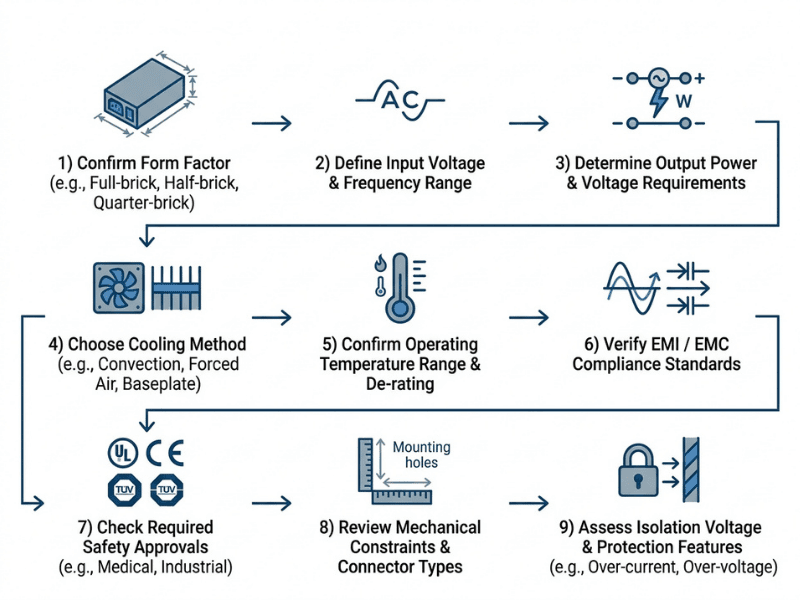
How to Select the Right AC-DC Brick Power Supply: A Step-by-Step Framework
Step 0: Confirm That a Brick Is the Right Form Factor
Before sizing a brick module, verify that the application requirements actually favor brick over alternatives. Brick modules make sense when: the system enclosure is sealed or fan-prohibited, board space is constrained, baseplate cooling to a chassis is feasible, and the application demands a certified component rather than a complete supply. If the system has adequate space for an enclosed supply and no fan prohibition, an open-frame or enclosed supply may offer better value.
Step 1: Define Input Requirements
Confirm the AC input voltage range (single-phase 85–264 V AC universal, or narrower range), frequency (47–63 Hz for universal; 360–440 Hz for some aerospace/defense applications), and whether the application requires power factor correction. Applications in regions with strict energy regulations or large distributed loads benefit from built-in PFC.
Step 2: Determine Output Voltage and Power
Identify all required output voltages and the maximum continuous current per rail. Add a 20–30% derating margin to the calculated load to avoid operating at rated maximum, which degrades reliability. Confirm that the module’s available output voltage options match your requirements, or evaluate whether a DC-DC post-regulator is acceptable.
Step 3: Specify the Cooling Method
Determine whether the module will be baseplate-cooled to a chassis, convection-cooled, or supplemented by a heatsink. Calculate the total thermal resistance from baseplate to ambient. Compare this against the module’s thermal derating curve to confirm rated output power is achievable at the maximum expected ambient temperature.
Step 4: Define Operating Temperature Range
Specify the full operating temperature range—from cold-start minimum to maximum sustained ambient. Check the module’s derating curve for power reduction at elevated temperatures. For outdoor or transportation applications, extended temperature ratings (−40 °C to +85 °C or beyond) may be necessary.
Step 5: Evaluate EMI/EMC Requirements
Determine the applicable EMC standard (CISPR 32 Class B, EN 55032, FCC Part 15 Class B, or medical-specific limits under IEC 60601-1-2). Confirm what EMI filtering the module provides internally and what external filtering the application note requires. For medical devices, conducted and radiated emissions testing at the system level is mandatory regardless of module-level EMC claims.
Step 6: Verify Safety Approvals
Match the required safety certifications to the module’s approval list. Medical applications need IEC 60601-1 with documented MOPP and leakage current data. Industrial applications typically require UL 62368-1 or IEC 62368-1. Transportation applications may require EN 50155 or additional railway-specific approvals. Confirm certifications are current and verifiable with the certification body.
Step 7: Check Mechanical Constraints
Confirm the brick size (full, half, quarter, etc.) fits the available PCB area and height envelope. Verify the baseplate interface dimensions match the chassis mounting surface. Confirm thermal interface material requirements and mounting pressure specifications from the datasheet.
Step 8: Review Isolation and Protection Specifications
For medical applications: verify MOPP rating, leakage current at rated load, and isolation voltage. For all applications: confirm OVP, OCP, OTP, and SCP behavior (latch-off vs. auto-restart), as this affects system-level fault response design.
Common Mistakes to Avoid
Assuming baseplate cooling means no thermal validation is needed. The module handles its internal thermal management; the system designer must handle the thermal path from baseplate to ambient. Without a proper thermal interface and chassis calculation, a module rated for 85 °C case temperature will overheat in a poorly designed enclosure.
Overlooking external EMI filter requirements. Many AC-DC brick modules include partial internal filtering but still require an external EMI filter and line-side bulk capacitance to meet Class B conducted emission limits. Treating a module’s internal filtering as fully compliant without checking the application note leads to failed EMC tests.
Using module approvals as system certification. A brick module certified to IEC 60601-1 is a component approval. The finished medical device must go through its own system-level certification process. The module approval contributes to—but does not substitute for—that process.
Choosing output voltage before checking derating and hold-up. Output voltage selection must account for the derating curve under maximum load and temperature, as well as minimum hold-up time under specific bulk capacitor values. Neither is guaranteed by the nominal output voltage specification alone.
Ignoring chassis interface flatness and mounting pressure. Thermal interface performance between the module’s baseplate and the chassis is highly sensitive to surface flatness and mounting torque. Inadequate contact due to chassis warpage or insufficient clamping pressure can increase effective thermal resistance by 2–5× compared to the datasheet value, causing premature thermal shutdown.
Frequently Asked Questions
Do AC-DC brick modules need external EMI filters?
Most do, yes. Standard AC-DC brick modules include some internal filtering, but the degree varies significantly by product. The module’s application note specifies what external EMI filter, common-mode choke, and line-side capacitor values are required to meet a given class of conducted emissions (e.g., CISPR 32 Class B). Some “all-in-one” brick solutions—like certain CBM-series products from Cincon—integrate bulk filtering internally for a more complete EMC solution, but these are the exception rather than the rule.
Can I use a fanless AC-DC brick module in a fully sealed enclosure?
Yes, provided the chassis is designed to conduct heat away from the module’s baseplate effectively. The module dissipates heat through its aluminum baseplate to the system chassis, which then dissipates to ambient air or a heatsink. The chassis must have sufficient thermal mass and surface area, and the thermal interface material between baseplate and chassis must be correctly specified. A fanless module in a sealed enclosure with inadequate thermal management will trigger OTP and shut down.
How do I approach baseplate cooling selection for an AC-DC brick module?
Start with the module’s baseplate-to-case thermal resistance (θ_bc) from the datasheet. Add the TIM thermal resistance (typically 0.1–0.5 °C/W, depending on material and area) and the chassis thermal resistance from the mounting surface to ambient. Sum these to get total thermal resistance (θ_total). Multiply by module power dissipation to find the temperature rise above ambient. Confirm the resulting baseplate temperature stays within the module’s rated maximum case temperature, with margin.
What is the difference between an AC-DC brick module and an open-frame power supply?
An open-frame supply is an uncovered PCB assembly, typically requiring a separate enclosure and often forced-air cooling. It generally offers more output configuration flexibility and lower cost. An AC-DC brick module is a fully enclosed, potted assembly with a standardized footprint and aluminum baseplate for conduction cooling. Brick modules favor sealed systems, high power density, and fanless operation; open-frame supplies favor flexibility and cost.
Are AC-DC brick modules suitable for industrial applications?
Yes. Industrial automation, field-deployed control systems, robotics, and sealed outdoor equipment are strong use cases. The key requirements are selecting a module rated for the expected ambient temperature range (including derating at high temperatures), verifying the appropriate safety certification (IEC 62368-1 or application-specific), and ensuring the module’s EMC performance meets the industrial electromagnetic environment requirements (e.g., IEC 61000 series).
What wattage ranges are available in AC-DC brick modules?
Wattage ranges depend on brick size. 1/32-brick modules typically start around 5–10 W; quarter-brick modules commonly cover 50–150 W; half-brick modules reach 100–400 W; full-brick modules extend to 700 W and beyond. Higher power brick solutions exist for specialized applications.
Do AC-DC brick modules include PFC and EMI filtering?
It depends on the specific module. Some brick modules integrate PFC as part of the AC front-end stage; others do not. Similarly, internal EMI filtering varies—some modules include minimal filtering and rely on external components, while others integrate more complete filtering. Always consult the module’s block diagram and application note for the specific product you are evaluating.
Are AC-DC brick modules suitable for medical devices?
Yes, with appropriate module selection. Medical-grade AC-DC brick modules designed to IEC 60601-1 with 2×MOPP isolation and leakage current ≤100 µA are appropriate for patient-proximate medical equipment. These modules simplify system-level isolation design. However, the module’s component-level certification must be complemented by full system-level IEC 60601-1 certification covering the complete device. Medical ODMs should also verify that the module manufacturer holds ISO 13485 certification and can provide a complete certification dossier for regulatory submissions.
Make the Right Power Decision—From Specification to Production
AC-DC brick power supplies offer a well-defined set of advantages: high power density, standardized form factors, conduction cooling for fanless operation, and enclosed construction for harsh environments. They are not universally the right choice—cost, output flexibility, and certification complexity mean that open-frame or enclosed supplies remain better fits for many applications. The selection decision comes down to accurately matching form factor advantages to the specific system requirements.
For design engineers: If your application involves a sealed enclosure, fan prohibition, extended temperature range, or IEC 60601-1 compliance requirements, AC-DC brick modules deserve serious evaluation. Use the step-by-step selection framework above to validate the fit before committing to a design architecture.
For ODM and OEM procurement teams: Sourcing a brick module from a manufacturer with in-house EMC validation, ISO 13485 certification, and complete certification documentation reduces downstream certification risk and supply chain uncertainty. Quankang has supported medical and industrial power design for over 36 years, holds 212+ active patents, and maintains an on-site EMC laboratory with a 98.3% first-pass EMC compliance rate across 10,000+ OEM projects.
[Speak with a Quankang application engineer about your AC-DC brick power requirements →]
[Request a factory quote for medical or industrial brick power modules →]