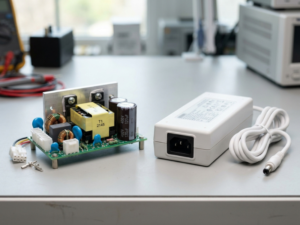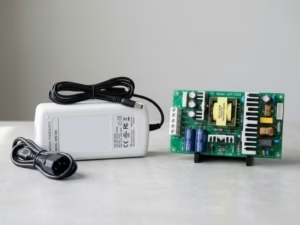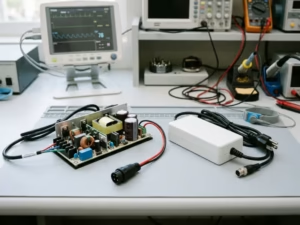
Quick answer: External power supply efficiency measures how well a power adapter converts AC wall power into usable DC power while minimizing energy loss during active use and standby (no-load) conditions. The most efficient adapters meet standards such as DOE Level VI and often use GaN technology, which means they waste less energy, run cooler, and tend to last longer than older designs.
Those little black bricks powering your devices are easy to overlook, yet they quietly shape your electricity bill, your carbon footprint, and how long your gear lasts. The gap between a good adapter and a bad one is bigger than most people realize.
This guide breaks down how external power supplies work and what efficiency really means. You’ll learn the difference between active mode efficiency and no-load power, why DOE Level VI matters, how GaN chargers stack up against older designs, and how to spot an efficient adapter in seconds. By the end, you’ll have a simple checklist for your next purchase.
What Is an External Power Supply?
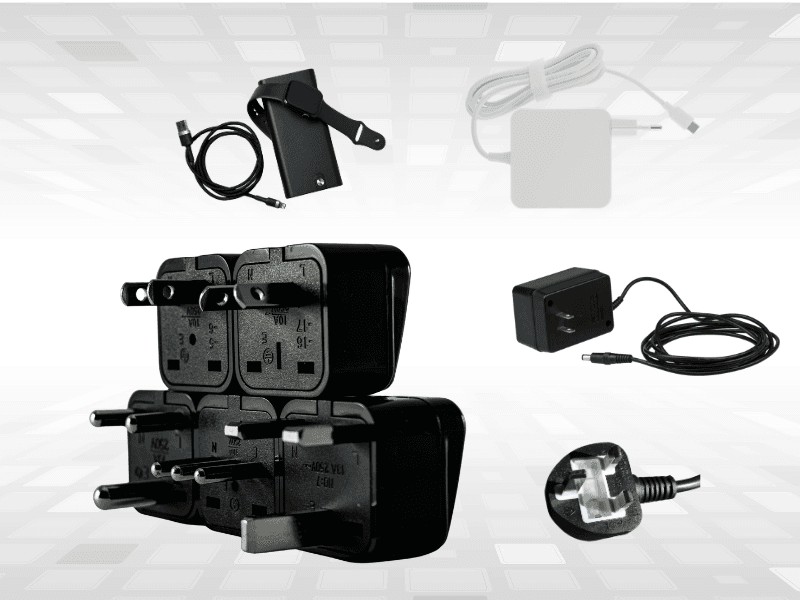
An external power supply (EPS) is the adapter that sits between your wall outlet and your device. You know it as your phone charger, the brick on a laptop cord, or the small unit powering your router. If it plugs into the wall and feeds low-voltage DC to electronics, it’s an EPS.
Common examples of EPS devices
External power supplies show up almost everywhere you have electronics:
- Laptop and notebook chargers
- Phone and tablet adapters
- Router and modem power supplies
- Game console power bricks
- Cordless phone bases and small appliance adapters
How an EPS converts AC to DC power
The job sounds simple, but is tricky to do well. Your wall delivers high-voltage AC, around 120 volts in the US. Most electronics need low-voltage DC, often 5, 12, or 19 volts. The EPS steps the voltage down and converts alternating current into the steady direct current your device can use. Every step in that conversion loses a little energy, and that loss is where efficiency comes in.
What Does External Power Supply Efficiency Mean?
Two numbers define how good an adapter really is. Understanding both helps you compare products on more than just price.
Active mode efficiency
Active mode efficiency measures how much input power actually reaches your device while it’s working. If an adapter pulls 100 watts from the wall and delivers 90 watts to your laptop, it’s 90% efficient. The missing 10 watts turn into heat. Higher active efficiency means more of your electricity does useful work.
No-load power consumption
No-load power consumption is the power an adapter draws when it’s plugged in but not charging anything. People call this “vampire power” because it drains current around the clock. Leave a charger in the wall with no phone attached, and an older unit still sips electricity for no benefit. Good modern supplies draw only a tiny fraction of a watt at no load.
Why does wasted energy become heat
No conversion is perfect. Transistors lose energy as they switch and as current flows through them, and transformers lose a bit in their windings and magnetic core. All of that loss shows up as heat. Less efficient adapters run warmer, and heat is the enemy of capacitors and other components. An efficient charger is, in a real sense, a longer-lived charger.
Why External Power Supply Efficiency Matters
It’s easy to shrug off a few watts. One charger sitting idle costs you almost nothing. But the math changes fast at scale, and the benefits go beyond your power bill.
- Lower electricity waste: Small per-adapter savings add up across a dozen devices in one home, then across millions of homes.
- Reduced standby losses: Cutting no-load draw nationwide saves a striking amount of energy and money over time.
- Less heat, longer life: Cooler-running components last longer, both in the adapter and the device it feeds.
- Lower emissions: Less wasted electricity means less generation, which trims carbon output across the market over the years.
- Simpler global compliance: Designing to meet major regional efficiency rules can reduce the need for multiple adapter variants and lower costs.
Here’s the key insight: no single adapter moves the needle, but better hardware design across billions of devices delivers a massive reduction in energy use. This is one of those rare cases where a minor design improvement pays off enormously at scale.
DOE Level VI vs Level V vs Energy Star
Flip over almost any adapter, and you’ll find a Roman numeral on the label, usually in a circle or next to the electrical ratings. That mark tells you which efficiency standard the supply meets. Higher numerals mean tougher requirements for both active efficiency and no-load draw.
What is DOE Level VI?
DOE Level VI is the current mandatory efficiency standard for external power supplies in the United States, set by the Department of Energy. It demands higher active efficiency and lower standby waste across a wide range of products. A new adapter sold in the US should carry the Level VI mark.
Level V vs Level VI
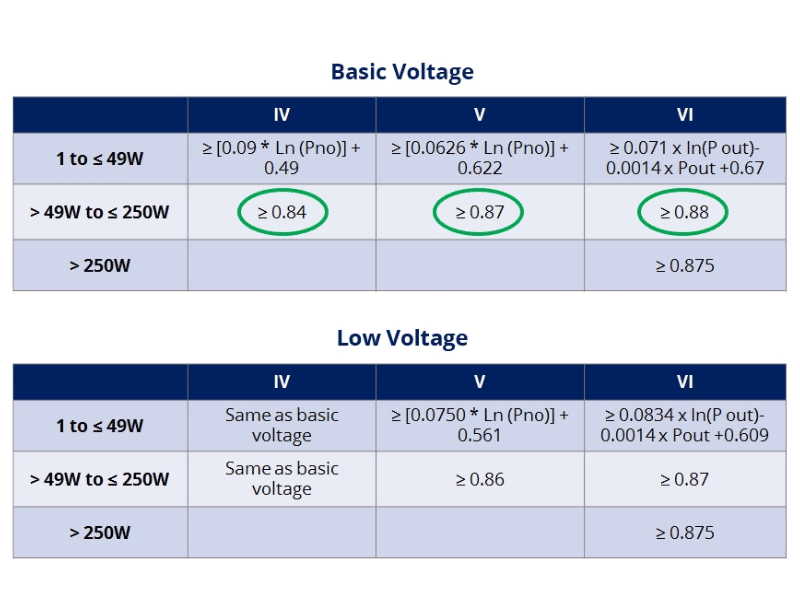
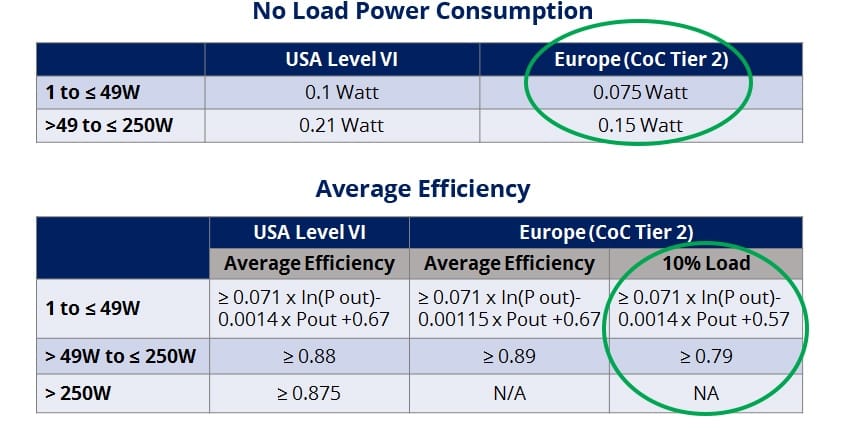
Level VI is the newer, stricter generation. Compared with Level V, it requires higher active-mode efficiency, lower no-load power consumption, and a broader range of products. In practice, a Level VI adapter wastes less energy both while working and while sitting idle. Spotting a “V” instead of “VI” usually means you’re holding older hardware.
Energy Star vs mandatory regulations
It helps to separate two kinds of programs:
- Energy Star is voluntary. Manufacturers earn the label by beating efficiency targets and use it as a selling point.
- DOE Level VI is mandatory. A product can’t legally be sold in the US without meeting it.
Think of Energy Star as a gold star for going above and beyond, while Level VI is the floor everyone must clear. The EU enforces its own minimum efficiency requirements through separate energy rules, which is why you often see similar efficiency marks on adapters worldwide.
How Modern Efficient Adapters Reduce Energy Waste
Today’s chargers are smaller, cooler, and far more efficient than the clunky bricks of twenty years ago. Two technology shifts explain why.
Switching vs. linear power supplies
Old-style linear supplies used a big, heavy transformer running at the wall’s line frequency. They were simple and reliable but bulky and wasteful, bleeding energy as heat even at light loads.
Switching power supplies changed the game. They switch power on and off at very high frequencies, thousands or millions of times per second, which lets them use a much smaller transformer and waste far less energy. Almost every modern adapter is a switching supply.
Why GaN chargers are more efficient
For decades, the transistors inside these supplies were made of silicon. Gallium Nitride (GaN) is a newer material that switches faster and loses less energy in the process. Faster switching lets designers use smaller components, and lower losses mean higher efficiency and less heat.
That’s why a GaN laptop charger can be half the size of an old silicon brick, deliver more power, and still run cooler. Do this, not that: when buying a new high-power charger, choose GaN over an older silicon design for a more efficient unit in a more compact package. Read More: GaN Power Supply: A Game-Changer for Home Healthcare Power Supplies
How to Identify an Efficient External Power Supply
You don’t need an engineering degree to verify your hardware. A few quick checks tell you most of what you need.
- Look for the Level VI marking. A current US adapter should show a Roman numeral “VI” near the printed ratings.
- Buy from reputable brands and trusted retailers. Legitimate brands pay for the efficiency and safety testing that no-name units often skip.
- Check for safety certifications alongside the efficiency mark.
- Prefer modern switching, or GaN designs over bulky older bricks.
- Match voltage and current to your device’s requirements before anything else.
Common misconception: people assume EPS Level VI and 80 Plus mean the same thing. They don’t. EPS Level VI rates the external brick, while 80 Plus rates the internal power supply inside a desktop PC. Match the right label to the right hardware.
Signs Your Old Power Adapter Is Inefficient
Some adapters quietly waste energy long after better designs arrived. Watch for these warning signs:
- Warm to the touch at no load. If the brick feels warm with nothing plugged in, it’s burning energy for no reason.
- A Level V mark or no efficiency mark at all. Both point to an older generation.
- Bulky, heavy design. Older, larger adapters tend to be the worst offenders.
- Runs very hot under light load. Excess heat signals wasted energy and a shortened lifespan.
- No reputable brand or safety markings. Cheap, counterfeit units often skip testing entirely and can pose fire or shock risks.
Older Adapters vs. Modern Efficient Adapters
Feature | Older Adapter | Modern Efficient Adapter |
|---|---|---|
No-load power use | Higher (notable vampire draw) | Much lower (fraction of a watt) |
Heat generation | Higher | Lower |
Size and weight | Bulkier, heavier | Smaller, lighter |
Efficiency mark | Level V or none | Level VI |
Core technology | Linear or older silicon | Switching / GaN |
Typical lifespan | Shorter (runs hotter) | Longer (runs cooler) |
If cost and power density matter most and you’re choosing a replacement, a modern Level VI or GaN adapter is almost always the smarter buy.
How to Choose and Maintain Efficient Adapters
A few habits can keep your energy waste low with little effort.
When you buy a replacement or aftermarket charger, take ten seconds to read the label and confirm the Level VI mark. If you can’t find any efficiency marking, treat that as a red flag.
For older adapters you can’t easily replace, a smart power strip is your friend. These strips cut power completely to idle devices, killing the vampire draw from inefficient supplies. Set one up for your entertainment center or desk, and you stop wasting power on everything sitting idle overnight.
Finally, be careful with cheap, no-name chargers. The few dollars you save up front aren’t worth the risk to your device or your home.
External Power Supply Efficiency FAQ
Do chargers use electricity when left plugged in?
Yes, though far less than they used to. Even with nothing charging, an adapter draws a small amount of power to keep its circuitry ready. This is no-load consumption. Modern Level VI supplies keep that draw very low, but it isn’t zero. The only way to reach true zero is to unplug it or cut power with a switch or smart strip.
What is DOE Level VI?
DOE Level VI is the current mandatory efficiency standard for external power supplies in the US. It requires higher active mode efficiency and lower no-load power consumption than the older Level V standard, and it applies to a broad range of products. New adapters sold in the US should carry the Level VI mark.
What is the difference between Level V and Level VI?
Level VI is the newer, stricter standard. It demands higher active efficiency, lower standby draw, and covers more product types than Level V. In practical terms, a Level VI adapter wastes less energy both while working and while idle.
Are GaN chargers more efficient than silicon chargers?
Generally, yes. Gallium Nitride switches faster and loses less energy than traditional silicon, which means less waste heat and higher efficiency. GaN also lets manufacturers build smaller, lighter chargers that deliver more power, so you get a more efficient unit in a more compact package.
How can I tell if my old laptop charger is wasting energy?
Check the label first. A Level V mark or no efficiency mark suggests an older, less efficient generation. A simple physical clue is heat: if the brick feels warm even when nothing is plugged into your laptop, it’s burning energy doing nothing. Bulky, older adapters tend to be the worst offenders.
Why does my charger get hot when charging?
Heat is wasted energy. Some power is always lost as the adapter steps the voltage down and converts AC to DC, and the transistors and transformer generate that heat. A little warmth under load is normal. But an adapter that runs very hot, especially at low or no load, is inefficient, and that heat shortens its life.
Is it worth replacing an old power adapter just to save energy?
For a single, rarely used adapter, the energy savings alone may not justify the cost. But the picture changes if the old supply runs hot, draws heavy standby power, or shows signs of age. In those cases, a modern Level VI or GaN replacement saves energy, runs cooler, and is safer. If you’re already buying a new charger, always pick the efficient one.
Final Checklist Before You Buy a Replacement Adapter
Run through these before you click “buy”:
- Output voltage matches your device’s requirement
- Output current (and wattage) meets or exceeds your device’s needsTheThe
- Level VI efficiency mark is printed on the label
- Recognized safety certifications are present
- Purchased from a reputable brand or trusted retailer
- GaN considered for compact, high-power charging
- Old, unmarked, or Level V bricks flagged for replacement or a smart strip
Key Takeaways
External power supply efficiency may seem like a small thing, but it adds up quickly across billions of devices. Here’s what to remember:
- Efficiency comes down to two numbers: active mode efficiency and no-load power consumption.
- DOE Level VI is the current mandatory US standard; Energy Star is a voluntary bonus.
- Switching and GaN designs waste less energy, run cooler, and last longer than older bricks.
- A quick label check for the Level VI mark tells you most of what you need.
Start today with something simple. Walk around your home, flip over a few power bricks, and check for that Level VI mark. The ones missing it are your easiest targets for a replacement or a smart power strip—a five-minute habit that trims your energy waste for years.