If you’ve ever wondered why some power supplies come with a chunky three-prong plug while others get by with two flat blades, the answer comes down to how they protect you from electric shock. That difference isn’t random. It follows a system of safety classes defined by the International Electrotechnical Commission (IEC).
The IEC sets global standards that help prevent electrical products from harming people. One of its core ideas is the protection class. A protection class describes the specific method a power supply uses to keep dangerous voltage away from your hands. Get the class right, and you build a product that’s safe, compliant, and easy to install. Get it wrong, and you’ve either over-engineered the cost or created a hazard.
One quick note before we go further, because it trips people up constantly: IEC Class II is not the same as NEC Class 2. One describes an insulation method. The other describes a power limit. We’ll untangle that later in this guide.
This article is for engineers spec’ing a design, product developers choosing a supplier, and buyers trying to read a datasheet without a translator. Let’s walk through what each class actually does.
What Are IEC Protection Classes?
The IEC exists to set common safety rules so that a power supply built in one country behaves predictably in another. Protection classes are part of that framework. They sort power supplies by how each one defends against electric shock.
Here’s the key part. A good design doesn’t just protect you when everything works. It protects you when something breaks. Protection classes account for both normal use and single-fault conditions, meaning one thing has failed, but the device still shouldn’t shock you.
The whole point is simple: a hardware failure should never turn the outer casing into a live conductor. If a wire comes loose inside, you shouldn’t feel it through the metal housing.
And just to repeat the warning from the intro, these protection classes have nothing to do with “Class 2” power ratings. Protection classes concern insulation and grounding strategies. Power ratings indicate how much energy the supply can deliver. Two different worlds, similar names.
How IEC Protection Classes Prevent Electric Shock
Every protection class leans on a small set of tools. Understanding the tools makes the classes click into place.
- Basic insulation is the first barrier. It’s the standard layer between live parts and everything else. On its own, though, basic insulation isn’t enough, because a single failure could expose you.
- Protective earth, or grounding, acts as a backup. If the insulation fails and a live wire touches the metal housing, the fault current rushes down the ground wire rather than through you. That surge trips a fuse or circuit breaker and cuts the power.
- Double or reinforced insulation takes a different path. Instead of relying on a ground connection, it stacks two independent layers of protection (or one layer engineered to do the same job). If one layer fails, the second still keeps you safe.
- Safety Extra Low Voltage (SELV) sidesteps the problem entirely. Run the voltage low enough, and even direct contact won’t deliver a dangerous shock.
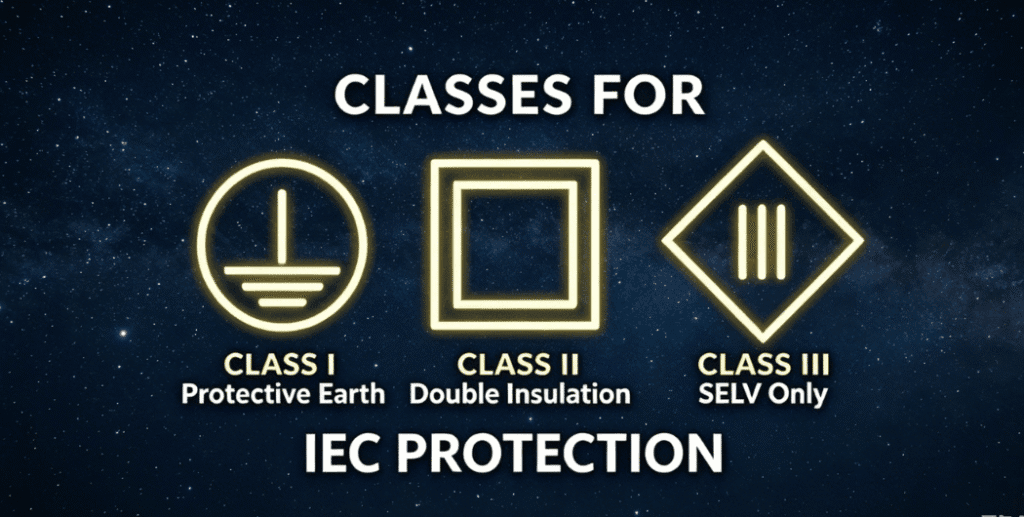
- Each class combines these tools differently. Class I uses basic insulation plus earth. Class II uses double or reinforced insulation. Class III relies on low voltage. That’s the heart of the whole system.
Class I Power Supplies: Basic Insulation and Protective Earth
A Class I power supply uses basic insulation as its first defense and a physical earth connection as its safety net.
You’ll spot these by the three-wire power cord. That third wire is the protective earth, and it bonds to the chassis or metal casing. Inside the unit, every exposed metal part that someone could touch connects back to that ground pin.
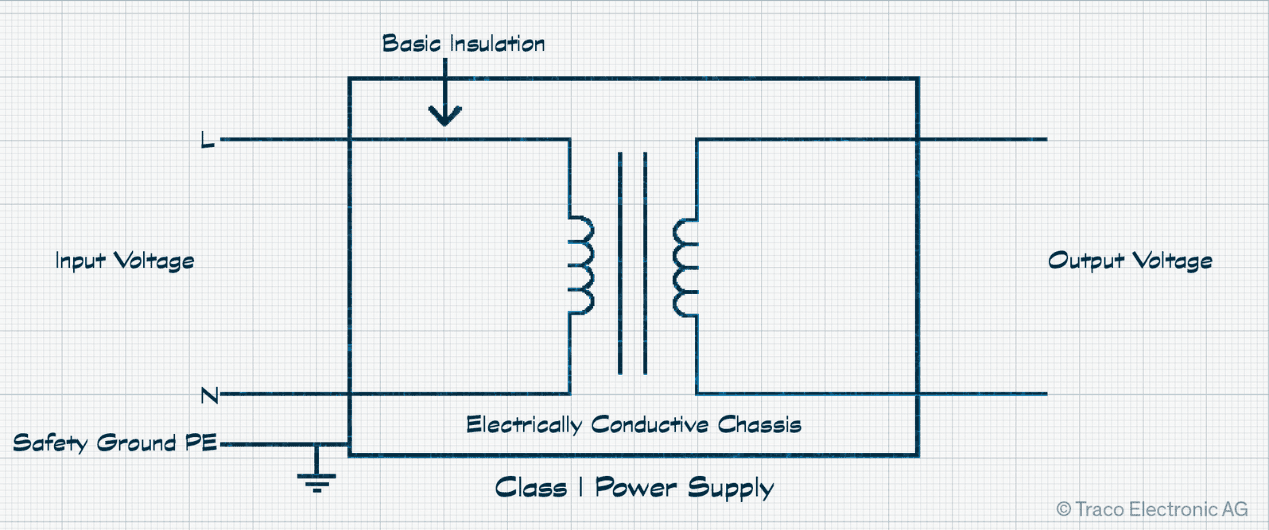
Here’s what happens during a fault. Say the insulation breaks down and a live conductor touches the housing. Without grounding, that housing would become live and dangerous. With Class I grounding, the fault current flows straight to earth. The sudden surge trips the fuse or circuit breaker, and the device goes dead before anyone gets hurt.
Because that ground connection matters so much, testing matters too. During production, engineers verify electrical continuity between the ground pin and every exposed metal surface. A broken ground bond defeats the entire safety strategy.
You’ll find Class I supplies in heavy machinery, large appliances, desktop computers, and bigger AC-DC supplies where a solid earth reference is already available.
The trade-offs: Class I designs are often cheaper to build because they don’t need elaborate internal insulation. The catch is that they depend on a properly grounded outlet. No good ground, no protection. They can also create ground loops, which add unwanted noise to audio gear and sensitive measurement equipment.
Class II Power Supplies: Double or Reinforced Insulation
A Class II power supply protects you without ever touching earth. It builds in two layers of protection instead.
There are two ways to do this. Double insulation uses two separate insulating layers, so if one fails, the other holds. Reinforced insulation uses a single, beefed-up layer engineered to provide the same protection as two. Either way, you get a second line of defense that doesn’t depend on a ground wire.
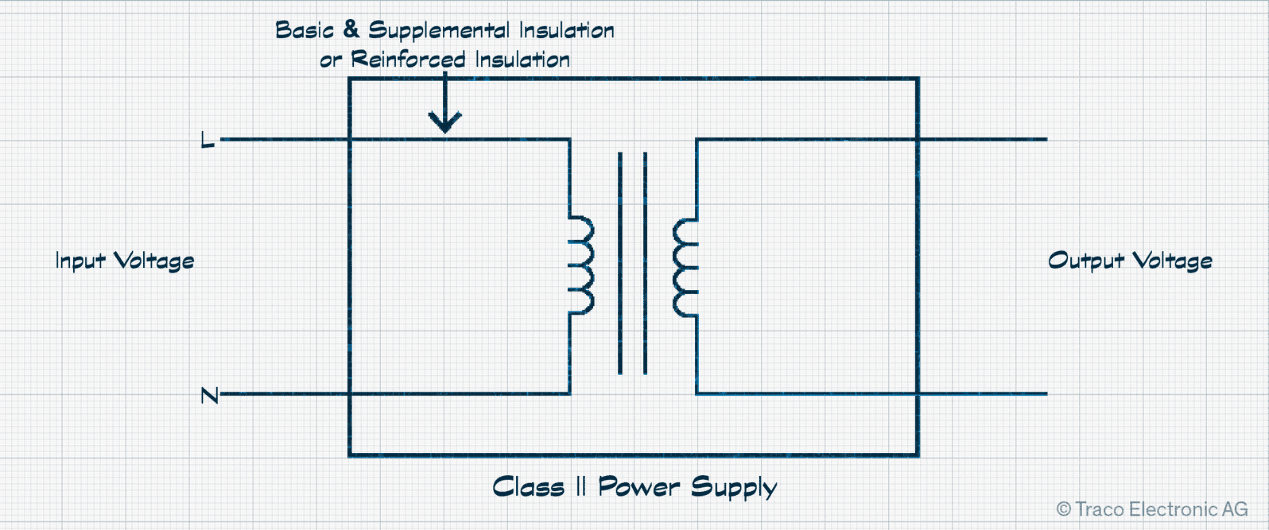
Since there’s no need for protective earth, Class II supplies typically use a two-wire, two-prong power cord. That’s a dead giveaway in the field.
The official mark is the “square within a square” symbol (a small square nested inside a larger one). When you see that symbol on a label, you’re looking at Class II construction.
This approach shines in portable and space-constrained designs. No ground requirement means more freedom in how you build and where you plug in. You’ll see Class II in household electronics, many medical devices, power tools used in older, ungrounded buildings, and many desktop power supplies.
The trade-offs: Class II offers great flexibility. It works in any standard outlet, grounded or not, and generally operates at a lower leakage current, which is a real benefit in medical settings where patient safety is critical. The downside is cost and size. Building reliable double or reinforced insulation can require extra material and space, so these units sometimes run a bit larger or pricier than comparable Class I designs.
Class III Power Supplies: Safety Extra Low Voltage (SELV)
A Class III power supply takes the simplest safety principle of all: keep the voltage low enough to avoid injury.
These units operate within SELV limits, typically below 60V DC or 42.4V AC peak. At those levels, the voltage itself isn’t high enough to drive a dangerous current through the human body, even on direct contact.
To make that work, a Class III system relies on a safety isolating transformer that fully separates the input side from the low-voltage output. That isolation guarantees the high voltage on the input can’t sneak through to the user-facing side.
The protection here doesn’t come from insulation layers or grounding. It comes from the low voltage being inherently safe.
One critical point that people forget: the source feeding a Class III unit must still meet Class I or Class II requirements. The low-voltage output is safe, but whatever steps the wall voltage down to SELV still handles dangerous voltages internally and needs its own protection.
Typical uses include medical equipment, laboratory tools, and various low-voltage electronics.
Class I vs Class II vs Class III: Key Differences
Here’s how the three classes stack up side by side.
| Feature | Class I | Class II | Class III |
|---|---|---|---|
| Method of protection | Basic insulation + protective earth | Double or reinforced insulation | Safety Extra Low Voltage (SELV) |
| Grounding requirement | Requires protective earth | No earth needed | No earth needed |
| Insulation approach | Single basic layer, backed by ground | Two layers (or one reinforced) | Low voltage, no shock-rated insulation needed |
| Input cord type | Three-wire (three-prong) | Two-wire (two-prong) | Low-voltage input from an isolating source |
| Common applications | Heavy machinery, large appliances, and desktop PCs | Household electronics, power tools, medical devices | Medical gear, lab tools, low-voltage electronics |
| Advantages | Often cheaper to build | Flexible, works in any outlet, lower leakage | Inherently safe voltage levels |
| Limitations | Depends on a good ground; possible ground loops | Can be larger or costlier | Needs an isolating transformer; source still needs protection |
A few points worth calling out around that table.
Class I is usually the budget-friendly choice, but it requires a three-wire electrical system to function. Class II buys you flexibility, since it runs safely in any standard outlet. If you work with audio or precision measurement gear, watch out: Class I can introduce ground loops that add noise, while Class II avoids that issue. And in medical environments, Class II’s lower leakage current is often the deciding factor. Just remember that the extra insulation in Class II can make a unit heavier or larger.
IEC Class II vs NEC Class 2: What’s the Difference?
This is the confusion I promised to clear up, and it’s a big one. The names look nearly identical, but they describe completely different things.
- IEC Class II is a method of protection against electric shock. It’s about insulation: double or reinforced layers that protect the user without grounding.
- NEC Class 2 is a power-limited circuit classification from the U.S. National Electrical Code. It has nothing to do with insulation strategy. Instead, it caps the output power of a circuit so that the energy delivered is too low to cause a fire or a serious shock.
So one is an insulation approach. The other is a power limit. A single power supply might be IEC Class II, NEC Class 2, both, or neither, depending on how it’s designed and certified.
NEC Class 2 applies to low-voltage electronics and control circuits, where limiting the available power simplifies the rest of your safety design. If your project involves control wiring, signaling, or low-power distributed devices, NEC Class 2 might be very important.
The practical takeaway: when you read a data sheet, check which “class” the manufacturer means. Don’t assume. Confirm whether you’re looking at a shock-protection class or a power rating before you specify the part.
How to Choose the Right Protection Class for Your Application
There’s no single “best” class. The right choice depends on where and how the product gets used. Run through this checklist.
- Check local electrical codes for the region where the product will ship and operate. Codes vary, and they often decide the question for you.
- Consider the environment. Damp, wet, or conductive areas raise the stakes and may push you toward a higher safety rating.
- Look at the enclosure material. Plastic cases pair naturally with Class II designs, since there’s no exposed metal to worry about grounding.
- Confirm the availability of grounding at the installation site. If you can’t count on a reliable ground, Class I loses its main advantage.
- Weigh leakage current for sensitive or medical applications. Lower is better, and Class II tends to win here.
- Factor in cable and connector costs. Three-wire systems for Class I add to the bill of materials.
- Plan for maintenance. Class I grounding systems need to remain intact throughout the product’s life, which requires inspection and maintenance.
- Match the method to the job. Align the protection class with your application, power delivery needs, and compliance targets.
When you weigh these together, the right class usually becomes obvious.
Common FAQs About IEC Protection Classes
Can a Class II power supply have a metal case?
Yes. The class is defined by the insulation method, not the housing material. A Class II unit can use a metal case as long as its double or reinforced insulation keeps that metal safely isolated from live parts without relying on a ground connection.
Why do some Class II power supplies still have a ground pin on the plug?
Sometimes the ground pin is there for functional reasons, like reducing electrical noise or providing a reference for sensitive electronics, rather than for shock protection. The safety still comes from the double or reinforced insulation. That functional ground is a bonus, not the primary defense.
Is IEC Class II the same as NEC Class 2?
No. IEC Class II describes an insulation-based shock-protection method. NEC Class 2 describes a power-limited circuit. They share a name but solve different problems. Always check what a data sheet means.
What happens to a Class I device if the building ground is faulty?
This is the weak spot of Class I. If the ground connection is broken or the outlet isn’t properly grounded, the safety net disappears. A fault that should trip a breaker could instead leave the housing live. That’s why proper grounding and periodic testing matter so much.
Does a Class III device need any insulation at all?
It still needs basic insulation for normal function and reliability, but it doesn’t depend on insulation for shock protection. The low SELV voltage is what keeps users safe. The protection comes from the voltage level itself.
Which protection class is best for outdoor LED lighting?
It depends on the fixture and local code, but outdoor LED lighting often favors Class II for its flexibility and freedom from grounding, or low-voltage SELV approaches for the lamp side. Wet and exposed conditions make insulation and isolation especially important, so check the environmental ratings alongside the protection class.
How do labeling and cabling differ between Class I and Class II supplies?
Class I uses a three-wire cord with a ground pin and is marked to show its earth requirement. Class II uses a two-wire cord and carries the “square within a square” symbol. The plug and the label tell you the class at a glance.
Conclusion
The three IEC protection classes each take a different route to the same destination.
Class I combines basic insulation with a protective earth connection. Class II relies on double or reinforced insulation and skips grounding entirely. Class III keeps the voltage low enough that it can’t cause a dangerous shock in the first place.
Different methods, one shared goal: protecting the person using the device. Every class exists to make sure a failure inside the box never becomes a danger outside it.
When you choose a class, match the insulation strategy to your environment, your device, and the compliance rules you have to meet. A grounded industrial machine and a portable plastic-cased gadget call for very different answers.
And one last reminder: don’t guess. Check the labels and data sheets for the official IEC symbols, and confirm the protection level before you commit. A few seconds of verification can save you from a costly redesign or a serious safety gap.