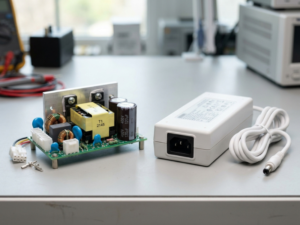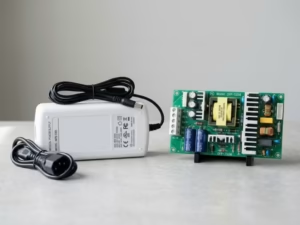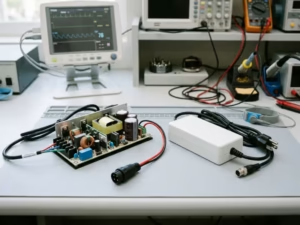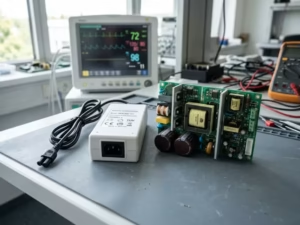
AC DC power adapter is an external power supply that converts alternating current (AC) from a wall outlet into direct current (DC) required by electronic devices.
Most modern electronics—including routers, medical devices, security systems, communication equipment, and industrial controllers—rely on AC DC adapters to deliver stable and safe DC power.
These adapters play a critical role in power conversion, electrical isolation, and device protection, ensuring sensitive electronics operate reliably.
In this guide, you will learn:
- How AC DC power adapters work
- Their internal components and design
- Key safety standards and certifications
- Differences between AC DC adapters and power supplies
- How engineers select the correct adapter
- Typical applications in industrial and medical equipment
By the end of this article, you will understand how to choose the right AC DC adapter for your device or project.
AC vs DC Power — Why Power Adapters Are Necessary
Alternating Current (AC)
Electricity supplied through wall outlets is alternating current (AC). The current continuously changes direction, making it ideal for long-distance power transmission.
Typical AC standards worldwide include:
| Region | Voltage | Frequency |
| North America | 100–120V | 60 Hz |
| Europe | 220–240V | 50 Hz |
| Asia | 220–240V | 50/60 Hz |
AC power is efficient for transmission but not suitable for most electronic circuits.
Direct Current (DC)
Electronic devices such as microprocessors, sensors, and communication modules operate on direct current (DC).
DC power provides:
- Stable voltage levels
- Reliable circuit operation
- Protection for sensitive electronic components
Because power grids supply AC but electronics require DC, AC DC power adapters are required to convert and regulate electricity.
Without proper power conversion, devices may experience:
- Voltage spikes
- Circuit damage
- Device malfunction
How AC DC Power Adapters Work
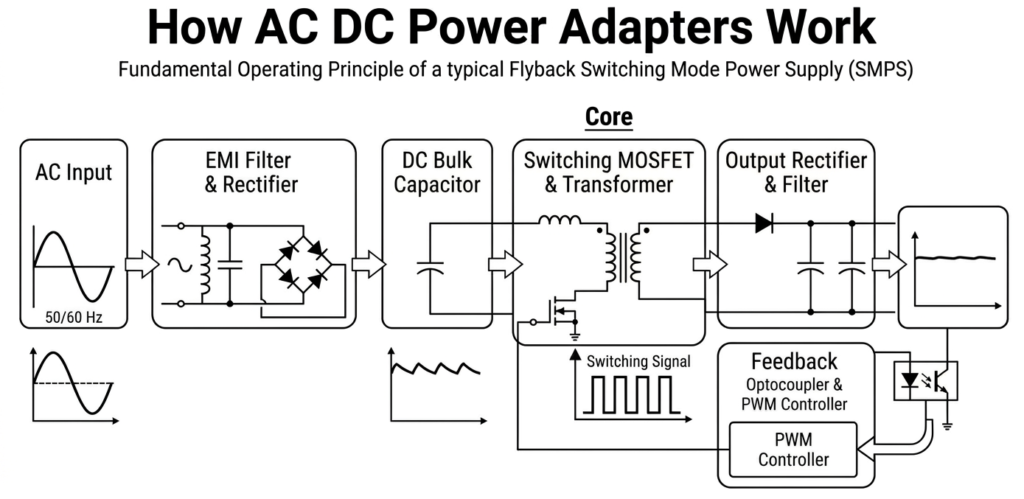
AC DC power adapters convert electrical energy through several stages to deliver stable DC output.
AC Input and EMI Filtering
The adapter receives high-voltage AC from the wall outlet.
An EMI (Electromagnetic Interference) filter removes electrical noise and prevents interference with nearby electronic equipment.
Rectification — Converting AC to DC
A rectifier circuit, typically using diodes arranged in a bridge configuration, converts AC into pulsating DC.
This is the first stage of converting AC power into usable DC electricity.
Filtering — Smoothing the Voltage
Capacitors and inductors smooth the pulsating DC signal.
This filtering stage reduces voltage ripple, ensuring the output power becomes more stable.
Voltage Regulation
Voltage regulation circuits maintain a constant output voltage, even if:
- Input voltage fluctuates
- Device load changes
Most modern adapters use switching regulators to achieve high efficiency and stable output.
Protection Circuits
High-quality AC DC adapters include multiple safety protections:
- Overvoltage protection
- Overcurrent protection
- Short circuit protection
- Thermal shutdown protection
These features prevent damage to both the adapter and the powered device.
Main Components of an AC DC Power Adapter
| Component | Function | Notes |
| Transformer | Voltage adjustment and isolation | Provides electrical separation |
| Rectifier | Converts AC to DC | Bridge diode configuration |
| Filter Capacitors | Smooth ripple voltage | Electrolytic or ceramic |
| Switching Controller | Voltage regulation | Maintains stable output |
| Protection Circuit | Safety functions | Prevents electrical damage |
Types of AC DC Power Adapters
Linear Power Adapters
Linear adapters use traditional transformers and linear regulators.
Advantages
- Simple design
- Low electrical noise
Disadvantages
- Large and heavy
- Low efficiency
- Higher heat generation
Because of these limitations, linear adapters are less common in modern electronics.
Switching Power Adapters (SMPS)
Most modern devices use switching power supply technology.
Advantages include:
- High efficiency
- Compact size
- Wide input voltage range
- Lightweight design
Switching adapters are widely used in:
- Routers
- Laptops
- IoT devices
- communication equipment
Wall Plug and Desktop Adapters
Two common adapter form factors exist.
Wall Plug Adapters
- Plug directly into wall outlets
- Compact design
- Common in consumer electronics
Desktop Adapters
- Separate adapter brick
- Higher power capability
- Often used in industrial equipment
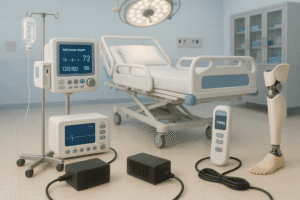
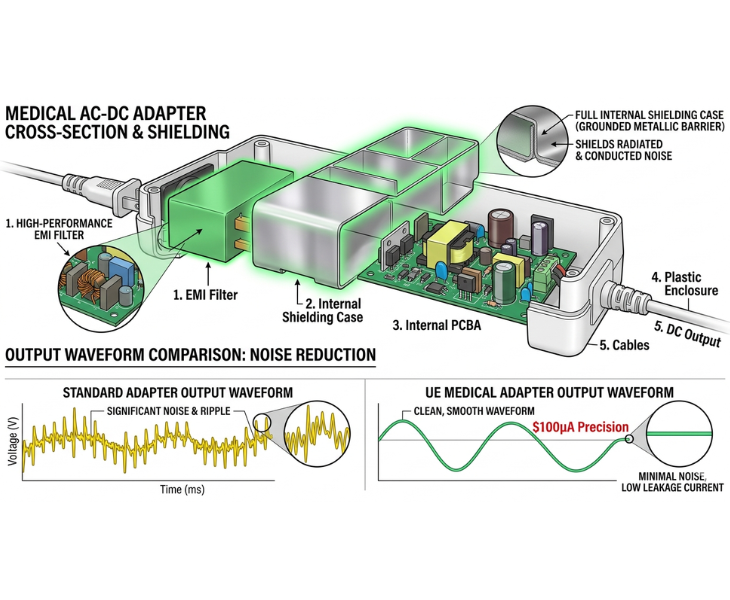
Medical-Grade AC DC Adapters
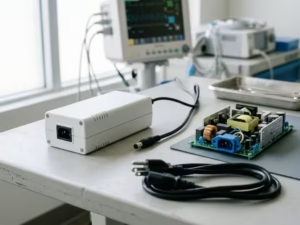
Medical power adapters are designed for medical electrical equipment.
Key characteristics include:
- IEC 60601-1 certification
- Ultra-low leakage current
- Reinforced insulation
- 2×MOPP patient protection
Typical applications:
- Patient monitors
- Ventilators
- Infusion pumps
ITE Power supply Adapters
ITE (Information Technology Equipment) adapters are used in IT and communication devices.
These adapters comply with:
IEC 62368-1 safety standards
Common applications include:
- Routers
- POS systems
- network switches
- displays
For a detailed guide on selecting adapters for medical projects, see our [Complete Selection Guide]
AC DC Adapter vs Power Supply
| Feature | AC DC Adapter | Power Supply |
| Location | External | Internal or external |
| Integration | Plug-and-play | Device integrated |
| Application | Consumer & commercial electronics | Industrial or high-power systems |
| Cooling | Passive | May require fan |
| Size | Compact | Larger in many cases |
Adapters are typically external power solutions, while power supplies may be integrated directly into equipment.
Safety Standards and Certifications
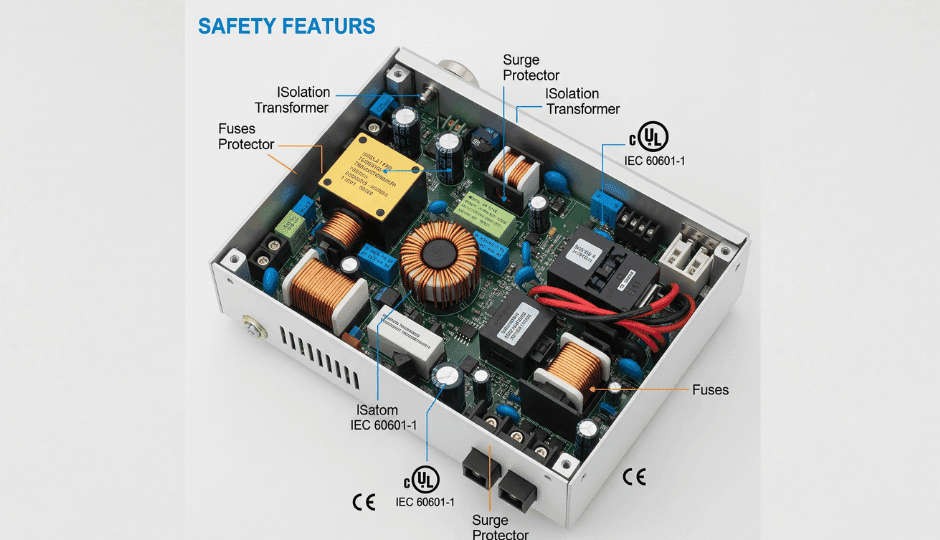
Safety certification ensures power adapters comply with international electrical safety regulations.
IEC 62368-1
Applies to:
- IT equipment
- audio/video devices
- communication electronics
IEC 60601-1
Applies to medical electrical equipment.
Key requirements include:
- Reinforced insulation
- Ultra-low leakage current
- Patient protection (2×MOPP)
UL Certification
Required for electrical safety in North America.
CE Marking
Mandatory for products sold in the European market.
AC DC Adapter Applications
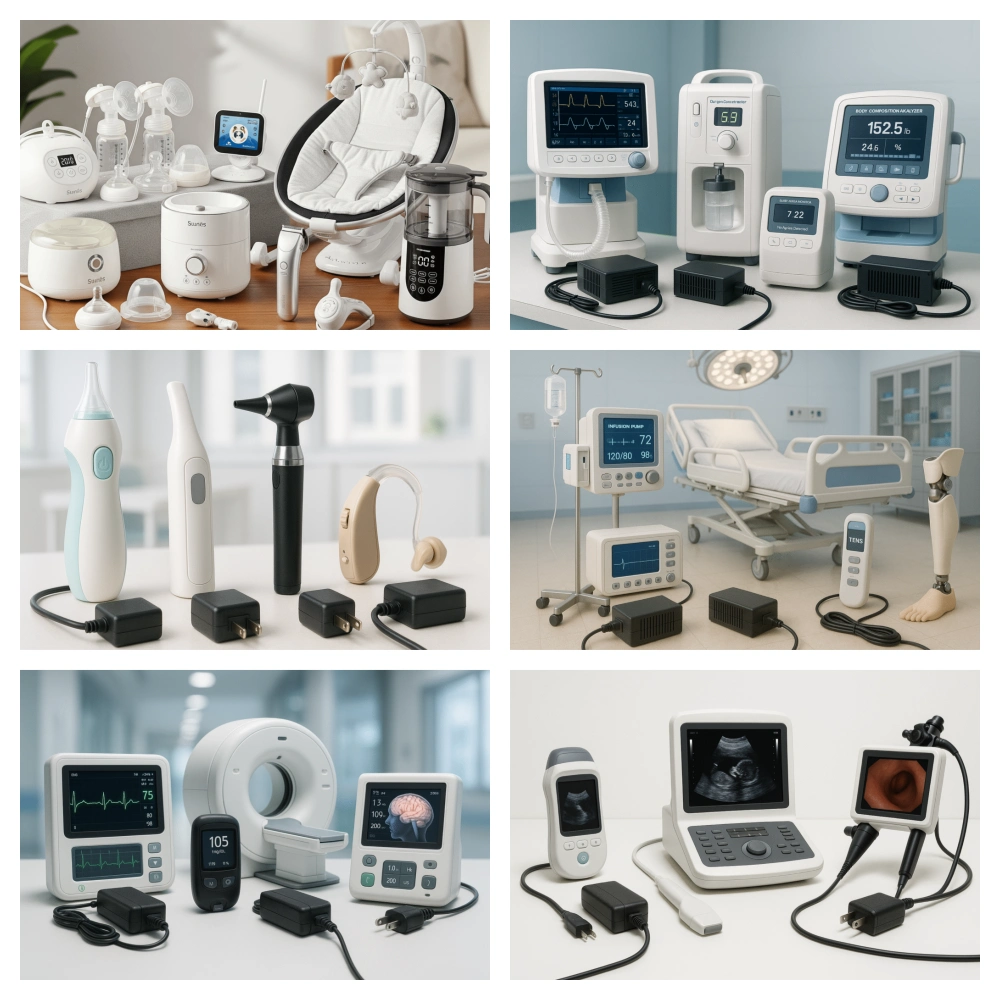
AC DC power adapters are widely used across many industries.
| Device | Typical Voltage | Adapter Type | Certification |
| Router | 12V | Switching adapter | IEC 62368 |
| Laptop | 19V | Switching adapter | IEC 62368 |
| Security camera | 12V | Wall adapter | IEC 62368 |
| Patient monitor | 24V | Medical adapter | IEC 60601 |
| Infusion pump | 12V | Medical adapter | IEC 60601 |
AC DC Adapter Selection Guide for Engineers
Choosing the correct AC DC adapter is essential for ensuring device reliability and certification compliance.
Engineers typically evaluate several key parameters.
| Parameter | Why It Matters | Recommendation |
| Output voltage | Must match device requirement | Exact voltage match |
| Output current | Determines load capacity | Adapter ≥ device current |
| Power rating | Prevent overload | Add 20–30% margin |
| Safety certification | Required for market access | UL / CE / IEC |
| Isolation design | Protect sensitive circuits | Reinforced for medical |
Selecting the right adapter early in product design helps prevent certification delays and system failures.
Need Help Selecting the Right AC DC Power Supply Adapter?
If you are designing electronic equipment or developing a new device, selecting the correct power adapter is essential.
Our engineering team can help you:
✔ Select the correct voltage and power rating
✔ Ensure compliance with IEC 62368 or IEC 60601
✔ Customize adapters for your product
Contact our engineers for technical consultation
How to Choose a Reliable AC DC Power Supply Adapter Manufacturer
For OEM equipment manufacturers, selecting the right supplier is just as important as choosing the adapter itself.
| Evaluation Factor | Why It Matters |
| Safety certification | Required for global markets |
| Engineering support | Helps with product development |
| OEM customization | Supports unique device requirements |
| Quality control | Ensures long-term reliability |
| Production capacity | Supports mass manufacturing |
Working with an experienced manufacturer can significantly simplify product certification and device integration.
Looking for a Reliable AC DC Adapter Supplier?
Quankang provides certified AC DC power adapters for global OEM manufacturers.
Our solutions include:
- Medical-grade adapters (IEC 60601-1)
- ITE adapters (IEC 62368-1)
- Industrial power adapters
- Custom AC-DC power solutions
Request a quotation within 24 hours
Common Mistakes When Selecting Power Adapters
Many engineers encounter problems due to incorrect adapter selection.
Common issues include:
- Using incorrect voltage adapters
- Selecting insufficient current rating
- Ignoring safety certifications
- Overlooking ripple voltage
- Poor thermal ventilation
Avoiding these mistakes improves system stability and product reliability.
Emerging Trends in AC DC Power Adapters
The power adapter industry continues to evolve with new technologies.
Important trends include:
- GaN semiconductor technology
- Higher power density designs
- Intelligent power monitoring
- Compact high-efficiency adapters
- Energy-efficient eco-design standards
These innovations help manufacturers build smaller and more efficient electronic products.
FAQ — People Also Ask
What does AC DC adapter mean?
An AC DC adapter converts alternating current from wall outlets into regulated direct current used by electronic devices.
Can I use any AC DC adapter?
No. The adapter’s voltage, current rating, and connector polarity must match the device requirements.
Are AC DC adapters universal?
Many adapters support 100–240V input, but plug types and output specifications vary.
What is the difference between linear and switching adapters?
Switching adapters are smaller, more efficient, and more common in modern electronics.
Why is medical adapter certification important?
Medical adapters must meet IEC 60601-1 safety standards to ensure patient protection.
About Quankang
Quankang is a professional manufacturer specializing in AC DC power adapters and medical-grade power supplies.
Our solutions include:
- Medical power supplies
- ITE power supply adapters
- Industrial AC DC adapters
- Custom OEM / ODM power solutions
Our products are widely used in:
- Medical devices
- Industrial electronics
- communication equipment
- smart hardware systems