EMC testing is often treated as a final gate.
The product is working, the electrical performance has been checked, the enclosure is complete, and the next step is formal certification. That is a sensible point to carry out formal testing, but it is a late point to discover that the power supply, cable arrangement, or grounding scheme needs further work.
For medical power supplies, EMC is better treated as a development issue as well as a certification issue.
A power supply may have good EMC performance in its own test arrangement. Once it is installed in a medical device, however, it becomes part of a different system. The final equipment has its own enclosure, cables, interfaces, PCB layout, grounding, and operating modes. Any of these can affect the final result.
This is where EMC pre-compliance testing is useful. It gives the engineering team a chance to look at the system before the design is difficult to change.
Why the final device needs its own EMC evaluation
A power supply data sheet can tell you a great deal about the adapter. It cannot describe every product in which that adapter may be used.
The test cable may be shorter than the cable used in the finished device. A cable that is routed neatly on a test bench may be routed alongside other circuits in production equipment. The grounding arrangement may change once the power supply is mounted in a metal enclosure. An interface or communication module may introduce a new path for noise or disturbance.
These details do not always create a problem. They can, though, change the EMC behaviour of the equipment.
This is one reason why a compliant power supply should not be confused with a guaranteed compliant system. The power supply is an important part of the EMC design, but the final result belongs to the complete device.
For background on the requirements that apply to medical equipment, see UE’s medical EMC compliance guide. This page is concerned with what happens before the formal certification stage.
What EMC pre-compliance testing is intended to find
Pre-compliance testing is not a shortcut to certification. It is a practical way to find issues while there is still time to deal with them.
During emissions work, the question is usually where the noise is appearing and what may be contributing to it. A peak may be related to the switching power supply, but it may also be related to a cable, filter, grounding path, PCB layout, or another circuit in the equipment.
During immunity work, the question is how the product reacts when it is exposed to disturbance. Electrostatic discharge, surge events, RF interference, and changes on the AC line may all be relevant, depending on the product and its intended environment.
The result is more useful when it leads to a specific engineering question. If a product responds unexpectedly during an ESD test, for example, it is worth finding out whether the disturbance entered through the enclosure, an interface, a cable, or the grounding arrangement. Changing several things at once may produce a better result, but it does not always explain what solved the problem.
That is why pre-compliance work usually follows a simple pattern: test, investigate, make a change, and test again.
UE’s EMC test environment
UE has established EMC test capability with a standard 966 anechoic chamber and a 843 conducted-emissions laboratory.
The anechoic chamber is used for controlled EMC evaluation where radiated behaviour needs to be examined. The conducted-emissions laboratory is used to assess noise carried through the power lines. Together, they allow the team to look at different parts of the EMC picture without waiting until the final certification stage.
The laboratory uses imported Rohde & Schwarz (R&S) certification-grade equipment. UE has completed benchmarking work with Huawei, the Dongguan Quality Supervision Bureau, and the Shenzhen Institute of Metrology.

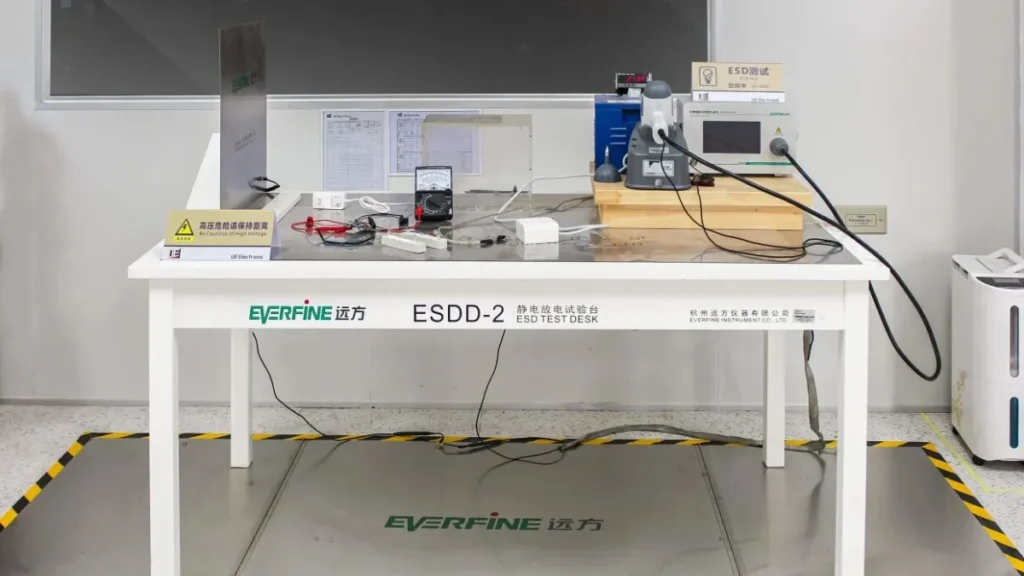
UE’s ESD test desk for evaluating the electrostatic discharge response of power supplies and electronic devices.
The equipment is used for two different stages of a product’s life.
During development, it supports EMC design validation, interference investigation, and verification after a design change. During production, it can be used for EMC quality sampling.
The second point is easy to overlook. A product that performed well during development should continue to perform consistently when it moves into volume production. EMC quality sampling gives manufacturers another way to check that the finished product has not changed in a way that affects its electromagnetic behaviour.
What to prepare before EMC pre-compliance testing
The test result is only as useful as the sample and setup being tested.
Where possible, bring the product in a configuration close to the one that will be used in the final equipment. This normally includes:
- The medical power supply and the device or representative system;
- The actual AC input and DC output cables;
- A typical load or the intended equipment load;
- The enclosure, if it is available;
- Relevant accessories, interfaces, and connected modules;
- The operating mode most likely to create the highest emissions or greatest sensitivity to disturbance;
- The intended market and the EMC requirements expected to apply.
There is no need to wait for a fully finished production unit before carrying out pre-compliance work. In fact, that can defeat the purpose. The more important point is to avoid testing an unrealistically simple setup that does not represent the product you intend to sell.
Design validation and production sampling are different jobs
At the design stage, EMC testing is mainly about learning.
The team may be comparing cable routes, checking the effect of a filter change, or investigating why a particular operating mode produces a different result. A design-stage test is there to support decisions.
At the production stage, the question is different. The design has already been agreed. The concern is whether the products leaving the factory continue to behave in the same way as the version that was validated.
This is where EMC quality sampling has a role. It provides a controlled check on selected production units and can help identify unexpected variation before it becomes a customer or certification issue.
The two activities use the same laboratory capability, but they answer different questions: one helps improve the design; the other helps maintain confidence in the design.
What pre-compliance testing cannot replace
EMC pre-compliance testing can reduce uncertainty, help locate likely sources of interference, and provide evidence that a design change has improved the result.
It does not replace the formal third-party certification process. Where formal testing is required, the finished product must still be evaluated through the appropriate process for its target market.
For a detailed explanation of IEC 60601-1-2 requirements and test levels, see UE’s IEC 60601-1-2 compliance guide.
The value of pre-compliance testing is that formal certification should not be the first time a product is exposed to a serious EMC evaluation.
Questions customers often ask
Does an EMC-compliant medical power supply guarantee that the finished device will pass EMC testing?
No. EMC data for a power supply applies to the configuration in which that power supply was evaluated. The final device may use different cables, grounding, enclosure materials, interfaces, load conditions, and internal layouts.
For example, an output cable that is short and well separated from other circuits during a component test may be longer or routed differently in the finished device. That can change the way noise is conducted or radiated. In the same way, a disturbance that does not affect the adapter on its own may enter the complete product through an interface, enclosure, or grounding path.
A suitable medical power supply reduces risk. It does not remove the need to assess the final system.
When should medical device teams start EMC pre-compliance testing?
The best time is usually when there is a representative prototype: late enough that the power supply, cables, normal load, and major system architecture are present, but early enough that the PCB, enclosure, cable arrangement, and filter design can still be changed without major disruption.
Testing a bare power supply is useful for component evaluation. Testing the power supply in a representative system is more useful for understanding the likely final EMC result.
A second pre-compliance check is often worthwhile after major changes to the enclosure, cable harness, grounding arrangement, power supply, or connected electronics.
What should be brought to an EMC pre-compliance session?
The most useful session starts with a setup that resembles the final product.
This normally means the medical power supply, the device or representative system, actual input and output cables, a typical load, relevant accessories, and the enclosure if it is available. If the product has several operating modes, it is also helpful to identify which mode is likely to represent the worst case.
Teams should also define the intended market and the EMC requirements they expect to meet. That helps ensure the test work is aimed at the right question from the beginning, rather than producing a result that is difficult to apply later.
How does production EMC quality sampling differ from design validation?
Design validation is used to understand and improve the product. It may involve changing a cable route, filter, grounding point, or layout, then checking whether the result has improved.
Production EMC quality sampling has a different purpose. The design should already be defined. The aim is to confirm that selected production units continue to behave consistently with the validated configuration.
This can be particularly useful after changes that may appear routine, such as a component substitution, revised cable assembly, material change, or manufacturing-process adjustment. The exact sampling plan should be agreed according to the product, production volume, and quality-control process.
Can UE’s EMC laboratory replace formal third-party certification?
No. UE’s EMC laboratory supports pre-compliance testing, interference investigation, design validation, and production EMC quality sampling. These activities can reduce uncertainty before formal testing and help verify the effect of design changes.
Formal certification remains a separate process and must follow the applicable requirements for the target market. The purpose of pre-compliance work is to make sure formal testing is not the first time the product is assessed in a representative EMC environment.