A practical buyer’s guide for device engineers, sourcing teams, and quality or regulatory teams who need to choose a medical power supply partner with confidence.
Choosing a medical power supply manufacturer looks like a routine sourcing task. It isn’t. The power supply sits between the wall outlet and the patient. If you pick the wrong supplier, you face safety risks, failed tests, delayed launches, and costly redesigns years down the road.
I often work with device teams who learn this the hard way. A low quote or a “medical grade” label tells you very little. What matters is whether the supplier can back up a specific model with real evidence. When you review medical power supplies, that evidence should include model-level safety and EMC documentation, not just broad product claims. It also matters whether the supplier will support you for the full life of your product.
This guide is for device engineers, sourcing and procurement teams, and quality and regulatory staff. I won’t walk through every standard. Instead, I’ll show you how to screen, compare, and confirm whether a manufacturer deserves a place in your design.
Judge every candidate on four dimensions: compliance, technical fit, manufacturing control, and lifecycle support. If you skip one, the gap usually shows up at the worst possible time.
Why You Can’t Leave the Power Supply for Later
Many teams treat the power supply as a late detail. They lock the core design first and plan to “drop in” a unit near the end. I understand the logic. In medical devices, though, this one part shapes your safety case, your test plan, and your launch date. Three risks explain why.
It Protects the Patient and Keeps the Device Running
The power supply forms the main barrier between mains voltage and the patient. If its isolation weakens or leakage current drifts too high, a patient or operator can receive a shock.
Smaller failures still cause real harm. A noisy output can disturb sensors, reset a monitor, or corrupt readings. Clinicians stop trusting a device that reboots at random, even when nobody gets hurt.
The Wrong Supplier Slows Every Milestone
A weak supplier rarely fails on day one. The trouble shows up during testing.
Your EMC lab finds emissions the datasheet never mentioned. Your test house asks for a CB report the supplier can’t produce. Each gap adds weeks of back-and-forth emails.
Then volume production arrives. You discover the factory can’t hold its lead time or keep quality steady across batches. Your ramp-up stalls while you chase answers.
Late Changes Cost More Than You Expect
Swapping a power supply after design freeze is rarely a simple part change. A new unit often brings a different footprint, thermal profile, and grounding scheme. That forces board or enclosure rework.
You also repeat safety and EMC testing at the system level. If you’ve already cleared the device, regulators may want an updated submission. I’ve watched teams lose six months or more on a change that a better early choice would have prevented.
A careful decision at the start costs far less than fixing it later.
Start With a First-Pass Screen: Compliance and Quality Basics You Must Verify
Before you compare efficiency curves or negotiate price, cut your list down. This first screen removes suppliers who look compliant on paper but can’t prove it for the model you plan to buy. It usually takes a few days, and it can save you months.
Start by separating two ideas that many buyers treat as one.
A Certified Company Isn’t the Same as a Certified Model
ISO 13485 certifies a manufacturer’s quality management system for medical devices. It tells you the company controls design, documents changes, handles complaints, and traces parts in a disciplined way. That matters a lot.
But ISO 13485 says nothing about whether a specific power supply meets IEC 60601-1. A factory can hold a valid ISO 13485 certificate and still sell models that have never gone through medical safety testing.
So I always check two layers:
- Company compliance: Does the factory run a quality system you can trust? Look for ISO 13485, and ideally ISO 9001 as well.
- Model compliance: Has this exact unit passed IEC 60601-1 and IEC 60601-1-2 testing at the right level, such as 2 x MOPP?
A strong first layer makes the second layer easier to trust. It never replaces it.
The Documents to Request Up Front
Once a supplier clears the company check, ask for model-level proof. I send the same request to every candidate so I can compare answers side by side:
- IEC 60601-1 evidence: The full test report, not just a certificate. Check the isolation rating (MOOP or MOPP), the leakage current results, and the applied creepage and clearance values.
- EMC test data under IEC 60601-1-2: Emissions and immunity results, the test setup, and the load conditions. Margins matter here, not just a “pass.”
- CB test certificate and CB test report: These help you reach many markets faster under the IECEE scheme.
- Declarations of conformity: For CE, UKCA, or other self-declared marks, ask which directives and standards the declaration covers.
- Market approvals: UL or cUL recognition for North America, plus any national marks your target regions need.
If a supplier takes more than a week to send the basics, note it. That delay usually returns later, when you need support during your own system testing.

How to Check a Certificate Properly
A logo on a website is a starting point, not proof. I’ve seen certificates that expired years ago, belonged to a different product family, or covered only the non-medical version of a unit. Here’s how to read one properly:
- Check the scope. Does the certificate cover medical use under IEC 60601-1, or only IT equipment under IEC 62368-1?
- Match the model number. Compare it character by character with your quote. Suffixes often indicate different output voltages, connectors, or enclosures. Make sure your exact variant appears on the list.
- Check the edition. Look for IEC 60601-1 Ed. 3.1 or 3.2, and IEC 60601-1-2 Ed. 4 or 4.1. Older editions may not satisfy your test house or regulator.
- Confirm validity and market fit. Check the issue date, the status, and the countries the approval covers. A CB certificate helps, but on its own it does not complete market access in every region.
- Verify at the source. Search the IECEE CB database or UL Product iQ yourself. Don’t rely only on a PDF from the sales team.
Any supplier who passes all five checks has earned a deeper technical review. Anyone who stumbles here should move down your list.
Technical Fit: “Can Supply Power” Is Not Good Enough
A power supply can pass every compliance check and still struggle inside your device. Certificates show that a unit is safe in general. They don’t show that it suits your patient, your enclosure, or your clinic. Start with the use case, then move on to the numbers.
Does It Match How Your Device Is Used?
Before I open a datasheet, I write down five facts about the device:
- Device type: Is it a bedside monitor, a portable infusion pump, or a large imaging cart? A home-use device also falls under IEC 60601-1-11, which adds its own requirements.
- Applied part class: Type B, BF, or CF sets your leakage limits. Anything that connects directly to the heart needs CF, and that rules out many off-the-shelf units.
- Environment: Will it see heat, humidity, high altitude, or frequent cleaning with harsh chemicals?
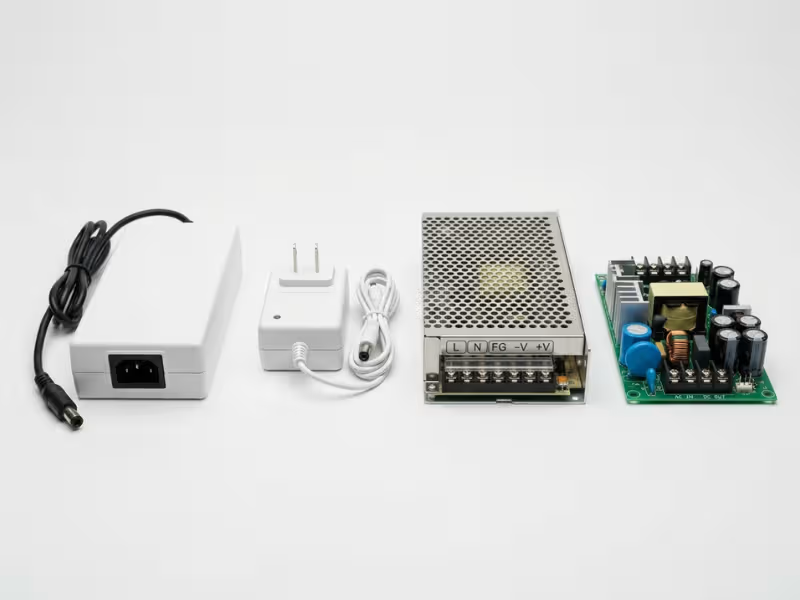
- Size and mounting: Open frame, enclosed, DIN rail, or external desktop adapter? Measure your real space, including the clearance around the unit.
- Thermal path: Will you have a fan, or must the unit cool by natural airflow inside a sealed case?
These answers shrink your options fast. If you skip this step, a great unit can still end up in the wrong product.
The Numbers That Actually Drive the Decision
A datasheet can list 40 specs. I focus on six, because these cause most of the late surprises.
1. Leakage current. For BF devices, patient leakage must stay under 100 µA in normal conditions. CF devices must stay under 10 µA. Check the system total, not just the power supply. Your cables, filters, and other parts add leakage too.
2. Isolation and protection architecture. Confirm 2 x MOPP if the device can touch a patient. That typically means 4,000 VAC input-to-output isolation and wider creepage distances. Also check whether the unit is Class I (earthed) or Class II (double insulated). That choice shapes your whole grounding design.
3. EMC margin. “Pass” isn’t enough. I look for at least 6 dB of margin below the emissions limits. Your motors, displays, and cables will eat up some of that headroom once the unit sits inside your device.
4. Thermal behavior and derating. Find the derating curve. Many units deliver full power only up to 50°C and then drop sharply. Check whether the rated power assumes forced air. If your enclosure has no fan, the usable output may fall by a third or more.
5. Efficiency and no-load power. Higher efficiency means less heat inside your device. Low no-load power matters for devices that sit on standby for hours. It also helps you meet energy rules in some markets.
6. Reliability indicators. Ask how the supplier calculated MTBF. Was it Telcordia SR-332 or MIL-HDBK-217F? At what temperature and load? An MTBF at 25°C means little if your unit runs at 45°C. Then ask about electrolytic capacitor life. It roughly halves for every 10°C rise, and capacitors usually set how long a power supply really lasts.
Once these numbers check out, you face one more decision: buy as-is, adapt, or build new.
Standard, Modified, or Fully Custom?
Choose a standard product when a catalog unit meets your power, isolation, and size needs with margin to spare. You get the fastest timeline, existing test reports, and the lowest cost. For most first-generation devices, I start here.
Choose a modified standard when you need a small change. That could be a custom connector, a different output voltage, conformal coating, or a special cable length. A good supplier can often reuse most of the original safety file. Expect weeks of work, not months. This path suits most teams that find a near match. If your project needs deeper adaptation, review a supplier’s custom power adapter capabilities before you commit to a full redesign.
Choose a full custom design when nothing fits your form factor. It also makes sense when you need several unusual outputs or CF-level leakage. High volume can justify it too. Budget for six to twelve months, plus full new safety and EMC testing. Only commit if the supplier has a real engineering team you can talk to directly.
A unit that fits your device on paper still needs a factory that can build it the same way every time.
Manufacturing and Supply Chain Control: Avoiding Problems Down the Line
A strong sample tells you something, but it does not prove production consistency. What matters is whether unit 5,000 behaves like unit five, and whether the parts will still exist when you reorder in year six. You don’t need a full audit manual for this. You need sharp questions and clear evidence.

How Do They Prove Every Unit Is Built Right?
Start with end-of-line testing. I ask every supplier four direct questions:
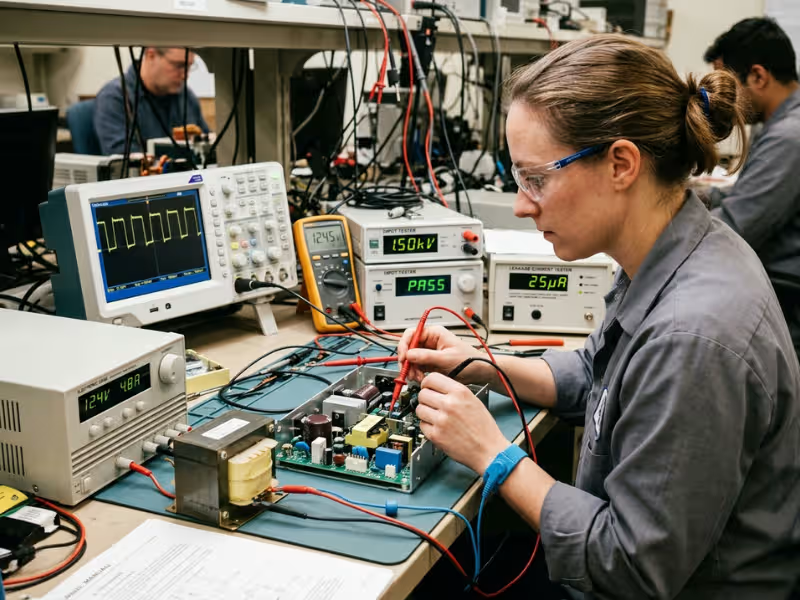
- Do you test 100% of units? Ask exactly what they check, such as output voltage, regulation, ripple, and protection functions. Sample testing alone doesn’t belong in a medical build.
- Do you run burn-in? Ask for the duration, temperature, and load. Then ask what happens to units that fail, and whether they track the failure causes.
- Does every unit get a hipot test? It should stress the isolation barrier at the voltage the safety report requires. Ask to see the pass/fail limits.
- Can you trace a unit by serial number? A strong supplier can link one serial number to its build date, component lots, and test results within a day.
You can’t always visit the factory. When that happens, ask for proof instead. A capable supplier should be able to show how its facilities support burn-in, hipot testing, EMC control, and traceability. Useful evidence includes:
- A recent ISO 13485 audit summary
- A full test record for one random serial number
- Burn-in logs and line yield data
- RMA and field failure rates for the last 12 months
- A process flow chart, or a short video walkthrough of the line
Next, ask about material consistency. Are critical parts locked on an approved vendor list? These include transformers, Y-capacitors, optocouplers, and electrolytic capacitors. Can the factory swap a component source without telling you? A quiet Y-capacitor change can push leakage current past your limit. That’s how good designs drift.
Will the Parts Still Be There in Year Seven?
Many medical devices stay in production for seven to ten years. Your power supply has to stay in the supplier’s catalog that long too.
- Which components are single-sourced? Ask for the actual list. Controller ICs and custom magnetics often show up here. Then ask about the backup plan for each one.
- How do you manage obsolescence? Look for active monitoring, pre-qualified alternates, and a written notice period. I push for at least 12 months before any last-time-buy date.
- What are your real lead time and MOQ? Ask for today’s numbers, not brochure numbers. Ask how fast they can scale from 500 to 5,000 units a month, and whether they hold buffer stock for key customers.
- Does the second site really exist? Many suppliers mention a backup factory. Ask if your exact model is already built and tested there. Check whether that site appears on the CB report or UL file. If not, the backup is a promise, not a plan.
Vague answers here usually predict trouble later. Strong suppliers reply with dates, numbers, and names. Even solid production control won’t save a project if documentation and change notices fall apart.
Documentation and Change Control: Where Many Projects Actually Fall Apart
Most power supply problems I see don’t start on the test bench. They start in an inbox. A missing report, a silent part change, or a vague revision note can stall a project that passed every performance test. Treat the paperwork as part of the product.
Can They Deliver the Full File, Fast?
Your test house and regulator will want more than a certificate. Expect them to ask for:
- The full IEC 60601-1 report
- The risk management summary
- The EMC report with setup photos
- A critical component list showing each part’s own approvals
Ask the supplier how long each document takes to arrive. A strong supplier keeps a ready-made package and sends it within two or three business days. Some will share only under NDA, which is fine.
A supplier who needs to “check with the lab” for every request will cost you weeks during your submission.
Will They Help With Your System-Level Testing?
The lab tests your device as a whole, not part by part. When your system fails a leakage, hipot, or conducted emissions test, you need the supplier’s engineers on the call, not just their sales rep.
Ask these questions early:
- Will they share the insulation diagram and creepage data with your test lab?
- Can they suggest filter or grounding fixes when your system fails EMC?
- Will they provide debug samples with test points or special builds?
The best suppliers treat your test failure as their problem too.
Are the Change Rules Written Down?
Every supplier changes parts over time. What matters is how and when they tell you. Ask for their written ECO and PCN procedure, then check four things:
- Notice period: I look for at least 90 days for form, fit, or function changes. For anything that touches the isolation barrier or other safety-critical parts, I push for six months.
- Change classes: Which changes need your approval, and which only need a notice? A Y-capacitor or transformer change should always require your sign-off.
- Revision control: Does the label show a revision code? Can you link each revision to its own test report?
- Last-time-buy terms: How much warning will you get, and how long can you keep placing orders after the notice?
Put all of this into your quality or supply agreement. A verbal promise from a sales manager disappears the day that person leaves.
Red Flags That Should Drop a Supplier Down Your List
You don’t need a full audit to spot a weak supplier. Most reveal themselves in the first few emails. When I see any of these signs, I lower the supplier’s score right away. When I see two or more, I usually walk away.
- “Medical grade” with nothing behind it. The label alone does not prove model-level compliance. If the supplier can’t send an IEC 60601-1 report for the exact model, treat the claim as marketing.
- The certificate doesn’t cover your model. The report lists the 24 V version, but you quoted the 48 V. Or the family listing stops one suffix short of your part number. That gap means new testing, on your schedule and often on your budget.
- Slow or guarded answers. Sharing under NDA is normal. Silence is not. If test reports, factory details, or change procedures take weeks or never arrive, expect the same delays during your submission.
- One source, no plan. A single-sourced controller IC or custom transformer isn’t fatal by itself. A supplier who has never thought about a backup is a real problem.
- Loose change communication. “We’ll let you know if anything changes” isn’t a process. Ask for the written PCN policy. If they can’t send one, assume parts may change without warning.
- Sales never reaches engineering. You ask about Y-capacitor values or derating at 50°C, and you get a brochure back. When your system fails EMC, that same wall will stand between you and a fix.
- A price far below everyone else’s. When one quote comes in 30% under the rest, something is usually missing. Burn-in, 100% hipot testing, or approved critical parts are the common cuts.
A red flag doesn’t always mean a supplier is dishonest. Often it means they aren’t ready for medical work yet. Your project shouldn’t pay for their learning curve.
How to Compare Medical Power Supply Manufacturers Side by Side
By this stage, you probably have two or three suppliers left. They all look solid on paper. Without a clear system, gut feel takes over and price wins by default. Here’s the scoring framework I use to keep the decision honest.
The Six Dimensions Worth Scoring
Score each supplier from 1 to 5 in six areas. Send every candidate the same document request and the same questions, or the scores mean nothing.
- Compliance readiness: Does the exact quoted model have current IEC 60601-1 and 60601-1-2 reports, plus the approvals your markets need?
- Technical fit: Does it meet your leakage, isolation, thermal, and space needs with margin?
- Documentation support: How fast and complete is the file? Will their engineers join your system-level testing?
- Manufacturing control: Do they run 100% testing, burn-in, and hipot, with full traceability and locked critical parts?
- Supply continuity: Look for backup sources, an obsolescence plan, real lead times, and clear last-time-buy terms.
- Commercial terms: Compare unit price, MOQ, warranty, and price stability across volume tiers.
Write one line of evidence next to each score. “4: full CB report received in two days” beats “4: seems good.” When your manager asks why you picked the pricier option, that line answers for you.

Set Your Weights Before You See the Prices
Equal weights quietly favor the cheapest bidder. Decide what matters most for your project, then lock the weights before quotes arrive. Two factors drive them: project phase and device risk.
Dimension | Design-in, high-risk (BF/CF) | Design-in, lower complexity | Mass production |
|---|---|---|---|
Compliance readiness | 25% | 20% | 15% |
Technical fit | 25% | 20% | 15% |
Documentation support | 20% | 15% | 10% |
Manufacturing control | 15% | 15% | 25% |
Supply continuity | 10% | 15% | 20% |
Commercial terms | 5% | 15% | 15% |
During design-in, a supplier who can’t support your test lab costs you months. That’s why fit and documentation carry more weight early. In production, one missed shipment hurts more than a few cents per unit, so manufacturing control and continuity move up.
For high-risk devices, I also set a hard floor. Any supplier scoring below 3 on compliance readiness drops out, whatever the total. A great price can’t make up for a missing MOPP rating.
Multiply each score by its weight and add them up. If two suppliers land within 5% of each other, don’t trust the decimal. Ask both engineering teams a hard question about your design. Their answers will break the tie.
Match the Supplier Type to Your Project
Scores show who’s strongest. Supplier type shows who fits your situation in the first place.
Large global brands offer broad catalogs, deep certification files, and multiple factories. They suit standard units and high-risk devices that need wide market access. The trade-off: smaller customers often wait for engineering attention, and customization stays limited unless your volume is large.
Specialist medical power manufacturers work inside 60601 every day. They’re often the best fit for modified standards, CF-level leakage, or tricky thermal designs, and their engineers usually reply fast. Check supply continuity closely, since some run from a single site.
Regional ODM and custom shops shine on unusual form factors, multiple outputs, and cost-driven volume programs. They move quickly and price aggressively. But you carry more of the compliance and audit work yourself. I use them only when my team has strong in-house regulatory skills and time for a full qualification.
Many strong programs mix types. A global brand might supply the main unit while a specialist builds a custom auxiliary supply. Score each one against the same matrix, and the right partner usually becomes clear.
A More Practical Supplier Evaluation Checklist
A checklist only helps if you work through it in the right order. Each step below removes weak suppliers before you invest time in the next one. Follow the sequence, and you won’t spend days on a technical review for a supplier who should have dropped out on day two.
- Lock the exact model and the standards it must meet. Write down the full part number, including every suffix. Then list the standards your device needs, such as IEC 60601-1 Ed. 3.2, IEC 60601-1-2 Ed. 4.1, and any home-use or regional rules.
- Send every supplier the same document request. Ask for the full IEC 60601-1 report, EMC test data, CB certificate, and market approvals. Then check each certificate in the IECEE or UL database yourself.
- Check the key specs against your device. Compare leakage current, MOPP rating, EMC margin, derating at your real internal temperature, and capacitor life. Flag any spec with thin margin, because that’s where surprises hide.
- Review how they build and source the unit. Confirm 100% testing, burn-in, hipot, and serial-number traceability. Ask for the list of single-sourced parts and proof that any backup site already builds your model.
- Test their documentation and change process. Track how long the full file takes to arrive. Get the written PCN policy and check the notice period for safety-critical parts.
- Score your top two or three on one weighted matrix. Set the weights before you open the quotes. Add one line of evidence next to every score.
- Get lifecycle commitments in writing before design-in. Agree on minimum production life, last-time-buy notice, and your approval rights for changes. Put them in your supply or quality agreement.
Most teams can finish this process in a few weeks per supplier. That’s a small cost compared with redesigning a device after launch.
Frequently Asked Questions
What certifications should a medical power supply manufacturer have?
At the company level, look for ISO 13485. ISO 9001 is a useful extra. At the model level, the unit needs IEC 60601-1 (Ed. 3.1 or later) and IEC 60601-1-2 test reports, a CB certificate, and approvals for your target markets, such as UL or cUL for North America and CE for Europe. Home-use devices also need IEC 60601-1-11 coverage. Company and model certifications answer different questions, so you need both.
Can an industrial power supply be used in a medical device?
Sometimes, but rarely as-is. ITE and industrial units certified to IEC 62368-1 often allow higher leakage current, and their isolation protects operators, not patients. If the supply sits well away from any applied part, you may be able to add an isolation transformer or extra insulation and cover it in your system safety file. That adds cost, size, and test work. For anything near a patient, a 60601-rated unit with 2 x MOPP usually costs less in the end.
How do you verify whether an IEC 60601-1 certificate actually applies to a quoted model?
Ask for the full test report, not just the certificate page. Find your exact part number, including every suffix, in the model list. Confirm the standard edition and the isolation rating (MOOP or MOPP). Also check the rated conditions, such as maximum ambient temperature and mounting orientation. Then look up the certificate number in the IECEE CB database or UL Product iQ. If your variant isn’t listed, ask the supplier in writing whether they will add it and when.
When is a modified standard power supply a better choice than a custom design?
A modified standard makes sense when a catalog unit already gets you most of the way there. Common changes include a new connector, an adjusted output voltage, conformal coating, or a different cable length. These usually let the supplier reuse most of the existing safety report. Expect 4 to 10 weeks and a modest engineering fee. A full custom design takes 6 to 12 months. Go custom only when no modification can meet your form factor, output mix, or leakage target, or when your volume justifies the investment.
What should buyers ask during a factory or supplier audit?
Focus on evidence, not the tour. Try these questions:
- Can you pull the full build and test record for this serial number right now?
- Which critical parts sit on your approved vendor list, and who signs off on changes?
- What were your line yield and field return rate last quarter?
- How do you handle units that fail burn-in or hipot?
- Can I see your written PCN procedure and the last notice you issued?
Watch how fast they answer. Quick, specific replies usually mean the system really works.
How long does it typically take to qualify a new medical power supply supplier?
For a standard unit from a supplier with solid documentation, plan on 6 to 12 weeks. That covers document review, sample evaluation, engineering tests, and the supply agreement. Modified units add the change work and retesting, so 3 to 5 months is common. Full custom programs, including safety and EMC certification, often run 9 to 15 months. Your own system-level testing and regulatory submission come on top of that, so start supplier qualification early.
Choose the Partner, Not Just the Part
A medical power supply manufacturer earns its place through evidence, not labels or low quotes. Keep the order simple.
Screen for compliance first. Drop anyone who can’t prove it for your exact model. Next, check technical fit against your device, your patients, and your enclosure. Only then compare manufacturing control and lifecycle support.
The order matters. Each step removes weak candidates before you spend hours on the next one.
Your next move is straightforward. Shortlist two or three suppliers and send each one the same document request. Then score them all on one weighted matrix, and lock the weights before the quotes arrive.
The supplier that wins on evidence is the one most likely to still support you in year seven of production. That’s the one worth designing in.