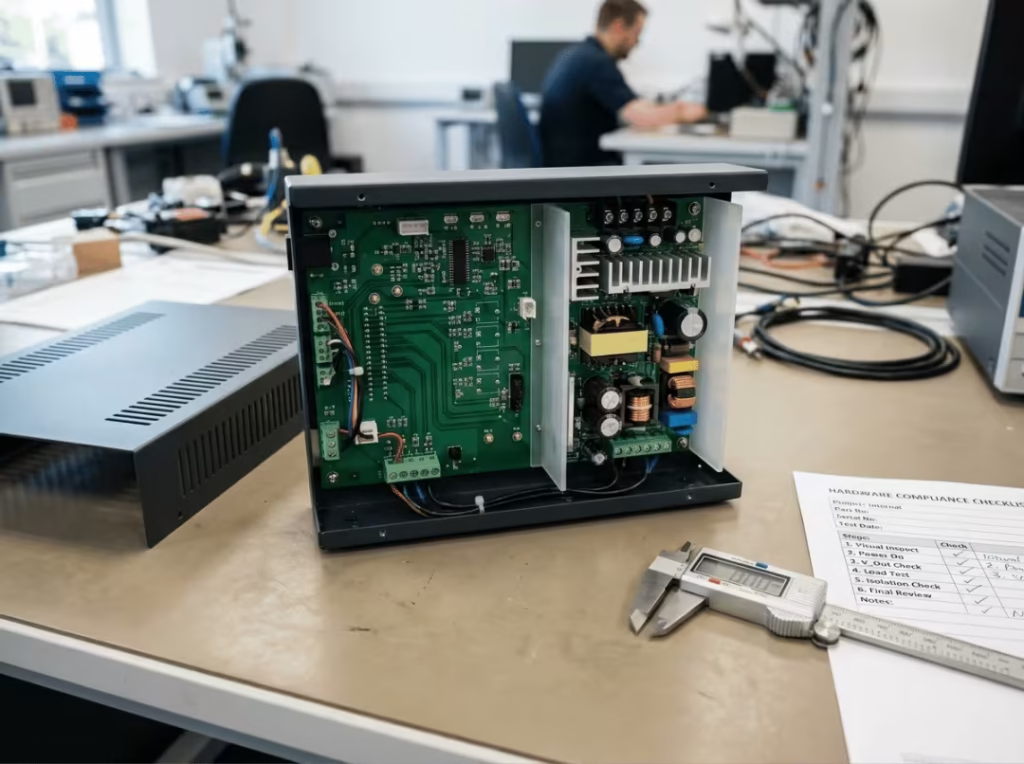
I have watched a product sit on a pallet for eleven weeks because someone assumed a “certified” power supply carried its certification into a new enclosure. It didn’t. The board got reworked, the schedule slipped two quarters, and the root cause traced back to a single decision made months earlier by an engineer who thought compliance was a testing problem. It wasn’t. It was a design problem the whole time.
That is the thing to understand about 62368-1 before anything else. It replaced IEC 60950-1 (IT equipment) and IEC 60065 (audio/video) with one hazard-based standard covering audio/video, information, and communication technology equipment. But the real change isn’t the merger. The old standards told you how to build. 62368-1 tells you what to prevent and places the burden on you to prove your prevention works. More freedom, more rope to hang yourself with.
This guide walks the ground the way I’d walk it on a real project: how to size up your own product, how to structure the work so it doesn’t blow up your timeline, and one live EU issue that most published guides still get wrong.
The Hazard-Based Approach, and Why It Changes How You Work
The One Shift That Matters
With 60950-1, you looked up a voltage clearance, applied it, and moved on. The rulebook did your thinking. 62368-1 takes that crutch away. It asks you to prevent injury and then defend the reasoning behind every safeguard you chose.
That sounds abstract until you’re in a review meeting with a test engineer asking why your insulation scheme is adequate — and “the table said so” is no longer an answer that exists. You own the argument now. If you can’t articulate it, you can’t certify. Freedom and accountability came in the same box.
The Three-Part Logic in Plain Terms
Everything runs on three interconnected ideas.
Energy sources. Your product is a collection of energies that can hurt someone: electrical, mechanical, thermal, radiation. Each is graded from Class 1 to 3 based on the harm it can cause. Class 1 is safe to touch. Class 2 causes pain or minor injury. Class 3 causes serious injury or starts a fire.
Safeguards. These are the barriers between that energy and a person. Basic handles normal conditions. Supplementary catches the basic one when it fails. Reinforced does the whole job alone. Who you’re protecting matters too — the standard splits people into ordinary persons (know nothing), instructed persons (trained to take precautions), and skilled persons (can protect themselves), and it holds you to a different bar for each.
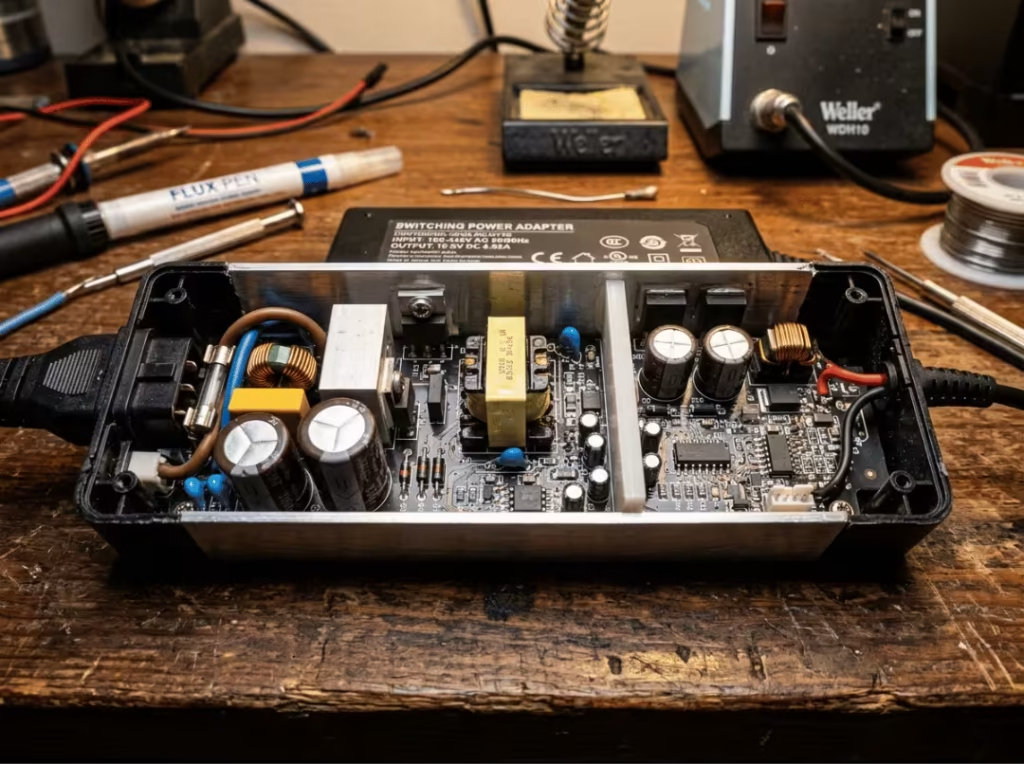
The link between them. This is where the model earns its keep as a design tool. A higher-energy class plus a less-savvy person equals a stronger safeguard. A Class 3 mains node an ordinary user can reach needs reinforced protection. A Class 1 node may need none. Look at any laptop charger: mains voltage sits behind reinforced insulation before it ever reaches the low-voltage output you handle. Match safeguard to class and person, and the design mostly designs itself.
Why This Is Proactive, Not Reactive
The old standards were forever playing catch-up. Flat panels, PoE, lithium cells — each new category exposed a gap and triggered another amendment. A model built on the physics of injury doesn’t need constant patching, because a new gadget still produces the same four energies.
The consequence lands on your desk directly: there’s no table to hide behind anymore. Can’t explain why a safeguard is adequate for a given source and a given person? Then you don’t have a certifiable product yet. Hold that thought — it’s the spine of everything below.
What Your Product Actually Needs — A Self-Assessment
Start by Mapping Your Energy Sources
Before you open a datasheet, walk the product. Where does electrical energy live? What gets hot? What spins, cuts, or pinches? Does anything emit light, laser, or sound? Write each source down and hang a rough class on it.
This map decides where your effort goes. A product with nothing above Class 1 is a light lift. One carrying a Class 3 source a user can reach is a different animal entirely, and you want to know that on day one, not at the lab.
Electrical Shock Protection — Where Most Products Live
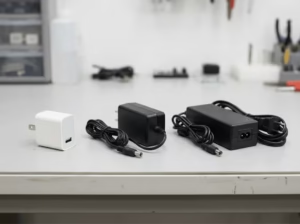
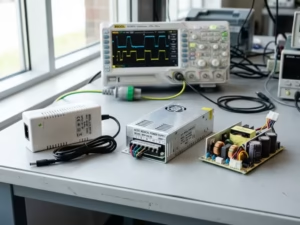
For most powered products, this is the main event. The standard caps touch current on anything a person can contact, require protective earthing so that fault current has a safe path home, and require insulation that survives the voltages and conditions your product will actually see. This is exactly why the ITE power supply inside your IT or communication equipment deserves early scrutiny — it’s usually the largest electrical energy source in the whole product.
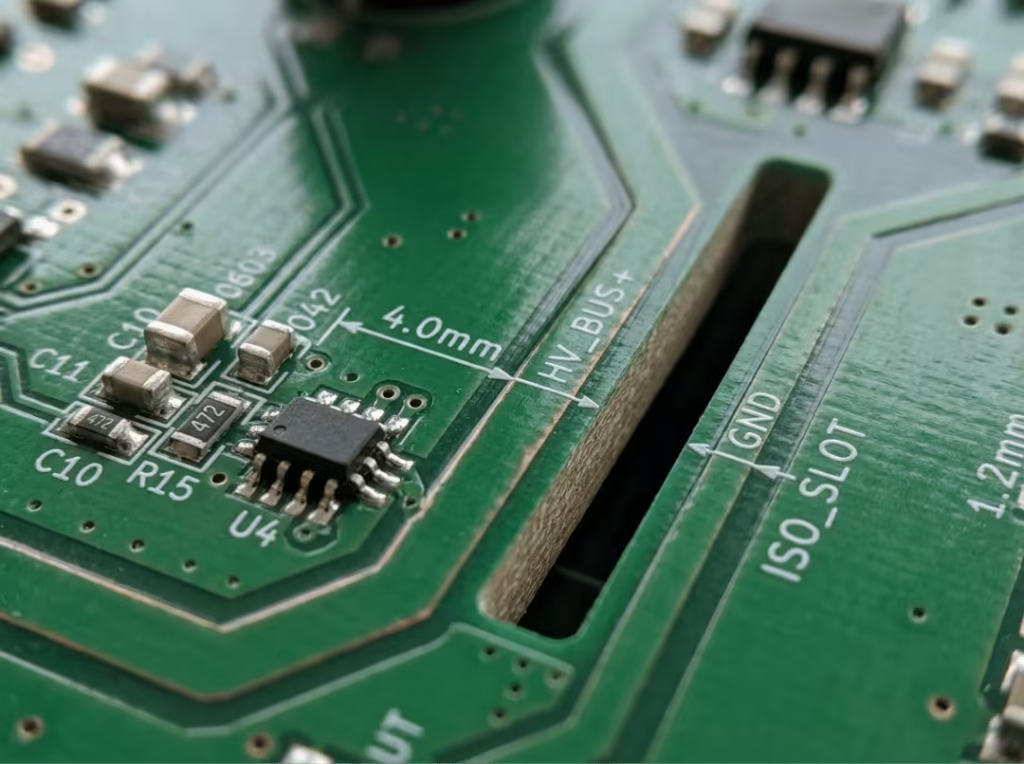
Creepage and clearance are where designs quietly go wrong. These are the surface and air distances that stop electricity from tracking or arcing where it shouldn’t, and they are not fixed numbers. They depend on working voltage, pollution degree (how much dust and moisture the product is exposed to), and the material group of your insulation. Push the voltage up or move the product into a dirtier environment, and those distances grow. I’ve seen a layout that sailed through as an office product fail outright when marketing quietly repositioned it for the factory floor — same board, dirtier world, spacings no longer legal. Pin down the intended environment before you route copper, because it dictates the geometry.
Thermal and Fire — The Two That Quietly Fail Audits
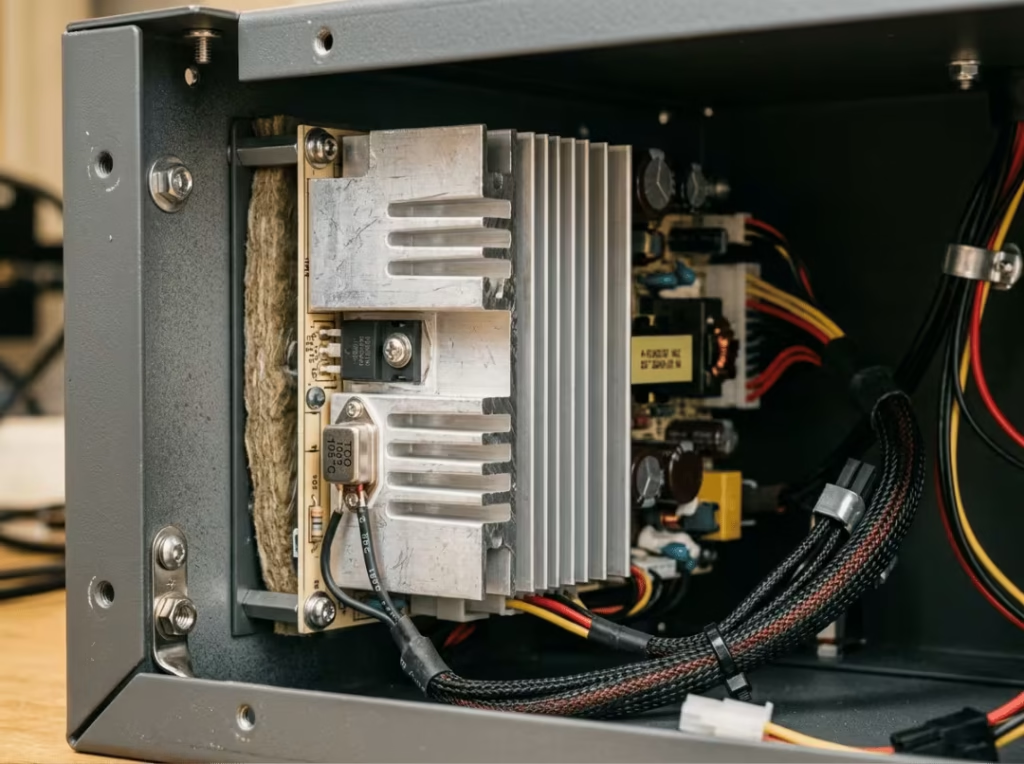
Heat and fire catch confident teams off guard precisely because they feel less urgent than shock. Accessible surface temperature limits depend on the material and dwell time — a metal handle someone grips has a far lower ceiling than a plastic shell they brush past. Internally, you need thermal protection that reins components in when a fault drives temperatures up.
Fire adds another layer: fire enclosures to contain ignition, flame-retardant ratings on enclosure materials, spacing between hot parts and anything that burns. Here’s what trips people up: whether you even need a fire enclosure, and how robust it must be, comes out of your fire-risk assessment. The standard won’t hand you the answer. Skip that assessment, and it doesn’t vanish; it reappears as a non-conformity late in the certification process, at the exact moment when a fix costs the most.
Mechanical, Optical, and Acoustic — Scope by Product
Only relevant if you have them, so don’t manufacture work. Mechanical means guards or interlocks around fans, motors, and gears, plus the 10-degree stability requirement. Optical applies if you’re running lasers or bright LEDs that need classification and, where relevant, labeling. Acoustic refers to anything that drives speakers or headphones.
Restraint is the skill here. A tabletop router doesn’t need a laser assessment. A fanless sensor doesn’t need moving-part guards. Go deep only where the energy actually exists.
How Deep Does Your Effort Go?
Your energy map produces one governing judgment: the depth of the whole project scales with your highest-class source. Find it first. A Class 3 electrical source an ordinary user can touch means real work across insulation, enclosure, and documentation. If everything caps at Class 1, you’re looking at a far shorter road. Identify the ceiling, and you’ve scoped the project.
Where 62368-1 Really Differs from 60950-1 (and Where People Get Burned)
Documentation Is Now a Deliverable, Not an Afterthought
Under the old regime, documentation trailed the design. Under 62368-1, it is the design. Your file needs a hazard analysis that names each source, a justification for every safeguard, evidence that each requirement is met, and traceability linking each specific hazard to the specific feature that handles it.
This — not failed tests — is the number-one reason projects stall. Labs bounce products back because the reasoning doesn’t hold together, even when the hardware is flawless. Treat the file as a report you’ll write at the end, and you’ll spend the end reconstructing decisions you can barely remember making. That’s the swamp where schedules die.
Component Certifications Don’t Transfer Automatically
This one bites experienced teams hardest, because it violates an instinct they’ve trusted for years. A part certified to 60950-1 does not automatically satisfy 62368-1 — and yes, that includes the bought-in power supply you’d mentally filed as “handled.”
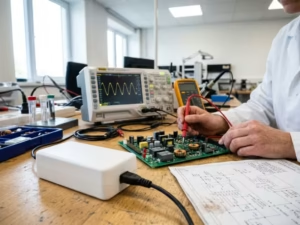
Take that power supply, certified comfortably years ago. Drop it into a tighter enclosure with less airflow, a higher ambient temperature, or a dirtier pollution level, and its old certificate tells you almost nothing about whether your product is safe. You have to demonstrate that the part still delivers adequate protection when used under your conditions. This is one reason teams increasingly reach for custom power adapters built and certified for the specific enclosure, thermal envelope, and environment they’re going into, rather than forcing an off-the-shelf part to fit. Reusing a certified component without re-evaluating its context is one of the fastest routes to a failed audit I know.
Testing Conditions Changed, Even Where Tests Look Familiar
Some tests kept their old names but changed underneath. 62368-1 places greater emphasis on battery charge and discharge limits, abnormal-operation fault conditions, mechanical stability and impact, and touch current under revised conditions. A test that looks like its 60950-1 ancestor may now run against different criteria and a different pass line.
So don’t let an old report ride on reputation. Check each one against the current standard before you count it as evidence. An expired assumption is more dangerous than a missing test, because it feels finished.
The EU Complication Most Guides Miss — The OJEU Citation Gap
The Situation in Plain Language
If you ship into the EU, read this twice. On 7 January 2026, EN 62368-1:2014 was withdrawn from the Official Journal of the European Union. It had already been superseded twice — first by EN IEC 62368-1:2020, then by EN IEC 62368-1:2024 — yet no newer version is currently cited in the OJEU. So the standard everyone works to no longer has a current European edition delivering the usual legal shortcut.
Why This Happened
Tighter scrutiny at the European Commission. After the James Elliott and Malamud cases put the legal weight of harmonized standards under real pressure, the Commission grew far more cautious about citing new ones and started clearing withdrawn references off the OJEU. Newer editions of EN 62368-1 continue to fall short in that assessment, and the 2024 edition is still grinding toward citation.
What It Means for You as an EU Manufacturer
A cited harmonized standard buys you a presumption of conformity — apply it and authorities presume you meet the essential requirements of the relevant legislation, including the Low Voltage Directive and the General Product Safety Regulation. With no current citation, that presumption thins. You may have to demonstrate conformity through a non-harmonized route, one a market surveillance authority can pick apart directly during a spot check. The technical bar didn’t move. The legal cushion did.
What to Do Now
Don’t sit on your hands waiting for the citation to sort itself out. Build your Technical Construction File and EU Declaration of Conformity so they stand on their own reasoning, not on a cited standard doing the arguing for you. Plan for a transitional window — roughly 18 months after withdrawal, with a practical adjustment period closer to 24 to 36 months — and watch CENELEC’s progress on citing the 2024 edition so you know when the shortcut comes back.
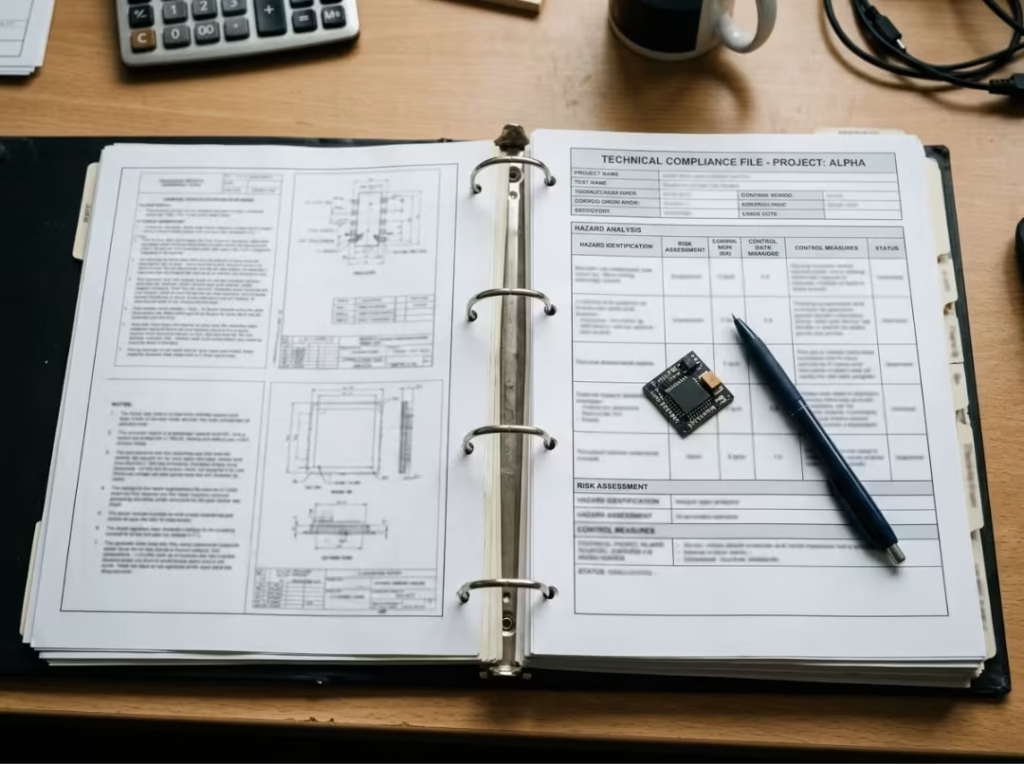
The takeaway I’d give any EU client right now: hitting the technical requirements is no longer the whole job. Proving conformity through the right route carries real weight, and the teams preparing that route today won’t get caught flat when an authority knocks.
Building Compliance Into Your Design Process
Step 1 — Run a Preliminary Hazard Assessment Early
Do the hazard assessment before detailed engineering, not after. It steers component choice, enclosure design, and layout — the decisions that cost pennies to change now and a redesign to change later. Teams that assess up front cut the right clearances the first time. Teams that skip it meet the problem at the lab and pay full price for the fix.
Step 2 — Design the Safeguards In, Don’t Bolt Them On
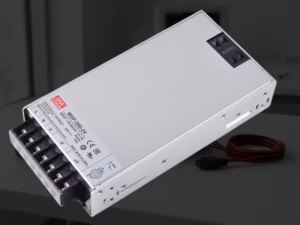
Bake insulation, thermal protection, and mechanical guards into the architecture from the start. Retrofitting a safeguard after design freeze is where budgets and schedules snap, because a late addition drags changes through everything around it. Designed in early, that same protection costs a fraction. This is especially true for regulated fields like medical power supplies, where patient-contact requirements and stricter isolation leave almost no room to bolt protection on after the fact.
Step 3 — Build the Documentation Package as You Go
Assemble the hazard assessment, specs, datasheets, test reports, and traceability matrix while the decisions are still warm, and keep it under version control. The failure mode is reconstruction — rebuilding your logic months later, from memory, under a deadline. Slow, painful, and exactly when errors slip in unnoticed.
Step 4 — Pick a Lab With Real 62368-1 Experience
Check accreditation, ask point-blank about products like yours, and get a preliminary assessment before you commit to a full program. A lab that has certified your kind of product spots trouble weeks early. The wrong lab costs you time you can’t buy back.
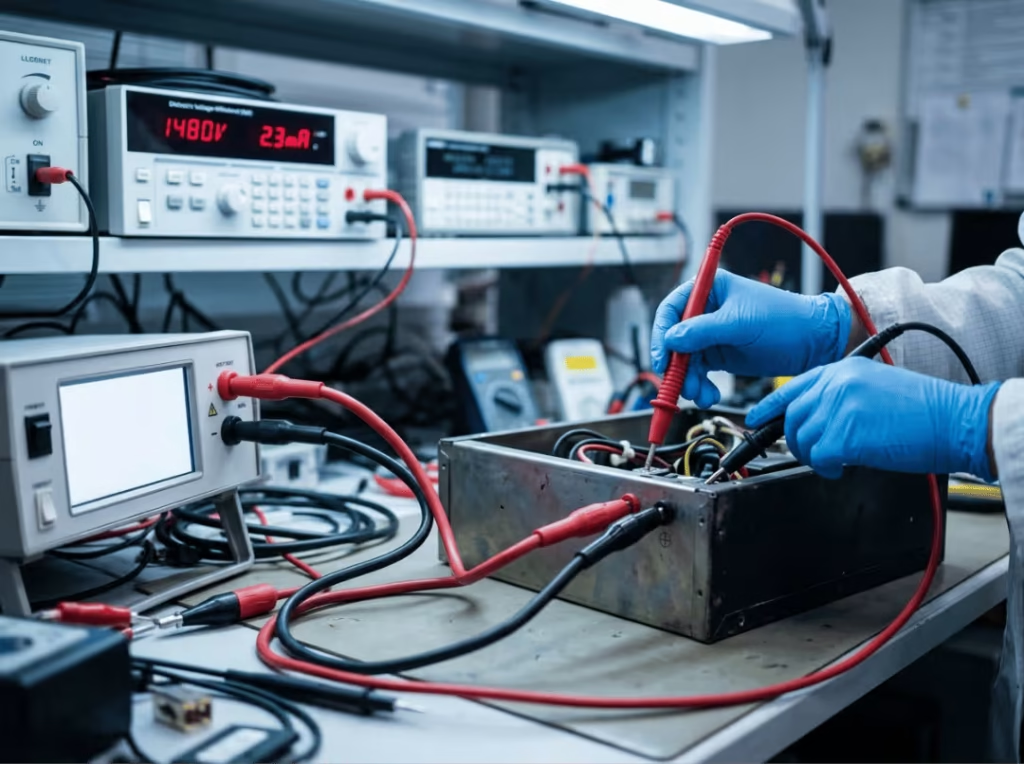
Step 5 — Pre-Audit Yourself
Run an internal review against the standard before you submit. A pre-audit catches the quiet gaps — a missing justification, a part used outside its rating — that would otherwise land as formal non-conformities, each one buying you another review cycle and another delay.
The Mistakes That Cost the Most Time
Underestimating documentation depth. The hazard assessment wants justification, not a ticked box. Thin reasoning stalls more technically sound products than any hardware flaw.
Trusting component certifications to carry the product. A certified part used outside its rated conditions, or in a combination that creates a new hazard, still fails. Re-evaluate every part in the context of your actual design.
Ignoring the intended environment. Pollution degree and operating conditions rewrite the requirements. A clean-office design won’t automatically survive an industrial or outdoor deployment.
Referencing the wrong edition for a market. Sharper than ever given the EU citation mess. Confirm the exact edition each market expects before you build your file around it.
Timelines and Market Access at a Glance
- North America: UL 62368-1 has been the sole standard for A/V and IT equipment since December 2020. Old standards aren’t accepted for new certifications.
- European Union: Mandatory under the Low Voltage Directive since December 2020 — but see the OJEU section for the live citation gap affecting your presumption of conformity right now.
- Other markets, including Japan, China, Australia, and many others, have adopted or referenced 62368-1. Confirm the specific edition and effective date per market.
- Certification timing: Realistically 8 to 16 weeks, and longer once you factor in design changes, component re-qualification, and documentation.
Frequently Asked Questions
What products does 62368-1 cover?
Audio/video, information technology, and communication technology equipment — the categories once split between IEC 60950-1 and IEC 60065.
What actually changed from 60950-1?
It moved from prescriptive construction rules to a hazard-based model. You identify energy sources, apply safeguards, and justify why each is adequate, instead of following fixed construction tables.
Can I still sell products certified to the old standards?
Existing certifications may hold until they expire, but new certifications and new product versions must meet 62368-1. Old standards are closed to new work.
Do I need to retest components certified to older standards?
Often, yes. A 60950-1 component doesn’t automatically satisfy 62368-1, especially in different conditions. Re-evaluate each one in the context of your actual product.
How long does certification take, and what drives the timeline?
Roughly 8 to 16 weeks, driven mainly by product complexity, lab workload, and how complete your documentation is. Design changes and component re-qualification further stretch it.
What’s the current EU status of EN 62368-1?
The moving piece to watch. EN 62368-1:2014 was withdrawn from the OJEU on 7 January 2026, and no newer edition is currently cited there, even though the 2020 and 2024 versions exist. That gap weakens the automatic presumption of conformity under the Low Voltage Directive and the General Product Safety Regulation, so you may need to prove conformity through a non-harmonized route that authorities can examine directly. Build your Technical Construction File and EU Declaration of Conformity to stand on their own, plan for a transitional window of roughly 24 to 36 months, and track CENELEC’s progress toward citing the 2024 edition.
What are the most common reasons certification fails?
Incomplete documentation, reused component certifications that don’t hold up in context, and ignoring the product’s intended environment — all ahead of outright hardware failures.
Conclusion — Treat Compliance as Design, Not Paperwork
The path through 62368-1 doesn’t change from project to project. Find your highest-severity energy source first. Design the safeguards in early, rather than bolting them on. Document the reasoning as you build, not from memory at the end. Do those three things and the standard stops feeling like a gate and starts working like a design tool.
Keep two jobs in view at all times. The technical one: match safeguards to energy classes and the people exposed to them. The procedural one, which carries unusual weight in the EU right now: pick the route that proves conformity while the OJEU citation gap stays open.
The teams that fold this into development — rather than staging it as a final hurdle — avoid costly rework, gain market access faster, and ship products that are genuinely safer. That’s the whole return, and it’s open to anyone willing to treat compliance as a decision made on day one rather than a scramble on the last.