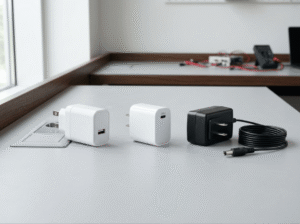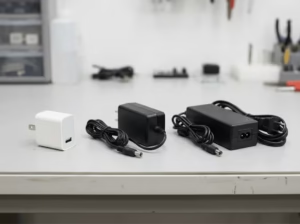
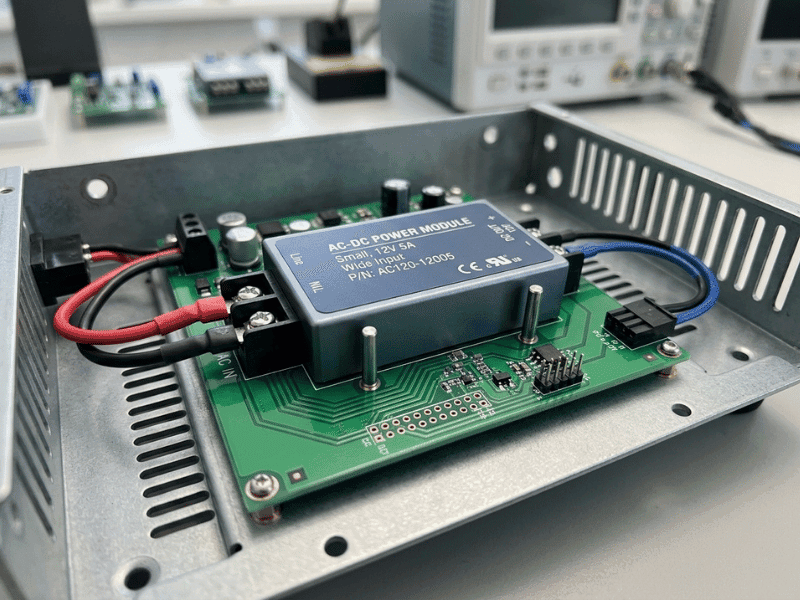
An AC-DC brick power supply is a self-contained, enclosed module that converts AC mains voltage to regulated DC output. Designed for integration into industrial, medical, and ITE equipment, these compact AC-DC power modules offer passive thermal management via baseplate cooling, a simplified board-mount footprint, and a certifiable safety boundary that separates the AC conversion stage from the rest of the system design.
Engineering a reliable power architecture means making decisions early that are difficult to reverse later. The choice of power conversion topology—whether to use an internal open-frame supply, an external adapter, or a self-contained AC-DC brick module—shapes the thermal design, certification strategy, mechanical layout, and long-term serviceability of the entire product.
AC-DC brick power supplies occupy a specific and well-defined position in this landscape. They are not a universal solution, but for the right application profile—compact industrial equipment, board-level medical devices, distributed ITE systems, and defense or broadcast hardware—they resolve several engineering tradeoffs at once. Their enclosed format creates a clear AC-DC boundary within the product. Their baseplate cooling design eliminates the need for an internal fan. And, where applicable, their standardized footprint simplifies both initial integration and long-term replacement logistics.
This article explains what an AC-DC brick power supply is at both the system and component level, where these modules are commonly specified, what their practical advantages and limitations are, and how to select the right unit for your application—covering output power headroom, thermal derating, IP rating, certifications, and protection features.
What Is an AC-DC Brick Power Supply?
An AC-DC brick power supply is a fully enclosed power conversion module that accepts AC mains input—typically universal input across 100–240V AC—and delivers a regulated DC output at a defined voltage and current rating. The module is self-contained: the transformer, switching topology, filtering, and regulation circuitry are all housed within a single mechanical package.
The term “brick” refers to the form factor. These modules are roughly rectangular and substantially more compact than equivalent enclosed panel-mount supplies. They are designed to mount directly onto a host PCB or into a host enclosure, functioning as a self-sufficient power subsystem rather than a discrete component.
Unlike external desktop adapters, which connect to equipment via a DC output cable, board-mount AC-DC brick modules are typically integrated into the product chassis, with AC input and DC output connections made via connectors, terminals, or pins specified in the module’s mechanical specification. This integration distinguishes them from external AC-DC power supplies, which remain outside the host device.
Power ratings for commercially available AC-DC brick modules typically span from around 20W to several hundred watts, depending on the design and thermal management approach.
How Does the Internal Architecture of an AC-DC Brick Module Work?
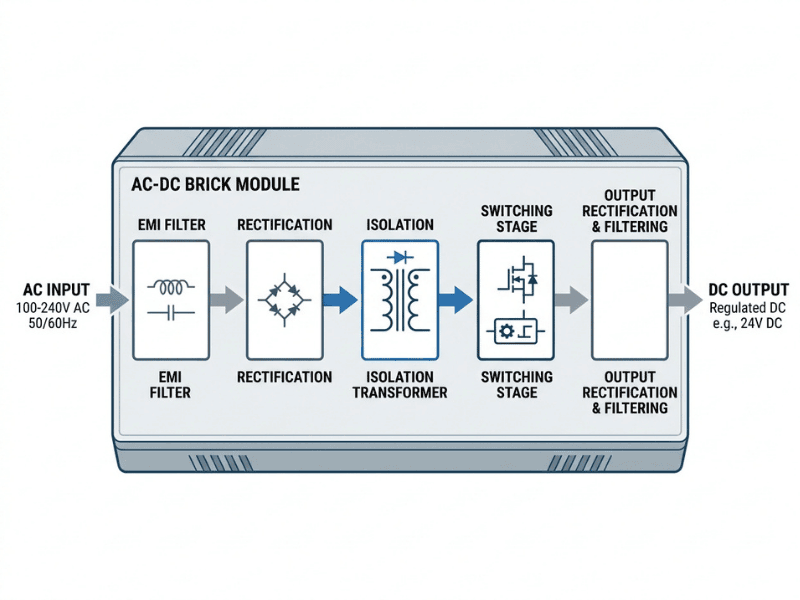
The internal topology of most AC-DC brick power supplies follows a flyback or forward converter architecture for lower power levels, transitioning to LLC resonant or phase-shifted full-bridge topologies at higher power ratings. The choice of topology influences efficiency, output ripple, and the complexity of the control loop.
The AC input stage incorporates an EMI filter—typically a combination of common-mode and differential-mode components—to suppress conducted emissions and meet regulatory limits such as FCC Part 15 and CISPR 22/32. This filter stage is followed by a bridge rectifier and bulk capacitor, which establish the high-voltage DC bus for the switching stage.
The transformer provides galvanic isolation between primary and secondary circuits. Isolation voltage and creepage/clearance distances at this stage determine whether the module can meet safety standards for industrial, ITE, or medical applications. For medical-grade AC-DC brick modules, the isolation design must satisfy the means of protection (MOPP) requirements defined in IEC 60601-1, with leakage current typically ≤ 500 µA for equipment not in patient contact, or ≤ 100 µA when 2x MOPP is required.
The secondary side includes an output rectifier, filter inductor, and output capacitor network. The regulation loop—typically voltage-mode or current-mode control—feeds back through the isolation boundary via an optocoupler or transformer-based feedback path to maintain output voltage within the specified regulation band under varying load and input conditions.
Capacitor selection on the secondary side varies by design. Some AC-DC brick modules use polymer or film capacitors rather than electrolytic types when the application demands extended service life, though specific component choices depend on the design target and manufacturer. Engineering teams should review the datasheet and request component-level documentation if capacitor type is a critical factor for their application.
Where Are AC-DC Brick Power Supplies Commonly Used?
Medical devices
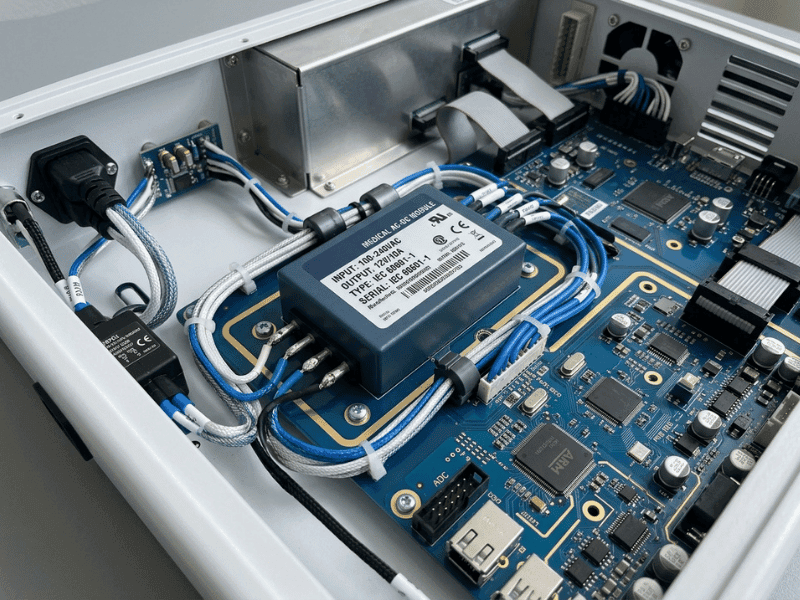
AC-DC brick modules are widely used in medical equipment where the power supply must meet IEC 60601-1 safety requirements, maintain low leakage current, and fit within a compact device enclosure. Diagnostic imaging equipment, patient monitoring systems, infusion pumps, and laboratory analyzers are common application categories. The enclosed brick module format establishes a certified isolation boundary within the device, simplifying the system-level safety assessment.
For patient-contact applications, a 2x MOPP isolation design with a leakage current ≤ 100 µA is typically required. Specifying a medical power brick that already carries IEC 60601-1 third-edition certification allows the device manufacturer to reference the supply’s certification documentation during their own regulatory submission, reducing the scope of in-house testing.
Industrial and ITE equipment
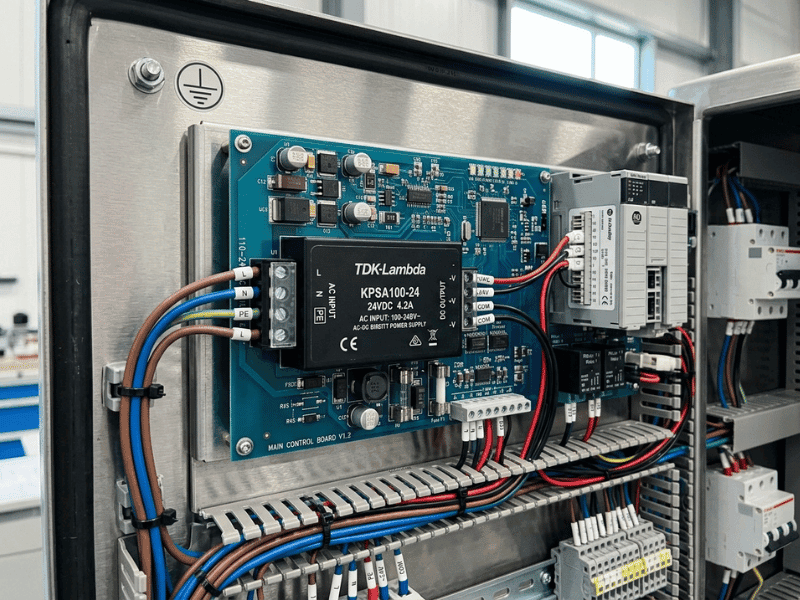
In industrial automation, programmable logic controllers, HMI terminals, measurement instruments, and distributed I/O systems frequently integrate compact AC-DC power modules where space within the equipment enclosure is limited. The board-mount format allows the power supply to be positioned close to the load, reducing DC distribution losses and simplifying the overall mechanical design.
For ITE applications, compliance with IEC/EN 62368-1—the current safety standard for audio/video, information technology, and communications technology equipment—is the relevant certification requirement. This standard replaced IEC 60950-1 and applies to most industrial and commercial electronics.
Consumer electronics
High-performance consumer electronics—including gaming peripherals, set-top boxes, and AV equipment—sometimes integrate AC-DC brick modules where the product’s power architecture calls for an internal conversion stage rather than an external adapter. The compact footprint allows designers to consolidate the power subsystem within the product housing without the cable and connector overhead of an external supply.
Defense and broadcast
Broadcast infrastructure equipment and defense electronics often operate in thermally constrained environments where fan-cooled supplies introduce unacceptable maintenance overhead or acoustic noise. AC-DC brick modules with wide operating temperature ranges and passive cooling are used in rack-mounted broadcast hardware, remote monitoring systems, and ruggedized field equipment. These applications typically require extended temperature qualification and, in some cases, custom mechanical specifications.
What Are the Main Advantages of Using an AC-DC Brick Power Supply?
Thermal management without a fan: how baseplate cooling works
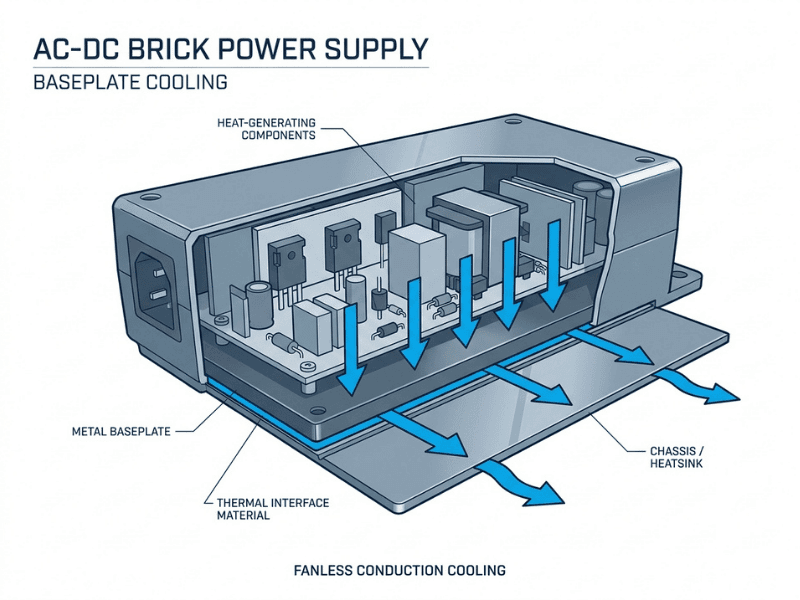
AC-DC brick power supplies are typically designed for conduction cooling through the baseplate—the underside of the module housing, which makes direct thermal contact with the host chassis or a heatsink. Heat from internal components travels through the module’s thermal structure to the baseplate and from there into the mechanical assembly.
This approach eliminates the need for an internal fan, removing a mechanical wear point from the assembly. For equipment deployed in dusty environments, sealed enclosures, or locations where maintenance access is infrequent, baseplate cooling offers a meaningful reliability advantage over forced-air designs. It also avoids the noise contribution of a fan motor, which matters in medical and broadcast environments where acoustic performance is specified.
The practical implication for system design is that the host chassis or mounting interface must be capable of supporting the module’s thermal load. Baseplate-cooled designs require adequate thermal conductivity between the module and the chassis, typically achieved through direct metal contact or a thermal interface material. Engineers should review the module’s thermal resistance specification (junction-to-baseplate or case-to-ambient) and confirm that the mounting interface can maintain the baseplate temperature within the specified limit under maximum load and maximum ambient conditions.
Longer service life through component selection
The component choices and thermal management approach in a well-designed AC-DC brick module can extend service life compared to fan-cooled equivalents operating at higher internal temperatures. Lower junction temperatures in switching devices and longer capacitor life at reduced operating temperatures are the primary mechanisms.
That said, service life is a function of operating conditions, not form factor alone. The relevant figure of merit is the module’s rated MTBF at the intended operating temperature, calculated to a recognized standard such as MIL-HDBK-217 or Telcordia SR-332. Procurement teams should request MTBF data and confirm the ambient temperature at which it was calculated.
Safety isolation at the system level
The enclosed AC-DC brick module establishes a defined isolation boundary within the host system. All AC conversion and primary-side circuitry is contained within the certified module, and the DC output interface is what the system designer works with. This partitioning reduces the scope of AC safety design work required at the system level and makes the certification boundary cleaner during compliance testing.
For medical device manufacturers in particular, specifying a pre-certified medical power brick from a supplier with verifiable IEC 60601-1 documentation accelerates the device-level regulatory submission.
Space savings in the host design
The compact footprint of an AC-DC brick module allows designers to allocate PCB real estate more efficiently. Compared to specifying discrete power conversion components or a larger enclosed supply, a brick module consolidates the power subsystem into a defined mechanical envelope with predictable mounting requirements. This is particularly relevant to portable instruments, compact ITE equipment, and devices in which the power supply must share chassis space with other subsystems.
PCB integration and assembly efficiency
Board-mount AC-DC brick modules are typically through-hole or press-fit components, mounted directly to the host PCB via pins or terminal blocks. This integration reduces the number of discrete wiring harness connections within the assembly, which can simplify production processes and reduce potential failure points at connectors.
The specific assembly requirements depend on the module’s pin configuration and the PCB design. Engineering teams should review the module’s mechanical drawing and confirm PCB layout requirements—including hole size, pad geometry, and keep-out zones—before finalizing the board design.
What Are the Practical Maintenance and Replacement Advantages?
Simplified field troubleshooting
Because the AC-DC brick module is a discrete, self-contained subsystem, field technicians can isolate a power supply fault without disassembling the entire product. The module can be tested independently and replaced as a unit if necessary. This modularity reduces mean time to repair (MTTR) in field service scenarios, which is a meaningful operational consideration for equipment deployed in remote or difficult-to-access locations.
Managing global distribution without multiplying SKUs
Many AC-DC brick modules are designed for universal AC input (100–240V AC, 47–63Hz), which means a single module specification covers North American, European, and Asian mains standards. This simplifies the bill of materials for products sold across multiple regions and reduces the inventory management complexity for distributors and OEMs operating globally.
Universal compatibility and the limits of cross-replacement
When a module reaches end of life or requires replacement, the board-mount form factor and defined output specifications enable evaluation of alternative modules from other suppliers. However, direct cross-replacement requires careful validation. Output voltage, current rating, and connector configuration are the starting point, but a complete compatibility assessment should also cover output ripple and noise, leakage current (critical for medical applications), hold-up time, inrush current profile, protection function behavior, and mechanical clearances within the host assembly.
Do not assume electrical and mechanical equivalence based on output specifications alone. Engage your power supply supplier’s application engineering team to confirm compatibility before substituting a module in a certified product design.
What Are the Potential Drawbacks of AC-DC Brick Power Supplies?
The brick form factor is well-suited to many applications, but it carries inherent constraints that engineering teams should evaluate before committing to the topology.
- Thermal dependency on the host chassis. Baseplate cooling transfers the thermal management requirement to the mechanical assembly. If the host chassis cannot adequately conduct heat away from the module—due to material properties, mounting configuration, or ambient conditions—the module will derate or trip over-temperature protection before reaching its rated output. This requires thermal analysis at the system level, not just at the module level.
- Higher unit cost than open-frame alternatives. The enclosed construction and pre-certification of a brick module carry a cost premium over specifying discrete components or an open-frame supply. For cost-sensitive, high-volume consumer applications where in-house certification is feasible, this tradeoff may favor a different topology.
- Fixed output voltage. Most standard AC-DC brick modules offer a fixed or trimmable output voltage within a narrow range. Applications requiring multiple output voltages typically address this by adding secondary DC-DC conversion stages or specifying multiple modules.
- Power density ceiling at higher wattages. As output power increases, the thermal constraints of passive cooling necessitate larger module footprints or more demanding chassis interfaces. At higher power levels, forced-air designs may offer better power density for a given chassis volume.
How Do You Choose the Right AC-DC Brick Power Supply for Your Application?
How much output power headroom is appropriate?
Start by calculating the maximum continuous power consumption across all loads the module must support simultaneously, including inrush contributions during start-up. Apply a derating margin of 20–30% above the calculated maximum. This headroom accounts for load transients, component aging, and the reduction in permissible output power at elevated ambient temperatures.
Do not specify a module at its nameplate maximum if the application will run near that level continuously, particularly in warm environments. Consult the module’s derating curve and confirm the derated output at your maximum operating temperature exceeds your load requirement with margin.
What IP rating does the installation environment require?
Most board-mount AC-DC brick modules are not independently IP-rated—their ingress protection is provided by the host enclosure. However, some external AC-DC power supplies in brick-style packaging carry independent IP ratings under IEC 60529. If your application requires protection against dust or liquid ingress at the power supply level, confirm whether this is addressed by the module itself or by the system enclosure design.
For industrial or outdoor applications where the power supply is exposed to environmental contaminants, clarify the IP requirements early in the design process and confirm the complete system-level ingress protection strategy with your enclosure and power supply suppliers.
What operating temperature range does the deployment require?
Standard commercial modules are typically rated for operation up to 40°C or 50°C at full load, with derating above that threshold. Industrial and wide-temperature designs extend the lower and upper limits, but the specific ratings vary by model. Distinguish between the module’s operating temperature range (the range across which it will function) and the full-load temperature limit (the point above which derating applies). Both figures are relevant to the system thermal budget.
For deployments in extreme environments—high-temperature industrial installations, cold-climate outdoor equipment, or applications with limited airflow—request the full derating curve from the supplier and confirm the derated output at your thermal worst case.
Which certifications are required for your application and market?
Certification requirements depend on the end product category and target geography. Key standards to evaluate include:
- IEC/EN 62368-1 — the current safety standard for information technology, audio/video, and communications equipment, which has superseded IEC 60950-1 in most markets. Applicable to the majority of industrial and ITE applications.
- IEC 60601-1 — required for power supplies integrated into medical electrical equipment. The third edition is the current version; confirm the specific edition required by your notified body.
- CE marking — required for products sold in the European Economic Area, covering the Low Voltage Directive and EMC Directive.
- UL listing — required for many North American industrial, commercial, and medical applications.
- FCC Part 15 — applicable to conducted and radiated emissions for equipment sold in North American markets.
Confirm that the supplier can provide verifiable certification documentation—third-party test reports and active certificate numbers—not solely supplier declarations of conformity.
What protection features should the module include?
At minimum, an AC-DC brick module for industrial or medical integration should incorporate over-voltage protection (OVP), over-current protection (OCP), and short-circuit protection (SCP). Over-temperature protection (OTP) is standard on many industrial designs. Confirm the behavior of each protection function—whether it latches or auto-recovers—and verify this is compatible with your system’s fault management architecture. For medical applications, also confirm the leakage current specification and ensure it meets the requirements for your device classification under IEC 60601-1.
Frequently Asked Questions About AC-DC Brick Power Supplies
What is the difference between an AC-DC brick power supply and an external AC-DC power supply?
An AC-DC brick power supply is typically integrated into the host product—mounted internally on the PCB or chassis—whereas an external AC-DC power supply connects to the equipment via a DC output cable and remains outside the host device. Both convert AC mains to regulated DC, but their approaches to integration, mechanical form factor, and thermal management strategies differ. Board-mount AC-DC brick modules are well-suited to designs in which the power conversion stage must reside inside the product enclosure.
What output power range is available for AC-DC brick modules used in industrial applications?
Industrial AC-DC power modules are commercially available across a broad range, typically from around 20W to several hundred watts for standard product lines. Higher-power applications may require custom designs or parallel operation of multiple modules, subject to the module supplier’s specifications. Engage the supplier’s application engineering team when operating near the upper boundary of available standard products.
Can an AC-DC brick power supply be used in medical devices without additional safety components?
A pre-certified medical power brick with IEC 60601-1 third-edition certification provides a certified isolation boundary and specified leakage-current performance. However, whether additional safety components are required at the system level depends on the device classification, intended use environment, and the results of the system-level risk assessment. Consult your compliance team and notified body to determine what additional protection measures, if any, are required beyond the power supply module itself.
How do I verify cross-compatibility when replacing an AC-DC brick module at end of life?
Cross-compatibility validation requires more than matching output voltage and current ratings. A complete evaluation should cover output ripple and noise, leakage current, hold-up time, inrush current profile, protection function reset behavior, connector and pin configuration, and physical clearances within the host assembly. For products that carry regulatory certification, substituting a power supply module may require partial re-testing. Consult your power supply supplier’s application engineering team and your compliance team before proceeding.
What certifications should I look for when specifying a compact AC-DC power module for European and North American markets?
For ITE and industrial applications, look for IEC/EN 62368-1 safety certification, CE marking (covering the LVD and EMC directives), and UL listing. For medical applications, IEC 60601-1, third edition, certification is required, along with CE marking under the EU Medical Device Regulation (MDR), for the complete device. FCC Part 15 compliance is relevant for North American markets. Confirm that all certifications are active and verifiable through the issuing body’s certificate portal.
Discuss Your Application with Quankang’s Engineering Team
Selecting the right AC-DC brick module requires matching the module’s thermal, electrical, and certification characteristics to the specific demands of your application. Standard datasheets provide the framework, but the detailed evaluation—derating at your operating temperature, certification scope for your target markets, leakage current for your device classification, and mechanical fit in your assembly—benefits from direct technical engagement.
Quankang has designed and manufactured industrial and medical-grade power supplies for over 36 years, with an active portfolio spanning 5W to 1000W, 212+ active patents, and a manufacturing facility certified to ISO 13485, ISO 9001, and IATF 16949. Our field application engineers support model selection for standard designs and can initiate custom power solution development for applications with non-standard requirements.
To discuss model selection, request certification documentation, or explore a custom AC-DC brick module for your project, contact the Quankang engineering team. Technical responses are provided within 24 business hours.