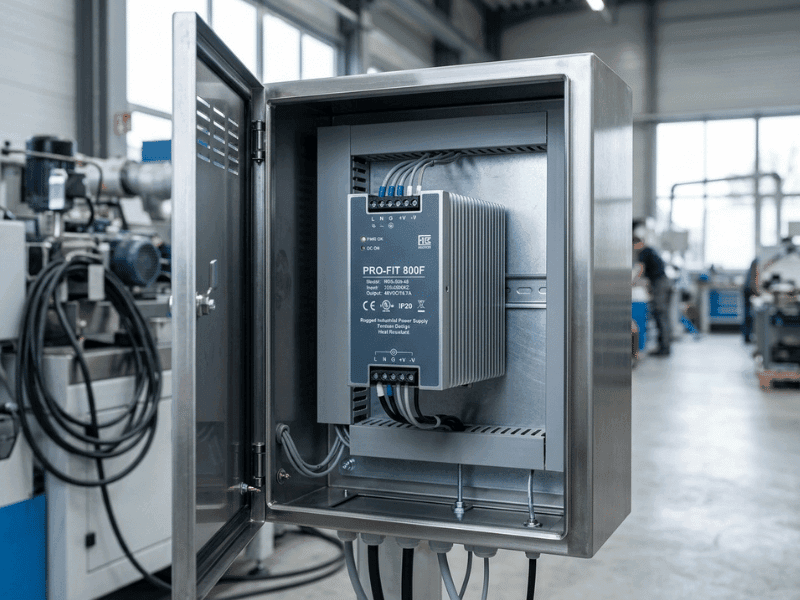
A fanless power supply uses passive thermal management—conduction cooling and natural convection—to dissipate heat without a mechanical fan. This design eliminates moving parts, reduces audible noise, and lowers the risk of particulate ingress, making fanless enclosed power supplies well-suited for industrial automation, medical equipment, outdoor kiosks, and other demanding environments.
Most engineers encounter the fan question early in a project: active cooling for efficiency, or passive cooling for reliability? For deployments in dusty factories, sealed enclosures, or noise-sensitive environments, a fanless power supply often resolves that tradeoff cleanly. No moving parts means no mechanical wear points, no particulate intake, and no fan motor drawing additional current.
This article explains how fanless power supplies work at a thermal level, outlines the application scenarios where they perform well, and walks through the key selection criteria—wattage headroom, IP rating, temperature derating, and certifications—that engineering and procurement teams need to evaluate before specifying a model. Where relevant, it also flags the questions most commonly raised during industrial procurement.
Whether you are selecting a DIN rail power supply for a factory automation cabinet or specifying a wide-temperature-range enclosed power supply for an outdoor deployment, the guidance below is intended to provide a clear technical foundation before you contact a supplier for model recommendations.
What Is a Fanless Power Supply?
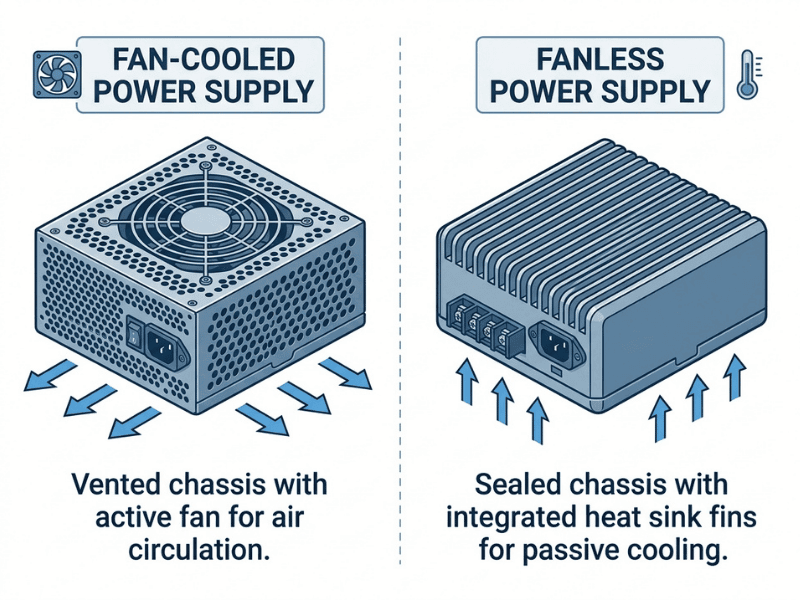
A fanless power supply is an AC-DC or DC-DC power conversion unit designed to operate without an internal cooling fan. Heat generated by the power conversion process is managed entirely through passive means: thermal conduction through the housing and natural convection of the surrounding air.
This contrasts with fan-cooled designs, which use a motorized fan to force air across internal components. Fan-cooled supplies can achieve higher power density in a given footprint, but they introduce mechanical components that are subject to wear over time—particularly in environments with elevated temperatures, humidity, or airborne particulates.
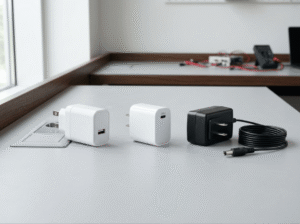
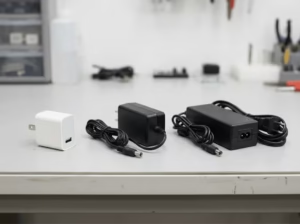
Fanless designs are available across a range of form factors. Common variants include:
- Enclosed fanless power supplies — a sealed or semi-sealed metal housing that conducts heat to external surfaces
- DIN rail fanless power supplies — designed for mounting inside industrial control cabinets on standard DIN rail
- Open-frame fanless power supplies — intended for integration into equipment where the host enclosure provides airflow or thermal mass
- IP-rated fanless power supplies — fully sealed units rated to IEC 60529 for protection against dust and water ingress
Power ratings for industrial fanless supplies typically range from a few watts up to several hundred watts, depending on the thermal management design and housing geometry.
How Do Fanless Power Supplies Work?
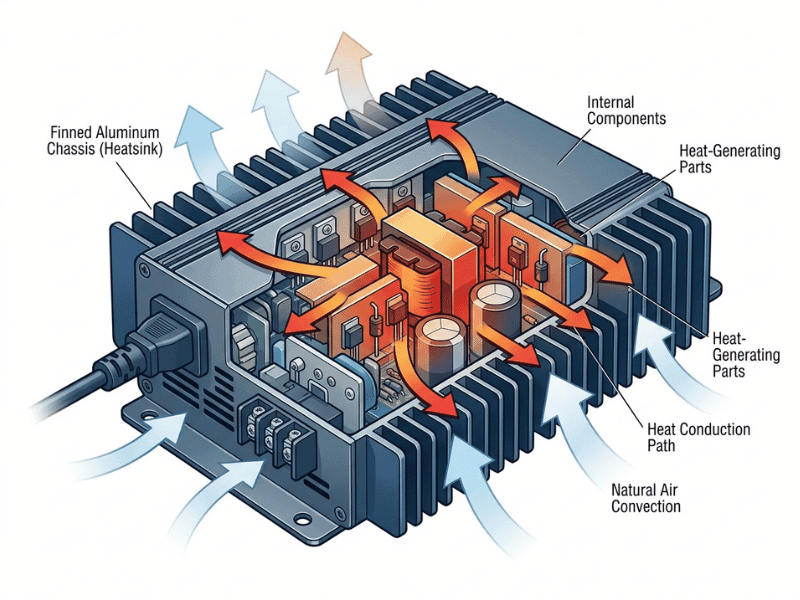
The core engineering challenge in a fanless power supply is moving heat from internal components—primarily the switching transistors, diodes, and transformer—to the environment without forced airflow. Three mechanisms carry most of this thermal load.
Conduction cooling
Heat travels from high-temperature components through thermally conductive materials (the PCB, thermal interface pads, and the metal housing) toward the unit’s outer surface. The housing acts as a heat spreader. In well-designed enclosed power supplies, the chassis is machined or cast from aluminum alloy, which offers a favorable combination of thermal conductivity and weight.
Component placement matters significantly here. Power semiconductors are typically mounted directly on the housing wall or via thermal interface materials to minimize the conductive resistance between the junction and the case.
Natural convection
Once heat reaches the outer surface of the housing, it transfers to the surrounding air through natural convection. Warm air rises away from the surface, drawing cooler air in. This process is slower than forced convection, which is why fanless supplies at a given power level generally require more surface area—and therefore a larger or differently shaped housing—than an equivalent fan-cooled design.
Fin structures, ribbed housings, and extended-surface geometries are common design features that increase convective surface area without significantly increasing the overall volumetric footprint.
Thermal derating
All power supplies have a rated output power at a defined ambient temperature, typically expressed as the maximum continuous load at or below a specific temperature (for example, 100% load up to 40°C or 50°C, depending on the model). Above that threshold, the supply is derated—meaning the maximum permissible output current decreases as ambient temperature rises—to keep internal component temperatures within safe limits.
For fanless designs, derating curves tend to be more conservative than for fan-cooled equivalents. This is a deliberate design margin, not a deficiency. Engineers specifying fanless power supplies should always review the derating curve for their target operating temperature and size the supply accordingly—leaving adequate headroom above the maximum continuous load at the highest expected ambient.
Key Benefits of Fanless Power Supplies in Industrial and Harsh Environments
The case for a fanless design is strongest where the operating environment places specific demands on the power supply’s physical robustness or acoustic profile.
Reduced mechanical failure points
Eliminating the fan motor removes one of the more common failure mechanisms in industrial power supplies. This is particularly relevant in high-temperature environments, where fan bearings degrade more rapidly, and in installations where maintenance access is infrequent or difficult.
Improved ingress protection
A sealed fanless enclosure has no ventilation apertures, which allows it to achieve higher IP ratings under IEC 60529. This is directly relevant to outdoor equipment, food-processing environments, and washdown applications, where dust, water, or cleaning agents could enter a vented housing.
Reduced audible noise
Fanless operation produces no fan noise. This matters in medical environments—operating rooms, patient monitoring areas, imaging suites—as well as in public-facing applications such as self-service kiosks and digital signage. The audible noise floor of a fanless supply is determined by transformer magnetostriction and capacitor vibration, both of which are typically low.
Simplified maintenance profile
No fan means no fan replacement interval to schedule, no filter to clean, and no airflow path to keep clear. For equipment deployed in remote or difficult-to-access locations, this reduces the total maintenance burden over the product’s service life.
Compatibility with sealed enclosures
Industrial control cabinets are often sealed or pressurized to exclude contaminants. A fanless DIN rail power supply draws no external airflow through the cabinet, preserving the enclosure’s IP integrity and simplifying thermal management for the overall system.
Typical Applications for Fanless Power Supplies
Outdoor kiosks and digital signage
Self-service terminals, ticketing kiosks, and outdoor display systems are frequently installed in locations where temperature swings are wide, and maintenance visits are infrequent. A wide-temperature, IP-rated fanless power supply is well-suited to these conditions. The sealed housing protects against rain, dust, and insects; the passive thermal design handles temperature excursions without requiring ventilation openings in the kiosk cabinet.
Factory automation and industrial control
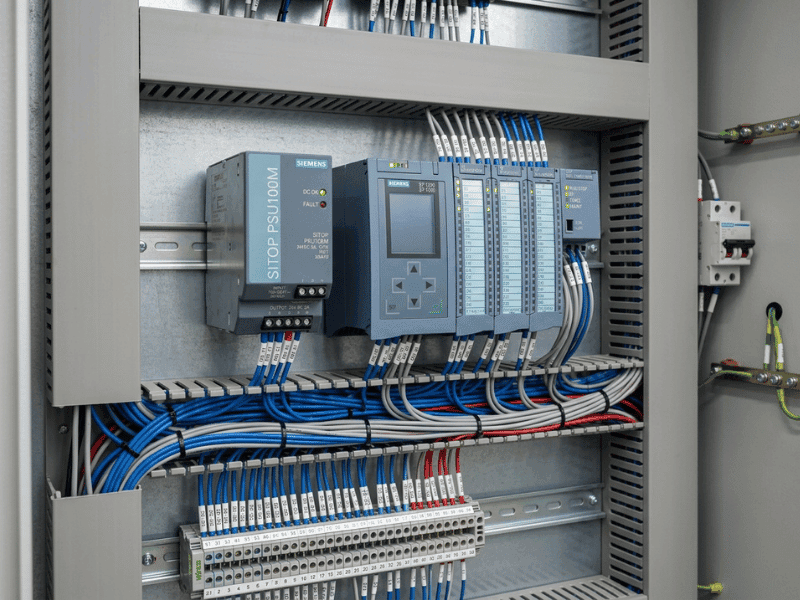
DIN rail power supplies in factory automation panels power PLCs, HMIs, relay banks, and sensor networks. These panels are often sealed against oil mist, metallic particulates, or chemical vapors. A fanless DIN rail power supply rated for the expected ambient temperature range integrates cleanly into these cabinets without creating an ingress point.
Medical equipment
In medical device design, acoustic noise, electrical safety, and long-term reliability all carry significant weight. Fanless enclosed power supplies are used in diagnostic imaging equipment, patient monitoring systems, laboratory analyzers, and surgical tools—applications that require a quiet operating environment and where the power supply may be integrated into a sealed device housing. Certifications such as IEC/EN 62368-1 (for information technology and audio/video equipment) and IEC 60601-1 (for medical electrical equipment) are typically required, depending on the device classification.
Telecom infrastructure and solar/renewables
Telecom base station equipment, remote monitoring nodes, and solar charge controllers are often deployed in outdoor cabinets or unmanned facilities. Ambient temperatures at these sites can be significantly higher or lower than standard commercial operating ranges. Wide-temperature fanless power supplies—those specified for operation across an extended temperature range—are designed for these scenarios and include protection features such as over-voltage, over-current, and short-circuit protection.
How to Choose the Right Fanless Power Supply
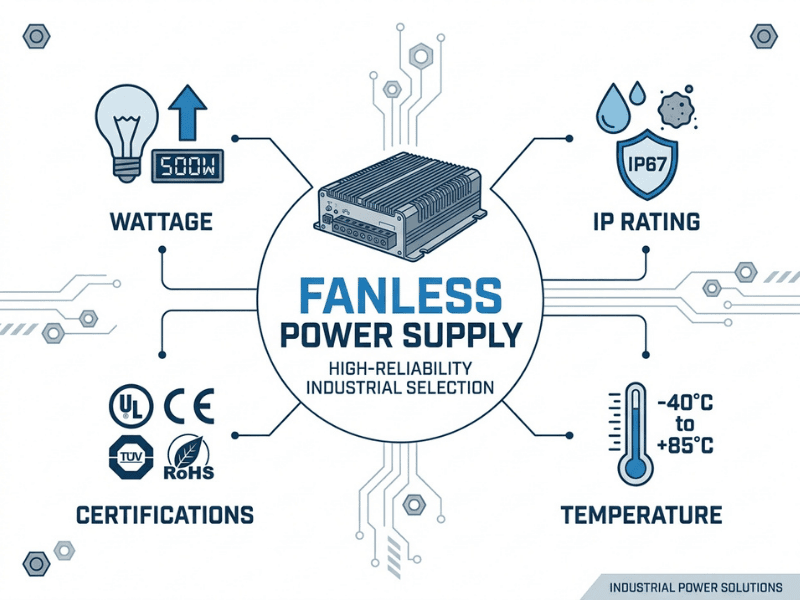
What output power rating do you need—and how much headroom is appropriate?
Start by calculating the maximum continuous power consumption of all loads the supply must support simultaneously. Add a safety margin—commonly 20–30% above the calculated maximum—to account for inrush currents, start-up transients, and component aging. This margin also provides buffer above the derating threshold at elevated temperatures.
Do not specify a supply at its rated maximum continuous output if the application will run near that level continuously in a warm ambient. Review the derating curve and confirm the derated output at your maximum operating temperature still exceeds your load requirement with margin.
What IP rating does your installation require?
IP ratings under IEC 60529 define the level of protection against solid particles (first digit) and liquids (second digit). An IP65 supply is fully dust-tight and protected against low-pressure water jets from any direction. IP67 adds protection against temporary immersion. For most industrial panel installations, IP20 (finger-safe, no specific water protection) may be sufficient if the supply is housed inside a sealed cabinet. For direct outdoor exposure or washdown environments, IP65 or higher is generally required.
Clarify the installation environment before specifying an IP rating, and confirm that the supply’s IP rating applies to the unit as shipped, not just to the housing material.
What operating temperature range does the deployment require?
Standard commercial power supplies are typically rated for operation within a defined ambient range, often up to 40°C or 50°C at full load. Industrial environments frequently exceed this. Extended-range or wide-temperature power supplies are designed for broader operating windows, including sub-zero lower limits for cold-climate deployments.
When evaluating temperature specifications, distinguish between the operating temperature range (the range over which the unit will function) and the full-load temperature limit (the temperature above which derating applies). Both figures are relevant to system design.
Which certifications are required for your application and market?
Certification requirements depend on the end product category and target market. Key certifications to review include:
- IEC/EN 62368-1 — the current safety standard for audio/video, information technology, and communications technology equipment, which has superseded IEC 60950-1 for most industrial and IT applications
- IEC 60601-1 — required for power supplies integrated into medical electrical equipment
- CE marking — required for sale in the European Economic Area, covering LVD and EMC directives
- UL listing — required for many North American industrial and commercial applications
- FCC Part 15 — relevant for conducted and radiated emissions in North American markets
Confirm that the supplier can provide verifiable certification documentation—not just declarations—before specifying a model for a regulated application.
What protection features does the supply include?
Industrial power supplies should incorporate over-voltage protection (OVP), over-current protection (OCP), and short-circuit protection (SCP) as standard. These functions protect both the power supply and the downstream load from fault conditions. Some applications also require over-temperature protection (OTP) and output hold-up time specifications. Confirm which protection features are standard and which, if any, require configuration or custom specification.
Frequently Asked Questions
What power range is available for industrial fanless power supplies?
Industrial fanless power supplies are available from a few watts up to several hundred watts, depending on the thermal design and housing geometry. Higher-power fanless designs require proportionally larger housings to maintain adequate passive thermal dissipation. For applications requiring power levels above what a standard fanless unit can deliver, a custom power solution with an optimized enclosure may be the appropriate path.
Are fanless power supplies suitable for use inside sealed industrial cabinets?
Yes. A fanless DIN rail power supply, or an enclosed power supply, is generally well-suited for installation inside sealed cabinets, since it requires no external airflow through the cabinet. The cabinet’s thermal design should account for heat dissipated by the power supply and other internal components, typically via the cabinet’s surface area or an external heat exchanger.
What protection features should an industrial fanless power supply include?
At a minimum, look for overvoltage protection (OVP), overcurrent protection (OCP), and short-circuit protection (SCP). These protect the supply and connected equipment from fault conditions. Over-temperature protection (OTP) is also standard on many industrial models. Confirm the protection features with the supplier and verify how each protection function resets—automatically or by power cycling.
Can fanless power supplies be customized for non-standard voltage or mechanical requirements?
Many industrial power supply manufacturers offer custom power solutions, including output voltage adjustment, modified connectors, custom housing dimensions, extended temperature qualification, and application-specific certifications. Lead times and MOQ requirements vary. For ODM projects with specific mechanical or electrical constraints, engaging the supplier’s engineering team early in the design cycle typically produces the most efficient outcome.
Which certifications apply to fanless power supplies for industrial versus medical applications?
For industrial and IT equipment, IEC/EN 62368-1 is currently the primary safety standard in most markets, having replaced IEC 60950-1. Medical applications require IEC 60601-1, with additional requirements depending on the device classification and intended use environment. CE marking and UL listing requirements apply based on the target market. Confirm applicable certifications with both the power supply supplier and your own compliance team before finalizing a specification.
How do I evaluate a fanless power supply’s thermal performance for my specific installation?
Review the full derating curve in the datasheet—not just the headline power rating. Identify the maximum ambient temperature for your installation and read off the derated output power at that temperature. Confirm this derated value exceeds your maximum continuous load requirement, with margin. If the datasheet does not include a derating curve, request it from the supplier before proceeding.
Talk to Quankang’s Engineering Team About Your Application
Quankang has designed and manufactured industrial and medical-grade power supplies for over 36 years, with an active portfolio spanning 5W to 1000W and a manufacturing facility certified to ISO 13485, ISO 9001, and IATF 16949.
If you are specifying a fanless enclosed power supply, DIN rail power supply, IP-rated power supply, or wide-temperature power supply for an industrial, medical, or outdoor application, our field application engineers can review your requirements and recommend a standard model or initiate development of a custom power solution.
To discuss model selection or request a technical consultation, contact the Quankang team directly. Responses are provided within 24 business hours.