Engineering Problems, Compliance Risks, and How Medical OEMs Can Prevent Redesign Delays
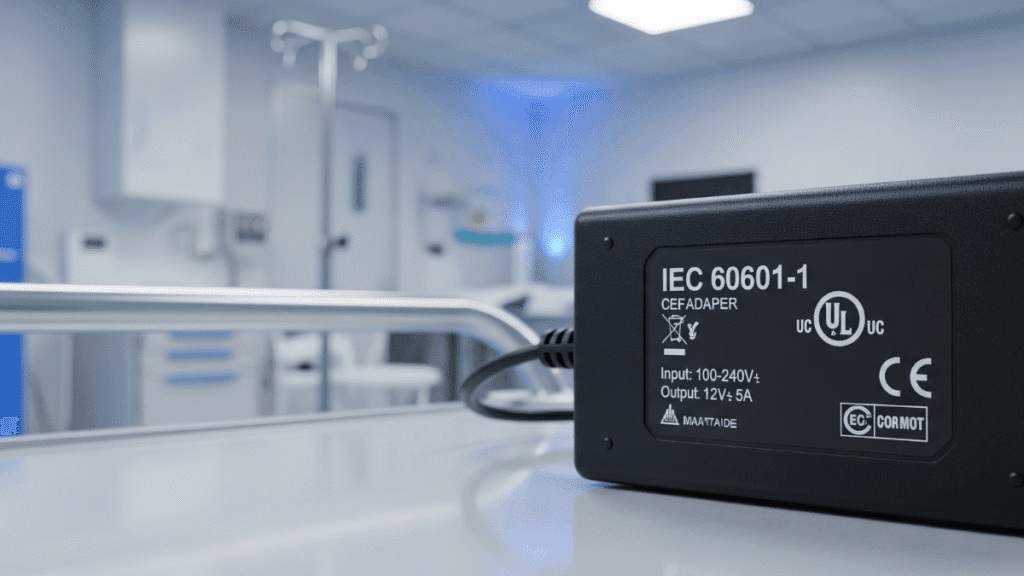
IEC 60601 certification is one of the most critical and difficult stages in medical device development.
Many medical OEM manufacturers successfully complete functional testing and prototype validation, only to encounter unexpected failures during:
- electrical safety testing
- EMC testing
- leakage current evaluation
- temperature rise testing
- surge immunity testing
- ESD verification
These failures often lead to:
- expensive redesign cycles
- delayed product launch
- repeated laboratory fees
- engineering resource waste
- regulatory approval delays
In many projects, the root cause is not a single catastrophic design error, but insufficient system-level consideration of medical power architecture, EMC behavior, isolation protection, or thermal reliability during early development.
This guide explains the most common reasons medical devices fail IEC 60601 certification and how OEM manufacturers can reduce compliance risk through proper engineering and medical power system design.
This article is part of our medical power engineering series:
→ Related Guide:
“Medical Power Supply Failures: Causes, IEC 60601 Risks, and Engineering Solutions”
→ Related Guide:
“IEC 60601 EMC Testing Problems and Solutions”
Why IEC 60601 Certification Failures Are So Common
Medical device certification is fundamentally different from consumer electronics compliance.
IEC 60601 standards evaluate not only normal operation, but also:
- abnormal conditions
- fault conditions
- patient safety risks
- electromagnetic disturbances
- long-duration reliability
Many OEM teams focus heavily on core functionality while underestimating:
- leakage current architecture
- EMC coupling paths
- grounding structure
- thermal margin
- isolation spacing
- system-level transient behavior
As a result, devices that appear electrically functional may still fail certification testing.
Real-World OEM Problem: Certification Failure After Final Prototype Freeze
A patient monitoring equipment manufacturer completed full prototype development and entered final IEC 60601 certification testing.
The device functioned correctly during internal validation and customer demonstrations. However, the product failed multiple compliance tests, including:
- conducted emissions
- leakage current
- ESD immunity
- temperature rise evaluation
The OEM initially assumed the main processor board caused the failures.
However, detailed analysis showed the primary issues originated from:
- a commercial-grade external adapter
- insufficient grounding continuity
- poor cable shielding strategy
- limited thermal margin inside the enclosure
System-Level Engineering Solution
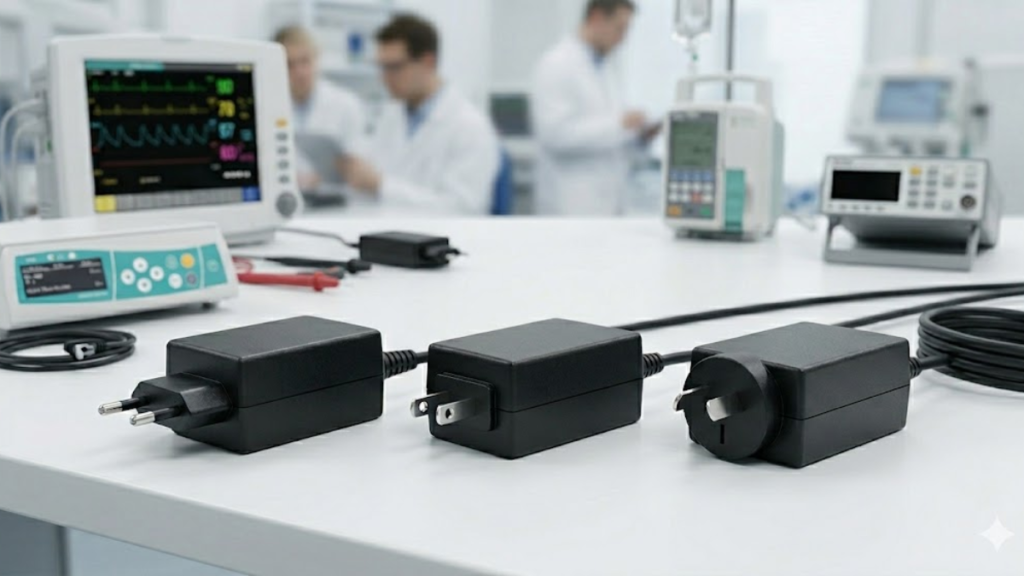
Instead of redesigning the entire control board, the OEM implemented a system-level medical power architecture update using a Quankang IEC 60601-certified medical power solution featuring:
- low-leakage EMI filter optimization
- reinforced 2×MOPP isolation
- low-ripple switching topology
- improved transient immunity
- high-efficiency thermal architecture
Additional optimization included:
- grounding refinement
- cable routing improvement
- enclosure shielding enhancement
After redesign optimization, the system successfully passed IEC 60601 certification testing while avoiding major delays to product launch.
This significantly reduced redesign cost and laboratory retesting expense.
1. Excessive Leakage Current Failure
Leakage current failure is one of the most common IEC 60601 problems.
This issue becomes especially critical in:
- ECG systems
- BF/CF patient-connected devices
- imaging systems
- portable monitoring equipment
Common Root Causes
- excessive Y-capacitor coupling
- poor isolation architecture
- insufficient transformer insulation
- uncontrolled parasitic capacitance
- commercial-grade adapters
Typical Certification Symptoms
- patient leakage current failure
- touch current failure
- inconsistent leakage results during AC polarity switching
Why It Happens
Commercial adapters often prioritize EMC suppression using large Y-capacitors, which may significantly increase leakage current.
Medical systems require balancing:
- EMC performance
- low leakage current
- patient safety isolation
Engineering Solutions
Medical-grade AC/DC power supplies reduce leakage risk through:
- optimized low-leakage EMI filtering
- reinforced transformer insulation
- controlled common-mode current
- 2×MOPP isolation protection
→ Related Resource:
“How to Reduce Leakage Current in Medical Devices”
→ Related Resource:
“What Is 2 × MOPP in Medical Power Supplies?”
2. Conducted EMC Emission Failure
Conducted emissions are among the most common EMC failures during IEC 60601-1-2 testing.
Common Root Causes
- unstable switching topology
- weak EMI filtering
- poor PCB grounding
- excessive ripple current
- noisy external adapters
Typical Symptoms
- failure near switching harmonics
- unstable EMC margin
- inconsistent laboratory results
Why It Happens
High-frequency switching currents propagate through:
- AC power lines
- cable structures
- grounding networks
Poorly optimized power systems may exceed EMC emission limits.
Engineering Solutions
Quankang medical power supplies improve EMC margin through:
- multi-stage EMI filtering
- low-ripple architecture
- controlled switching transitions
- shielded transformer design
→ Related Resource:
“Medical Power Supply EMI Troubleshooting Guide”
3. Radiated Emission Failure
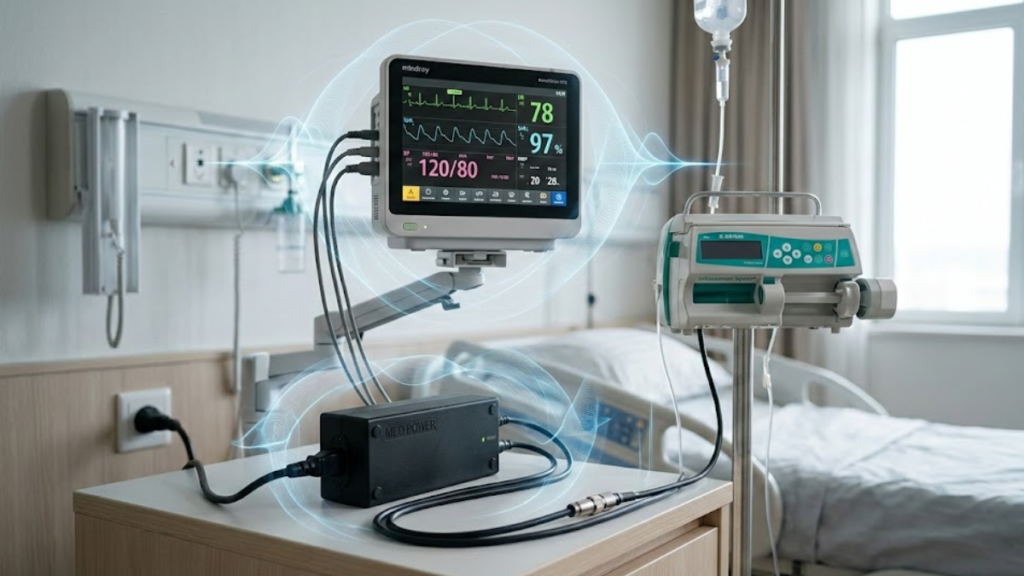
Radiated EMI failures occur when switching noise propagates through:
- cables
- enclosure openings
- PCB traces
- grounding structures
Portable medical devices are especially vulnerable because compact layouts increase coupling effects.
Common Symptoms
- failure above 100 MHz
- cable resonance peaks
- unstable wireless communication
Common Root Causes
- poor shielding continuity
- unstable grounding
- long cable loops
- high dv/dt switching edges
Engineering Solutions
System-level optimization may include:
- enclosure shielding refinement
- grounding optimization
- cable filtering
- low-noise medical power architecture
4. ESD Immunity Failure
Electrostatic discharge (ESD) failures are extremely common during IEC 60601 testing.
Medical systems may fail ESD evaluation because of:
- floating metal structures
- weak grounding continuity
- poor shielding
- insufficient transient suppression
Typical Symptoms
- MCU reset
- display freeze
- communication interruption
- temporary sensor malfunction
Why It Happens
Static discharge energy couples into:
- signal traces
- grounding structures
- communication interfaces
Sensitive analog systems are particularly vulnerable.
Engineering Solutions
Quankang engineering support may include:
- grounding optimization
- transient suppression refinement
- shielding improvement
- isolation enhancement
5. Surge and EFT Immunity Failure
Hospital electrical systems frequently generate transient disturbances caused by:
- motor startup
- backup power switching
- high-power equipment
- unstable infrastructure
Weak immunity design may result in:
- system reboot
- power interruption
- sensor instability
- permanent damage
Common Root Causes
- weak surge suppression
- insufficient hold-up time
- unstable transient response
- poor AC input protection
Engineering Solutions
Quankang medical power solutions improve immunity through:
- enhanced surge protection
- optimized hold-up time
- reinforced AC input architecture
- stable transient response
6. Temperature Rise Failure
Many medical devices fail IEC 60601 temperature rise evaluation during continuous operation.
This is particularly common in:
- fanless devices
- compact portable systems
- enclosed medical equipment
Common Root Causes
- low power conversion efficiency
- restricted airflow
- hotspot concentration
- capacitor overheating
Typical Symptoms
- enclosure overheating
- unstable operation
- unexpected shutdown
- accelerated aging
Engineering Solutions
Quankang medical adapters improve thermal reliability through:
- high-efficiency power topology
- optimized thermal derating
- long-life capacitor selection
- high-temperature validation
→ Related Resource:
“Why Medical Power Supplies Overheat”
7. Creepage and Clearance Failure
Insufficient spacing between high-voltage and low-voltage circuits may result in certification failure.
Common Root Causes
- compact PCB layout
- incorrect transformer spacing
- insufficient insulation distance
Risks
- hi-pot failure
- insulation breakdown
- long-term reliability concerns
Engineering Solutions
Medical power systems should follow proper:
- creepage distance
- clearance spacing
- reinforced insulation design
→ Related Resource:
“Creepage and Clearance in IEC 60601 Power Supplies”
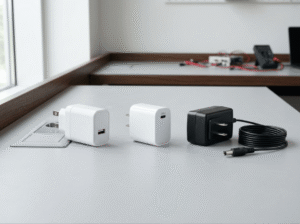
Why Commercial Adapters Often Cause Certification Failure
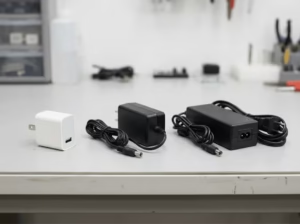
Many OEM manufacturers initially select commercial or industrial adapters during early development because they are:
- lower cost
- easily available
- electrically functional
However, commercial adapters are rarely optimized for:
- IEC 60601 leakage limits
- patient-connected systems
- low ripple medical electronics
- long-duration medical operation
- EMC margin stability
This frequently creates certification problems during final validation.
Typical Commercial Adapter vs IEC 60601 Medical Adapter
| Parameter | Commercial/Industrial Adapter | IEC 60601 Medical Adapter |
| Leakage Current | 250–500 μA+ | <100 μA (BF) |
| Isolation Protection | Basic insulation | 2×MOPP |
| EMC Margin | Minimal compliance margin | Optimized for IEC 60601-1-2 |
| Ripple Noise | Higher ripple under load | Low ripple for medical systems |
| Thermal Validation | Consumer workload | Continuous medical operation |
| Lifecycle Support | Short-term availability | Long-term OEM support |
Many certification failures originate from system-level power architecture limitations rather than the main control board itself.
How to Reduce IEC 60601 Certification Risk
Medical OEM manufacturers can significantly reduce redesign risk through early engineering planning.
Select Medical Power Architecture Early
Avoid changing power systems late in development.
Validate Under Real Operating Conditions
Test during:
- charging mode
- wireless operation
- continuous load
- elevated temperature
Optimize Grounding and Shielding Early
Not after EMC failure occurs.
Consider Leakage Current and EMC Together
Medical power design always involves balancing:
- EMC suppression
- patient leakage current
- signal integrity
Use IEC 60601-Certified Medical Power Supplies
Medical-certified adapters significantly improve:
- EMC margin
- leakage current stability
- thermal reliability
- certification success probability
Engineering Support for IEC 60601 Certification Projects
Medical OEM manufacturers frequently encounter challenges involving:
- EMC redesign
- leakage current failure
- grounding instability
- ESD immunity problems
- temperature rise failure
- certification delay risk
Quankang engineering teams support medical device manufacturers with:
- IEC 60601-compliant medical power supplies
- low-leakage AC-DC adapters
- low-noise medical power architectures
- EMC troubleshooting support
- thermal optimization assistance
- OEM and ODM engineering collaboration
Whether you are developing patient monitoring systems, portable ultrasound devices, infusion pumps, imaging equipment, or wireless healthcare products, selecting the correct medical power architecture is essential for certification success and long-term reliability.
For technical consultation regarding IEC 60601 compliance or medical power supply selection, contact Quankang engineering teams.
FAQ
Why do devices fail IEC 60601 certification?
Common causes include leakage current problems, EMC failure, thermal issues, poor grounding, and insufficient isolation.
Can the external adapter cause certification failure?
Yes. In many projects, the external adapter is a major contributor to EMC and leakage current problems.
Why do failures appear late in development?
Many issues only appear under:
- full-load operation
- elevated temperature
- EMC stress
- transient conditions
What is the most common IEC 60601 failure?
Leakage current and EMC failures are among the most common certification problems.
How can redesign risk be reduced?
Early system-level medical power planning significantly improves certification success.