TL;DR: Selecting the right AC input plug and DC output connector for a power adapter requires evaluating target markets (IEC plug type by region), conductor count (2 vs. 3 prong), and DC output needs (barrel size, polarity, current rating, locking mechanism, or USB standard). This guide covers each decision point with a 7-parameter checklist, comparison table, and common mistakes to help engineers and product teams make the right call fast.
Connector selection rarely gets the spotlight in product development, but it’s one of the most consequential decisions a hardware engineer or product manager can make. Choose the wrong AC input plug, and your adapter is dead on arrival in a new market. Specify the wrong DC output connector, and you risk compatibility failures, safety incidents, and costly redesigns.
This guide goes beyond a general overview. It’s a practical reference for product managers, hardware engineers, procurement teams, and ODM/OEM teams who need to make defensible, specification-ready decisions—covering everything from IEC plug types by region to barrel connector polarity, USB-C Power Delivery specs, locking connector use cases, and the most common mistakes that create problems downstream.
AC Input Plug Selection
How do you choose the right AC input plug by region?
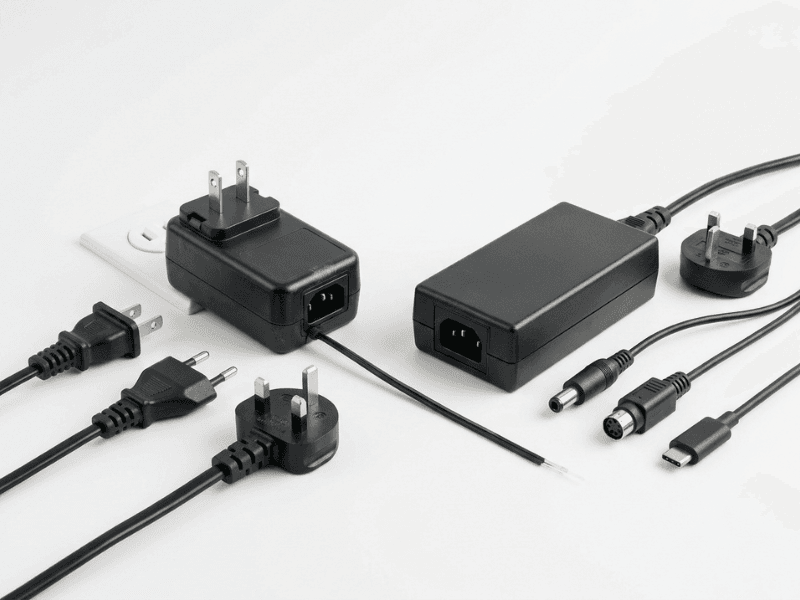
The International Electrotechnical Commission (IEC) defines 14 plug types, labeled Type A through Type N. Each corresponds to specific regions, voltage levels, and frequency standards. For any power adapter designed for multi-market distribution, this is your starting point.
Plug Type | Key Regions | Voltage | Frequency |
|---|---|---|---|
Type A | USA, Canada, Mexico, Japan, Central America | 120V (USA), 100V (Japan) | 60 Hz (50/60 Hz Japan) |
Type B | USA, Canada, Mexico (grounded) | 120V | 60 Hz |
Type C | Europe, South America, Asia, Africa (Europlug) | 220–230V | 50 Hz |
Type E | France, Belgium, Poland | 230V | 50 Hz |
Type F | Germany, Austria, the Netherlands, most of continental Europe (Schuko) | 230V | 50 Hz |
Type G | UK, Ireland, Hong Kong, Singapore, Malaysia | 230V | 50 Hz |
Type I | Australia, New Zealand, China, Argentina | 220–230V | 50 Hz |
Type L | Italy | 230V | 50 Hz |
Type N | Brazil (adopted as an IEC standard in 2011) | 127V/220V | 60 Hz |
A few nuances are worth noting. Type A plugs used in North America are polarized—the neutral blade is wider than the live blade. Japanese Type A plugs use two equal-width blades and are typically non-polarized. This means Japanese plugs fit North American outlets, but North American plugs don’t always fit Japanese sockets. For global products, the safest path is either a universal input with interchangeable blade kits or a detachable IEC inlet cord, which allows the same adapter chassis to ship worldwide with a region-specific cord swap.
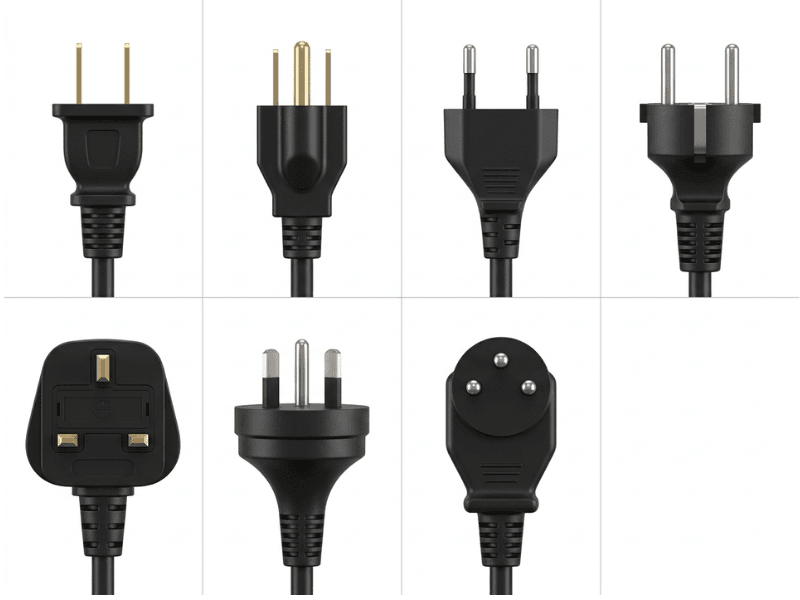
Many desktop adapters address this by providing a standard IEC C14 or C8 inlet on the chassis. Wall plug adapters often solve it with a modular blade system—interchangeable heads for Type A, C, G, I, and others snap onto the same adapter body.
Should a power adapter use a 2-conductor or 3-conductor plug?
The conductor count comes down to safety class and insulation design.
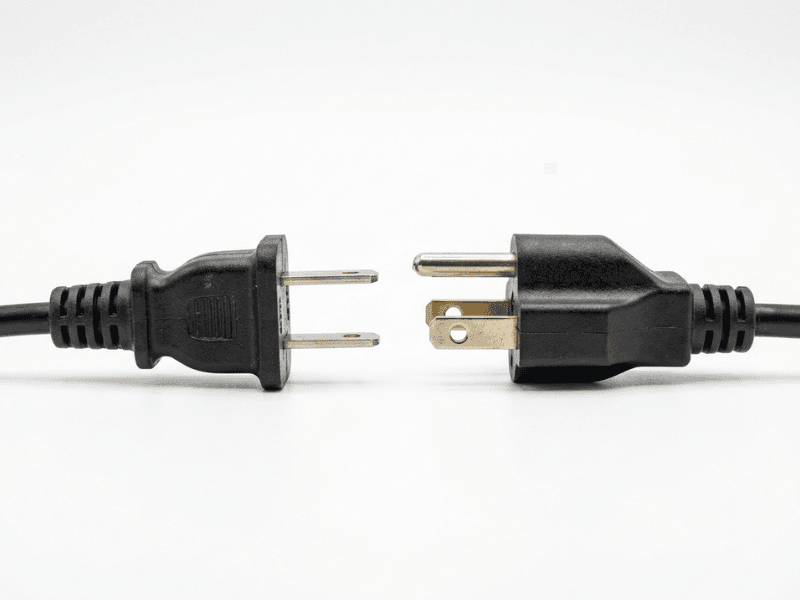
Two-conductor (ungrounded) plugs are used in Class II (double-insulated) power supplies. These designs rely on reinforced or double insulation between the primary AC circuit and any accessible parts, making a ground conductor unnecessary. This is common for consumer electronics where the output is low voltage, and the product enclosure is non-metallic.
Three-conductor (grounded) plugs are used in Class I designs, where a Protective Earth (PE) conductor provides an additional layer of safety by routing fault current to ground rather than through a user. Desktop adapters for higher-power applications, industrial equipment, and products with metal enclosures typically require a grounded plug.
The correct choice must align with the safety certifications your product needs—UL, CE, PSE, CCC, etc.—and with the regulatory requirements in each target market.
What’s the difference between Line/Neutral and Line 1/Line 2 configurations?
Single-phase AC power uses either a Line + Neutral configuration or a Line 1 + Line 2 (balanced) configuration.
In Line/Neutral systems, the Neutral conductor is held near ground potential, making it the “safer” of the two. North American Type A/B plugs enforce this polarity via asymmetric blade sizing. Most international connectors—including most Type C, E, and F variants—do not enforce polarity, so Line and Neutral can be reversed. Most loads designed for international markets do not depend on polarity.
Line 1/Line 2 configurations carry equal and opposite voltages referenced to ground. No Neutral conductor is used. This configuration is common in industrial or balanced power environments. Power adapter designs intended for these systems should not assume a grounded neutral.
DC Output Connector Selection
Barrel Connectors: Sizes, Polarity, Locking, and Orientation
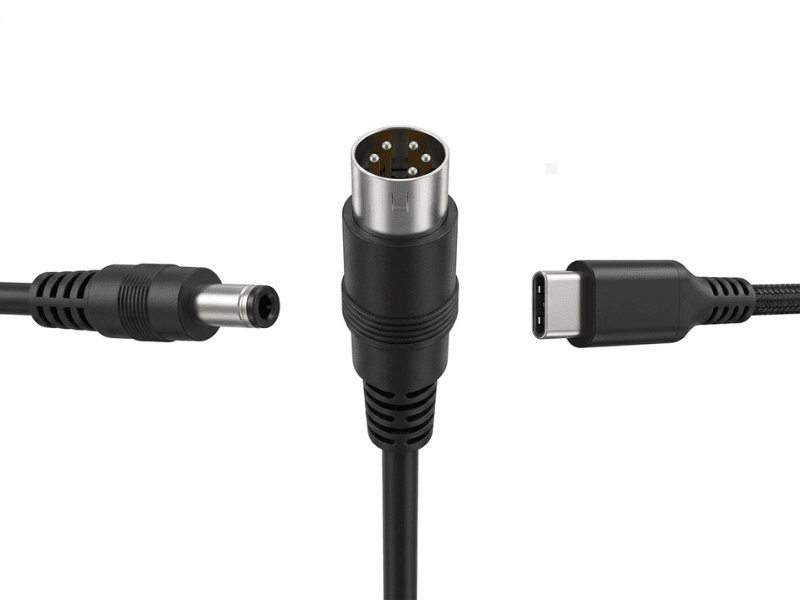
Barrel connectors are the most widely used DC output connectors in consumer and commercial power adapters—primarily because they’re inexpensive, toolless to connect, and do not require orientation to mate.
Sizing: The two most common barrel connector configurations are:
- 5.5mm outer diameter / 2.1mm inner diameter — standard for most 9V–24V applications
- 5.5mm outer diameter / 2.5mm inner diameter — common in higher-current or specialty applications
These two sizes look nearly identical but are not interchangeable. A 2.5mm plug inserted into a 2.1mm jack will not make reliable electrical contact on the center pin—this is one of the most common field failure modes. Engineers specifying barrel connectors should also define the barrel length, as this affects both insertion depth and retention.
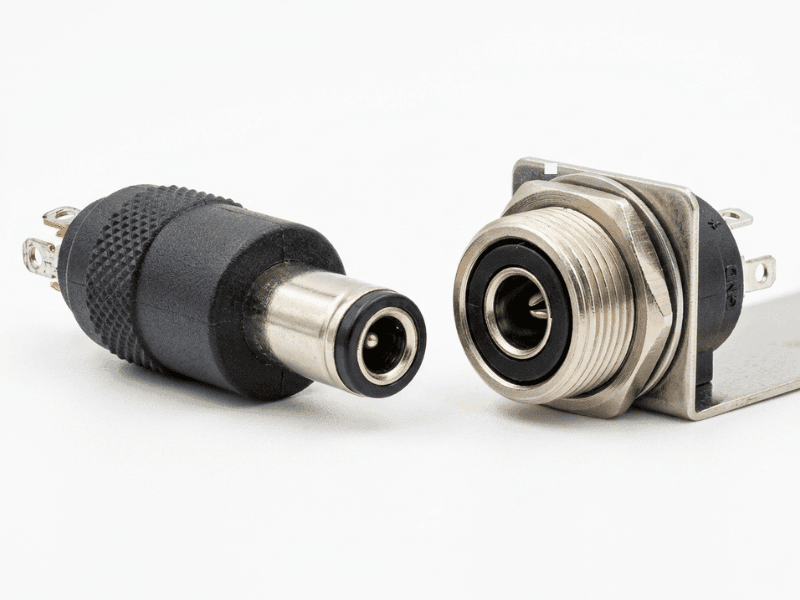
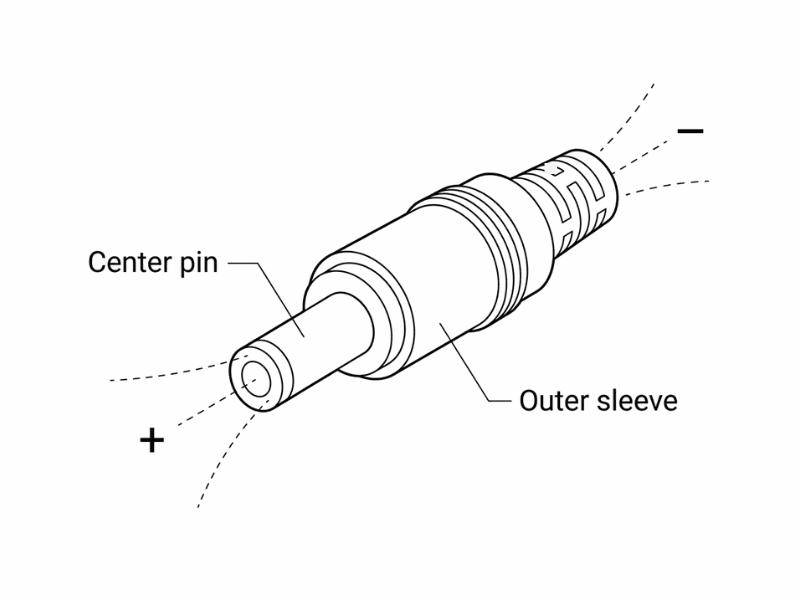
Polarity: By widely followed convention, barrel connectors are center positive—the inner pin carries the positive voltage and the outer sleeve carries ground (negative). This convention exists because if the outer sleeve inadvertently contacts an exposed conductor, it connects to ground rather than a live voltage. However, this convention is not universal. Some legacy products and certain industrial designs reverse it. Always verify and clearly label polarity using IEC 60417 symbols on the product housing.
Locking options: Standard barrel connectors have no mechanical retention mechanism—they can be pulled free accidentally. Two locking variants solve this:
- Threaded locking: A hex nut on the jack mates with a threaded collar on the plug. Reliable in vibration-prone or industrial environments.
- Twist-lock: A quarter-turn locks the plug in place. Faster to operate than threaded, but provides less holding force.
For applications subject to vibration, repeated handling, or where accidental disconnection would cause system failure, a locking barrel connector is the correct specification.
Orientation—Straight vs. Right-Angle: Straight (in-line) plugs are the default and easiest to manufacture. Right-angle plugs are useful when cable routing must stay parallel to the chassis surface (reducing the physical footprint) or when mechanical retention is needed—a cable under tension will torque a right-angle connector against its jack rather than pull it straight out, providing passive retention without a locking mechanism.
Current limits: Barrel connectors have relatively modest current-carrying capacity. The cantilevered spring contact inside the barrel jack limits surface area and contact force. For most standard barrel connectors, ratings in the 3A–5A range are typical. Exceeding this risks heating, voltage drop, and contact degradation.
DIN Connectors: When Do They Outperform Barrel?
DIN power connectors, defined by IEC 60130-9, use four contacts arranged at approximately 90-degree intervals within a circular housing. Originally standardized by Deutsches Institut für Normung (DIN), these connectors are now an IEC standard.
DIN connectors belong in the specification when:
- The application requires a higher current than a barrel connector can reliably handle
- Durability is a priority—DIN housings are more robust than the cantilevered-spring mechanism of a barrel connector
- A locking variant is needed (threaded DIN connectors are available)
DIN connectors are commonly found in medical equipment power supplies, industrial control systems, and high-reliability embedded applications. They cost more than barrel connectors and require correct orientation during mating, but their superior current capacity and durability justify the premium in demanding use cases.
USB Connectors: Type-A, Micro, and USB-C Power Delivery
USB connectors were developed for simultaneous data and power transfer, but they’ve increasingly been used as power-only connectors in consumer adapters and charging applications.
USB Type-A: The classic rectangular connector supports up to 5V at approximately 1–2A under the base USB specification—roughly 5–10W. Widely recognized and accepted by end users, but limited in power delivery, and only mates in one orientation. Appropriate for 5V-only applications where simplicity matters.
USB Micro/Mini: Functionally similar to Type-A in terms of power limits, but with smaller form factors. Common in legacy devices. Being phased out in many markets in favor of USB-C.
USB-C with Power Delivery (PD): The most capable option. USB-C connectors are reversible (either orientation mates correctly), compact, and support the full USB Power Delivery specification.
- Standard Power Range (SPR): Up to 20V at 5A = 100W
- Extended Power Range (EPR), USB PD Revision 3.1: Supports 28V, 36V, and 48V at 5A = up to 240W
- Programmable Power Supply (PPS): Within SPR, allows voltage adjustment from 3.3V to 21V in 20mV increments
- Adjustable Voltage Supply (AVS): Within EPR, allows 15V–48V adjustment in 100mV steps
USB-C with EPR is now capable of replacing traditional barrel connectors in high-power applications, including gaming laptops and high-performance embedded systems. One important constraint: USB-C connectors should only be used on adapters with negotiated voltage outputs. A standard USB Type-A or Micro-USB jack connected to a device expecting 5V will be damaged if the supply outputs 12V or 19V. USB-C PD prevents this through a handshake protocol—source and sink negotiate the contract before full voltage is applied.
7-Parameter Connector Selection Checklist
Before finalizing any power adapter connector specification, verify each of the following:
- Output voltage — Determines minimum insulation requirements for the connector and informs USB-C PD tier if applicable
- Output current — Must not exceed the connector’s rated current; barrel connectors typically cap at 3–5A without derating
- Plug/jack dimensions — For barrel connectors: outer diameter, inner diameter, and barrel length; avoid the 2.1mm/2.5mm mismatch trap
- Polarity — For barrel connectors: confirm and label center positive or center negative per IEC 60417
- Locking requirement — Evaluate whether vibration, industrial use, or criticality of continuous power justifies a threaded or twist-lock mechanism
- Environmental conditions — Indoor/bench use, outdoor exposure, IP rating requirements, and temperature range
- Cable strain and space constraints — Straight vs. right-angle plug, cable management needs, and chassis footprint
Connector Type Comparison: Barrel vs. DIN vs. USB-C
Barrel Connector | DIN Connector | USB-C (PD) | |
|---|---|---|---|
Best for | Low-to-mid power DC devices, cost-sensitive designs | Higher-current moderate power, industrial/medical | Consumer electronics, PD-capable devices |
Typical max current | 3–5A | Higher than the barrel | 5A (up to 240W with EPR) |
Cost | Low | Medium | Medium |
Orientation required | No | Yes | No (reversible) |
Locking available | Yes (threaded, twist-lock) | Yes (threaded) | No (CC pins only) |
Signal transmission | No | No | Yes |
Standardization level | Loose (dimensions vary) | IEC 60130-9 | Fully standardized (USB-IF) |
Typical use cases | Routers, cameras, instruments, embedded systems | Industrial controls, medical PSUs | Laptops, tablets, consumer devices |
Common Mistakes to Avoid
1. Ignoring polarity on barrel connectors
Center positive is the convention, not a standard. Some products—particularly legacy designs—use a center-negative configuration. Using the wrong polarity will damage the load, sometimes irreversibly. Always verify with a multimeter and add IEC 60417 polarity markings to the product label.
2. Barrel plug size mismatches (2.1mm vs. 2.5mm)
These two sizes look almost identical on the shelf and feel similar during insertion—but a 2.5mm plug in a 2.1mm jack produces intermittent contact on the center pin. This is a frequent cause of field returns and difficult-to-reproduce failures. Explicitly call out both inner and outer diameters in your BOM and product documentation.
3. Using USB Type-A or Micro-USB on non-5V adapters
Devices with USB jacks expect 5V. Connecting a 12V or 19V supply with a USB Type-A or Micro-USB plug will destroy the downstream device. Use USB-C with PD negotiation if your adapter needs to output voltages above 5V via a USB connector.
4. Omitting locking connectors in high-vibration environments
Standard barrel connectors have no retention mechanism. In applications involving vibration—industrial machinery, robotics, transportation, outdoor equipment—an accidental disconnection can cause system failure or create a safety hazard. If your product operates in any of these environments, threaded or twist-lock barrel connectors are a non-negotiable specification.
5. Ignoring regional certification requirements for AC plugs
Selecting the right plug geometry is only part of the compliance picture. Each major market has its own safety certification body: UL/CSA in North America, CE marking in Europe, PSE in Japan, CCC in China, SAA in Australia, and BIS in India, among others. Using an uncertified plug assembly in a regulated market is a product liability issue. Verify certification requirements for every target geography before finalizing the AC input.
Frequently Asked Questions
Can I use a 2.5mm barrel plug in a 2.1mm jack?
No. A 2.5mm inner-diameter plug is slightly larger than a 2.1mm jack will accept cleanly. Forcing the connection will result in poor or intermittent contact on the center pin. In some cases, the plug may appear to seat but deliver unreliable power. Always match inner and outer diameters exactly.
Are all barrel connectors center positive?
No. The center-positive—where the inner pin carries positive voltage, and the outer sleeve carries ground—is the dominant convention, but it is not a universal standard. Some legacy products and specialty designs use a center-negative configuration. Always verify polarity before connecting any barrel-jack power supply to a load, and mark polarity explicitly on the product housing using IEC 60417 symbols.
When should I choose a locking DC connector?
Specify a locking connector (threaded or twist-lock barrel, or threaded DIN) whenever the application involves vibration, repeated connection cycles, outdoor or industrial environments, or any scenario where an accidental disconnection would cause system failure or a safety hazard. Standard barrel connectors rely only on spring tension for retention, which is insufficient in high-motion or critical-reliability applications.
Is USB-C better than a barrel connector for a power adapter?
It depends on the application. USB-C with Power Delivery is fully standardized, reversible, supports up to 240W with USB PD Revision 3.1 EPR, and enables intelligent voltage negotiation—making it the right choice for consumer electronics, laptops, and multi-device charging scenarios. Barrel connectors are lower-cost, require no protocol stack, and remain appropriate for fixed-voltage, low-power applications where interoperability with existing devices is a priority.
Do I need a 2-prong or 3-prong power adapter?
This depends on the safety class of your design. Class II (double-insulated) designs can use a 2-prong plug because their insulation provides sufficient protection, eliminating the need for a protective earth connection. Class I designs require a 3-prong plug to route fault current to ground. Your required safety certifications and the output power level of the adapter will determine which class—and therefore which plug type—is appropriate.
What is USB PD Extended Power Range (EPR), and when does it apply?
USB PD Revision 3.1 introduced Extended Power Range (EPR), which extends USB-C power delivery from the previous 100W cap (Standard Power Range) to a maximum of 240W, using voltages of 28V, 36V, or 48V at 5A. EPR requires compatible cables and connectors, and a PD handshake to verify EPR capability before elevated voltage is applied. EPR is relevant for power adapters targeting high-performance laptops, gaming systems, and other devices that previously required proprietary high-wattage barrel connectors.
Start with the Right Specification
Getting connector selection right the first time prevents costly rework, failed market entries, and field reliability issues that are difficult to trace back to their source. The core principle is straightforward: match the AC input to the target market’s regulatory environment and the DC output to the electrical and mechanical demands of the load.
For product teams in the specification stage, the checklist and comparison table in this guide provide a reusable framework. For procurement and ODM/OEM teams, the common mistakes section highlights the mismatches most likely to create problems in production and the field. If you have a specific application to evaluate, consult your power supply manufacturer’s application engineering team—most maintain dedicated resources for exactly these connector-level decisions.