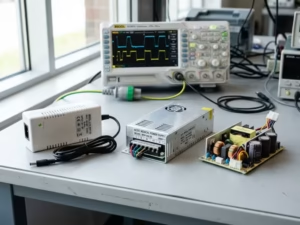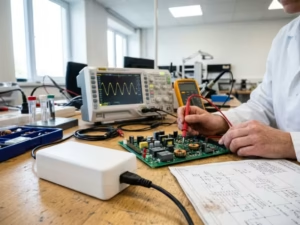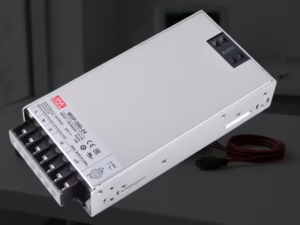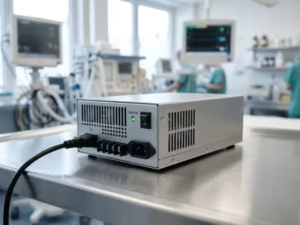
Several external power supply categories — including wall-plug adapters, desktop adapters, interchangeable-plug adapters, open-frame PSUs, medical-grade supplies, and USB-C/PD adapters — offer models designed to meet Level VII efficiency requirements. Whether a specific unit qualifies depends on its output power, no-load power draw, voltage classification, and applicable regional scope.
This guide provides a category-level shortlist to help you narrow your options, a structured verification process for confirming compliance at the model level, and application-specific guidance to support your selection. It is not an exhaustive catalog of verified models. Final compliance decisions should always be confirmed against current official rules, individual model datasheets, and the applicable regional requirements for your target market.
What Is Level VII Efficiency?
Level VII efficiency is widely recognized as the next benchmark for external power supplies under U.S. Department of Energy (DoE) standards. It is expected to set stricter active-mode efficiency targets and reduce the no-load power allowance by roughly 25% compared with Level VI. Manufacturers and importers shipping external power supplies into regulated regions — including the United States — should plan for these requirements as part of their product roadmap.
The standard targets two main sources of energy waste: losses during normal operation, and power drawn silently when a device sits idle. A supply that meets Level VII efficiency requirements must perform efficiently across its full load range — not just at peak output.
Consumer, medical, industrial, and networking products that ship with an external adapter are generally expected to fall within scope. If you design or source those products, it is worth confirming now whether DoE Level VII rules apply to your specific product classification and target region.
Transparency note: Regulatory implementation timelines and exact applicability can change. Always verify the current compliance status of any product against the latest published rule and official certification database before making sourcing or design decisions.
Class A vs. Non-Class A: Why the Distinction Matters
Not all external power supply Level VII requirements work the same way. The scope divides into two groups, and the difference determines which efficiency thresholds apply.
- Class A external power supplies convert AC to low-voltage DC, use a single output voltage, and meet defined size and use criteria. They face the core active-mode efficiency and no-load limits.
- Non-Class A external power supplies include multiple-voltage units, high-power designs, and certain specialized supplies. They may fall under different tiers or qualify for exemptions.
Confirm your product’s classification before assuming a specific compliance target. Getting this wrong can cause a failed certification late in the development cycle — at the point where it is most expensive to fix.
Power Supply Categories That Can Support Level VII Efficiency
Many product categories include units designed to meet Level VII efficiency requirements. The table below maps common categories to typical wattage ranges, Level VII support status, best-fit applications, and the key compliance risk to watch for in each type.
Use this as a starting filter. Compliance is always confirmed at the individual model level — no category is automatically compliant.
Power Supply Category | Wattage Range | Level VII Support | Best For | Key Compliance Risk |
|---|---|---|---|---|
Wall-plug adapters | 5W–30W | Available in select models | Consumer devices, small electronics | Low-cost variants often miss no-load targets |
Desktop adapters | 24W–300W | Available in select models | Medical, networking, industrial | Wide variation across models in the same family |
Interchangeable plug adapters | 10W–65W | Available in select models | Global / multi-region products | Performance may vary across regional variants |
Open-frame external PSUs | 60W–330W | Depends on design | Automation, instrumentation | Results vary significantly by topology |
Medical-grade external supplies | 30W–250W | Available in select models | Patient-contact and lab equipment | Must satisfy both efficiency and safety isolation requirements |
USB-C / PD adapters | 15W–140W | Available in select models | Consumer & portable electronics | Marketing claims can outrun actual specification compliance |
This table gives you a category-level shortlist. To build a model-level list for your project, request the datasheet, no-load power figure, and compliance documentation for each specific unit you are evaluating.
Why Compliance Must Be Verified at the Model Level
A category name describes the form factor. It says nothing about whether a specific unit passes Level VII. Two desktop adapters in the same wattage class can produce very different efficiency results — one clears the standard, the other does not.
The deciding factor is design. Conversion topology, component selection, and how a supply is tuned for low-load and no-load conditions all determine the final efficiency figures. The same product family can contain both compliant and non-compliant units. Only the datasheet — and the formal compliance record on file — can confirm a specific model’s status.
How to Verify Level VII Compliance
Before finalizing any specification, work through this checklist. It typically takes only a few minutes and prevents costly corrections later.
- Check the datasheet for an explicit compliance statement — look for “DoE Level VII” or an equivalent regional reference.
- Confirm the no-load power figure falls within the Level VII limit for that wattage tier.
- Verify the unit is in scope as an external power supply, and confirm its Class A or non-Class A classification.
- Match the wattage tier to the correct efficiency threshold — requirements scale with output power.
- Review the test conditions cited in the datasheet to confirm they reflect the official test method.
- Check regional markings and certification claims for every market where you plan to ship.
If a datasheet omits efficiency or no-load figures, treat that as a red flag. Credible suppliers publish these numbers clearly. Missing data signals a need for harder questions before you commit.
Level VII Compliance Verification Checkpoints
Use this table when evaluating a specific model. Each checkpoint maps to a practical review action and explains why it matters.
Checkpoint | What to Review | Why It Matters |
|---|---|---|
Datasheet compliance statement | Look for explicit “DoE Level VII” or equivalent wording | Confirms the supplier has tested and positioned the unit for the standard |
No-load power consumption | Compare the stated standby draw against the Level VII limit for the wattage tier | No-load performance is the most common compliance failure point |
Output voltage classification | Identify basic voltage (≥6V) vs. low voltage (<6V, ≥550mA) | Different efficiency thresholds apply depending on the voltage class |
Product classification | Confirm Class A or non-Class A status | Determines which compliance pathway and thresholds apply |
Wattage tier | Match output power to the correct efficiency band | Minimum efficiency targets differ across wattage ranges |
Test method alignment | Verify specs reflect the official measurement conditions | Prevents comparisons based on non-standard or favorable test setups |
Regional certification marking | Check for DoE compliance marking and applicable regional equivalents | Required for legal import and sale in regulated markets |
If a supplier cannot address each of these checkpoints with documentation, request formal test reports before proceeding.
Can You Keep Using a Level VI Adapter?
It depends on your timeline and what you are launching. Existing inventory and products already on the market often fall under transition provisions that allow continued use for a defined period.
For new designs and fresh certifications, plan to specify a Level VII compliant supply. Re-qualification or replacement is typically required when you launch a new design, refresh an existing product, or begin shipping into a market where the new standard is enforced. Starting that process early prevents supply gaps from disrupting your schedule.
Level VII Power Supplies by Application
The right Level VII supply depends heavily on your use case. Power requirements, safety standards, and duty cycles all shift the priorities. Here is what to focus on — and watch out for — across four common applications.
Medical Devices
Medical equipment must satisfy both patient-safety isolation requirements and efficiency targets simultaneously. A compliant medical-grade supply must meet Level VII requirements and reinforced isolation and regulatory safety standards, which impose meaningful design and certification constraints.
- Prioritize reinforced or double isolation alongside Level VII compliance.
- Typical wattage ranges from roughly 30W to 250W across desktop and external form factors.
- Confirm both efficiency compliance and medical safety certifications (such as IEC 60601-1) on the datasheet before specifying.
- Common buying mistake: Sourcing a general-purpose Level VII adapter and assuming it satisfies medical safety requirements. It usually does not — medical-grade certification is a separate and additional requirement.
Industrial Automation
Industrial environments prioritize reliability and thermal performance. Efficiency must hold up across wide operating temperature ranges, not just at room temperature. Open-frame and panel-friendly supplies are standard, but Level VII compliance varies widely across this segment.
- Open-frame external PSUs are well-suited for cabinet and equipment integration.
- Verify efficiency performance across the full temperature range your application demands.
- Confirm Level VII support at the design level — results vary significantly across open-frame topologies.
- Common buying mistake: Selecting a unit based on room-temperature datasheet figures without checking performance at operating extremes.
Networking Equipment
Networking gear typically runs continuously, so low no-load and light-load power draw translates directly into measurable energy savings. Level VII’s tighter idle limits benefit always-on equipment more than almost any other category.
- Desktop adapter ranges fit most routers, switches, and access points.
- Prioritize strong light-load efficiency for equipment running 24/7.
- Across a large fleet, even small reductions in no-load draw compound into significant annual energy cost savings.
- Common buying mistake: Focusing only on rated output efficiency and overlooking standby draw, which dominates real-world consumption for always-on devices.
Consumer Electronics
Consumer products balance unit cost against compliance requirements. Wall-plug and USB-C PD adapters dominate this space, and at high shipment volumes, efficiency improvements — even modest ones — compound quickly across a product portfolio.
- Wall-plug and USB-C/PD adapters cover most consumer needs.
- Balance cost-per-unit with no-load and active efficiency requirements for each target market.
- Products shipping across multiple regions benefit from interchangeable plug designs — but verify that regional variants meet the efficiency requirements for each market, not just the primary one.
- Common buying mistake: Accepting a supplier’s Level VII marketing claim without requesting model-level documentation to back it.
Level VI vs. Level VII: What Changed and What to Do About It
The shift from Level VI to Level VII tightens requirements in two key areas: no-load power draw and active-mode efficiency. The table below maps each major change to the practical action buyers and designers should take.
Factor | Level VI | Level VII Direction | What Buyers and Designers Should Do |
|---|---|---|---|
No-load power draw | Higher allowance (up to ~0.10W–0.21W depending on wattage) | ~25% tighter — many adapters expected to target ≤0.075W | Recheck standby specs; do not assume a Level VI unit passes |
Active efficiency targets | Previous baseline across the load range | Stricter average efficiency, particularly at light loads | Validate efficiency across the full load curve, not just at peak |
Low-load performance (10–25% load) | Less emphasized | Now, a key compliance checkpoint | Request light-load efficiency data from suppliers |
Transition for existing units | Current enforced standard | Incoming standard — transition rules apply | Audit your supply chain now; identify units that will require replacement |
Scope | External power supplies | External power supplies (updated thresholds) | Confirm whether your specific product class and region are affected |
Common failure mode | N/A (was compliant baseline) | No-load power and light-load efficiency | Run compliance checks against both metrics before finalizing any spec |
Planning horizon | Already in place | Plan ahead of the effective date | Build in lead time for supplier qualification and re-certification |
Do not assume a Level VI unit automatically passes Level VII. Many will require redesign or re-selection. Starting the transition process early is the single most effective way to avoid schedule disruption and supply shortfalls.
Frequently Asked Questions
What is Level VII efficiency for power supplies?
Level VII is the anticipated next DoE efficiency standard for external power supplies. It is expected to raise active-mode efficiency requirements and reduce the no-load power allowance by roughly 25% compared with Level VI. The goal is to cut energy waste both during active use and when a device sits idle. Always verify the current implementation status against official DoE documentation.
Which power supplies need to comply with Level VII?
External power supplies sold into regulated regions — including the U.S. — are generally expected to need compliance. This typically covers adapters shipped with consumer, medical, industrial, and networking products. The specific threshold depends on the unit’s wattage tier and its Class A or non-Class A classification. Confirm your product’s compliance pathway against the current published rule.
Are all external power supplies required to meet Level VII?
No. Scope depends on product classification and intended use. Class A external power supplies face the core efficiency and no-load requirements. Some non-Class A and specialized supplies fall under different tiers or may qualify for exemptions. Confirm your product’s classification before assuming which threshold applies.
How can I verify if a power supply supports Level VII efficiency?
Check the datasheet for a clear DoE Level VII compliance statement or equivalent regional reference. Confirm the no-load power figure meets the tighter limit, and verify that the test conditions match the official method. Use the verification checkpoint table in this guide as a structured starting point. If key figures are missing, request formal test reports from the supplier before proceeding.
What is the difference between Level VI and Level VII?
Level VII is expected to lower the no-load power limit by roughly 25% and set stricter average active-mode efficiency targets, particularly at light loads. The scope remains focused on external power supplies, but the thresholds are tightened across wattage tiers. In practical terms, Level VII requires supplies to waste less energy across the full operating range — not just at peak load.
Can I still use an existing Level VI adapter?
In many cases, yes — for existing inventory and products already on the market, transition provisions often allow continued use for a defined period. For new designs and certifications, plan to specify a Level VII compliant supply. Replacement or re-qualification is typically required when launching or significantly refreshing a product. Check current transition rules for your specific region and product class.
What wattage range does Level VII cover?
Level VII is expected to apply across the external power supply range, but efficiency and no-load targets vary by wattage tier. Lower-power adapters and higher-power supplies face different thresholds. Always match the specific requirement to your unit’s rated output before finalizing a specification.
How do I know if a supplier’s Level VII claim is credible?
Ask for three things: an explicit compliance statement in the datasheet referencing DoE Level VII, the actual no-load power figure for the specific model, and a formal test report from an accredited lab. If any of these are unavailable or vague, treat the claim as unverified until documentation is provided.
Can one product family contain both compliant and non-compliant models?
Yes — and this is one of the most common sourcing errors. Compliance is determined at the individual model level by design choices like topology, component selection, and no-load tuning. Two models in the same product family at the same wattage can produce different results. Never assume family-wide compliance based on one model’s datasheet.
What documents should I request before approving a Level VII power supply?
At minimum, request: the product datasheet with explicit compliance wording, the stated no-load power figure, efficiency data at light load (10–25%), a formal test report from an accredited laboratory, and regional certification marking details for your target markets.
Final Recommendations
- No product category is automatically Level VII compliant — qualification is confirmed at the individual model level.
- The datasheet is the primary source for verifying compliance status, but it must include explicit compliance wording, not just general efficiency claims.
- No-load power consumption is the first figure to check and the most common point of compliance failure.
- Use the verification checkpoint table in this guide to structure your supplier conversations before committing.
- Match each supply to the right application, wattage tier, and target region — then validate with documentation, not assumptions.
- Start your Level VII transition planning now. Certification timelines and component availability can extend your lead time beyond what you expected.
Take the Next Step
Finding Level VII compliant power supplies starts with knowing which categories and models to evaluate — and having the right documentation to confirm compliance before you commit.
Browse Level VII Power Supplies
Explore our range of external power supply solutions across wattage tiers, form factors, and applications — with compliance information available for each product family.
Request Specifications and Datasheets
Need efficiency figures, no-load power data, or compliance documentation for a specific model? Contact us, and we will send the specs you need.
Get a Compliance Recommendation
Not sure which unit fits your application, wattage requirement, or target region? Our team can help you identify the right Level VII compliant supply for your design.