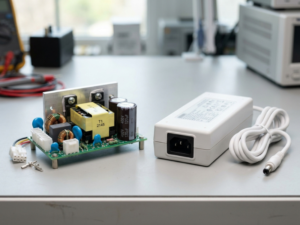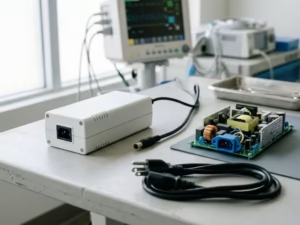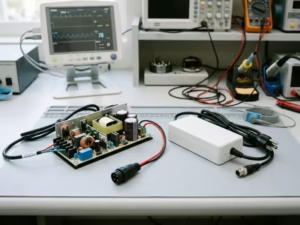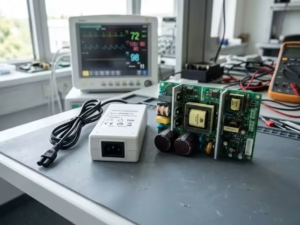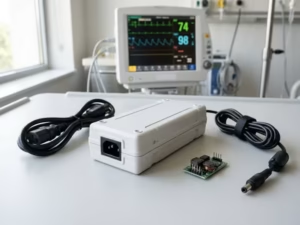
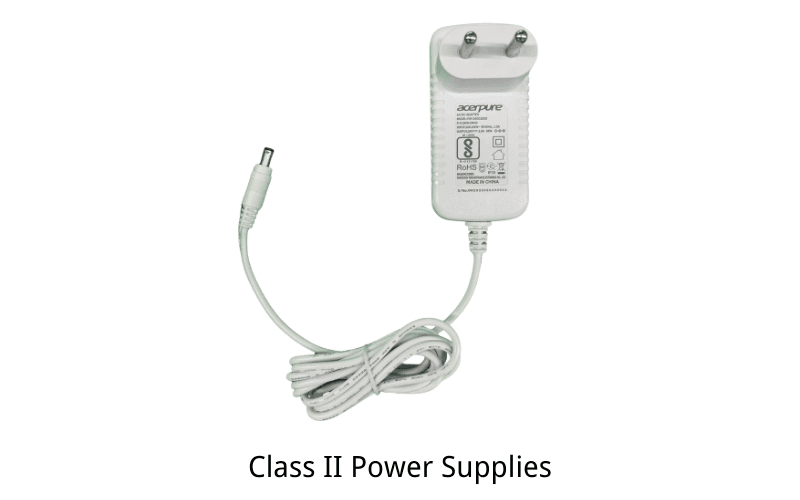
Ever noticed that your refrigerator has a three-prong plug, but your phone charger gets by with just two? That small difference isn’t random. It reflects two distinct strategies for protecting people from electric shock, and in power supply design, those strategies have names: IEC Class I and Class II.
Choosing the right one shapes far more than the plug. It affects your bill of materials, your enclosure choice, your EMC performance, and even the final weight of your product. This guide breaks down the core differences, the engineering principles behind them, real-world examples, and a clear way to decide—so engineers and procurement teams can choose with confidence.
30-Second Quick Answer
If you just want the conclusion, here it is:
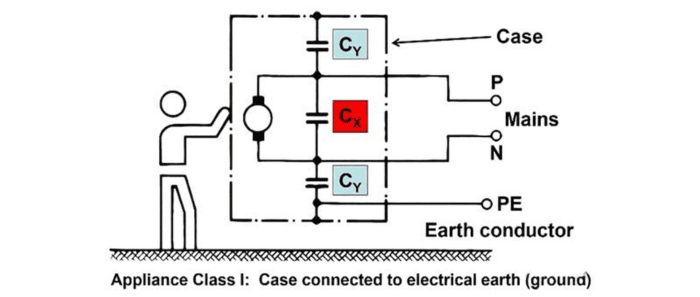
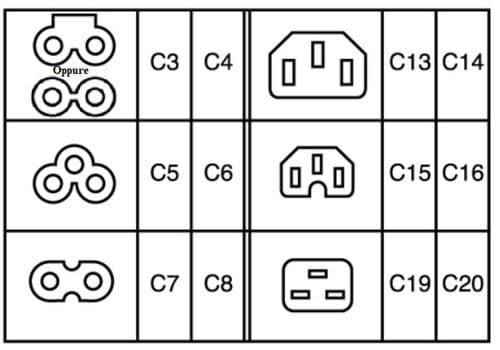
- IEC Class I power supply: Relies on basic insulation plus a protective earth (ground) to prevent electric shock. If the insulation fails, the fault current is safely routed to ground. These units typically use a 3-core input cord and a 3-pin inlet.
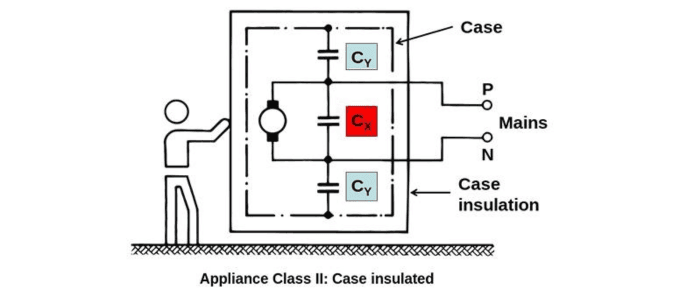
- IEC Class II power supply: Relies on double insulation or reinforced insulation, with no protective earth required. These units typically use a 2-core input cord and a 2-pin inlet (such as IEC60320 C8 or C18).
An easy way to remember it: Class I relies on grounding as its backup, while Class II relies on additional insulation. Neither is more advanced than the other. They’re simply two different routes to the same goal—a safe product.
Class I vs Class II Power Supply Comparison Table
Criteria | IEC Class I Power Supply | IEC Class II Power Supply |
|---|---|---|
Protection principle | Basic insulation + protective earth | Double or reinforced insulation |
Grounding required | Yes (mandatory) | No |
Input connection | 3-core cord, 3-pin inlet | 2-core cord, 2-pin inlet (C8/C18) |
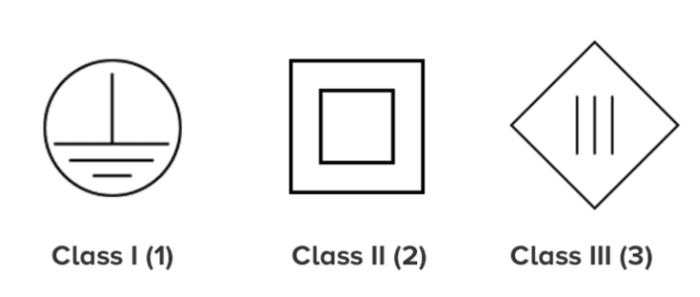
Safety marking | Protective earth symbol | “Class II,” “Double Insulated,” or concentric square symbol |
Common appliance examples | Refrigerators, microwaves, kettles, irons, and toasters | Hair dryers, TVs, DVD players, AC adapters |
Typical applications | Industrial gear, servers, and systems with reliable grounding | Laptop adapters, phone chargers, and home medical devices |
EMC notes | Ground aids noise dissipation | No ground path; may need extra filtering |
Design complexity | Simpler grounding structure | Stricter creepage and clearance requirements |
Cost tendency | Depends on the system grounding architecture | Higher insulation effort, but no ground wiring |
A quick note on identification: Housing material and plug style are useful clues, but they aren’t proof. A metal enclosure often points to Class I and a plastic one to Class II—yet the reliable way to confirm protection class is the product marking and the accompanying documentation. A plastic housing alone does not make a device Class II.
Common Examples at a Glance
Sometimes, a few familiar products make the concept click faster than a definition:
- Class I (grounded): refrigerators, microwaves, kettles, irons, toasters—often larger appliances with metal enclosures.
- Class II (double insulated): hair dryers, televisions, DVD players, copiers, and most external AC adapters—frequently housed in plastic.
- Class III (SELV-powered): low-voltage consumer devices and other products fed by a safe extra-low voltage source.
Notice the pattern: metal-bodied appliances tend toward Class I, while compact, plastic-bodied devices often lean toward Class II. Treat these as quick reference points, not hard rules.
Core Principles Explained
To really understand the difference, it helps to get comfortable with three ideas: protective earth, double insulation, and reinforced insulation. Each answers the same question in its own way: if something inside the device fails, what stops that fault from reaching the person handling it?
What Is Protective Earth?
Inside a Class I device, three conductors do the work: line, neutral, and earth. Line and neutral carry the current that powers the device during normal operation, while the earth wire stays inactive—waiting to act only under abnormal conditions. That third conductor is the protective earth, and it bonds directly to the metal enclosure and exposed conductive parts.
Protective earth is a dedicated safety path. During normal operation, it carries no current—it simply stays in reserve. But if basic insulation fails and a live conductor contacts the metal enclosure, that enclosure would otherwise become live and dangerous to touch. Instead, the fault voltage is directed to ground through the low-resistance earth conductor.
Here’s what physically happens next. The fault current surges to ground, tripping a fuse or circuit breaker almost instantly. Power is cut, the enclosure never holds a dangerous voltage, and the hazard is prevented from reaching the user. In effect, the protective earth path clears the fault, allowing the protective device to disconnect the circuit. For this reason, Class I equipment requires a protective earth connection—it is the core line of defense.
What Is Double Insulation?
Double insulation places two independent layers of insulation between live parts and the user:
- Basic insulation: the first barrier during normal operation
- Supplementary insulation: a backup that continues protecting the user if the first layer fails
Here’s what makes it robust in the event of a fault. If the basic insulation breaks down—say, a live part shifts or degrades—the supplementary layer still stands between the fault and anything the user can touch. Both layers would need to fail simultaneously for a hazard to reach the user, which the design treats as highly unlikely. That built-in redundancy is why a Class II supply can safely operate without a ground connection.
What Is Reinforced Insulation?
Reinforced insulation is a single insulation system that is equivalent to double insulation. It isn’t physically two layers stacked together. Instead, it achieves the same protection level through a higher insulation rating, along with greater creepage distances and clearances.
Whether double or reinforced, the goal is identical: keep single-fault risk away from the user without depending on a ground connection.
A Critical Distinction: Class II ≠ Class 2
This is where people stumble most. Many treat the two as the same thing, but they come from entirely different standards.
- IEC Class II (Roman numeral): describes the insulation protection method that shields users from electric shock. That’s the subject of this article.
- NEC Class 2 (Arabic numeral): comes from the U.S. National Electrical Code and describes a Limited Power Source (LPS). It concerns the volt-amp (VA) rating of the output and the wiring requirements—such as wire size, installation, and current-carrying capacity.
In one line: Class II is about insulation safety; Class 2 is about output power and wiring. They govern different things, so the two should never be treated as equivalent.
Medical and Home Healthcare Applications
As demand for home healthcare grows, so does the need for Class II medical power supplies.
An aging population, rising rates of chronic disease, and advancing medical technology are moving more devices out of the clinic and into the home. These home medical device power supplies operate in unpredictable environments and are used by non-expert users, so the safety bar is especially high.
The IEC60601-1 standard sets requirements for medical equipment and systems used in home healthcare, and many of these scenarios favor Class II input designs. The reasoning is straightforward:
- Home grounding conditions are often unreliable
- Double or reinforced insulation doesn’t depend on external earthing
- A 2-core input suits portable, flexible home use
That said, compliance requirements vary by the specific application and the end equipment. The appropriate protection class depends on the device’s intended use, patient contact, and the standards that apply to the complete system—so treat Class II as a common choice in home healthcare, not a universal rule. When selecting a medical power supply, whether it meets Class II requirements is often a key decision point early in the design process.
A Quick Note on Class III Power Supplies
For completeness, here’s the third category.
Class III power supplies run on safety extra-low voltage (SELV). The voltage itself stays within a safe range, so it won’t deliver a dangerous shock. As a result, Class III needs neither protective earth nor double insulation.
Under IEC62368-1, Class III protection relies on supply from an ES1 (safe-to-touch) energy source and does not generate an ES3 (hazardous) energy source. You’ll see it in low-voltage toys, portable devices, and similar applications.
How to Choose: Class I or Class II?
There’s no universal “better” here—only “better fit.” In practice, safety standards set the floor, and secondary factors usually decide the rest. Use the logic below.
When Class II Makes Sense
- The product targets home or portable applications
- You’re using a 2-core input cord and want simpler wiring
- It’s a home medical device that must meet IEC60601-1 requirements
- The deployment environment has unreliable grounding
- Size and weight matter, since skipping ground hardware trims both
When Class I Makes Sense
- The system already has a reliable, complete grounding architecture
- It’s industrial equipment or a data center with solid grounding infrastructure
- You want a ground path to assist EMC noise dissipation
- The device has substantial metal enclosures, where grounding adds protection
A Special Note for Medical Devices
Medical applications can’t be judged on Class type alone. You also need to weigh the specific use case, patient contact method, and applicable standards. The smart move is to align power-supply selection with regulatory requirements early in the design process, which helps avoid costly rework later.
Keep one more thing in mind: a protection class isn’t only a theoretical decision. It directly influences your insulation design, grounding strategy, creepage and clearance layout, validation testing, and downstream compliance workflows. Lock in the right class early, and you reduce the risk of redesign, retesting, and schedule slips later in the program.
Frequently Asked Questions
Does a Class II power supply need grounding?
No. Class II protects users through double or reinforced insulation, so it does not rely on protective earth. That said, some systems still use a functional earth to suppress electromagnetic noise—but that is a separate concept from a safety ground.
How can I identify whether equipment is Class I or Class II?
Start with the markings, not the appearance. A protective earth symbol and a 3-pin plug point to Class I, while a “Class II” label, a “Double Insulated” note, or a concentric square symbol points to Class II. Housing material and plug style are helpful clues—but they aren’t conclusive. A plastic housing does not automatically make a product Class II, and a metal one does not automatically make a product Class I. For certainty, rely on the product marking and the accompanying documentation.
Is Class II safer than Class I?
Not in any simple sense. Both meet safety standards; they just take different paths. Class I uses insulation plus grounding, while Class II uses double or reinforced insulation. Safety levels are comparable, and the right choice depends on your application.
Why do some laptop adapters use three-prong plugs?
The laptop runs on a low DC voltage, but the AC adapter is the part that connects to the wall. Some adapters use a Class I three-prong design—often to improve EMC performance or to provide a ground reference that reduces noise and leakage current. That stray leakage is what users sometimes feel as a faint tingle on a metal chassis.
Is it safe to use a Class I device without proper grounding?
No. A Class I device depends on its earth connection for safety. Removing or bypassing that ground—for example, by using an adapter that defeats the ground connection on a two-prong outlet—removes the protection and leaves the user exposed if a fault occurs. Always use a properly grounded outlet instead.
Can a Class II power supply be used in a Class I system?
In some cases, yes—but it depends on the system design and the applicable compliance requirements. Certain lower-power Class II products are used within Class I systems, which may still employ a functional earth. Note that connecting a Class II supply’s output to a safety ground or functional ground creates a low-impedance noise path that affects EMC. In those cases, additional external filtering is often required to maintain compliance.
What symbol identifies Class II equipment?
Class II safety labels usually show the words “Class II” or “Double Insulated,” or a concentric square symbol (one square inside another). When you see that symbol, it indicates the device uses double insulation and requires no ground.
Pick the Right Power Supply—Start With a Specialist
Once you understand the difference between Class I and Class II, the next step is applying it to your specific product. Whether you’re building industrial equipment, consumer products, or medical applications, the right power-supply choice directly affects safety, compliance, and time to market.
If you’re selecting a power supply for an upcoming project, contact our engineering team for selection guidance, or browse our Class I and Class II product catalog to find the solution that best fits your application.