Many industrial and networking projects face a common question:
Can you use a POE adapter to power a device that does not natively support POE?
The short answer is yes—but only with the correct method and components.
This article explains how POE adapters can be safely used with non-POE devices, what additional equipment is required, common mistakes to avoid, and how this approach is applied in real-world deployments.

What Is a Non-POE Device?
A non-POE device is any device that:
Does not support IEEE 802.3af / at / bt power negotiation
Requires a dedicated DC power input, such as 5V, 12V, or 24V
Uses Ethernet only for data, not for power
Common examples include:
Legacy IP cameras
Industrial controllers
IoT gateways with DC barrel jack input
Access control panels
Embedded networking equipment
Can a POE Adapter Directly Power a Non-POE Device?
No. A POE adapter cannot be connected directly to a non-POE device.
Doing so may result in:
No power delivery
Device startup failure
Potential electrical risk in non-standard setups
To safely power a non-POE device using POE infrastructure, an additional conversion step is required.
The Correct Solution: POE Adapter + POE Splitter
The standard and safe method involves two components:
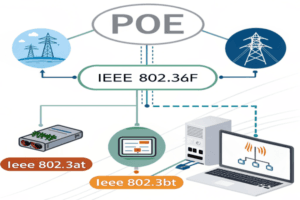
POE Adapter (POE Injector) – Adds power to the Ethernet cable
POE Splitter – Separates power and data at the device end
How it works
[Network Switch]
│
▼
[POE Adapter]
│ (Data + Power)
▼
[POE Splitter]
├── Data (Ethernet)
└── DC Power (5V / 12V / 24V)
│
▼
[Non-POE Device]
The splitter converts POE power into the DC voltage required by the device, while passing Ethernet data unchanged.
Step-by-Step: How to Power a Non-POE Device Using POE
Step 1: Identify the Device Power Requirement
Check the device datasheet for:
Input voltage (e.g. DC 12V)
Maximum power consumption (W)
Connector type (barrel jack, terminal block, etc.)
Step 2: Select the Appropriate POE Adapter
Key parameters to confirm:
IEEE standard: 802.3af / at / bt
Maximum output power
Compatibility with standard POE splitters
The POE adapter’s role is power delivery, not voltage conversion.
Step 3: Choose a Matching POE Splitter
The POE splitter must:
Support the same IEEE POE standard
Output the correct DC voltage
Provide sufficient current capacity
Tip: Always select the splitter based on the device, not the adapter.
Step 4: Verify Cable Quality and Length
Use Cat5e or Cat6 pure copper Ethernet cable
Keep cable length within Ethernet standards
Avoid CCA cables in POE applications
Common Mistakes to Avoid
Using Passive POE Instead of IEEE POE
Passive POE provides fixed voltage and lacks negotiation. This can cause incompatibility or instability when combined with splitters.
Mismatched Voltage Output
A 12V device connected to a 24V splitter may be damaged or fail to operate.
Underrated Power Capacity
If the splitter cannot supply enough current, the device may restart or shut down under load.
Typical Use Cases for POE + Splitter Solutions
| Application scenario | Reason for using POE |
| Legacy IP cameras | Existing POE cabling |
| Industrial sensors | Centralized power |
| Access control | Reduced wiring |
| Outdoor enclosures | Fewer AC outlets |
This approach is especially useful when upgrading infrastructure without replacing all end devices.
Notes on Quankang POE Adapters (Neutral Technical Reference)
In many POE-based system designs, POE adapters are defined as IEEE-compliant active POE injectors with integrated power conversion.
Quankang POE adapters are designed to:
Support IEEE 802.3af / at / bt standards
Deliver stable POE output suitable for use with standard POE splitters
Operate in continuous-duty networking environments
They are commonly applied in projects involving IP surveillance, wireless access points, and industrial networking, where POE adapters are used as part of a broader system solution.
Selection should always be based on system requirements and device specifications, rather than brand alone.
POE Adapter vs Direct DC Power: When Does POE Make Sense?
Using POE to power non-POE devices is recommended when:
AC power outlets are limited
Centralized power management is preferred
Devices are ceiling-mounted or remotely installed
Direct DC power may be simpler when:
Devices are close to power sources
No Ethernet connection is required
Related POE Reference Articles
POE Adapter: Complete Buying Guide for IP Cameras, APs & IoT Devices
POE Adapter vs POE Injector: What’s the Difference?
POE Adapter Not Working? 7 Common Problems and Solutions
Passive POE vs Active POE: Why IEEE Standard Matters
Final Thoughts
A POE adapter can be safely used with non-POE devices only when combined with a properly selected POE splitter.
By understanding POE standards, voltage requirements, and power limits, system designers can extend POE infrastructure to support a wide range of legacy and industrial devices—without compromising reliability or safety.
Careful component selection and validation are key to successful POE deployments.