For a medical device OEM, approving a Medical Power Supply is not the end of sourcing. It is the point where lifecycle control begins.
Once a power supply has passed engineering evaluation, system testing, compliance work, and purchasing approval, the device team has created a known configuration. If that configuration later changes—because of a semiconductor substitution, PCB revision, transformer material change, connector update, manufacturing-process adjustment, certification update, or end-of-life event—the question is no longer simply whether the replacement power supply can deliver the same voltage and wattage. The real question is whether the change affects the assumptions, evidence, and test results used to approve the medical device.
That is why we recommend treating the power supply as a controlled subsystem across the product lifecycle, not as a commodity that can be replaced by matching a few datasheet values.
For U.S.-market medical device manufacturers, this approach is especially relevant in 2026. The FDA’s Quality Management System Regulation (QMSR) became effective on February 2, 2026 and incorporates ISO 13485:2016 by reference. FDA describes the framework as promoting consistency in design, production, and lifecycle controls. That does not mean every power-supply revision automatically requires a new regulatory submission. It does mean that changes should be evaluated through the finished-device manufacturer’s applicable quality and regulatory processes rather than handled as an informal purchasing substitution.
This article focuses on that post-approval problem: how engineering, quality, regulatory, and procurement teams can keep a medical power architecture stable for years without freezing the supply chain so rigidly that necessary changes become impossible.
Why Medical Power Supply Approval Creates a Configuration Baseline
During development, teams naturally focus on whether the selected power supply works. After approval, the more important question becomes: what exactly was approved?
A model number alone may not be enough.
The approved configuration can include the electrical design revision, output setting, connector, DC cable, AC inlet or plug, enclosure, label, firmware or protocol configuration where applicable, certification status, safety-critical components, manufacturing site, and supporting test documentation.
If one of those items changes, the impact can range from negligible to significant. A packaging artwork correction is not the same type of change as a transformer insulation-system revision. A cable color change is not equivalent to changing cable length in an EMC-sensitive system. A drop-in semiconductor replacement may be electrically compatible at nominal load while still changing thermal, switching, EMC, or reliability behavior.
We therefore recommend creating a power-supply configuration baseline at the point of design release.
A practical baseline answers five questions:
- Which exact power supply configuration is approved?
- Which documents define that configuration?
- Which tests were performed on it?
- Which characteristics are safety, EMC, thermal, mechanical, or performance-relevant?
- What types of future changes require notification and review?
This turns “approved power supply” from a vague purchasing description into a controlled engineering object.
For projects still choosing a platform, our Medical Power Supply range provides external, open-frame, enclosed, and medical USB/USB-PD configurations. The lifecycle-control process should begin before the final configuration is frozen, because the form factor determines which interfaces and integration conditions need to be controlled later.
A Medical Power Supply Change Is Not Just a BOM Event
Purchasing systems often see a component change as a part-number or BOM issue. Medical device engineering has to look at a wider impact chain.
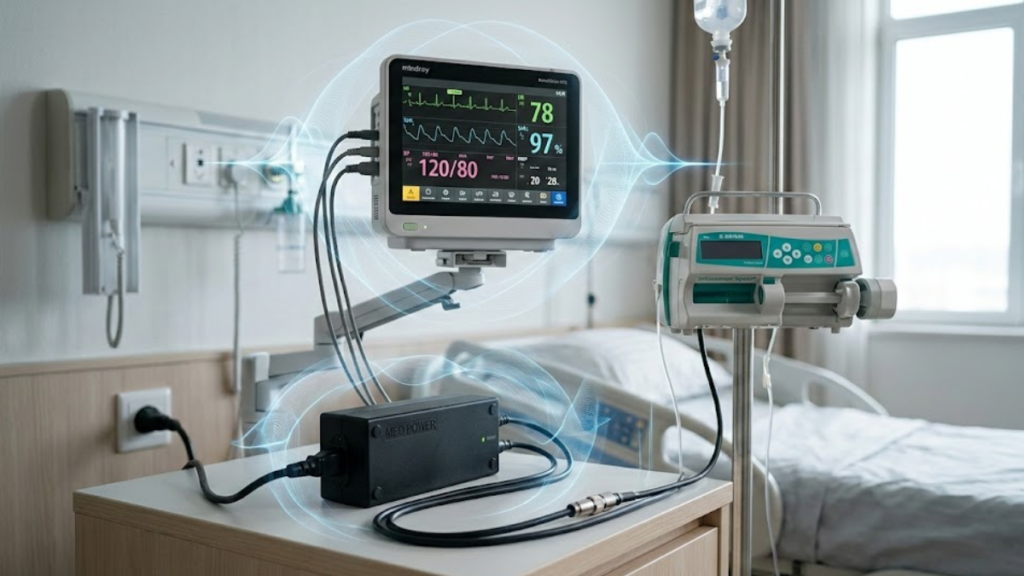
A power supply can interact with the finished device through several paths at once:
- electrical output and transient behavior;
- isolation and insulation architecture;
- leakage-current contribution;
- conducted and radiated emissions;
- immunity behavior;
- thermal loading;
- mechanical fit and mounting;
- grounding and shielding;
- cable routing and connector interfaces;
- labeling and certification documentation.
The effect of a change therefore depends on where the power supply sits in the system architecture.
An external desktop adapter may isolate many mechanical and thermal issues from the host enclosure, but its cable, connector, grounding arrangement, label, and approved safety configuration still matter. An open-frame supply is more tightly coupled to the device because the OEM controls mounting, enclosure, airflow, protective barriers, grounding, and internal cable routing.
That difference is why we do not recommend one universal change-control checklist for every medical power supply.
For integrated equipment, our Medical Open Frame Power Supply series is designed for internal integration. When this architecture is used, change assessment should explicitly consider the host enclosure, airflow, grounding, shielding, and mechanical safety arrangement rather than reviewing the PSU in isolation.
Build a Change-Impact Matrix Before You Need It
The best time to decide how a supplier change will be reviewed is before the supplier sends the first change notification.
We recommend that OEM teams create a simple change-impact matrix during supplier qualification. The matrix does not decide regulatory significance by itself. Its purpose is to route each change to the right internal reviewers and identify the evidence that may need to be refreshed.
| Change category | Example | Primary review questions | Possible evidence to revisit |
| Safety-critical electrical | Transformer, insulation material, Y-capacitor, fuse | Does the protection or leakage-current architecture change? | Safety evaluation, dielectric tests, leakage-current data |
| Power conversion | Controller IC, MOSFET, rectifier, magnetics | Do switching behavior, losses, or protection thresholds change? | Load tests, thermal data, EMC pre-compliance |
| PCB/layout | Routing, layer stack, component placement | Does the change affect spacing, parasitics, EMC, or heat flow? | Safety review, EMC, thermal verification |
| Mechanical | Enclosure, mounting, dimensions | Does fit, clearance, airflow, or accessibility change? | Mechanical fit-check, thermal review |
| Cable/connector | DC plug, cable length, wire construction | Does the interface or emissions/immunity behavior change? | Fit, polarity, voltage-drop, EMC checks |
| Manufacturing | Site, process, test method, tooling | Is the released design produced and screened equivalently? | Process validation records, production test coverage |
| Documentation | Label, drawing, certificate, datasheet | Does the controlled configuration or market status change? | Document review, regulatory file update |
| End-of-life | Discontinued component or platform | Is an alternate equivalent, or does redesign begin? | Risk review, requalification plan, supply bridge |
The table is intentionally cross-functional. Procurement may own the supplier communication, but procurement should not be expected to determine whether a transformer, PCB, or filtering change affects the device safety case.
Likewise, engineering should not approve a technically acceptable change without checking whether quality records, certificates, labels, or regulatory documentation are affected.
The workflow should make those handoffs explicit.
Define What the Supplier Must Notify You About
“Please notify us of major changes” is too ambiguous for a long-life medical program.
The word major can mean different things to a component manufacturer, a power-supply manufacturer, an OEM engineer, and a regulatory specialist. A supplier may view a semiconductor replacement as routine because electrical specifications remain within tolerance, while the OEM may need to assess whether the change affects EMC or thermal performance in the finished device.
We recommend defining notification categories in the purchasing specification or quality agreement.
Depending on the program, the notification scope can include changes to:
- safety-critical components;
- PCB revision or layout;
- transformer or insulation construction;
- output cable or connector;
- enclosure or mounting;
- manufacturing location;
- production process or test coverage;
- firmware/protocol configuration for applicable digital or USB-PD products;
- certification status;
- product labeling;
- key material sources;
- discontinuation or end-of-life status.
The agreement should also define what information is expected in a change notice. At minimum, an OEM usually needs enough information to understand what changed, why it changed, which configurations are affected, when the change is planned, and what verification the supplier performed.
The notice period itself should be agreed project by project. We avoid presenting one universal number because component availability, safety issues, regulatory changes, and force-majeure events can create different timelines.
The important commercial principle is that the notification arrives early enough for the OEM to perform a documented impact assessment before changed production reaches the approved device program whenever practicable.
Separate Supplier Verification From OEM Requalification
A common lifecycle mistake is to treat supplier verification and finished-device requalification as the same activity.
They are related, but they answer different questions.
The power supply manufacturer verifies whether the revised PSU still meets its controlled design and product requirements. The medical device OEM evaluates whether the changed PSU remains acceptable inside the specific finished device and its regulatory context.
Those scopes overlap, but neither automatically replaces the other.
For example, a revised power supply may pass the manufacturer’s electrical safety and functional tests. The OEM may still decide to repeat system-level EMC testing because the host device contains sensitive analog circuitry or wireless modules. Conversely, a documentation-only change may require regulatory-file review without repeating electrical testing.
We recommend using a risk-based requalification decision rather than automatically repeating every historical test or automatically accepting every supplier change.
A useful decision sequence is:
First, identify the changed characteristic. Do not begin with the supplier’s conclusion that the change is “equivalent.”
Second, map the characteristic to the finished device. Ask where it could affect safety, essential performance, EMC, thermal behavior, mechanical integration, software/protocol behavior, labeling, or market approvals.
Third, review existing evidence. Determine whether supplier comparison data, component qualifications, drawings, test reports, or engineering analysis already address the risk.
Fourth, define the minimum additional verification needed. This may range from document review to bench testing, EMC pre-compliance, thermal verification, mechanical fit, safety testing, or broader device revalidation.
Fifth, document the decision. Record not only what was tested, but why the chosen scope was considered appropriate under the OEM’s quality system.
This is where early access to engineering data becomes valuable. A supplier relationship built only around price and delivery dates gives the OEM less information when a change must be assessed quickly.
Control the Sample Used for Requalification
When a change requires physical testing, the sample itself must be identifiable.
A requalification sample should not simply be described as “the new version.” We recommend linking it to the supplier’s revision, date code or lot where available, configuration, connector/cable version, label revision, and change notice.
That traceability creates a clean bridge between three records:
change notification → tested sample → approved production revision
Without that bridge, a team can complete testing successfully and still have difficulty proving which production configuration the results actually represent.
Our manufacturing framework includes AOI, ICT, full-load burn-in activities, DQA verification, EVT/DVT/PVT support, and MES/SAP-based batch traceability. These controls are useful in lifecycle management because engineering decisions can be tied to identifiable production information rather than to an untraceable sample.
For the OEM, the key sourcing question is therefore not simply “Do you have traceability?” A better question is:
Can the supplier connect a fielded or tested unit to the controlled production configuration needed for a quality investigation?
That is the traceability outcome that matters.
Treat Certification Scope as Model- and Configuration-Specific
Medical power supply sourcing often becomes confusing when teams use certification names as generic product attributes.
Our medical product platforms reference standards and certifications including IEC 60601-1, IEC 60601-1-2, IEC 60601-1-11, CE, UL, FCC, CB, PSE, KC, and BIS across relevant products and configurations. However, certification scope varies by model. We do not recommend assuming that every approval applies to every wattage, output, enclosure, cable, or customized version.
This becomes especially important during change control.
If a certified configuration changes, the team should determine whether the existing certification documentation still covers the revised version. The answer depends on the specific product, change, certification scheme, and target market.
The same caution applies when an OEM moves from a standard model to a customized configuration. A new connector, cable, enclosure, grounding arrangement, PCB revision, or output configuration may be commercially simple but should still be checked against the applicable approval scope.
The practical rule is:
Never use “same family” as a substitute for checking the exact approved configuration.

Use Change Control to Protect EMC Margin, Not Just Safety Certification
Medical power supply lifecycle reviews often focus first on electrical safety. EMC deserves its own change-impact path.
A component substitution or layout change can alter switching behavior, parasitic paths, filtering performance, or cable-coupled noise even when nominal output voltage and current remain unchanged.
That does not mean every change requires a full external EMC certification campaign. It means the OEM should decide whether the change could consume part of the system’s existing EMC margin.
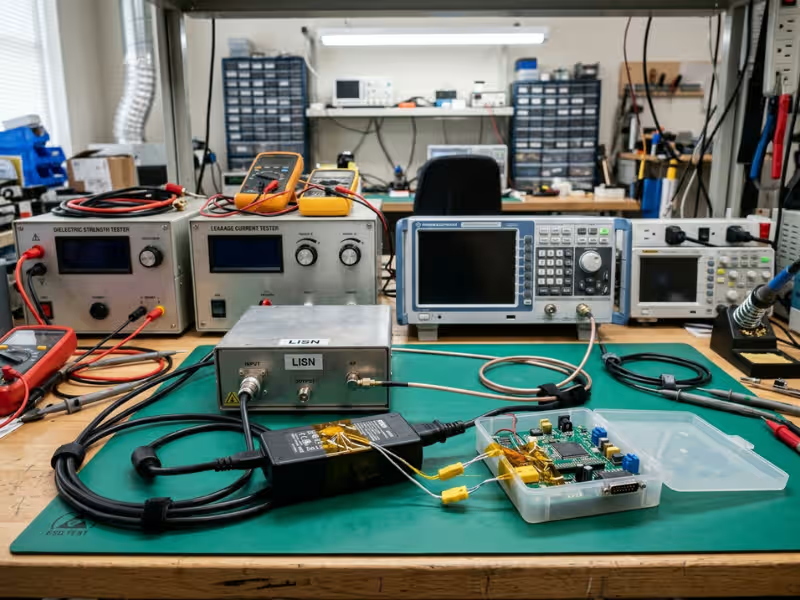
This is one reason we use in-house EMC pre-compliance capability during engineering support. Pre-compliance work can provide faster feedback before a team commits to a broader external test scope.
For a long-life program, we recommend preserving selected EMC baseline data from the approved configuration. When a relevant change occurs, engineers can compare the revised sample against a known reference rather than evaluating it without context.
The same principle applies to thermal behavior. A replacement switching device may satisfy the same electrical function while changing losses or temperature distribution. A targeted thermal comparison can sometimes reveal a difference before it becomes a reliability or enclosure problem.
Make End-of-Life Planning Part of the Original Sourcing Decision
The most disruptive supplier change is sometimes not a revision. It is an end-of-life notice.
Medical device programs can remain commercially active long enough for individual electronic components or power platforms to change during the product’s life. We therefore recommend discussing continuity before the first production purchase order.
Our official support scope includes long-term component sourcing, buffer or safety-stock planning, scheduled shipments, and medical-product lifecycle planning that can support 5–10 year requirements depending on the project.
That statement should not be interpreted as a universal guarantee that every component will remain unchanged for a fixed period. No responsible lifecycle plan should depend on that assumption.
Instead, long-term planning should define how the parties will respond when change becomes necessary.
The plan can include:
- forecast sharing;
- critical-component monitoring;
- last-time-buy evaluation;
- buffer-stock options;
- alternate-component engineering;
- requalification responsibility;
- documentation updates;
- transition-lot identification;
- end-of-life communication.
This changes the procurement discussion from “Can you supply this part for years?” to the more useful question: “How will we manage continuity when the supply chain changes?”
Evaluate the Cost of Change Before Comparing Unit Prices
Medical power supply sourcing ROI should include the cost of maintaining an approved configuration.
Two offers with similar electrical specifications can create different lifecycle costs if they differ in documentation, engineering access, traceability, change communication, certification coverage, or long-term support.
A useful commercial comparison can include the following.
| Cost area | Questions for the OEM team |
| Initial unit price | Are quotations based on the same configuration and volume? |
| Qualification | What testing and documentation are required before release? |
| Customization | Are tooling, engineering, cable, connector, or enclosure changes included? |
| Certification | Which approvals already apply to the exact quoted configuration? |
| Change review | What engineering evidence is available when a revision occurs? |
| Requalification | Who supplies samples, reports, drawings, and comparison data? |
| Inventory bridge | Can buffer stock or scheduled deliveries support a transition? |
| Traceability | Can affected lots and revisions be identified efficiently? |
| EOL response | What options exist for last-time buy, alternate validation, or redesign? |
| Internal labor | How much engineering, quality, and regulatory time will the sourcing model consume? |
This is where a slightly lower purchase price can become less important than the cost of repeated engineering work.
The point is not that a higher-priced power supply is automatically better. It is that unit price should be compared only after the lifecycle responsibilities are made visible.
For procurement teams, this creates a more defensible sourcing decision because the comparison reflects the cost of keeping a regulated product in production, not just the cost of receiving the first shipment.
Decide When Customization Helps—and When It Creates More Configuration to Control
Customization can solve real medical-device constraints, but every custom feature also becomes part of the configuration baseline.
We support changes such as voltage/current adjustment, DC plug selection, cable length and construction, grounding and shielding, PCB layout, housing, labeling, and packaging. Our Custom Power Adapters page summarizes the broader configuration options available for OEM/ODM projects.
The lifecycle question is whether each customization creates enough product value to justify the additional configuration control. A connector required by the host device may be essential; an optional cosmetic difference may simply multiply SKUs, drawings, labels, inventory, and revision records.
We therefore recommend classifying customization as functional, compliance-relevant, or commercial. Functional changes receive engineering review; compliance-relevant changes are also assessed for safety, EMC, labeling, or approval impact; commercial changes still require document and SKU control. This keeps the change process proportional to the actual risk.
A Cross-Functional Workflow for Every Power Supply Change
For most OEMs, the hardest part of change control is not testing. It is ownership.
We recommend assigning a clear workflow before production starts:
Procurement or supplier quality receives the notification. They verify that the affected part numbers, timing, and supply implications are clear.
Engineering performs technical impact screening. Electrical, mechanical, thermal, EMC, and interface implications are reviewed as relevant.
Quality determines controlled-record impact. Drawings, specifications, approved supplier records, inspection requirements, and traceability expectations are updated where necessary.
Regulatory assesses market/submission implications. The exact assessment depends on the device, market, approval pathway, and nature of the change.
The team defines verification or requalification. The scope is based on the identified impact rather than a fixed test package.
Purchasing releases the changed configuration only after the required approvals are complete. Transition inventory and effective dates are coordinated so old and new revisions do not become mixed unintentionally.
This workflow turns supplier change control into a predictable business process rather than an emergency response.
What the 2026 U.S. QMSR Context Means for OEM Buyers
The FDA’s QMSR took effect on February 2, 2026 and incorporates ISO 13485:2016 by reference. FDA states that the framework promotes consistency across design, production, and lifecycle controls and specifically includes risk management within the harmonized quality-system approach.
For OEM buyers, the practical implication is not that procurement should become the regulatory department. It is that supplier management, engineering change review, production control, and quality documentation should connect to one another.
A medical power supply is a good example because it crosses several functions at once.
The purchasing team controls the commercial relationship. Engineering understands the electrical and system consequences. Quality controls records and supplier processes. Regulatory determines whether a change affects market authorization or supporting documentation.
If those functions operate independently, a supplier change can move too far before the right reviewer sees it.
If they operate through a defined change workflow, the organization can respond faster without lowering the standard of evidence.
The Better Sourcing Question Is “Can We Control This Platform for Its Full Life?”
At the beginning of a project, it is natural to ask whether a medical power supply meets the required voltage, power, form factor, IEC 60601-1-related needs, leakage-current target, and target-market certification strategy.
Those are necessary questions.
For a B2B medical device program, however, we recommend adding one more:
Can we keep this exact power architecture controlled, traceable, supportable, and reviewable as the device moves from prototype to production and through its commercial life?
That question changes how supplier capability is evaluated.
At Quankang, we support medical power projects from product selection and engineering review through customization, EMC pre-testing, validation, certification coordination, production, and long-term sourcing. Our manufacturing and quality processes include automated inspection and testing activities together with MES/SAP-based traceability, giving OEM teams a stronger information base when a production or lifecycle change needs to be reviewed.
If you are qualifying a new medical power platform, send us your electrical requirements, form factor, target markets, expected lifecycle, forecast, interface constraints, and change-control expectations. We can first review whether an existing certified platform fits the program and then identify where customization or additional verification is actually necessary.
Request a quote for your Medical Power Supply project and include your lifecycle requirements from the start—not after the first change notice arrives.