Selecting a medical power supply should not stop at checking the output voltage and wattage. For medical device OEMs, engineering teams, and procurement professionals, a datasheet provides the first technical evidence needed to determine whether a power supply is suitable for a specific application.
A power supply may appear to meet a device’s basic voltage and power requirements while still creating problems during system integration, thermal testing, electrical safety evaluation, EMC testing, or long-term operation.
The key is to evaluate the specifications under their stated operating conditions and to identify which claims require additional documentation or supplier verification.
This guide explains the 10 specifications engineers should review when evaluating a medical power supply datasheet, how to identify incomplete or potentially misleading specifications, what questions to ask the supplier, and what should be verified before moving from datasheet review to sample testing.
Quick Answer
When evaluating a medical power supply datasheet, engineers should check these 10 areas:
- AC input voltage and frequency
- DC output voltage
- Output current and rated power
- Load regulation and output stability
- Ripple and noise
- Leakage current and insulation protection
- MOOP and MOPP protection levels
- Efficiency and thermal performance
- Operating temperature and derating
- EMC and medical certification information
These specifications should not be evaluated independently.
For example, a 65 W power supply may appear suitable for a 60 W medical device, but the actual suitability depends on the load profile, ambient temperature, derating requirements, transient demand, cooling conditions, safety requirements, and applicable certification.
A datasheet should therefore be treated as the first stage of technical evaluation, not the final approval document.
Core Principle: Don’t Evaluate Datasheet Specifications in Isolation
A specification is meaningful only when its operating conditions are understood.
Consider a few common examples:
- 65 W rated power— At what ambient temperature? Is the rating continuous or peak?
- 24 VDC output— What is the voltage tolerance and regulation under changing loads?
- Low ripple— What measurement bandwidth and load condition were used?
- High efficiency— At what input voltage and load level?
- 2×MOPP— Does the protection level apply to the exact model and configuration?
- IEC 60601 compliant— Which standard, edition, model, and certification scope are covered?
This is why engineers should avoid comparing datasheets based only on the largest or smallest headline number.
A better evaluation asks:
What does this specification mean under the actual operating conditions of my medical device?
Section 1: The 10 Critical Specifications to Check
1. AC Input Voltage and Frequency
The first specification to verify is the power supply’s input range.
A medical power supply intended for international applications may support a wide AC input range such as 100–240 VAC, while other models may be designed for narrower input conditions.
What to check
Engineers should review:
- Rated input voltage range
- AC input frequency
- Minimum and maximum operating voltage
- Input current
- Whether full rated output is available across the entire input range
- Any input-voltage-related derating
- Regional requirements for the target market
A wide input range can simplify deployment across different countries, but engineers should not assume that output performance is identical at every input condition.
Questions to ask the supplier
- Is the rated output power available across the complete input range?
- Does the power supply require derating at low or high input voltage?
- What is the maximum input current?
- Are these specifications applicable to the exact model being evaluated?
For OEM projects intended for multiple markets, input requirements should be confirmed during the early design stage.
2. DC Output Voltage
The DC output voltage must be compatible with the medical device’s power architecture.
Common requirements may include 12 VDC, 19 VDC, 24 VDC, or other application-specific output voltages.
What to check
Review:
- Nominal output voltage
- Output voltage tolerance
- Line regulation
- Load regulation
- Startup behavior
- Output voltage under minimum and maximum load
- Whether the output is fixed or adjustable
Do not evaluate a voltage specification only by comparing nominal values.
For example, a datasheet stating 24 VDC does not by itself describe how the output behaves during startup, rapid load changes, or operation near the rated power.
Why output stability matters
Medical devices can contain:
- Processors
- Sensors
- Displays
- Communication modules
- Motors
- Pumps
- Precision measurement circuits
An unstable supply can contribute to system resets, communication errors, measurement abnormalities, or startup problems.
Output voltage should therefore be considered together with regulation, transient response, ripple, and the actual device load profile.
3. Output Current and Rated Power
Output current and rated power are closely related, but they should not be treated as interchangeable specifications.
The basic relationship is:
P = V × I
For example:
24 V × 2.5 A = 60 W
However, a medical device’s average power consumption is not necessarily the same as its maximum power requirement.
What to check
Engineers should determine:
- Continuous operating current
- Maximum operating current
- Startup current
- Transient or peak load
- Motor or pump startup demand
- Rated output power
- Peak power capability
- Overload protection
- Power derating conditions
Example
A medical device may normally consume 45 W but require significantly more power for a short period during startup.
A 45 W power supply may therefore be inadequate even though the average operating power appears to match the supply rating.
The correct approach is to evaluate the complete load profile, rather than average consumption alone.
Red flags
Be cautious when a datasheet provides only:
Rated output: 65 W
without explaining whether the rating is continuous, the applicable ambient temperature, or the derating conditions.
4. Load Regulation and Output Stability
Medical devices can experience substantial changes in electrical load during different operating modes.
For example:
- Standby
- Normal operation
- Maximum processing load
- Pump activation
- Motor startup
- Wireless transmission
- Display activation
Load regulation describes how the output voltage changes as the load changes. Line regulation describes how the output changes as the input voltage changes.
What to check
Look for:
- Load regulation
- Line regulation
- Transient response
- Startup time
- Hold-up behavior, where applicable
- Recovery after a sudden load change
Why it matters
A power supply that performs well under steady-state conditions may behave differently when the connected device suddenly changes its load.
This can be particularly important for medical equipment containing motors, pumps, compressors, processors, wireless modules, or sensitive analog circuits.
If transient performance is not specified, engineers should request additional test data or evaluate the supply using the actual device load profile.
5. Ripple and Noise
Ripple and noise represent unwanted AC components on the DC output.
For sensitive medical electronics, excessive ripple or high-frequency noise may increase system-level filtering requirements or affect sensitive circuits.
Potential effects can include:
- Signal interference
- Sensor instability
- Display noise
- Communication errors
- Measurement disturbances
- Additional filtering requirements
What to check
Review:
- Maximum ripple and noise
- Measurement bandwidth
- Test load
- Input conditions
- Measurement method
- Whether the specification applies across the complete load range
Do not compare ripple numbers without checking test conditions
Suppose Supplier A specifies:
Ripple and noise: 80 mVp-p
while Supplier B specifies:
Ripple and noise: 120 mVp-p
This does not automatically mean Supplier A has better output performance.
The measurements may have been made using different:
- Bandwidths
- Loads
- Test fixtures
- Measurement methods
A fair comparison requires comparable test conditions.
6. Leakage Current and Insulation Protection
Leakage current is a particularly important consideration for medical power supplies.
Medical electrical equipment may require more stringent protection against electric shock depending on the application and system architecture.
What to check
Review:
- Maximum leakage current
- Touch current, where applicable
- Insulation structure
- Dielectric strength
- Isolation characteristics
- Test conditions
- Applicable safety requirements
A specification such as:
Low leakage current
is not sufficient for engineering evaluation.
The datasheet or supporting documentation should provide meaningful numerical information and test conditions where applicable.
Why the power supply matters
The power supply is only one part of the final medical electrical system.
System-level leakage can be affected by:
- AC input components
- EMI filtering
- Power supply insulation
- DC cables
- Chassis
- Other connected equipment
A low-leakage power supply can reduce system-level risk, but it does not automatically guarantee that the complete medical device will meet its applicable requirements.
For a more detailed discussion of leakage current, see Quankang’s technical resource on reducing leakage current in medical devices.
7. MOOP and MOPP Protection Levels
Engineers should not rely on the word “medical” alone when evaluating electrical protection.
Two important concepts under IEC 60601-1 are:
- MOOP — Means of Operator Protection
- MOPP — Means of Patient Protection
MOPP generally involves more stringent protection requirements because patient protection may involve additional safety considerations.
Depending on the device architecture and applicable requirements, a power supply may need a specified level of protection such as:
- 1×MOOP
- 2×MOOP
- 1×MOPP
- 2×MOPP
What to verify
Ask the supplier for information regarding:
- Applicable IEC 60601-1 requirements
- MOOP/MOPP level
- Insulation system
- Working voltage
- Dielectric strength
- Certification or evaluation documentation
- Certification scope for the exact model
Important distinction
The required protection level depends on the complete medical device design, including the applied parts, patient connections, isolation architecture, and risk assessment.
Therefore:
2×MOPP should not be treated as a universal requirement for every medical power supply.
It must be evaluated according to the intended application.
8. Efficiency and Thermal Performance
Efficiency affects more than energy consumption.
It also determines how much power is converted into heat.
The basic relationship is:
Power Loss = Input Power − Output Power
For example, if a power supply delivers 60 W at 90% efficiency, approximately 6.7 W is dissipated as heat.
At 95% efficiency, the corresponding loss is approximately 3.2 W.
The difference can become significant in compact medical equipment with limited airflow.
What to check
Review:
- Efficiency at different load levels
- Minimum or typical efficiency
- No-load consumption
- Standby power consumption
- Thermal performance
- Maximum case temperature
- Cooling requirements
Why this matters
Additional heat can affect:
- Internal component temperature
- Capacitor lifetime
- Enclosure temperature
- Cooling requirements
- Reliability
- System performance
Efficiency should therefore be evaluated together with the thermal design of the medical device.
9. Operating Temperature and Derating
A datasheet may specify a broad operating temperature range, but this does not necessarily mean that the power supply can deliver its full rated output throughout that range.
This is where the derating curve becomes important.
For example, a power supply may be rated at 65 W under specified conditions but require reduced output at elevated ambient temperatures.
What to check
Engineers should review:
- Operating temperature range
- Storage temperature
- Full-load temperature range
- Output power derating curve
- Maximum case temperature
- Cooling conditions
- Altitude limitations, where applicable
Example
Suppose a medical device requires 60 W continuously.
A 65 W power supply may initially appear to provide adequate capacity. However, if its output must be derated significantly at the actual operating temperature, the available power may fall below the device requirement.
Therefore:
Rated power should always be evaluated together with temperature and derating conditions.
This is especially important for compact, enclosed, portable, or high-power medical equipment.
10. EMC and Medical Certification Information
The final category is compliance documentation.
Engineers should distinguish between:
“Medical grade” as a product description
and:
Documented compliance or certification for a specific model and configuration.
Depending on the application and target market, engineers may need to review:
- IEC 60601-1
- IEC 60601-1-2
- Applicable regional requirements
- EMC emissions
- EMC immunity
- Safety test information
- Certification scope
- Exact model and configuration covered
EMC should be evaluated at system level
A medical power supply that has been evaluated against applicable EMC requirements does not automatically make the complete medical device EMC compliant.
System-level performance can also depend on:
- PCB layout
- Cables
- Grounding
- Shielding
- Mechanical enclosure
- External interfaces
- Device operating modes
This is why power supply selection should take place early enough to allow system-level EMC evaluation.
For more detailed information about medical EMC problems and engineering solutions, see Quankang’s dedicated IEC 60601 EMC testing guide.
Section 2: Practical Evaluation & Risk Mitigation
How to Spot a Weak or Misleading Medical Power Supply Datasheet
Not all datasheets provide the same level of engineering information.
A professional datasheet should define the conditions under which its specifications apply. Engineers should be cautious when important claims are presented without numerical limits, test conditions, operating boundaries, or supporting documentation.
Common warning signs include:
| Datasheet Claim or Omission | What It May Mean | What to Ask |
| “Low leakage current” | No measurable limit is provided | What is the maximum value and test condition? |
| “High efficiency” | Efficiency may apply only at one load point | At what input voltage and load was it measured? |
| “2×MOPP” | Protection level or scope may be unclear | Does it apply to this exact model? |
| “65 W output” | Full power may not be available under all conditions | What are the temperature and derating conditions? |
| “Low ripple” | Measurement conditions are missing | What bandwidth and load were used? |
| “IEC 60601 compliant” | The applicable standard or certification scope may be unclear | Which model and standard are covered? |
| Wide temperature range | Full rated power may not be available throughout the range | Can you provide the derating curve? |
| “Medical grade” | Marketing terminology alone does not establish compliance | What supporting technical documentation is available? |
A single missing specification does not necessarily mean a product is unsuitable.
However, multiple incomplete claims should prompt the engineering team to request additional documentation before approving the product.
Illustrative Example: Step-by-Step Datasheet Evaluation
The following example is for illustration only. It does not represent actual supplier products or test results.
Suppose an OEM is developing a medical device requiring approximately 60 W continuous output at 24 VDC.
Two example datasheets are being reviewed.
| Specification | Example Datasheet A | Example Datasheet B |
| Output | 24 VDC | 24 VDC |
| Rated Power | 65 W | 75 W |
| Efficiency | 92% | 95% |
| Operating Temperature | -10 to +50°C | -20 to +60°C |
| Derating Curve | Not provided | Provided |
| Leakage Current | “Low” | Numerical value specified |
| MOPP | 2×MOPP stated | 2×MOPP documented |
| EMC Information | General statement | Test documentation available |
At first glance, both products may appear suitable.
However, the engineering review should continue.
Step 1: Confirm the load requirement
The device requires 60 W continuously.
The 65 W supply provides only limited nominal headroom, so its thermal and derating conditions become particularly important.
Step 2: Review the derating information
If Datasheet A does not provide a derating curve, the OEM cannot determine whether 65 W remains available at the actual device operating temperature.
Additional supplier information should therefore be requested.
Step 3: Verify leakage current
“Low leakage current” is not sufficient for comparison.
The numerical value, measurement conditions, and applicable requirements should be confirmed.
Step 4: Verify MOPP claims
A statement that a product provides 2×MOPP should be checked against the relevant certification or evaluation documentation and exact model.
Step 5: Review EMC evidence
The OEM should determine whether the relevant EMC evaluation covers the exact product and configuration and whether additional system-level testing will be required.
Step 6: Check integration requirements
Finally, the engineering team should verify:
- Connector
- Cable
- Dimensions
- Mechanical mounting
- Cooling conditions
- Input configuration
The example demonstrates an important principle:
The product with the highest wattage or best headline specification is not automatically the best choice.
Datasheet vs. Test Report vs. Certification: Why a Datasheet Is Not Enough
These documents serve different purposes.
| Document | Primary Purpose |
| Datasheet | Defines product specifications and operating characteristics |
| Test Report | Provides test results under specified conditions |
| Certification / Certificate | Provides evidence of conformity within a defined scope |
| Product Specification | Defines detailed technical requirements agreed between supplier and customer |
| Sample Evaluation | Confirms performance in the customer’s actual application |
A datasheet is therefore an important starting point, but it does not replace appropriate testing or certification documentation.
For regulated medical device projects, engineers should verify that supporting documents correspond to the exact model, configuration, and intended application.
Section 3: Action Plan & Supplier Engagement
Medical Power Supply Datasheet Evaluation Checklist
Before approving a medical power supply for sample evaluation, engineers can use the following checklist:
Electrical
- ☐ Input voltage range verified
- ☐ Input frequency verified
- ☐ Output voltage verified
- ☐ Output voltage tolerance verified
- ☐ Continuous current verified
- ☐ Peak/startup load verified
- ☐ Rated output power verified
- ☐ Line/load regulation reviewed
- ☐ Transient response reviewed
- ☐ Ripple and noise conditions reviewed
Safety
- ☐ Leakage current documented
- ☐ Insulation requirements reviewed
- ☐ Dielectric strength information reviewed
- ☐ MOOP/MOPP level confirmed
- ☐ Applicable IEC 60601-1 requirements identified
Thermal
- ☐ Efficiency reviewed
- ☐ Operating temperature verified
- ☐ Derating curve reviewed
- ☐ Cooling conditions understood
- ☐ Maximum case temperature reviewed
EMC and Compliance
- ☐ IEC 60601-1 information reviewed
- ☐ IEC 60601-1-2 information reviewed where applicable
- ☐ EMC test evidence reviewed
- ☐ Certification scope verified
- ☐ Exact model/configuration confirmed
Mechanical Integration
- ☐ Connector type confirmed
- ☐ Cable specification confirmed
- ☐ Dimensions verified
- ☐ Mounting requirements confirmed
- ☐ Mechanical constraints reviewed
What Engineers Should Ask the Supplier
When important information is missing from a datasheet, asking targeted questions can prevent problems later in the development process.
| Topic | Question to Ask the Supplier | Why It Matters |
| Output power | Is the rated output power continuous? | Confirms actual operating capacity |
| Temperature | At what ambient temperature is full rated power available? | Prevents thermal overestimation |
| Derating | Can you provide the output derating curve? | Confirms power availability |
| Peak load | What peak or startup load can the unit support? | Evaluates transient requirements |
| Ripple | What bandwidth and load conditions were used? | Enables fair comparison |
| Leakage | What is the maximum leakage current and test condition? | Supports safety evaluation |
| MOPP | Does the stated MOPP level apply to this exact model? | Avoids incorrect compliance assumptions |
| EMC | Which EMC requirements have been evaluated? | Supports system EMC planning |
| Certification | Does the documentation cover the exact model and configuration? | Confirms documentation scope |
| Connector | Can the connector and cable be customized? | Supports mechanical integration |
| Documentation | Can you provide test reports or technical documents? | Supports engineering and certification review |
From Datasheet Review to Sample Testing & Supplier Qualification
A datasheet review should normally be the first step rather than the final approval stage.
A typical OEM evaluation process is:
Datasheet Review
↓
Specification Comparison
↓
Supplier Technical Questions
↓
Sample Evaluation
↓
System-Level Testing
↓
Safety / EMC Verification
↓
Supplier Qualification
↓
Production Approval
The depth of each stage depends on the medical device, applicable standards, risk analysis, and customer requirements.
This process helps identify technical problems before they become expensive redesign or certification issues.
Section 4: Enterprise Solution & Closure
How Quankang Evaluates Medical Power Supply Requirements
For OEM and ODM projects, selecting a medical power supply involves more than matching voltage and wattage.
Quankang evaluates power supply requirements across several areas, including:
1. Electrical Requirements
- AC input range
- Output voltage
- Continuous current
- Rated power
- Startup and transient load
2. Safety Requirements
- Leakage current
- Isolation
- MOOP/MOPP requirements
- Applicable medical safety requirements
3. EMC Requirements
- Conducted emissions
- Radiated emissions
- Immunity considerations
- System-level integration
4. Thermal Requirements
- Operating temperature
- Enclosure conditions
- Cooling method
- Power derating
5. Mechanical Requirements
- Power supply dimensions
- DC connector
- Cable length
- Plug configuration
- Device integration constraints
6. Project Requirements
- Target market
- Certification requirements
- Customization requirements
- Sample validation
- Production quantity
- Long-term supply considerations
This approach allows the power supply to be evaluated as part of the medical device system rather than as an isolated catalog component.
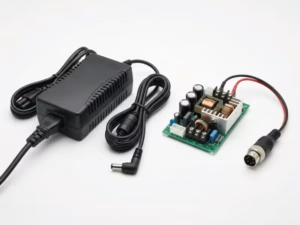
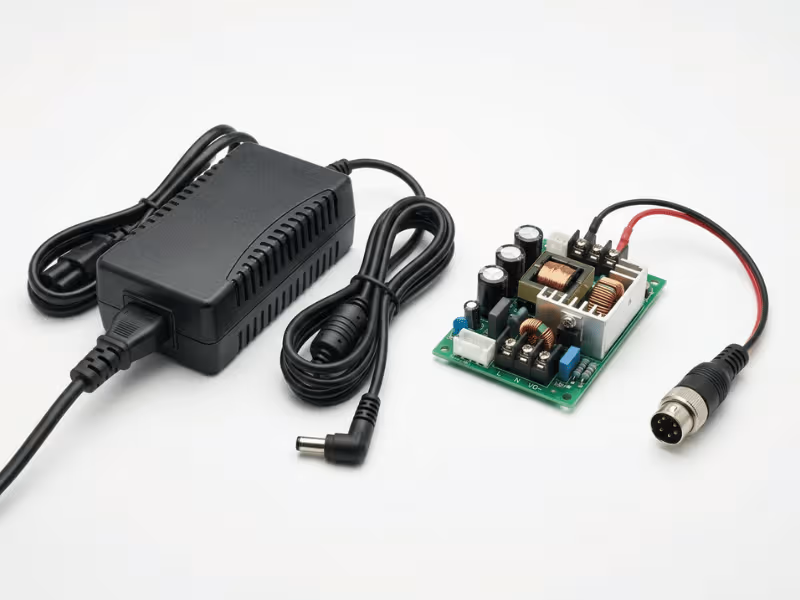
Quankang’s medical power supply portfolio includes solutions such as medical desktop power adapters, wall-plug power supplies, and open-frame power supplies for professional electronic and medical applications.
Need Help Evaluating a Medical Power Supply?
If you already have a medical power supply datasheet, preliminary specification, or device power requirement, Quankang can evaluate the key requirements and help identify a suitable power supply solution.
When contacting Quankang, providing the following information can accelerate technical evaluation:
- Input voltage
- Required output voltage
- Continuous and peak current
- Rated power
- Application and medical device type
- Leakage current requirements
- MOOP/MOPP requirements
- Operating temperature
- Connector and cable requirements
- Target certifications
- Expected quantity
Request a Technical Evaluation or Contact Quankang for your medical power supply requirements.
FAQ
What are the most important specifications on a medical power supply datasheet?
Output voltage, output current, rated power, leakage current, MOOP/MOPP protection, efficiency, operating temperature, derating, EMC, and certification information are among the most important specifications. Their relative importance depends on the medical device architecture and application.
Is a higher-wattage medical power supply always better?
No. A higher-rated power supply is not automatically the correct choice. Engineers should also consider voltage compatibility, continuous and peak loads, thermal conditions, derating, connector compatibility, safety, EMC, and certification requirements.
What does 2×MOPP mean on a medical power supply datasheet?
2×MOPP means two means of patient protection under the applicable IEC 60601-1 framework. Whether 2×MOPP is required depends on the medical device’s isolation architecture, applied parts, patient connections, risk assessment, and applicable requirements.
Can a medical power supply datasheet prove IEC 60601 compliance?
Not by itself. A datasheet defines product specifications, while certification and test documentation provide additional evidence within a defined scope. Engineers should verify that the relevant documentation applies to the exact model and configuration.
Why is the derating curve important?
Because the maximum rated output may not be available under every operating condition. Ambient temperature, cooling, input voltage, altitude, and other factors can affect the available output power.
Why should engineers check ripple test conditions?
Because ripple and noise values cannot always be compared directly. Different measurement bandwidths, loads, fixtures, and methods can produce different results.
What information should an OEM provide when requesting a medical power supply?
At minimum, provide input voltage, output voltage, current, power requirement, application, connector and cable requirements, dimensions, operating temperature, certification requirements, quantity, and any specific leakage current, MOOP/MOPP, or EMC requirements.
Key Takeaways
A medical power supply should not be evaluated by output voltage and wattage alone.
Before approving a model, engineers should verify:
- Electrical compatibility— input, output, current, power, regulation, and transient performance.
- Safety— leakage current, insulation, and MOOP/MOPP protection.
- Thermal capability— efficiency, operating temperature, and derating.
- EMC and certification— applicable requirements and supporting documentation.
- Integration requirements— connectors, cables, dimensions, and operating conditions.
- Supplier capability— engineering support, documentation, customization, quality, and supply continuity.
A thorough datasheet review helps identify unsuitable products before sample testing and certification, reducing the risk of integration problems, redesign, and unnecessary development costs.
For medical device OEMs, the best power supply is not simply the one with the right voltage and wattage. It is the one whose electrical, safety, thermal, EMC, mechanical, and documentation requirements can be verified for the intended application.