Sourcing power supplies for medical equipment carries risks that ordinary electronics never face. One wrong specification can mean patient harm, a failed audit, or a costly recall. Whether you design infusion pumps, diagnostic imaging systems, or patient monitors, the power supply sits at the heart of both safety and reliability. This guide from Quankang walks you through 10 decision factors—from regulatory scope and output quality to reliability and EMC—so you can specify with confidence and sidestep the mistakes that catch even experienced buyers.
1. Why Standard Power Supplies Cannot Replace Medical-Grade Units
A commercial or industrial power supply may share the same voltage and wattage numbers as a medical unit, yet still be unfit for a patient-connected device. The gap lies in what the datasheet does not always highlight: isolation architecture, leakage current limits, and construction requirements tied to human safety.
Standard supplies are typically designed to IEC 62368-1 or similar safety standards. Those standards protect operators and equipment, but they do not address the tighter leakage limits and reinforced isolation that patient contact demands. Swap a general-purpose unit into a medical design and you inherit a compliance problem you may not discover until formal testing.
Medical-grade units differ in ways that directly affect your project:
- Reinforced patient isolation. Isolation barriers are built and rated to means of patient protection (MOPP) levels, not just basic operator protection.
- Controlled leakage current. Earth and patient leakage are held well below commercial thresholds, with certified figures under normal and single-fault conditions.
- Documented compliance. Certification to IEC 60601-1 gives your notified body or reviewer a recognized starting point instead of a gap to explain.
- EMC behavior suited to clinical use. Filtering is designed against IEC 60601-1-2, where devices operate close together and immunity matters as much as emissions.
Choosing a medical-grade unit early is not a premium for its own sake. It removes redesign loops later, when a leakage failure or isolation shortfall surfaces during qualification.
2. The Main Types of Medical Power Supplies
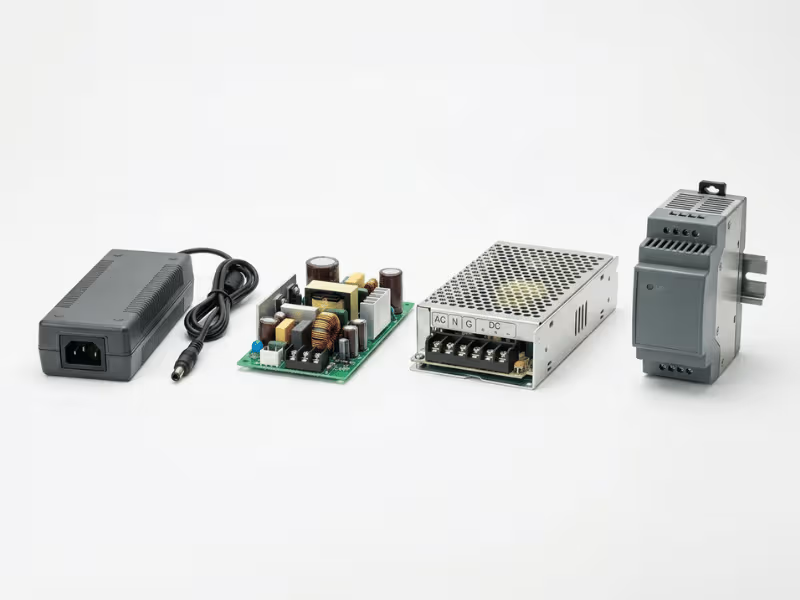
Medical power supplies come in several form factors, each suited to different integration and thermal needs. Keep in mind that these categories describe physical integration only. Your final selection must also weigh protection level, applied-part classification, and use environment, which the later sections cover in detail.
a. External AC/DC Adapters
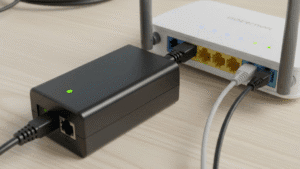
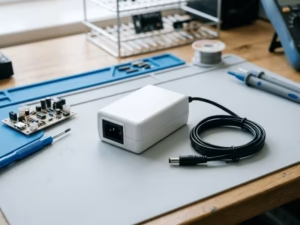
Desktop and wall-mount adapters plug into mains and deliver regulated DC outside the device enclosure. By keeping heat and high voltage external, they simplify your safety approvals and thermal design. They fit home-care equipment and portable monitors well. The trade-off is added bulk plus a connector that users can misplace or damage.
b. Open-Frame Power Supplies
Open-frame units are bare PCB assemblies mounted directly inside your equipment. They deliver high power density at low cost, which suits space-constrained designs. Because live components sit exposed, they demand careful mechanical protection and airflow. You also carry responsibility for creepage and clearance within your own enclosure.
c. Enclosed Power Supplies
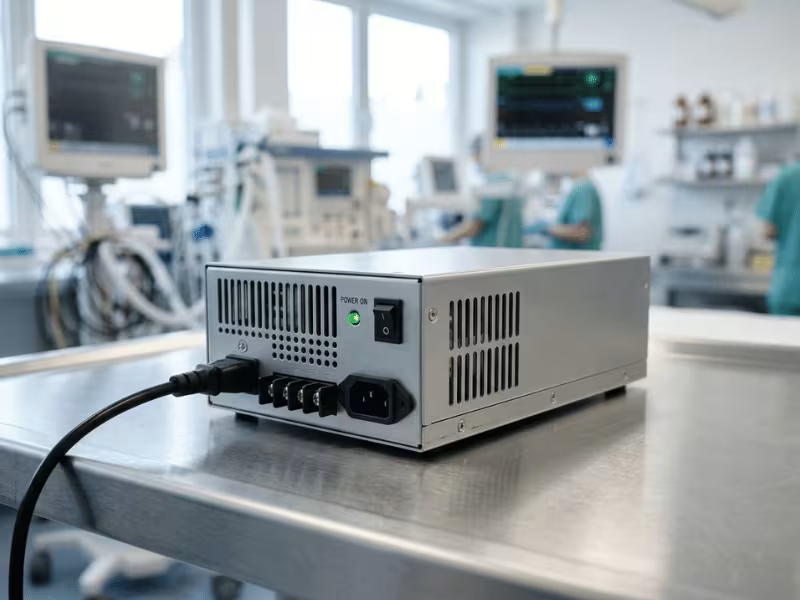
Enclosed models house the electronics in a protective metal case that adds shielding and mechanical safety. They handle higher wattage and rougher conditions than open-frame designs, making them a fit for imaging systems and lab instruments. The downside is a larger footprint and higher price than open-frame alternatives.
d. DIN Rail Power Supplies
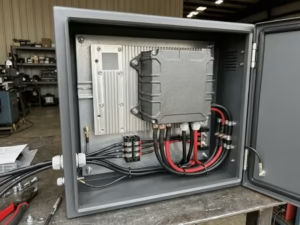
DIN rail units clip onto standard rails inside control cabinets, which eases installation and service. They suit modular systems, sterilization equipment, and larger fixed installations. Standardized mounting speeds assembly and future upgrades. The trade-off is a footprint built for cabinets rather than compact handheld or portable devices.
3. Medical vs. Industrial Power Supplies: Key Differences
Buyers sometimes assume that an industrial-grade supply, being robust and well built, is “good enough” for a medical device. It rarely is, and the reasons go beyond ruggedness.
The core divide is isolation and leakage. Industrial supplies target operator safety and equipment protection; medical supplies add patient protection, with reinforced barriers and far tighter leakage limits. An industrial unit certified to IEC 62368-1 will not satisfy IEC 60601-1 review, no matter how reliable it is in the field.
Certification scope differs too. Industrial products often carry marks aimed at general equipment, while medical units need documented compliance to the medical standards and their collateral requirements, such as EMC to IEC 60601-1-2. A brief note on the underlying technology: most modern medical supplies use switching designs for their efficiency and compact size, and today’s units meet strict noise and leakage limits. Linear designs remain relevant only for the narrow set of applications demanding ultra-low noise for sensitive analog measurement, and they pay for it in weight, size, and wasted heat. For most projects, the meaningful question is not linear versus switching, but industrial versus medical-grade compliance.
4. Matching the Power Supply to the Use Environment
Where your equipment operates reshapes the power supply requirements. Temperature, cleaning routines, user proximity, and available cooling all steer the choice. Review the three common use environments below before you finalize a specification, since each carries distinct safety and durability expectations.
a. Hospital and Clinical Settings
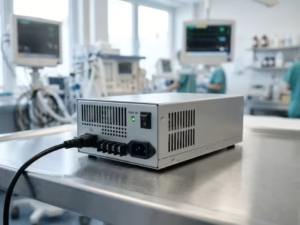
Clinical environments demand robust EMC performance, because many devices operate side by side and interference travels easily. Frequent surface disinfection calls for sealed or well-protected units that resist aggressive cleaning agents. Where patient contact is likely, prioritize supplies that support 2×MOPP isolation and continuous-duty operation, so the device stays safe and dependable through long procedures.
b. Home-Care Applications
Home-care devices land in the hands of untrained users under unpredictable conditions. External adapters help here, keeping high voltage away from the patient while tolerating dust, humidity, and physical knocks. Low no-load power consumption also matters, since this equipment often stays plugged in continuously between uses across long stretches.
c. Laboratory and Diagnostic Equipment
Labs run precision instruments that punish electrical noise. Favor supplies with tight regulation and low ripple to protect measurement accuracy. Stable thermal behavior counts as well, because instruments may run extended test cycles. Confirm that isolation and grounding suit sensitive analog front ends and any shared bench power arrangements.

5. Avoiding Common Purchasing Pitfalls
Before you commit to a supplier, test your specification against the mistakes that trigger the most failed audits and returns. A few minutes of review here saves expensive redesigns later. Three issues deserve special attention.
a. Ignoring Leakage Current Limits
Wattage grabs attention; leakage current gets overlooked, yet it sits at the center of patient safety. A unit that clears general safety standards can still exceed medical patient-leakage limits. Confirm the supply is certified to IEC 60601-1 leakage requirements for your specific applied-part classification, not just to a generic safety mark.
b. Wrong Input Voltage Range
Devices sold globally face mains from roughly 90 V to 264 V, across both 50 Hz and 60 Hz. A narrow input range shrinks your addressable markets and invites brownout failures. Where possible, choose a universal-input supply, then verify performance at the voltage and frequency extremes of every target region.
c. Trusting a Mark Without the Test Report
A supply certified only for industrial use will not pass medical review, and a CE mark alone tells you little about which standards were actually met. Request the current, valid certificates and the underlying test reports for every region you sell into. Datasheet claims are a starting point, not evidence.
6. Regulatory Scope: Component Standards, Device Validation, and Market Access
Compliance is where medical power supplies diverge most sharply from commercial units, and where loose language causes real trouble. It helps to separate three layers that buyers often blur together.
Component-level standards. The power supply itself is evaluated against recognized standards. IEC 60601-1 defines isolation, leakage, and construction requirements for medical electrical equipment, while IEC 60601-1-2 addresses electromagnetic compatibility. A supply certified to these standards gives you a compliant building block. It does not, on its own, make your finished device compliant.
System-level device validation. Your complete device must be validated as a system. Isolation barriers, leakage paths, earthing strategy, applied-part design, and EMC behavior all depend on how the supply integrates with everything around it. A supply’s certificate reduces risk, but the responsibility for demonstrating a safe, compliant system rests with the device manufacturer.
Market-access marking. Finally, selling the device requires clearing each region’s regulatory pathway. In the United States, that means the FDA’s device pathway; in the European Union, conformity under the EU MDR expressed through CE marking; in Great Britain, UKCA marking. These are device-level regulatory routes, not power supply certifications. Some regions also apply national deviations to IEC 60601-1, so confirm the applicable edition and any collateral standards early.
A note on applied-part classifications, since they drive isolation requirements. Type BF parts allow patient contact but not direct cardiac connection, while Type CF parts offer the highest protection for direct heart contact. The supply’s isolation, expressed in means of patient protection, must suit your device’s classification, with critical applications commonly requiring 2×MOPP. Treat a 2×MOPP rating on a component as an enabler, not a finish line: it supports a BF- or CF-oriented design only when the surrounding system is designed and validated accordingly.
7. Choosing the Right Power Specifications
Sizing power is a balance between headroom and efficiency. Undersize the supply and it overheats or shuts down; oversize it and you waste money, space, and light-load stability. Work from your device’s true worst-case load, then apply sensible margins using the guidance below.
a. Wattage Headroom
Measure peak load across every operating mode, including startup surges that brief bench tests often miss. Add roughly 20–30% headroom so the supply never runs at its absolute limit. For a 100 W peak load, a 130 W unit offers comfortable margin while keeping efficiency high and thermal stress low during continuous operation.
b. Thermal Derating
Rated wattage usually assumes a moderate ambient, often 25°C or 50°C. Past that point, output capability falls along a derating curve. An enclosure running 60°C internally can force a 150 W supply to deliver only 100 W. Read the derating chart against your real operating temperature, not the headline rating, and size accordingly.
c. Load Margin and Stability
Supplies behave best loaded between roughly 40% and 80% of capacity. Very light loads can hurt regulation, while sustained full load shortens component life. Keep your typical operating point inside this window so voltage stays stable, ripple stays low, and the unit reaches its rated lifespan.
8. Key Output Factors to Evaluate
With wattage settled, turn to output quality, which feeds directly into device accuracy and safety. Datasheets list several parameters worth close scrutiny. Weigh each factor below against your circuit’s real sensitivity before you approve a supply.
a. Voltage Accuracy
Set-point accuracy shows how close the output sits to nominal, typically within ±1% to ±3%. Sensitive circuits may need tighter tolerance. Confirm the figure holds across your full load and temperature range, not only at a single convenient test point.
b. Ripple and Noise
Ripple and noise ride on top of the DC output and can corrupt analog measurements. Values are quoted in millivolts peak-to-peak. A sensitive front end may need under 50 mV, so match the specification to your most vulnerable circuit and verify it under real loading rather than idealized conditions.
c. Transient Response
When load changes suddenly, the output dips or overshoots before recovering. Fast transient response keeps voltage within limits during those events. Check the specified deviation and recovery time, especially for devices with pulsed loads such as motors, pumps, or wireless transmitters that switch rapidly.
d. Isolation Voltage
Isolation voltage defines the barrier between input, output, and ground. Medical units require higher isolation than commercial ones to meet patient-protection limits. Confirm the rated dielectric strength matches your MOPP requirement, and check that it covers both input-to-output and output-to-ground paths.
9. Reliability and Longevity
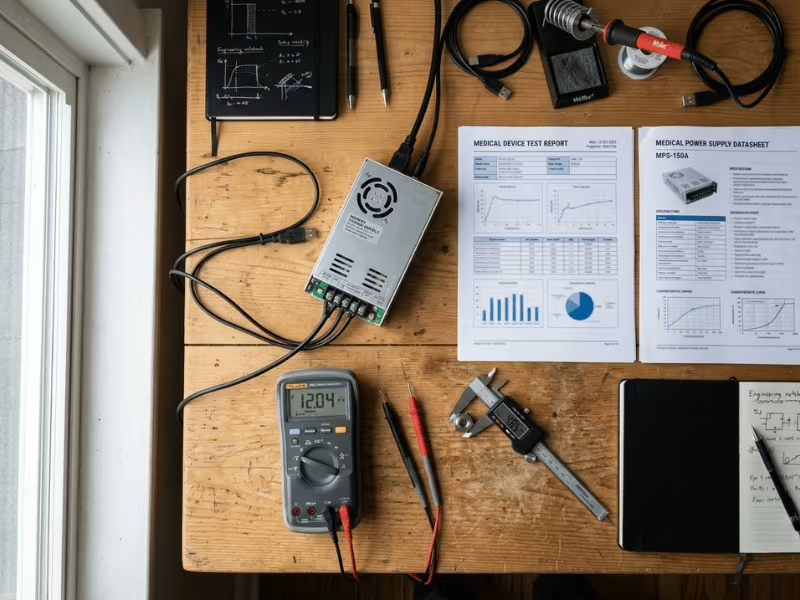
Medical equipment often runs for years with little downtime, so reliability is not a nice-to-have. A cheap supply that fails mid-procedure costs far more than the initial saving—in service calls, lost trust, and potential patient impact. Assess long-term performance across the areas below before you decide, and treat this section as heavily as compliance.
a. MTBF and Operating Temperature
Mean time between failures (MTBF) estimates expected reliability, with higher figures signaling a more robust design. Read it alongside the rated operating temperature range and the conditions the MTBF assumes, since the same number means little without its baseline. A supply comfortable across a wide range runs cooler under stress, and cooler operation extends the life of every internal component.
b. Capacitor Lifetime at Operating Temperature
Electrolytic capacitors usually age first, so their grade and thermal exposure largely set the supply’s real lifespan. Capacitor life roughly doubles for every 10°C drop in operating temperature, which is why a unit running near its thermal limit can wear out years earlier than the same unit running cool. Look for long-life, high-temperature capacitors from reputable makers, and factor your actual internal temperature into any lifespan estimate rather than trusting the best-case rating.
c. Fanless vs. Fan-Cooled Designs
Cooling method carries its own trade-offs. Fanless, convection-cooled supplies remove a moving part that can fail and simplify cleaning in clinical settings, but they need generous airflow and may derate harder at high wattage. Fan-cooled units pack more power into a smaller volume, yet introduce a wear item, audible noise, and a dust path that matters in sterile or home environments. Match the approach to both your power density and your maintenance reality.
d. Qualification, Burn-In, and Supply Continuity
Ask how the manufacturer proves reliability, not just what the datasheet claims. Practices such as burn-in screening and HALT (highly accelerated life testing) surface weak units and design margins before product ships. Just as important for a multi-year medical program is component obsolescence: confirm the supplier’s approach to long-term availability and lifecycle support, because a discontinued supply can force a redesign and full recertification long before your device retires.
10. Safety and EMC Verification at System Level
Even a well-chosen supply can cause trouble once it sits inside your device. This section is not about picking the unit—Sections 5 and 6 covered leakage limits and isolation—but about the checks that confirm the integrated system behaves. Treat these as sign-off gates rather than datasheet line items.
a. EMC Behavior in the Finished Device
Medical devices must meet IEC 60601-1-2 for both emissions and immunity, and a supply that passes in isolation can still push your device over the limit once cables, enclosures, and neighboring circuits enter the picture. Request the supply’s EMC test data, confirm it was evaluated to the current edition for your markets, then validate emissions and immunity on the assembled device, not just the component.
b. Preserving Creepage and Clearance in Your Layout
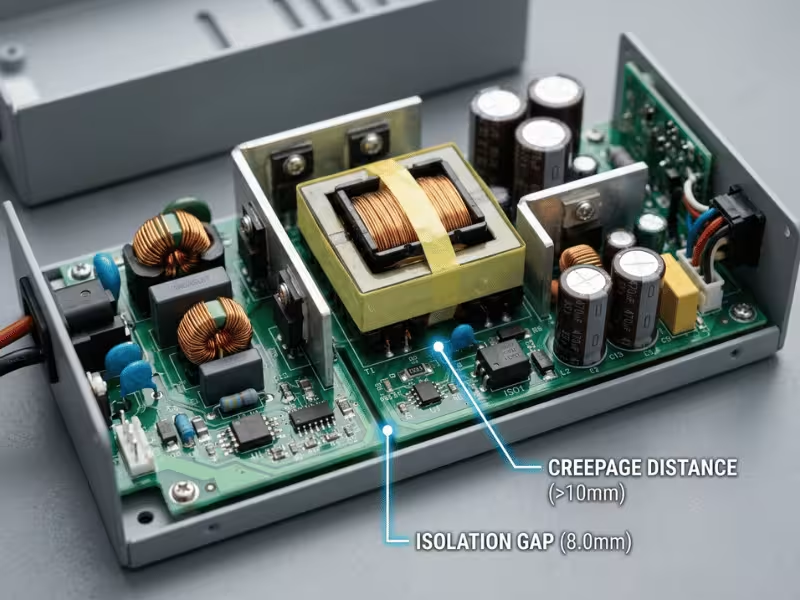
Creepage and clearance distances define the physical spacing that prevents arc-over and breakdown, and medical isolation demands larger distances than standard equipment. A supply that meets these distances internally can still be undermined by your own board and enclosure layout. Verify that connectors, wiring, and adjacent components preserve the required spacing throughout the finished assembly.
c. From Datasheet Compliance to System Validation
The recurring theme across these checks is simple: a compliant component is necessary but not sufficient. Datasheet compliance describes the supply on its own; system validation proves your device is safe as built. Build time and budget for full-device testing into your project plan, and never treat a supplier’s certificate as a substitute for validating the integrated product.
Industry Friction Points Worth Planning For
A few recurring problems trip up otherwise careful teams. Anticipating them protects your schedule and your budget.
- Treating datasheet compliance as system compliance. The most common and most expensive mistake is assuming a certified supply guarantees a certified device. It does not. Leakage, EMC, and isolation must be proven on the finished system, and teams that skip this discover it during formal testing, when changes cost the most.
- Custom modifications that trigger recertification. Asking a supplier to tweak output voltage, connectors, or firmware can quietly invalidate the unit’s existing certification. What looks like a small change may require re-testing and re-documentation, adding months. Clarify certification impact before you request any modification.
- Sourcing on price without lifecycle visibility. Choosing the cheapest qualifying unit feels efficient until it is discontinued mid-program. For a device expected to sell for years, a supply’s long-term availability and the supplier’s engineering support can matter more than a small per-unit saving.
Our Recommendation
Selecting a medical power supply means balancing patient safety, output quality, and multi-year reliability against cost—and doing so with clear eyes about where component compliance ends and system validation begins. If you are weighing options, Quankang medical power supplies are built to serve as a dependable, review-ready foundation for that work.
- Certified building blocks. Units certified to IEC 60601-1 with 2×MOPP isolation, suitable for device designs targeting BF or CF applied-part requirements when integrated and validated at the system level.
- Output quality for sensitive designs. Universal 90–264 V input with tight regulation and low ripple, protecting diagnostic and laboratory circuits across a broad power range.
- Reliability you can plan around. Long-life, high-temperature capacitors, strong MTBF ratings, and lifecycle support aimed at multi-year medical programs, with fanless and fan-cooled options to match your thermal and maintenance needs.
- Documentation and engineering support. Certificates, EMC and safety test reports, derating data, and application engineering to help you match the right supply to your device—and to keep your system-level validation on track.
Ready to specify with confidence? Contact the Quankang team for datasheets, test reports, and hands-on help matching the right power supply to your design.