UL Listed applies to complete, standalone products cleared for field installation. UL Recognized applies to components that will be incorporated into a larger system. Using the wrong mark — or misreading a supplier’s claim — can result in failed inspections, rejected shipments, and serious liability exposure.
If you’ve ever stared at two nearly identical components on a spec sheet — one marked “UL Listed,” the other “UL Recognized” — and wondered whether the difference actually matters, it does. Significantly.
Specifying the wrong certification can bring a project to a halt. Inspectors reject non-compliant panels. Customs flags shipments. Legal teams get involved. And in industries like industrial controls, medical devices, and power electronics, the downstream consequences of a compliance failure extend well beyond paperwork.
This guide is written for engineers, procurement managers, and compliance professionals in the industrial, power, and electronics sectors who need to know exactly what each mark means, when to use it, and how to verify it. You’ll find clear definitions, a side-by-side comparison table, real-world product examples across industries, role-specific guidance, common misconceptions, and a practical decision framework for determining which certification your product actually needs.
What Is UL — and Why Do These Marks Carry Regulatory Weight?
Underwriters Laboratories, universally known as UL, is one of the most widely recognized Nationally Recognized Testing Laboratories (NRTLs) in the United States. That NRTL designation is granted by OSHA, which authorizes qualified testing labs to certify that products meet established safety standards before they reach the market.
UL builds most of its testing procedures from International Electrotechnical Commission (IEC) standards — the same framework used by certification bodies in Europe and Asia — adapted to align with US regulatory requirements. This means that UL-certified products are evaluated against technically rigorous, internationally grounded criteria, not a proprietary or arbitrary checklist.
One important clarification before going any further: UL does not “approve” products. That term is explicitly disallowed by UL’s own guidelines. UL certifies that a product has met specific safety requirements at the time of testing. The manufacturer retains full responsibility for safe design, correct application, and ongoing compliance. The distinction matters — it shapes how engineers, procurement teams, and compliance officers should interpret what a UL mark actually guarantees.
UL marks carry real regulatory weight in the US market. The National Electrical Code (NEC) and most local inspection authorities require “listed” or “labeled” equipment as a baseline requirement for field installation. In practice, this makes a UL Listed mark a de facto prerequisite in many sectors, not just a nice-to-have.
What Does UL Listed Mean?
UL Listed is a certification for complete, self-contained, standalone products. It confirms that the entire product — evaluated exactly as it would be installed and used in the field — has been tested against UL’s published safety standards for its specific equipment category.
The UL Listed mark is the familiar circular “UL” symbol, typically accompanied by the word “LISTED.” It signals to Authorities Having Jurisdiction (AHJs), electricians, and inspectors that the product has been reviewed as a finished, field-deployable item and meets applicable safety requirements without any additional qualifications.
What does UL Listed testing actually cover?
The scope is comprehensive. Evaluators assess construction integrity, electrical safety (grounding, insulation quality, live part securement), performance under fault conditions (power surges, short circuits), and environmental durability (resistance to dust, water ingress, and temperature extremes). The goal is to verify that the product is safe for real-world installation by a qualified electrician or end user, without the need for further component-level evaluation.
Common UL Listed product examples include:
- Finished industrial control panels built to UL 508A
- External power adapters and lab power supplies
- Consumer and commercial electrical appliances
- Smoke and CO₂ detectors
- Computer and industrial computing equipment
- Heaters and HVAC units
For AHJs conducting on-site inspections, the UL Listed mark is a green light. It means the product was evaluated as a complete system and is cleared for field installation under the scope of the applicable standard.
What Does UL Recognized Mean?
UL Recognized is a certification for components and subassemblies intended for installation within a larger piece of equipment — not for standalone field use. Recognition confirms that the component meets specific safety requirements under defined operating conditions, with the expectation that it will be incorporated into a finished assembly that itself undergoes system-level evaluation.
The physical mark for UL Recognized is a backward “UR” or “RU” symbol. This marking conveys a specific, non-negotiable message: this part is factory-ready, not field-ready. An AHJ who sees only a UL Recognized mark on a standalone installation will reject it.
Conditions of Acceptability — the most important concept in UL Recognition
Every UL Recognized component’s certification comes with a set of Conditions of Acceptability, documented in the component’s UL certification file. These are not suggestions. They define the exact operating parameters within which the component’s recognition is valid, including:
- Maximum voltage, current, and short-circuit current ratings (SCCR)
- Required enclosure types for fire or electrical shock protection
- Mounting orientation and spacing requirements
- Maximum ambient operating temperature
Violate any one of these conditions in your design, and the component’s recognition is void within your assembly — even if the physical mark is present and the part itself is legitimate.
Common UL-recognized component examples include:
- Internal AC-DC and DC-DC power supplies
- Relays and contactors
- Printed circuit boards (PCBs)
- Wires, cables, and connectors
- X and Y capacitors
- Terminal blocks and transistors
- Transformers and display technology
One frequently misunderstood exception: lab power supplies and external power adapters carry UL Listed marks, not UL Recognized, because they function as standalone devices — even though they’re “power supplies” by product category.
UL Listed vs. UL Recognized: Side-by-Side Comparison
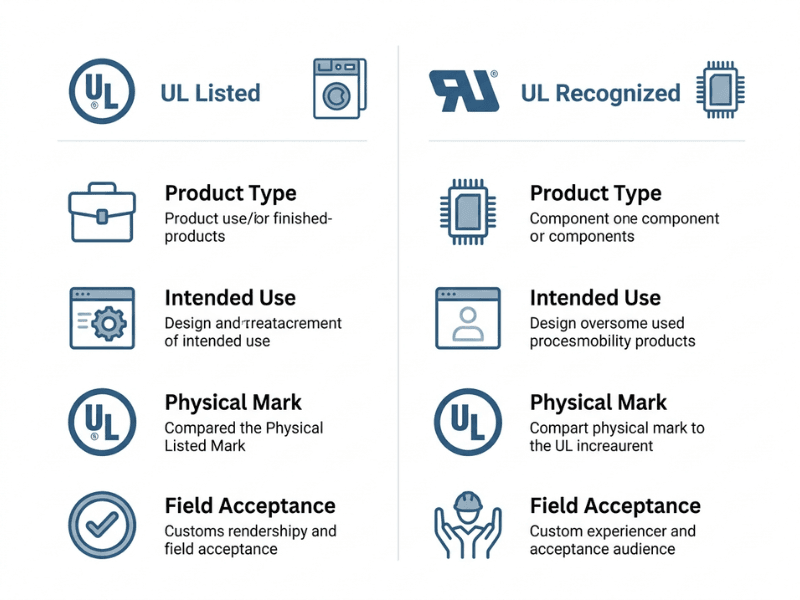
The table below provides a quick-reference summary of the key differences between UL Listed and UL Recognized certifications.
Attribute | UL Listed | UL Recognized |
|---|---|---|
Product type | Complete, standalone end-products | Components or subassemblies for factory integration |
Intended use | Field installation and direct end-user use | Installation within a larger, UL-listed assembly |
Evaluation scope | Full product tested as a whole system | Component tested under specific, limited conditions |
Physical mark | Circular “UL” mark, often with “LISTED” | Backward “UR” or “RU” mark |
AHJ acceptance | Accepted for field inspection and code compliance | Not accepted as a standalone product in the field |
Cost and timeline | More expensive; a full Listing can take months | Generally 30–70% cheaper; often completed in weeks |
Manufacturer responsibility | Ensure the finished product’s safety as a whole | OEM must comply with all Conditions of Acceptability |
The Testing Process: What Each Certification Actually Requires
UL Listed testing is a top-to-bottom evaluation of the entire product. Construction integrity, electrical safety, fault-condition performance, and environmental durability are all under scrutiny. The evaluation is designed to confirm that the product is safe for real-world field use — no additional protections assumed, no system-level dependencies accounted for.
UL Recognized testing is a narrower, more surgical evaluation. Tests are calibrated to the component’s defined operating conditions within a larger system. A low-voltage, non-isolated DC-DC converter, for example, may only require testing for peak voltage, material flammability, and component temperature rise. A high-power AC-DC converter faces a far broader range of evaluations: electric shock risk, fire and smoke generation, and electromagnetic emissions, among others.
The cost and timeline implications are significant. Recognition investigations are generally 30–70% cheaper than full Listing engagements and can be completed in weeks rather than months. A complex product pursuing full UL Listing — one involving extensive enclosure testing, environmental stress analysis, and multiple back-and-forth review cycles with UL engineers — can take several months and considerably more engineering hours.
For component manufacturers, UL Recognition is typically the preferred path. For system-level product manufacturers targeting commercial distribution or AHJ-governed markets, the investment in full Listing is usually unavoidable.
Real Product Examples Across Industries
Power supplies
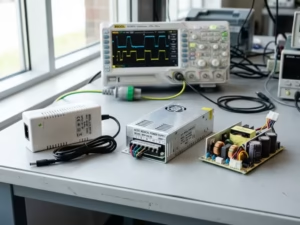
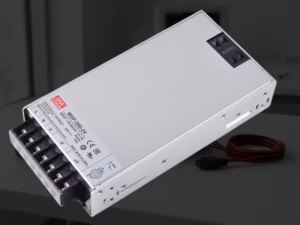
Most internal AC-DC and DC-DC power supplies carry UL Recognized marks. They’re embedded components — they don’t function without a host system. Applicable standards include UL 62368 for IT and AV equipment and UL 60601-1 for medical applications. The exception, as noted above, applies to external adapters and bench power supplies, which are UL Listed because they operate as standalone devices.
Industrial control panels
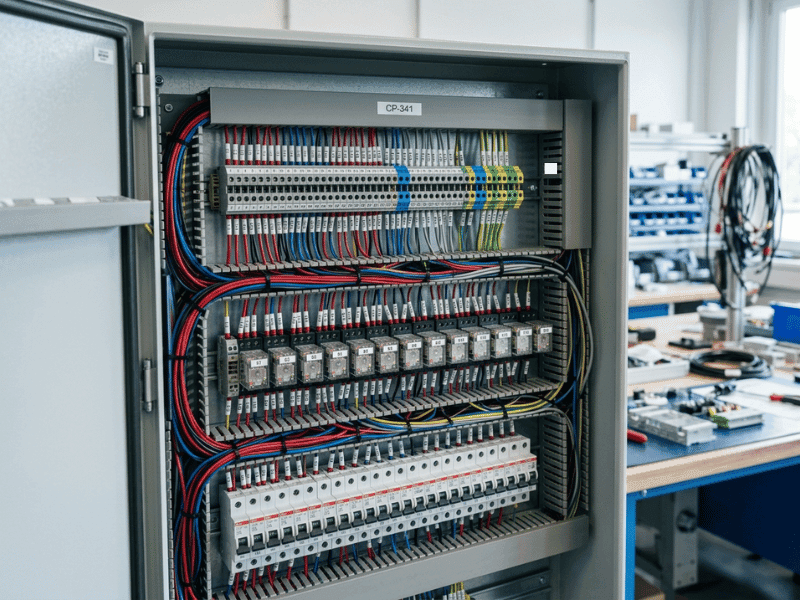
A panel built and evaluated to UL 508A earns a UL Listed mark as a finished assembly. Inside that panel, you’ll typically find a mix of both mark types: UL Listed main circuit breakers and UL Recognized relays, terminal blocks, and contactors. Using UL Recognized components within a UL 508A panel is entirely appropriate — but only if the panel builder adheres to each component’s Conditions of Acceptability and meets the UL 508A construction requirements. The recognized status of a component does not automatically transfer compliance to the panel.
Computing and electronics
An industrial computer system that undergoes a complete, system-level safety evaluation earns the UL Listed mark. The internal circuit boards, power supply modules, and safety-critical semiconductor components within that computer are typically UL Recognized.
Consumer and commercial appliances
Finished products — smart home devices, kitchen appliances, HVAC equipment — carry UL Listed marks. Their internal PCBs, transformers, and capacitors carry UL Recognized marks. The end-user never interacts with a UL Recognized mark directly, but those components are the foundation on which the system-level Listing is built.
What This Means for Your Team
What does UL Recognized mean for engineers and designers?
When selecting components for a new design, retrieve the UL file number for every recognized component and review the complete Conditions of Acceptability before finalizing your design specifications. Build those conditions into your design from day one — a violation discovered late in the development cycle is expensive to remediate.
Think ahead to the system-level Listing goal. Using UL Recognized components simplifies the path to a final UL Listing, but only when they are applied correctly. A UL Recognized component misapplied in your assembly doesn’t just risk non-compliance — it can trigger a full re-evaluation of the system.
What does UL certification mean for procurement teams?
Never accept “UL Approved” or “UL Certified” from a supplier as confirmation of compliance. “UL Approved” is not a valid UL term. “UL Certified” is an umbrella term that doesn’t specify whether a product is Listed or Recognized. Both phrases can be used — intentionally or not — to obscure the absence of proper certification.
Require suppliers to provide UL file numbers on every specification sheet. Verify them using UL’s Product iQ™ database before raising a purchase order. Procurement documents should specify “UL Listed” or “UL Recognized” explicitly, along with the applicable standard (e.g., UL 508A, UL 62368), to eliminate ambiguity in the supply chain.
What does UL compliance mean for compliance and quality professionals?
A UL Recognized component maintains its certification status in a finished assembly only if its Conditions of Acceptability are honored throughout the manufacturing process. A single non-conforming substitution — a different terminal block than the one specified, a relay mounted in a non-permitted orientation — can compromise the entire panel’s compliance status.
In the event of an incident such as a fire or electrical fault, investigators will audit every component in the assembly. Documentation of each component’s UL status, file number, and compliance with Conditions of Acceptability is not administrative overhead — it’s essential liability protection.
Common Misconceptions About UL Certification
“UL Approved is a valid certification term.”
It is not. UL explicitly disallows this language. UL’s own published guidelines cite “UL Approved” as an example of incorrect terminology. The correct terms are UL Listed, UL Recognized, and UL Classified.
“UL Certified is the same as UL Listed.”
UL Certified is a broader marketing umbrella used across UL’s Certification Marks program. It does not carry the same specificity as Listed or Recognized and cannot be used interchangeably with either term for compliance purposes.
“A UL-recognized component can be installed in the field.”
It cannot. A UL-recognized mark explicitly indicates that the component is not cleared for standalone field installation. Any AHJ conducting an inspection will reject it.
“Using all UL Listed components makes the finished assembly UL Listed.”
Not necessarily. The finished assembly must be evaluated separately as a complete product. The certifications of individual components do not roll up automatically into a system-level Listing.
“All UL certifications are recognized globally.”
UL is an NRTL accredited primarily for the US and Canada markets. CE (Conformité Européenne) is the EU-specific conformity mark and does not carry NRTL status. A CE mark alone does not satisfy US code requirements for field installation.
CE, CSA, and ETL: How Do They Relate to UL in the North American Market?
OSHA’s NRTL program currently recognizes multiple testing laboratories, all authorized to certify products against the same underlying IEC-based safety standards. UL, ETL (operated by Intertek), and CSA (Canadian Standards Association) are among the most widely recognized NRTLs. For most regulatory purposes, their Listed and Recognized marks are functionally interchangeable — a product carrying an ETL Listed mark meets the same standards as one carrying a UL Listed mark.
In practice, UL has become the most widely referenced mark in the US market, and AHJ acceptance of UL marks is nearly universal. For organizations selling products across North America, look for the “C-UL” or “cULus” marks — these indicate cross-certification for both the Canadian and US markets under a single evaluation.
The CE mark is a different matter entirely. CE is a self-declaration of conformity with EU directives, not a third-party NRTL certification backed by ongoing factory surveillance. It satisfies EU regulatory requirements but does not meet US or Canadian code requirements on its own. Products bearing only a CE mark require additional NRTL testing to obtain the recognition or listing required for US market entry.
How to Determine Which UL Certification Your Product Needs
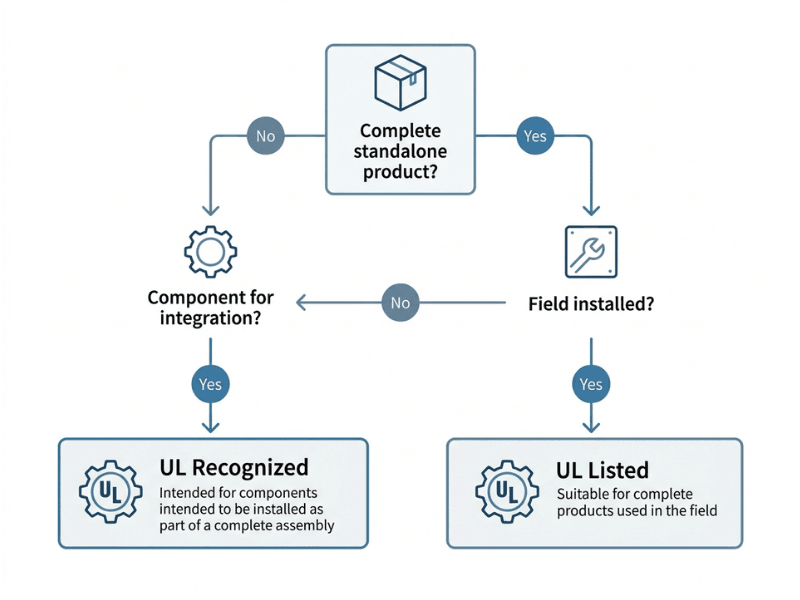
The central question that drives the decision is straightforward: Where will this item ultimately be installed — in the field as a finished product, or inside a factory as part of a larger assembly?
- If it will be field-installed as a standalone product → UL Listed is required.
- If it will be factory-integrated into a larger system → UL Recognized is appropriate.
Use this checklist to confirm your path:
- Is the product a complete, self-contained end-product, or a component designed for integration into a larger system?
- Will it be installed in the field by a qualified electrician or an end user, or assembled in a factory by a qualified manufacturer?
- Does the target market — distributors, industrial buyers, or AHJs — require a specific UL mark as a condition of sale or installation approval?
- Does the applicable industry standard (UL 508A, UL 62368, UL 60601-1) prescribe a specific certification type for this product category?
On cost-benefit trade-offs: UL Recognition is faster and less expensive, making it the preferred path for component manufacturers who need to support OEM design-in activity. Full Listing requires a larger investment but unlocks field installation approval, commercial distribution, and AHJ acceptance — outcomes that Recognition cannot deliver.
How to Verify a UL Mark and Avoid Counterfeit Certifications
Counterfeit UL marks are a real and persistent supply chain risk. Visual inspection of a mark alone is not sufficient to confirm genuine certification.
Know the physical marks:
- UL Listed: the familiar circular “UL” mark, typically paired with the word “LISTED”
- UL Recognized: a backward “UR” or “RU” symbol
Locate the UL File Number. Every genuinely UL-certified product carries a unique alphanumeric file number, typically beginning with the letter “E,” on its product label, packaging, or datasheet. This is the definitive identifier for verifying the scope and validity of a UL certification.
Verify using UL Product iQ™:
- Locate the UL File Number on the product label, packaging, or datasheet.
- Visit the UL Product iQ™ website (a free account is required).
- Enter the file number and review the results: manufacturer name, product category, applicable UL standard, and any Conditions of Acceptability.
- If the file number returns no results, or the details on screen don’t match the product in hand, treat that as a red flag and reject the part.
UL Product iQ™ verification should be a non-negotiable step in both procurement workflows and incoming inspection procedures. A UL file number check takes less than two minutes and can prevent compliance failures that cost far more to unwind.

Choosing the Right Mark: The Stakes Are Higher Than You Think
The distinction between UL Listed and UL Recognized is not a technicality. It defines whether a product can legally and safely be installed in the field, and whether the components inside a finished assembly actually support — or silently undermine — the system’s compliance status.
UL Listed means field-ready, standalone, and cleared for AHJ inspection. UL Recognized means factory-ready, integrated, and valid only within the specific operating conditions documented in the component’s certification file.
Get this right from the start. Verify UL file numbers through UL Product iQ™ before components enter your supply chain. Build Conditions of Acceptability into your design specs and manufacturing documentation. Specify the correct mark — and the applicable standard — explicitly in every procurement document.
For further reading, explore related topics including UL 508A panel building requirements, control panel component sourcing best practices, and power supply selection for ITE and medical applications.
Frequently Asked Questions
Can I use a UL Recognized component in place of a UL Listed product?
No. UL-recognized components are not certified for standalone field use. They are designed and tested for integration within a larger, factory-assembled system. An AHJ will reject a field-installed component that carries only a UL Recognized mark, and it does not satisfy NEC requirements for finished, field-installed equipment.
Does a finished assembly made entirely from UL Recognized components automatically count as UL Listed?
No. The individual component certifications do not combine to create a system-level Listing. The finished assembly must be separately submitted to a NRTL-accredited lab and evaluated as a complete product before it can carry a UL Listed mark.
Does OSHA or the NEC actually require UL Listing by law?
Neither OSHA nor the NEC mandates UL Listing by name. However, both reference safety standards that UL is one of the most widely accepted means of demonstrating compliance with. In practice, AHJs and major industrial buyers treat UL Listed status as a baseline requirement for field-installed equipment, making it effectively mandatory in most commercial and industrial applications.
How much more does UL Listed certification cost compared to UL Recognized?
UL Recognition is generally 30–70% cheaper than a full UL Listing and can often be completed in weeks. A full Listing for a complex product — particularly one requiring extensive enclosure testing and environmental evaluation — can take several months and significantly more engineering hours. The cost differential reflects the scope: Listed testing evaluates the entire system; Recognition testing evaluates a component under defined conditions.
What happens if a non-UL or incorrectly applied UL Recognized component is used in a UL 508A-certified panel?
It can void the panel’s compliance status. During an inspection, an AHJ may flag the panel as non-compliant, requiring rework or re-evaluation. In the event of an incident such as a fire, investigators will scrutinize every component in the assembly. Organizations that cannot document proper UL status and Conditions of Acceptability compliance for every component face significant insurance and legal liability exposure.
How do CE, CSA, and ETL marks relate to UL certification in the US market?
ETL (Intertek) and CSA (Canadian Standards Association) are both OSHA-recognized NRTLs, equivalent in standing to UL. Their listed and recognized marks meet the same underlying safety standards and are generally accepted interchangeably with UL marks in the US and Canadian markets. CE is an EU conformity mark, not an NRTL certification, and does not satisfy US code requirements on its own. Products bearing only a CE mark require additional NRTL testing before they can be used in US field installations.