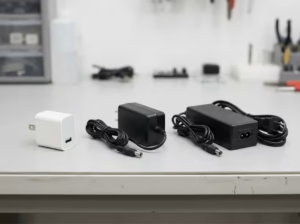
How to Identify, Diagnose, and Reduce EMI Problems in Medical Devices
Electromagnetic interference (EMI) is one of the most common and difficult problems in medical device development.
Many medical OEM manufacturers encounter situations where a device works normally during internal testing but suddenly fails during IEC 60601-1-2 EMC certification or in real clinical environments.
Typical symptoms include:
- unstable ECG waveforms
- touchscreen malfunction
- wireless communication interruption
- random MCU reset
- sensor instability
- imaging artifacts
- unexplained system reboot
In many cases, the root cause is not the main control board itself, but EMI generated or amplified by the medical power system.
This guide explains practical EMI troubleshooting methods used in medical device engineering, including how to identify EMI sources, isolate coupling paths, and optimize medical power architectures for IEC 60601 compliance.
This article is part of our medical power engineering series:
→ Related Guide:
“Medical Power Supply Failures: Causes, IEC 60601 Risks, and Engineering Solutions”
→ Related Guide:
“IEC 60601 EMC Testing Problems and Solutions”

Why EMI Problems Are More Difficult in Medical Devices
Medical systems are far more sensitive to EMI than standard industrial electronics because they often combine:
- high-gain analog front-end circuits
- patient-connected electrodes
- wireless communication modules
- compact enclosure structures
- switching power systems
- high-speed digital processing
Medical environments also contain many potential interference sources:
- electrosurgical systems
- wireless infrastructure
- imaging equipment
- motor-driven equipment
- backup power systems
Unlike consumer devices, medical products must maintain stable operation even under electromagnetic disturbance.
As a result, even relatively small EMI problems may trigger:
- IEC 60601 certification failure
- inaccurate diagnostic data
- unstable patient monitoring
- clinical reliability concerns
Common Symptoms of EMI Problems in Medical Devices
EMI issues often appear differently depending on system architecture and device application.
Typical EMI Symptoms
| Symptom | Possible EMI Cause |
| ECG waveform distortion | Common-mode switching noise |
| Touchscreen instability | Radiated emissions coupling |
| Wireless disconnection | RF interference |
| MCU reset | EFT or surge disturbance |
| Sensor drift | Ground noise coupling |
| Imaging artifacts | Ripple or switching harmonics |
| USB communication failure | Conducted noise injection |
In many projects, symptoms only appear under specific operating conditions such as:
- battery charging
- motor startup
- high CPU load
- wireless transmission
- long-duration operation
This makes EMI troubleshooting particularly difficult during certification testing.

Real-World OEM Problem: ECG Noise During Charging
A portable ECG monitor manufacturer experienced severe waveform instability whenever the device was connected to external AC power during patient monitoring.
The ECG system operated normally during battery-powered operation, but noise spikes appeared immediately after the external adapter was connected.
Initial investigation revealed:
- ECG analog front-end design was stable
- shielding performance was acceptable
- noise amplitude increased significantly during battery charging mode
- common-mode switching noise coupled through the external adapter
The original commercial-grade adapter used relatively aggressive EMI filtering optimized for consumer electronics rather than patient-connected medical systems.
System-Level Engineering Solution
To improve signal integrity without redesigning the ECG acquisition circuitry, the OEM replaced the original adapter with a Quankang IEC 60601-certified medical power supply featuring:
- low-leakage EMI filter optimization
- reduced common-mode coupling current
- shielded transformer architecture
- controlled parasitic capacitance
- low ripple switching topology
Additional optimization included:
- analog ground isolation refinement
- cable routing improvement
- shielding continuity enhancement
After system-level optimization, ECG waveform stability improved significantly while maintaining IEC 60601 EMC compliance.
This avoided major redesign delays during final validation.
Understanding EMI Noise Paths in Medical Devices
Effective EMI troubleshooting requires understanding how noise propagates through the system.
Most EMI problems involve three elements:
| Element | Description |
| Noise source | Switching converter, motor, RF module |
| Coupling path | Cable, ground, radiation, capacitance |
| Sensitive victim | Sensor, MCU, analog front-end |
If any one of these elements is controlled, EMI problems can often be significantly reduced.
Common EMI Coupling Mechanisms
1. Conducted Noise Coupling
Conducted EMI travels through:
- AC input lines
- DC power rails
- signal cables
- grounding structures
This is one of the most common EMI mechanisms in medical devices.
Conducted emissions typically dominate the lower frequency spectrum (150kHz to 30MHz). This requires strategically tuned Pi-filters, common-mode chokes with high impedance, and optimized differential mode filtering.
Common Sources
- switching power supplies
- motor drivers
- DC-DC converters
- battery charging systems
Typical Symptoms
- unstable sensor readings
- communication failure
- ripple-induced waveform distortion
Engineering Solutions
Quankang medical power solutions reduce conducted EMI through:
- multi-stage EMI filtering
- low ripple architecture
- optimized switching transitions
- controlled common-mode current
2. Radiated EMI Coupling
Radiated EMI occurs when high-frequency energy propagates through the air.
Compact medical devices are especially vulnerable because of:
- dense PCB layouts
- long cable structures
- compact enclosure spacing
Common Symptoms
- touchscreen malfunction
- wireless instability
- unexpected sensor behavior
Common Root Causes
- poor shielding
- long grounding loops
- excessive dv/dt switching
- enclosure resonance
Engineering Solutions
Typical solutions include:
- shielding optimization
- cable routing refinement
- grounding improvement
- reduced switching edge speed
Radiated EMI issues usually peak at higher frequencies (30MHz to 1GHz+), where high dv/dt and di/dt switching nodes act as unintentional loop antennas.
3. Common-Mode Noise Problems
Common-mode noise is one of the most critical EMI challenges in medical systems.
It often originates from:
- transformer parasitic capacitance
- Y-capacitor coupling
- switching transitions
Medical devices with patient-connected sensors are especially sensitive to common-mode current.
Typical Symptoms
- ECG baseline instability
- patient signal noise
- touch current fluctuations
- EMC emission failure
Engineering Solutions
Quankang medical adapters reduce common-mode noise through:
- controlled transformer shielding
- optimized low-leakage EMI filters
- balanced grounding architecture
- controlled parasitic capacitance
→ Related Resource:
“How to Reduce Leakage Current in Medical Devices”
4. Ground Loop Problems
Ground loops occur when multiple return current paths create voltage differences between system grounds.
This problem is common in:
- imaging systems
- patient monitoring systems
- USB-connected medical equipment
Typical Symptoms
- low-frequency signal noise
- unstable sensor output
- communication interruption
Engineering Solutions
Common improvements include:
- single-point grounding
- analog/digital ground separation
- shield grounding optimization
- cable isolation refinement

Why External Power Adapters Often Cause EMI Problems
Many OEM manufacturers initially suspect the main PCB when EMI problems occur.
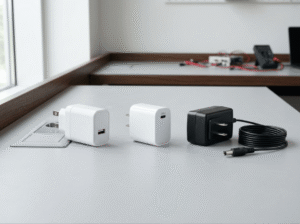
However, in medical systems, the external switching adapter is often a major noise source.
Commercial-grade adapters commonly prioritize:
- low cost
- compact size
- consumer EMC compliance
rather than:
- low common-mode current
- ultra-low ripple
- medical signal integrity
- patient-connected EMC stability
This is why replacing a commercial adapter with a medical-grade IEC 60601 adapter often significantly improves EMC margin.
Common IEC 60601-1-2 EMC Tests Related to EMI Problems
Medical devices must comply with IEC 60601-1-2 electromagnetic compatibility requirements. Understanding common EMC tests helps engineering teams identify the root causes of EMI failures more efficiently.
| EMC Test | Typical Failure Cause |
| Conducted Emissions | Switching noise entering AC power lines |
| Radiated Emissions | PCB layout issues, cable radiation |
| ESD Immunity | Poor grounding or insufficient protection |
| EFT Immunity | Inadequate filtering on power inputs |
| Surge Immunity | Weak transient suppression design |
| RF Immunity | Insufficient shielding or isolation |
Many certification failures are not caused by a single component but by interactions between the power architecture, grounding strategy, and enclosure design.
Typical Commercial Adapter vs IEC 60601 Medical Adapter
| Parameter | Commercial/Industrial Adapter | IEC 60601 Medical Adapter |
| Leakage Current | 250–500 μA+ | <100 μA (BF) |
| Isolation Protection | Basic insulation | 2×MOPP |
| Ripple Noise | Higher ripple under load | Low ripple for sensitive medical systems |
| EMC Margin | Minimal compliance margin | Optimized for IEC 60601-1-2 |
| Operating Environment | Commercial/industrial | Clinical and patient-connected environments |
| Lifecycle Stability | Shorter lifecycle support | Long-term medical lifecycle support |
Many EMC failures originate from system-level power architecture rather than the main control board itself.
Engineering Tradeoff: EMI Suppression vs Leakage Current
One of the most difficult engineering challenges in medical power design is balancing:
- low EMI emissions
- low leakage current
Increasing Y-capacitor values may improve EMI suppression while simultaneously increasing leakage current.
Reducing leakage current too aggressively may worsen EMC performance.
This tradeoff becomes especially important in:
- ECG systems
- BF applications
- CF-type patient-connected devices
Quankang medical power solutions optimize both EMC and leakage current through:
- low-leakage EMI filter design
- controlled common-mode current
- shielded transformer structures
- balanced grounding architecture
→ Related Resource:
“What Is 2 × MOPP in Medical Power Supplies?”
Step-by-Step EMI Troubleshooting Process
Step 1: Identify the Operating Condition
Determine when the problem occurs:
- charging mode
- AC operation
- wireless transmission
- motor startup
- high-load condition
Step 2: Isolate the Noise Source
Disconnect or isolate:
- external adapter
- wireless modules
- motors
- peripheral cables
to identify the dominant EMI source.
Step 3: Analyze Coupling Paths
Evaluate:
- grounding structure
- cable routing
- shielding continuity
- common-mode current paths
Step 4: Measure Ripple and Noise
Check:
- output ripple
- switching harmonics
- common-mode current
- transient noise behavior
Step 5: Optimize System-Level Architecture
EMI problems are often solved through combined improvements involving:
- adapter selection
- grounding optimization
- shielding enhancement
- PCB layout refinement
- cable filtering
rather than a single component replacement.
EMC Design Challenges in Compact Medical Devices
Portable medical devices create additional EMI challenges because they integrate:
- battery charging systems
- wireless communication
- compact fanless enclosures
- sensitive analog circuits
In many projects, EMC problems only appear during:
- full-load operation
- thermal stress conditions
- battery charging
- cable movement
This makes early EMC planning critical during medical device development.
→ Related Resource:
“Why Medical Power Supplies Overheat”
How Quankang Medical Power Supplies Improve EMI Performance
Quankang medical power solutions are specifically engineered for low-noise medical applications.
Key features include:
Low Ripple Switching Architecture
Designed for:
- ECG systems
- imaging equipment
- sensitive analog electronics
Low-Leakage EMI Filter Optimization
Helps balance:
- EMC suppression
- patient leakage current safety
Shielded Transformer Structures
Reduce:
- radiated emissions
- common-mode coupling
- switching harmonics
IEC 60601 EMC Compliance Validation
Quankang medical adapters undergo:
- conducted emission testing
- radiated emission testing
- EFT validation
- surge immunity testing
- ESD evaluation
This helps OEM manufacturers reduce EMC redesign risk.
Key Engineering Takeaways
Successful EMI troubleshooting requires engineers to focus on three fundamental elements:
Noise Source
Examples include:
- Switching converters
- Battery chargers
- Wireless modules
- Motor drivers
Coupling Path
Noise may propagate through:
- Power cables
- Signal traces
- Ground structures
- Radiated electromagnetic fields
Sensitive Circuits
Typical victims include:
- ECG acquisition circuits
- Analog front-end systems
- Sensors
- Wireless communication modules
In many medical device projects, addressing the power architecture and grounding strategy can significantly reduce EMI issues without requiring major PCB redesign.
Early EMC planning often reduces certification delays, engineering costs, and product launch risks.
FAQ
What causes EMI problems in medical devices?
Common causes include switching noise, grounding problems, poor shielding, ripple coupling, and low-quality external adapters.
Why does ECG noise appear during charging?
Charging mode often introduces common-mode switching noise from the external adapter into sensitive analog front-end circuits.
Can the external adapter cause EMC certification failure?
Yes. In many projects, the external adapter is one of the largest EMI sources in the system.
Why are medical devices more sensitive to EMI?
Medical devices frequently use high-gain analog circuitry and patient-connected sensors that are highly sensitive to electrical noise.
How can EMI problems be reduced?
Effective solutions often involve system-level optimization including grounding, shielding, adapter selection, and cable routing refinement.
What is the difference between EMI and EMC?
EMI refers to unwanted electromagnetic interference generated by a device, while EMC (Electromagnetic Compatibility) refers to a device’s ability to operate correctly in its electromagnetic environment without causing or suffering from interference.
Why do EMI problems often appear only during certification testing?
Certification laboratories expose devices to controlled electromagnetic disturbances that may not be present during normal operation. This often reveals hidden weaknesses in grounding, shielding, filtering, or power architecture.
How does common-mode current affect ECG systems?
Common-mode current can couple into patient-connected electrodes and introduce noise into sensitive ECG acquisition circuits, causing waveform distortion and reduced signal quality.
Can replacing a power adapter improve EMI performance?
In many cases, yes. Medical-grade power supplies are typically optimized for low leakage current, reduced common-mode noise, and improved EMC performance compared with standard commercial adapters.
What is the most common source of EMI in portable medical devices?
Common sources include switching power supplies, battery charging circuits, wireless communication modules, and inadequate grounding structures.
Engineering Support for Medical EMI Troubleshooting
Medical OEM manufacturers frequently encounter challenges involving:
- IEC 60601 EMC failures
- ECG signal noise
- conducted emissions
- radiated emissions
- grounding instability
- ripple interference
- common-mode current problems
Quankang engineering teams support medical device manufacturers with:
- IEC 60601-compliant medical power supplies
- low-EMI AC-DC adapters
- low ripple medical power architectures
- EMC troubleshooting support
- grounding and shielding optimization
- OEM and ODM engineering collaboration
Whether you are developing ECG systems, portable monitoring devices, imaging equipment, or wireless healthcare products, selecting the correct low-noise medical power architecture can significantly improve EMC stability and reduce certification risk.
For technical consultation regarding EMI troubleshooting or medical power supply selection, contact Quankang engineering teams.