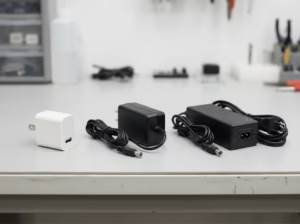
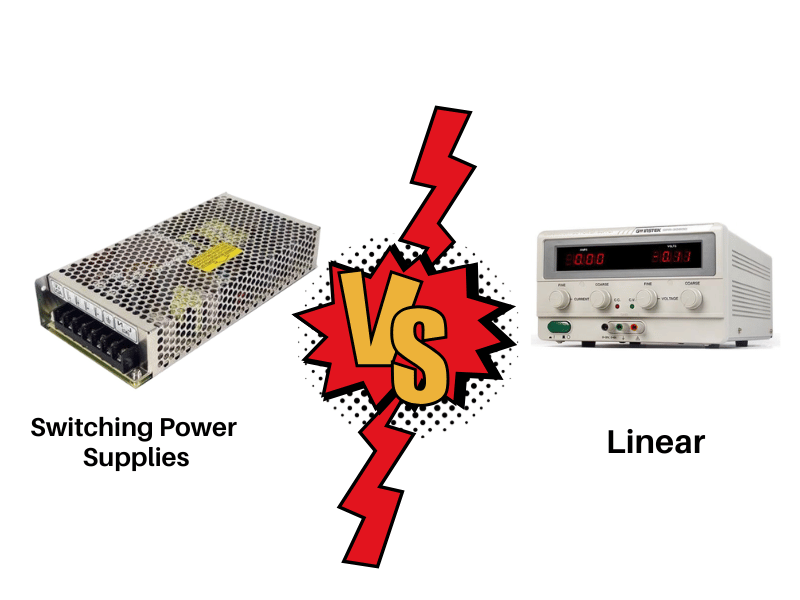
Power supplies are a core part of every medical electronic system. They affect safety, signal quality, thermal performance, device size, and long-term reliability. In medical applications, the choice between a linear and a switching power supply is not merely a technical preference. It can directly shape how well a device performs in real clinical conditions.
If you design, source, test, or integrate medical equipment, you need to understand where each type of power supply fits best. In this guide, you will see how linear and switching power supplies work, where they are used, how they differ in noise, efficiency, size, and cost, and what trade-offs matter most. By the end, you should have a clearer basis for choosing the right approach for your medical device or system.
1.0 What Is a Linear Power Supply?
Definition and Working Principle
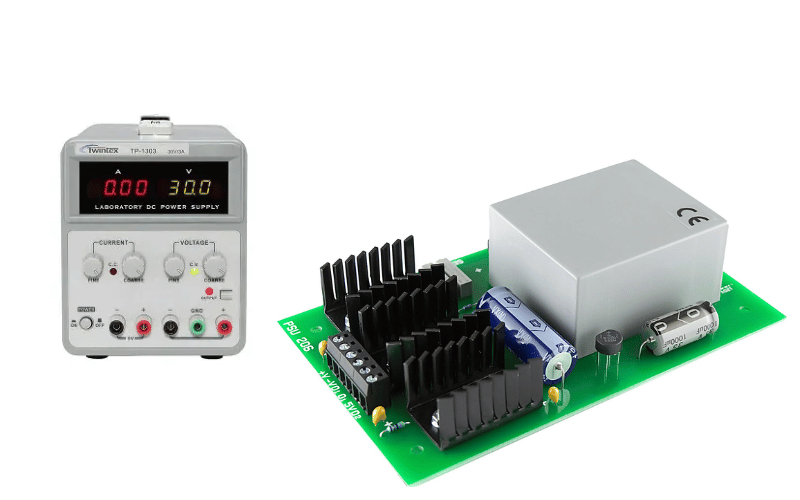
A linear power supply is a type of AC-DC power conversion system that uses a transformer, rectifier, filter, and linear regulator to produce a stable output voltage. It works by stepping down the incoming AC mains voltage to a lower level, converting that AC into DC, smoothing the waveform, and then regulating the output to the required value. The regulator continuously dissipates excess voltage as heat to maintain a clean and constant output.
This design is called “linear” because the regulating element operates in its linear region rather than rapidly switching on and off. That simple operating method gives the supply a key advantage: low electrical noise. For many medical systems, especially those with sensitive analog circuits, that matters a great deal. Stable output and low ripple can improve measurement accuracy and reduce interference with nearby electronics.
Linear designs are older than switching designs, but they are still important. Their architecture is easier to understand, troubleshoot, and often validate in low-noise environments. However, they tend to be larger, heavier, and less efficient than switching power supplies because they waste more energy as heat during regulation.
Key Features
Linear power supplies are known for low ripple and noise, simple circuit design, and predictable performance. These features make them attractive in devices where power purity matters more than compact size. A well-designed linear supply can deliver extremely clean DC output with minimal high-frequency interference.
They are also valued for fast, stable response in some low-power analog systems. Because there is no high-frequency switching stage, electromagnetic emissions are inherently lower. That can simplify system-level EMI management in medical equipment. In practical terms, this means fewer concerns about noise coupling into sensor paths, signal conditioning stages, or precision reference circuits.
The trade-off is efficiency. A linear regulator drops excess voltage as heat, so thermal management becomes a major issue as power levels rise. That is why linear power supplies are usually favored in lower-power or highly noise-sensitive designs rather than in high-power portable systems.
Applications in Medical Devices
Linear power supplies are commonly used in medical devices that rely on clean analog performance. Examples include diagnostic instruments, laboratory analyzers, signal acquisition systems, electrophysiology equipment, and some imaging support electronics. In these systems, noise can distort readings, reduce sensitivity, or create false signals.
They are also used in test benches and calibration setups for medical engineering. In those environments, output stability and low ripple are often more important than efficiency or weight. Some systems use a linear supply only for the most sensitive analog rail, while other rails are powered differently.
In short, linear power supplies remain a strong choice when signal integrity is the priority. If your medical device needs quiet, stable power and does not face strict size or heat limits, a linear design may be the better fit.
2.0 What Is a Switching Power Supply?
Definition and Working Principle
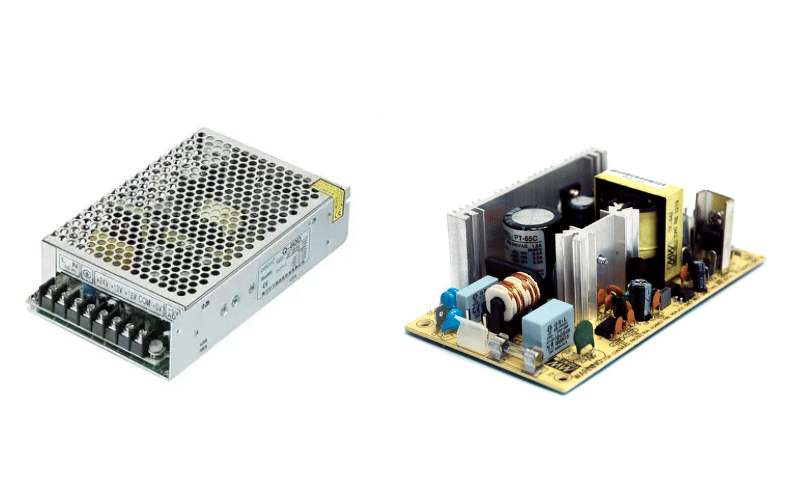
A switching power supply is a power conversion system that regulates output by rapidly switching semiconductor devices on and off. Instead of dissipating excess voltage continuously as heat, it converts energy in high-frequency pulses, then smooths and controls the output with transformers, inductors, capacitors, and feedback circuits. This method allows the supply to deliver a stable DC output with much higher efficiency than a linear design.
The operating principle is more complex than that of a linear power supply. First, the input AC is rectified into DC. Then that DC is chopped into high-frequency pulses by switching transistors. These pulses pass through a compact magnetic stage and a filtering network before being regulated into the final output voltage. Because the conversion happens at high frequency, the magnetic components can be much smaller than those in a linear supply.
This efficiency is the main reason switching power supplies dominate modern medical electronics. They waste less energy, generate less heat for a given power level, and can support a wide input range. At the same time, the switching action produces more electrical noise, so good filtering, shielding, and layout are essential in medical applications.
Key Features
Switching power supplies are known for high efficiency, compact size, low weight, and flexible design. These features make them well-suited for modern medical systems where designers must balance performance, thermal limits, space constraints, and portability. A high-quality switching supply can power complex electronics while keeping heat and enclosure size under control.
They also support a wide range of output configurations. Single-output, dual-output, and multiple-output designs are common. Some models combine universal AC input, battery charging, digital control, and remote monitoring in a single unit. That makes them useful in both compact devices and larger integrated medical platforms.
Their main challenge is electrical noise. High-frequency switching creates ripple, conducted emissions, and radiated emissions that can affect sensitive medical circuitry if not managed properly. However, modern switching designs use advanced filtering, shielding, synchronous control, and careful PCB layout to reduce these issues to acceptable levels.
Applications in Medical Devices
Switching power supplies are widely used in portable and high-power medical devices. Common examples include patient monitors, infusion pumps, ventilators, ultrasound systems, portable imaging units, surgical equipment, and hospital workstation electronics. In these applications, small size and high efficiency are major advantages.
They are also common in systems with multiple internal voltage rails. A single switching supply can often support processors, displays, motors, sensors, and communication modules with better space efficiency than a large linear design. This is especially useful in compact equipment where internal airflow and thermal buildup are tightly controlled.
In short, switching power supplies are often the practical choice for modern medical devices. If you need efficiency, compact packaging, and flexible power architecture, a switching design usually offers the best starting point.
3.0 Key Features of Linear and Switching Power Supplies
Noise and Ripple Levels
Noise and ripple are often the first factors engineers compare. Linear power supplies generally perform better here. Their output is smoother and contains less high-frequency interference because they do not rely on rapid switching. This makes them useful for precision analog measurement, low-level signal capture, and circuits where noise can reduce diagnostic accuracy.
Switching power supplies produce more ripple and high-frequency noise by nature. Even so, modern designs can reduce this problem significantly through filtering, shielding, and careful control methods. For many medical systems, the noise level is acceptable if the supply is well-designed and the device architecture properly isolates sensitive circuits.
If your application includes ECG front ends, sensor amplifiers, or other noise-critical analog stages, linear power may still have the edge. If the system can tolerate moderate switching noise or filter it effectively, a switching supply may be a better overall fit.
Efficiency and Heat Dissipation
Efficiency is one of the biggest differences between the two technologies. Linear power supplies are simple, but they are not efficient when there is a large gap between the input voltage and the output voltage. The unused energy becomes heat. That heat must be removed through heat sinks, airflow, or a larger enclosure design.
Switching power supplies are far more efficient because they transfer power in controlled pulses rather than burning off excess energy continuously. In medical products, this can reduce enclosure temperature, improve reliability, and support smaller designs. Lower heat also matters in portable and patient-adjacent equipment, where thermal comfort and long service life are important.
As power levels increase, this difference becomes even more important. A linear design that works well at low power may become impractical at higher output levels due to thermal losses. This is one reason switching supplies dominate in power-hungry medical equipment.
Size and Weight
Linear power supplies usually require larger transformers and heat sinks. That makes them heavier and bulkier, especially in AC-powered systems. In older stationary medical equipment, this was sometimes acceptable. In modern compact systems, it is often a disadvantage.
Switching power supplies operate at high frequencies, which allows for smaller magnetic components and lighter construction. This makes them a better match for portable medical devices, tightly integrated systems, and equipment that must fit into slim enclosures or mobile carts. A smaller power stage can also free up space for batteries, communication modules, or added functionality.
If product size is a key design limit, switching power usually wins. If size is less critical and noise is the priority, linear may still be justified.
Cost-Effectiveness
Cost-effectiveness depends on more than purchase price. Linear power supplies often have simpler circuitry, which can help in low-power, low-volume applications. For a basic noise-sensitive system, a linear solution may be easy to design and validate. However, larger transformers, heavier materials, and stronger thermal management can raise total system cost.
Switching power supplies may be more complex internally, but they often reduce system-level costs. Higher efficiency can lower cooling needs. A smaller size can cut enclosure and shipping costs. Multi-output capability can reduce the number of separate power modules inside a medical device.
A good rule is this: for simple, low-power, low-noise medical electronics, linear can be cost-effective. For compact, high-power, or feature-rich systems, switching power usually offers better value. The best decision depends on total design needs, not just the unit price.
In summary, linear power supplies lead in noise performance and simplicity, while switching power supplies lead in efficiency, size, and scalable value. Your choice should reflect the priorities of the medical device, not a general preference.
4.0 Pros and Cons of Linear and Switching Power Supplies
Strengths of Linear Power Supplies
Linear power supplies offer very clean output power. That is their strongest advantage in medical engineering. When a device depends on low ripple, low noise, and minimal electromagnetic interference, a linear design can support better analog performance and easier noise control.
They are also conceptually simple and often easier to troubleshoot. Designers and technicians can usually predict their behavior under varying load conditions without having to deal with the added complexity of high-frequency switching control. This simplicity can improve confidence during development and testing, especially in sensitive medical systems.
Another strength is stable operation in precision applications. In devices such as reference instrumentation, sensor front ends, and laboratory electronics, clean and steady power can be more valuable than efficiency. Linear power remains relevant because some medical tasks still demand that level of output purity.
Weaknesses of Linear Power Supplies
The biggest weakness of linear power supplies is inefficiency. Excess energy is dissipated as heat, thereby increasing thermal stress and limiting practical output power. As a result, designers may need larger heat sinks, bigger housings, or active cooling to keep the system within safe temperature limits.
They are also bulky and heavy. The transformer and thermal components take up more space than those in a switching supply. This makes linear designs less attractive for portable devices, compact enclosures, or systems where weight matters.
Cost can also become an issue at higher power levels. The circuit itself may be simple, but the added materials for heat management and larger mechanical packaging can make the total design less economical.
Strengths of Switching Power Supplies
Switching power supplies are highly efficient, which is why they are so widely used in modern medical devices. High efficiency reduces waste heat, supports smaller enclosures, and can extend battery life in portable equipment. These advantages are especially valuable in devices that must run continuously or operate in tight spaces.
They are also compact and lightweight. Because they switch at high frequency, they use smaller transformers and magnetic components. This enables dense packaging, modular designs, and multi-output configurations that suit modern medical platforms.
Another major strength is flexibility. Switching power supplies can support wide input ranges, multiple voltage rails, digital control, remote monitoring, and system integration features that are harder to achieve with basic linear designs. This makes them a strong match for complex medical electronics.
Weaknesses of Switching Power Supplies
The main weakness of switching power supplies is noise. High-frequency switching generates ripple and electromagnetic emissions that can interfere with sensitive analog circuits if the system is not designed carefully. In medical electronics, that means filtering and layout are critical.
They are also more complex. Their design, debugging, and validation can take more engineering effort than a simple linear supply. Control loops, EMI compliance, shielding, and transient response all require attention. If the supply is poorly designed, noise or stability issues may appear in the final device.
In some low-power, ultra-clean applications, that added complexity is not worth the trade-off. A switching supply may still work, but it may require extra filtering stages that reduce the original size or cost benefit.
Comparison Table
Power Supply Type | Strengths | Shortcomings |
|---|---|---|
Linear Power Supply | Very low noise and ripple; simple architecture; stable output; low EMI by nature; strong fit for analog and precision medical circuits | Lower efficiency; generates more heat; larger and heavier; less suitable for portable or high-power systems; can increase system-level thermal cost |
Switching Power Supply | High efficiency; compact size; lightweight; flexible output options; better for high-power and portable devices; easier to scale in complex systems | Higher noise and ripple; more EMI concerns; greater design complexity; may need added filtering; can complicate validation in sensitive analog applications |
Both technologies have clear strengths. The right choice depends on what the medical device needs most: low noise and simplicity, or efficiency and compact integration. If your application is noise-sensitive, a linear option may be the safer choice. If your device needs high power density and lower heat, switching is usually the better path.
5.0 Applications of Linear and Switching Power Supplies in Medical Devices
Linear Power Supplies
Linear power supplies are often used in medical devices where measurement integrity matters more than compact size. Examples include diagnostic analyzers, signal conditioning modules, calibration benches, and low-noise analog instrumentation. In these systems, even small amounts of switching noise can affect sensor output or reduce signal accuracy.
They also appear in some imaging support electronics and laboratory environments. A linear rail may be used to power sensitive analog front ends while other parts of the system use a different architecture. This selective use helps preserve clean signal paths in critical sections.
In practice, linear power supplies are best for stationary devices or subsystems with modest power demands. If the goal is clean DC power for precision electronics, they remain a trusted solution.
Switching Power Supplies
Switching power supplies are used in a much wider range of modern medical devices. You will find them in patient monitoring systems, infusion pumps, ventilators, ultrasound units, portable diagnostic equipment, surgical tools, and various imaging platforms. Their efficiency and compact size make them especially useful where heat and space are limited.
They are also well-suited for systems with multiple internal loads. For example, a switching supply can support a processor board, display backlight, communication module, motor driver, and sensor subsystem. This makes them ideal for complex medical electronics that must fit into smaller housings.
Portable medical devices benefit the most. Lower weight and better energy efficiency help extend battery runtime and improve mobility for both caregivers and patients.
Hybrid Applications
Many medical devices use both technologies together. This is often the most practical solution. A switching power supply handles the main power conversion efficiently, while local linear regulators clean up power for the most noise-sensitive circuits. This hybrid approach balances efficiency with signal integrity.
For example, a portable diagnostic device may use a switching front-end supply to reduce size and heat, then use linear post-regulation for its analog measurement channels. An imaging subsystem may do the same for detector electronics or reference circuits. This approach gives designers more control over trade-offs.
The key point is that the choice is not always either-or. In medical design, hybrid power architecture is common because it allows each subsystem to get the type of power it needs most.
6.0 Main Differences Between Linear and Switching Power Supplies
1. Efficiency and Heat Dissipation
Linear power supplies are less efficient because they dissipate unused energy as heat. This makes thermal management harder as power levels rise. Switching power supplies is much more efficient, so they generate less heat and support denser packaging.
If your device runs at higher power or in a tight enclosure, switching power has a clear advantage. If power demand is low and heat is manageable, linear can still be practical.
2. Noise and Ripple Levels
Linear power supplies deliver cleaner output with lower ripple and less high-frequency noise. That makes them a strong choice for sensitive analog medical circuits. Switching power supplies generates more noise due to the rapid switching action, though modern filtering can reduce it substantially.
If the medical application depends on low-noise measurements, linear systems often have an advantage. If the system can effectively isolate or filter out noise, switching remains a strong option.
3. Size and Weight
Linear designs are larger and heavier because they rely on bulky transformers and heat sinks. Switching designs are smaller and lighter because they operate at high frequency and use smaller magnetic components.
This difference matters in portable and compact medical equipment. If mobility or enclosure size is important, switching power is usually the better match.
4. Cost-Effectiveness
At low power, a linear design can be attractive because of its simplicity and clean output. At higher power, its thermal and mechanical costs often rise quickly. Switching power supplies are more complex, but they usually offer better overall value in modern systems because they save space, reduce heat, and enable flexible integration.
So, cost-effectiveness depends on the full design context. The cheaper circuit is not always the cheaper system.
5. Suitability for Specific Applications
Linear power supplies are best suited for low-noise diagnostic equipment, calibration systems, and sensitive analog subsystems. Switching power supplies are best suited for portable devices, high-power systems, multi-output platforms, and compact medical electronics. Hybrid systems combine both when one device needs the benefits of each.
That final point matters most. The right answer is not universal. It depends on your medical application, acceptable noise level, thermal budget, available space, and system complexity.
Conclusion
Choosing between linear and switching power supplies for medical applications is really about choosing the right trade-off. Linear power supplies offer low noise, simple operation, and stable performance for precision analog systems. Switching power supplies offer high efficiency, compact size, and stronger flexibility for portable, multi-output, and higher-power medical devices.
The best choice depends on what your device needs most. If signal purity is the top priority, linear power may be the better solution. If size, heat control, and efficiency matter more, switching power is usually the stronger fit. In many cases, a hybrid approach delivers the best result. Start by defining your medical device’s noise limits, thermal budget, size constraints, and power architecture, then select the power strategy that supports safe, reliable performance over the long term.