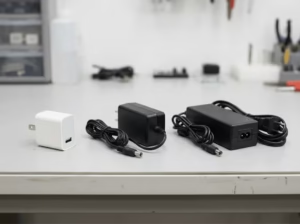
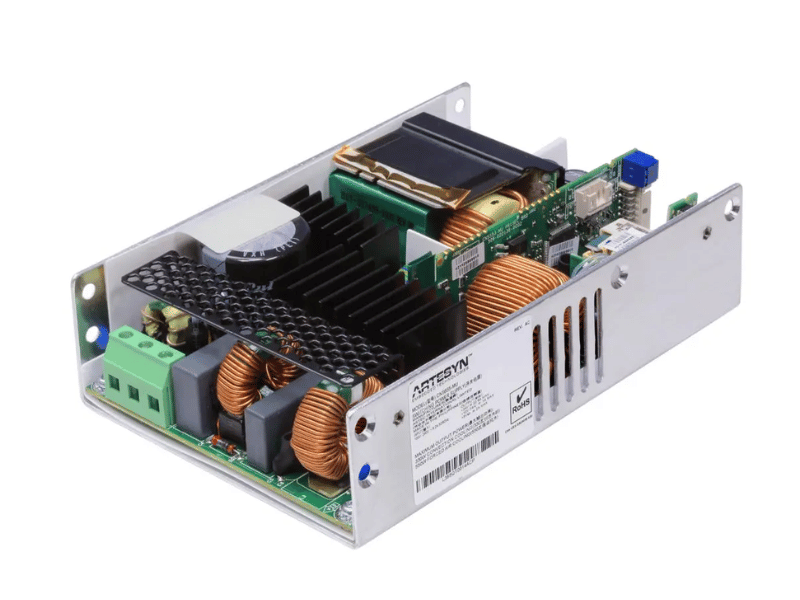
Medical devices rely on stable power more than most other electronic systems. In a consumer product, a poor power supply may cause inconvenience. In healthcare, it can affect device accuracy, disrupt treatment, or pose safety risks to patients and clinicians. That is why AC-DC medical power supplies are designed to meet far stricter standards than general-purpose power supplies.
From patient monitors and infusion pumps to imaging systems and surgical tools, these power supplies do far more than convert wall power into usable DC output. They help protect patients, reduce electrical risk, support low-noise performance, and improve long-term reliability. If you are selecting a power solution for a medical device, you need to weigh safety, performance, size, and cost together. This guide explains what AC-DC medical power supplies are, their key features, the main types available, how they compare, and where each type works best.
1.0 What Is an AC-DC Medical Power Supply?
An AC-DC medical power supply is a power conversion device that converts mains alternating current into stable direct current for medical equipment. While that sounds similar to a standard AC-DC power supply, the medical version is built to a much higher safety and performance level. It must operate reliably in environments where people may be directly connected to the device or depend on it for diagnosis, monitoring, or treatment.
In healthcare applications, power quality is not a secondary concern. A medical device may need clean output for sensitive electronics, reinforced isolation to protect patients, and low leakage current to meet regulatory limits. Because of this, medical power supplies are engineered with stricter insulation systems, tighter safety controls, and compliance targets that do not apply to ordinary commercial products.
Definition and Purpose
The main purpose of an AC-DC medical power supply is to deliver safe, regulated DC power to a medical system. It converts incoming AC mains voltage into one or more controlled DC outputs for internal circuits, sensors, displays, motors, and communication modules. This conversion must remain stable even when load conditions change, input voltage varies, or the system runs continuously for long periods.
These power supplies are used both inside medical devices and as external adapters. In either case, they help ensure that the final product performs as intended while minimizing electrical hazards. In short, they are not just energy sources. They are safety-critical components within the device architecture.
Key Features
Medical power supplies include features that set them apart from standard industrial or consumer models. One of the most important is compliance with medical safety standards such as IEC 60601-1. This standard addresses key issues, including electrical isolation, leakage current, creepage and clearance distances, and protection against shock.
Other important features include low ripple and noise, high efficiency, reliable thermal performance, and built-in protection functions such as overvoltage, overcurrent, and short-circuit protection. Many designs also support low no-load power consumption, compact form factors, and operation across global AC input ranges. These features matter because medical devices often need to run quietly, safely, and predictably in demanding environments.
Applications in Medical Devices
AC-DC medical power supplies are used in a wide range of healthcare equipment. Common examples include patient monitors, ventilators, ultrasound units, infusion pumps, diagnostic analyzers, electrosurgical systems, and imaging platforms. Some devices need only a modest low-voltage rail, while others require multiple outputs to support digital control, analog sensing, motors, and user interfaces.
They also play a key role in portable and home healthcare products, where size, efficiency, and safety are especially important. Whether the device is a compact bedside monitor or a large imaging system, the power supply must support both medical compliance and dependable daily operation. That foundation leads directly to the next topic: the features that matter most when evaluating these supplies.
2.0 Key Features of AC-DC Medical Power Supplies
AC-DC medical power supplies are selected for more than simple voltage conversion. In healthcare, the power stage must support patient safety, signal integrity, stable device operation, and long service life. A supply that appears acceptable for general electronics applications may still fail to meet the demands of medical equipment.
That is why engineers and buyers usually focus on four areas: safety, performance, durability, and cost-effectiveness. Each one affects the final device differently, and each can shape compliance, maintenance needs, and total product value.
Safety Features
Safety is the defining feature of a medical power supply. These units are designed to reduce electrical risk in devices that may be touched by clinicians, used near vulnerable patients, or connected directly to the body. Compliance with IEC 60601-1 is one of the clearest indicators of this design approach. It sets requirements for insulation, isolation, leakage current, and protective construction.
Isolation is especially important because it separates the dangerous mains side from the low-voltage output side. Reinforced or double isolation helps prevent shock if one layer of protection fails. Low leakage current is equally critical. In medical systems, even very small stray currents can become serious if the device has patient-applied parts. Good safety design lowers that risk and supports regulatory approval.
Protection circuits also matter. Over-voltage protection, over-current protection, short-circuit protection, and thermal shutdown all help prevent device damage and unsafe operating conditions. These features protect both the medical device and the people around it.
Performance Metrics
Performance in a medical power supply is about more than delivering the right nominal output. The output must stay stable, clean, and predictable during real use. Many medical devices contain sensitive analog front ends, communication modules, sensors, and processors that can all be affected by poor power quality.
Low ripple and noise are often major priorities. Excessive electrical noise can interfere with monitoring accuracy, distort readings, or make sensitive circuits harder to design. Efficiency is also important, especially in compact or enclosed equipment. Higher efficiency reduces wasted heat, improves thermal management, and can support smaller overall system designs.
Other useful performance metrics include load regulation, line regulation, transient response, hold-up time, and start-up behavior. Together, these tell you how well the supply handles changing conditions. In medical electronics, strong performance helps preserve both device accuracy and user confidence.
Durability and Reliability
Medical devices are often expected to operate for long periods with minimal downtime. For that reason, the power supply must be built for long-term reliability. A failure in the power stage can shut down the entire device, disrupt clinical workflows, and increase service costs.
Durability starts with component quality. High-grade capacitors, transformers, semiconductors, and thermal materials help the supply survive constant use and repeated startup cycles. Mechanical design also matters. A robust enclosure, secure connectors, and good thermal layout can all improve long-term performance.
Reliability is especially important in environments such as hospitals, diagnostic labs, outpatient centers, and home healthcare settings. In each of these, the supply may see long duty cycles, repeated transportation, or continuous operation. A durable design lowers the chance of field failures and reduces maintenance over time.
Cost-Effectiveness
Medical power supplies are rarely chosen on price alone, but cost still matters. The real goal is cost-effectiveness, which means balancing compliance, performance, and reliability against the total system budget. A lower-cost supply may seem attractive at first, but if it leads to certification delays, heat problems, or reliability issues, it can prove far more expensive later.
A cost-effective medical supply is one that fits the device requirements without major overdesign. If the application only needs a single low-power output, a complex high-end unit may add unnecessary cost. On the other hand, under-specifying the power supply can lead to redesign work, early failures, or poor field performance.
In practice, the best value usually comes from choosing a supply that meets the needed safety standard, delivers stable output, and provides reasonable thermal and electrical margin. That combination supports both product quality and manageable lifetime cost. Next, let’s look at the main types of AC-DC medical power supplies and where each one fits.
3.0 Types of AC-DC Medical Power Supplies
AC-DC medical power supplies come in several forms, and each type suits a different kind of device or design goal. Some are optimized for low noise. Others focus on compact size, multiple rails, or specialized medical functions. Understanding these categories helps narrow the choices before you compare detailed specifications.
The most useful way to classify these supplies is by conversion method, output configuration, and application range. The following types appear most often in medical equipment design and purchasing decisions.
Linear vs. Switching Power Supplies
A linear medical power supply uses a traditional power conversion approach. It typically relies on a mains transformer, rectification stage, filtering components, and linear regulation to produce a stable DC output. The biggest advantage of this design is low ripple and noise. That makes linear supplies attractive for very sensitive analog circuits, measurement systems, and applications where signal purity matters more than efficiency.
The drawbacks are size, weight, and heat. Linear supplies tend to be bulkier because they use larger transformers and dissipate more power during regulation. In compact medical devices, there can be mechanical and thermal design challenges. They are also generally less efficient than switching designs.
A switching medical power supply uses high-frequency switching technology to convert AC mains into a regulated DC output. Because it operates at much higher frequencies, it can use much smaller magnetic components and achieve higher efficiency. This makes switching supplies lighter, more compact, and better suited to portable systems or devices with tight internal space.
Their main weakness is electrical noise. Switching action generates ripple and EMI that must be controlled through filtering, shielding, and careful layout. Still, modern switching medical power supplies have improved significantly, and many now offer noise performance suitable for a wide range of medical devices. For most new equipment, switching technology is the more common choice because it balances efficiency, size, and cost well.
Read More: Linear vs. Switching Power Supplies for Medical Applications
Single Output vs. Multiple Output
A single-output medical power supply provides one regulated DC output. This is often enough for smaller devices or designs that use onboard DC-DC converters to generate secondary rails locally. Single-output supplies are simpler, easier to integrate, and often lower in cost than multi-output versions.
They are common in portable monitors, chargers, compact therapy devices, and low-complexity systems. If the device architecture is straightforward, a single-output approach can reduce wiring complexity and simplify compliance testing.
A multi-output medical power supply provides two or more regulated outputs from a single unit. This is useful when a medical device includes several subsystems that require different voltages, such as logic boards, analog sensing circuits, displays, fans, motors, and communications modules. Instead of combining several separate supplies, the designer can power the entire system from one integrated unit.
The advantage is system consolidation. The challenge is output planning. Each rail must deliver the right current, maintain regulation, and behave correctly during startup and fault conditions. Multi-output supplies are common in imaging systems, diagnostic analyzers, and advanced bedside equipment, where several internal blocks must work together.
High Voltage Medical Power Supplies
High-voltage AC-DC medical power supplies are used in specialized devices that need output in the kilovolt range or otherwise elevated voltage levels. Examples include X-ray systems, certain imaging platforms, detector bias systems, and specialized therapeutic equipment. These supplies are a distinct category because the design challenges are much greater than in standard low-voltage units.
Key concerns include insulation, spacing, arc prevention, control precision, and safe discharge behavior. High voltage in a medical setting demands strict engineering discipline because the consequences of failure are more severe. These units often require custom integration, additional shielding, and advanced monitoring features.
They are less common than standard low-voltage supplies, but in the applications that need them, they are absolutely central to system performance. A high-voltage medical power supply must combine medical compliance with precise high-energy control, which is demanding.
Bipolar Power Supplies
A bipolar power supply can provide both positive and negative output relative to a reference point. In some cases, it can also serve as a source or sink of current, depending on the design. This makes bipolar supplies useful for advanced electronics where symmetrical rails are needed or where bidirectional power behavior matters.
In medical applications, bipolar power supplies are often used in precision analog systems, signal-conditioning circuits, actuator control, and certain test or stimulation equipment. For example, a sensitive analog front end may require both positive and negative rails to power op-amps and signal-processing stages. Some medical research systems and specialized instruments also benefit from the ability to handle changing current-flow conditions.
Compared with simpler single-polarity supplies, bipolar units are more specialized. They may add design complexity, but they can also solve problems that would otherwise require multiple separate supplies. Choosing this type makes sense when the device architecture clearly benefits from dual-polarity or four-quadrant behavior.
Taken together, these categories show that there is no single best type of medical power supply for every application. The right choice depends on the device’s electrical needs, sensitivity to noise, space constraints, and safety priorities. To make those tradeoffs clearer, the next section compares the main options side by side.
4.0 Comparison of AC-DC Medical Power Supplies
Different AC-DC medical power supplies can look similar at first glance. They all convert AC mains into controlled DC output, and many share the same general safety requirements. But once you compare them in terms of performance, size, noise, and cost, the differences become much more apparent.
The best choice depends on what matters most in your device. A portable monitor may value compact size and efficiency. A diagnostic instrument may prioritize noise and stability. A large system may require several rails from a single integrated source. The following comparison highlights the main tradeoffs.
Efficiency and Performance
Switching medical power supplies usually offer much higher efficiency than linear designs. They waste less energy as heat, which is a major advantage in enclosed or portable devices. Higher efficiency can also improve reliability by reducing thermal stress on internal components.
Linear supplies, however, still perform very well in terms of output smoothness and simple control behavior. They are often favored in applications where low-noise analog performance matters more than heat or form factor. Single-output supplies can also offer simpler regulation behavior than multi-output versions, while multi-output units trade some simplicity for broader system support.
Noise and Ripple Levels
Linear power supplies generally have lower ripple and noise than switching supplies. That makes them easier to use in very sensitive measurement or analog front-end applications. If a medical device depends on ultra-clean rails, linear technology may still be the preferred option.
Switching supplies can produce more noise because of their high-frequency conversion method. That said, modern filtering and shielding techniques have made many switching medical supplies suitable even for demanding medical electronics. Single-output units may also have a simpler noise profile than multiple-output models, depending on the internal architecture.
Size and Weight
This is one of the clearest differences. Switching supplies are usually much smaller and lighter because they use high-frequency transformers and more efficient conversion stages. That makes them ideal for compact devices, portable systems, and applications with limited internal space.
Linear supplies are larger and heavier, which can be acceptable in benchtop or fixed equipment but less ideal in mobile products. Single-output units also tend to be smaller and easier to package than multi-output versions, which must support more internal circuitry and output filtering.
Cost and Maintenance
Cost depends on both the unit price and the long-term impact on the full product. Switching supplies are often more cost-effective in modern designs because they are efficient, compact, and widely available. They can lower cooling demands and support smaller enclosures, which reduces total system cost.
Linear supplies may cost more due to size, heat management, and materials, though they can still be worthwhile in niche low-noise applications. Multi-output supplies may cost more than single-output models upfront, but they can reduce wiring, simplify system integration, and replace several smaller power modules.
Comparison Item | Linear Medical Power Supply | Switching Medical Power Supply | Single-Output Supply | Multiple Output Supply |
|---|---|---|---|---|
Conversion Method | Linear regulation | High-frequency switching | One regulated rail | Two or more regulated rails |
Efficiency | Lower | Higher | Depends on design | Depends on design |
Ripple and Noise | Very low | Higher, but can be filtered well | Often simpler noise profile | More complex output interaction |
Size and Weight | Larger and heavier | Smaller and lighter | Usually compact | Larger than single-output models |
Heat Dissipation | Higher | Lower | Moderate | Depends on total load |
Best Use Case | Sensitive analog and low-noise systems | Portable, compact, and efficient devices | Simple medical devices | Complex systems with many subsystems |
Integration Complexity | Moderate | Moderate to high | Lower | Higher |
Cost Consideration | Higher thermal and size costs | Often, a better total value | Lower upfront cost | Higher upfront cost, better consolidation |
Maintenance Impact | Can run warm, larger cooling needs | Better efficiency can reduce stress | Easier replacement and setup | Fewer separate supplies to manage |
This comparison makes one point clear: no category wins in every area. The right AC-DC medical power supply depends on the medical device, the performance targets, and the design constraints. With that in mind, let’s look at how these supplies are used in real healthcare applications.
5.0 Applications of AC-DC Medical Power Supplies
AC-DC medical power supplies support a wide range of healthcare equipment, from large hospital systems to compact portable devices. Their design requirements vary with the clinical use case, but the need for safe and reliable DC power remains constant.
In many applications, the power supply must do more than energize the electronics. It must also support accuracy, patient protection, low noise operation, and long service life. The following examples show how different medical devices rely on these supplies in different ways.
Imaging Systems
Imaging systems such as MRI-related support electronics, CT scanners, X-ray units, and ultrasound platforms often require highly stable power with strict safety isolation. Some of these systems also need multiple regulated rails to support processing boards, display systems, detectors, motion control, and interface electronics.
In advanced imaging, power quality directly affects system performance. Noise, drift, or unstable regulation can degrade signal accuracy or image quality. High-voltage medical power supplies are also critical in applications such as X-ray generation, where controlled high-energy output is part of the system’s core function.
Patient Monitoring Devices
Patient monitoring devices include ECG systems, bedside monitors, pulse monitoring equipment, blood pressure devices, and wearable or portable diagnostic units. These products often contain sensitive analog circuits and low-power digital systems, so they benefit from clean output, stable regulation, and strong electrical isolation.
Because many of these devices operate close to or directly on the patient, leakage current limits are especially important. In this category, the medical power supply helps protect the patient while also preserving signal integrity. Compact switching supplies are common here, though low-noise designs remain a major priority.
Surgical Equipment
Surgical equipment includes electrosurgical systems, powered tools, laser systems, and specialized treatment devices. These applications may require higher current capability, robust fault protection, and dependable operation under demanding conditions. In some cases, fast transient response and stable output during load changes are especially important.
Safety and reliability are critical because device interruption during a procedure can have serious consequences. Power supplies used in surgical systems are often chosen for robust thermal performance, durable construction, and proven compliance. Depending on the design, they may be single-output, multi-output, or highly specialized high-power units.
Portable Medical Devices
Portable medical devices include infusion pumps, handheld diagnostics, compact ultrasound units, and home healthcare equipment. These applications place extra pressure on the power supply because space is limited and efficiency matters more. The supply must be compact, light, and cool-running while still meeting medical safety standards.
Switching AC-DC medical power supplies are especially common in this category because they offer the best balance of size, efficiency, and global input compatibility. For devices used outside the hospital, reliability is just as important as portability. The supply must support repeated transport, changing usage conditions, and long service intervals.
These examples show how broad the medical power supply field really is. A design that works well in a portable monitor may not be right for an imaging platform or surgical unit. That is why comparing the core differences between supply types remains essential, especially when choosing between linear and switching designs.
6.0 Main Differences Between Linear and Switching Medical Power Supplies
Linear and switching medical power supplies are the two most common design approaches in AC-DC conversion. Both can be engineered for medical compliance, but they differ in several practical ways that affect device design, performance, and cost. If you understand these differences early, you can make a much better selection.
The five areas below usually have the biggest impact on real medical applications. Each one influences not only the power stage but also the overall product design.
Efficiency and Heat Dissipation
Switching medical power supplies is much more efficient than linear supplies in most cases. They convert a larger share of incoming power into useful output and waste less energy as heat. That matters in compact devices, enclosed systems, and portable medical products where every watt counts.
Linear supplies are less efficient because they dissipate excess voltage as heat. This can complicate thermal design and may require larger heat sinks or increased ventilation. In a fixed system, that may be acceptable, but in a small medical device, it can become a serious limitation.
Noise and Ripple Levels
Linear power supplies are known for very low ripple and noise. That is their biggest strength and the main reason they still appear in some sensitive medical and laboratory systems. If your design includes precision analog measurement or highly noise-sensitive circuitry, a linear supply may simplify the power architecture.
Switching supplies generates more electrical noise because of their fast switching action. However, many modern medical switching supplies include advanced filtering and shielding, and their noise performance is good enough for most medical devices. The key is to verify real performance, not assume all switching supplies behave the same way.
Size and Weight
Switching supplies are usually much smaller and lighter. This gives them a strong advantage in portable and space-limited medical equipment. The use of smaller transformers and more efficient conversion stages makes a compact design much easier.
Linear supplies need larger transformers and cooling provisions, so they take up more space and add weight. In benchtop or cabinet-based systems, that may not matter much. In handheld or cart-based equipment, it often matters a great deal.
Cost-Effectiveness
From a system-level view, switching supplies is often more cost-effective. They reduce enclosure size, lower cooling needs, and more easily support portable designs. Their high efficiency can also improve reliability by lowering internal temperatures over time.
Linear supplies may still be worth the extra cost in niche low-noise applications, but they often increase material and thermal management costs. So while the unit price is important, the better comparison is total product cost, including space, heat, and long-term performance.
Suitability for Specific Applications
Linear medical power supplies work best where output purity is the top priority and size is less critical. That can include certain analog instruments, test systems, and specialty diagnostic electronics. They are chosen for signal quality, not convenience.
Switching medical power supplies is better for most mainstream healthcare devices, especially portable units, compact systems, and multi-output platforms. They offer a practical balance of efficiency, size, and modern performance. For most new product designs, switching technology is the default starting point unless low-noise demands clearly point elsewhere.
In short, linear supplies offer low noise and simple behavior, while switching supplies offer higher efficiency, smaller size, and broader flexibility. The best option depends on what the medical device needs most.
Conclusion
Choosing the right AC-DC medical power supply is about more than finding the right voltage. In healthcare, the power supply affects patient safety, device reliability, signal quality, thermal design, and long-term service performance. That is why comparing linear and switching designs, output configurations, and application-specific needs is so important.
If your device requires a compact size and high efficiency, a switching medical power supply is often the best fit. If ultra-low noise is most important, a linear design may still have value. Start with the device’s safety and performance requirements, then match the supply to the actual use case. A well-chosen medical power supply helps the whole product perform better, last longer, and meet the demands of real clinical use. Contact us for assistance !