When selecting a power adapter for your 12 V DC device, one of the most frequent questions is whether a 12 V 1 A or 12 V 2 A adapter is the right choice. Although both supply the same voltage, they differ significantly in current capacity, power delivery, and suitability for various devices. This article explains those differences and how they affect safe and reliable operation.
1. What “12V 1A” and “12V 2A” Actually Mean
The designation “12V 1 A” indicates the adapter provides 12 volts of direct current (DC) and can supply up to 1 ampere of current — equivalent to 12 watts of maximum power. Likewise, a “12V 2 A” adapter can supply up to 2 amperes, or 24 watts of power at the same 12 V output. In both cases, the device being powered determines how much current is drawn, up to the adapter’s rated maximum.
If you’re new to current ratings and want a more general explanation of how amperage affects power delivery across different voltages, you may find this overview helpful:
What Is the Difference Between 1A and 2A Power Adapters?
2. Key Differences Between 12V 1A and 12V 2A Adapters
Current Capacity
12V 1A Adapter: Max current 1 A. Suitable for low-power devices that draw relatively small amounts of current.
12V 2A Adapter: Max current 2 A. Can deliver twice the current of a 1 A adapter, making it suitable for medium-power electronics and devices that require more power.
Power Headroom and Reliability
A higher current rating provides headroom above the minimum requirement, which improves stability and reduces the likelihood of the adapter operating at its thermal and electrical limits. This headroom helps adapters run cooler and last longer.
Device Compatibility
A 12V 2A adapter can safely power a device rated for 12V 1A, as long as the voltage and polarity match. The device will draw only the current it needs.
A 12V 1A adapter should not be used on a device rated for 12V 2A, because it cannot supply the required current. This mismatch often leads to unstable operation and can stress or overheat the adapter.
3. What Happens in Practical Use
Using 12V 2A on a 12V 1A Device
If you connect a 12V 2A adapter to a device that requires only 1 A:
The device will draw only the current it needs.
The adapter will have unused capacity, which can reduce stress and heat buildup.
This setup is generally safe as long as the output voltage and polarity match the device requirements.
In some cases, the extra current capacity can enhance performance under transient loads (such as startup surges in security cameras or other electronics).
If you want a deeper look at what a 12V 2 amp adapter is, how it works, and which devices typically require it, read:
What Is a 12V 2 Amp Adapter and When to Use It?
Using 12V 1A on a 12V 2A Device
Conversely, a 12V 1A adapter cannot reliably power a device designed to draw up to 2 A:
The adapter may overheat or shut down because it’s being asked to deliver more current than its rating allows.
The device may operate erratically, reset intermittently, or fail to operate altogether.
Prolonged overload may shorten the adapter’s lifespan or cause failure.
For safe operation, the adapter’s current rating should always meet or exceed the device’s maximum current requirement.
4. Choosing Between 1A and 2A Adapters
Here’s a simple guide to help decide:
Use a 12V 1A adapter for devices that explicitly specify 1 A or less current draw — e.g., small LED modules, lightweight routers, or low-power peripherals.
Use a 12V 2A adapter for devices with higher current needs — e.g., larger networking gear, CCTV cameras, motion-controlled devices, and many embedded systems.
When in doubt, select the adapter with the higher current rating (2 A rather than 1 A), provided the voltage and polarity match. This avoids underpowering issues and improves reliability.
Note that higher current capacity alone does not make an adapter “fast” in a charging sense — it simply indicates it can supply more power demand.
For a complete, structured approach to selecting the correct voltage, current rating, connector type, and safety margin across 5V, 12V, and 24V systems, see our full guide:
Step-by-Step Guide: Choosing the Right Power Adapter (12V, 5V, 24V)
5. Other Technical Considerations
Polarity and Connector Size
Even with the correct voltage and current rating, the plug’s physical size and polarity (center positive vs center negative) must match the device’s specification. Incorrect polarity can cause immediate damage.
Quality and Safety
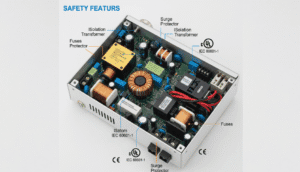
Always choose adapters with safety certifications (such as UL, CE, FCC, or RoHS) to reduce risks from overheating, shorts, or electrical hazards. Higher quality adapters also tend to have better voltage regulation and lower ripple.
6. Summary
| Feature | 12V 1A Adapter | 12V 2A Adapter |
| Max Current | 1 amp | 2 amps |
| Max Power | 12 W | 24 W |
| Suitable for | Low-power electronics | Mid-power electronics |
| Safe on 1A devices | Yes | Yes |
| Safe on 2A devices | No | Yes |
| Performance headroom | Limited | Higher |
Conclusion
The main difference between 12V 1A and 12V 2A adapters lies in their current capacity and corresponding power delivery. While a 12V 2A adapter can power both 1A and 2A devices safely (given correct voltage and polarity), a 12V 1A adapter should only be used with devices that require 1A or less. Choosing an adapter with a rating equal to or higher than what your device needs helps ensure stable operation, enhanced reliability, and reduced risk of overload. Always verify voltage, polarity, and certification before use for best results.