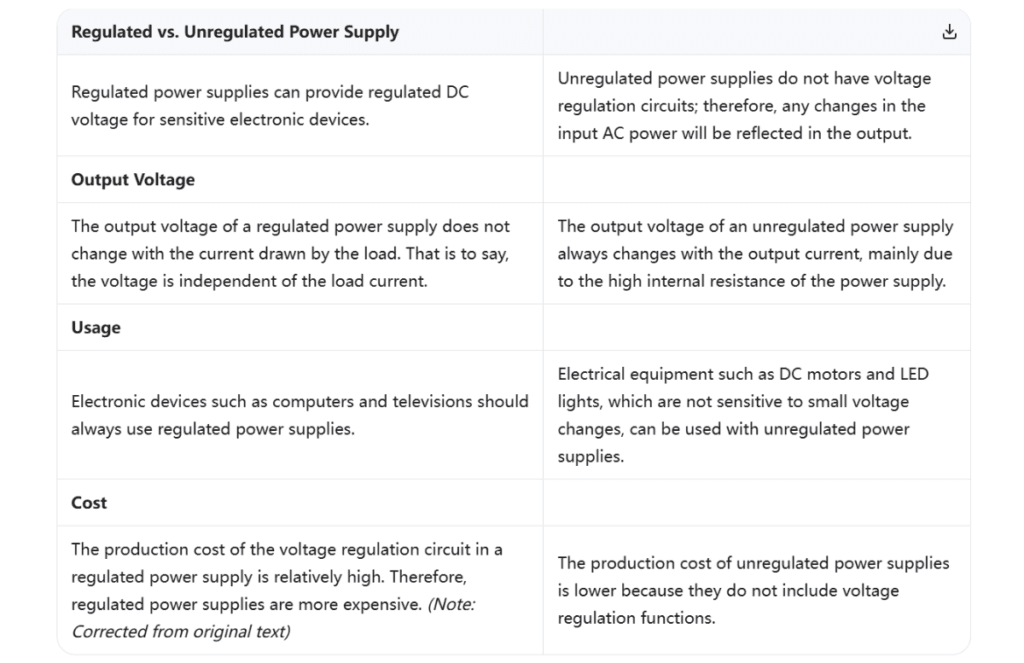
Regulated power supplies use a voltage regulator to maintain a steady output voltage regardless of input fluctuations or load changes — making them essential for sensitive electronics. Unregulated supplies are simpler, cheaper, and perfectly adequate for motors, lamps, and other load-tolerant devices. Choosing wrong can damage equipment or waste the budget.
Pick the wrong power supply and you’ll either fry your electronics or overpay for regulation you never needed. It’s one of those decisions that seems minor until something goes wrong — and by then, the damage is done.
The choice between a regulated and an unregulated power supply comes down to what your load actually needs. Some devices tolerate voltage swings without complaint. Others need a rock-steady supply, or they’ll malfunction, overheat, or fail outright. Getting this right isn’t complicated, but it does require understanding what each supply type actually does — and doesn’t.
This guide covers how both types work, where each belongs, how to compare them in terms of efficiency and cost, and how to make the right call for your specific application. Whether you’re a design engineer selecting components for a new product or a technician troubleshooting an existing system, the information here will help you make informed choices.
The Basic Mechanics of Unregulated Power Supplies
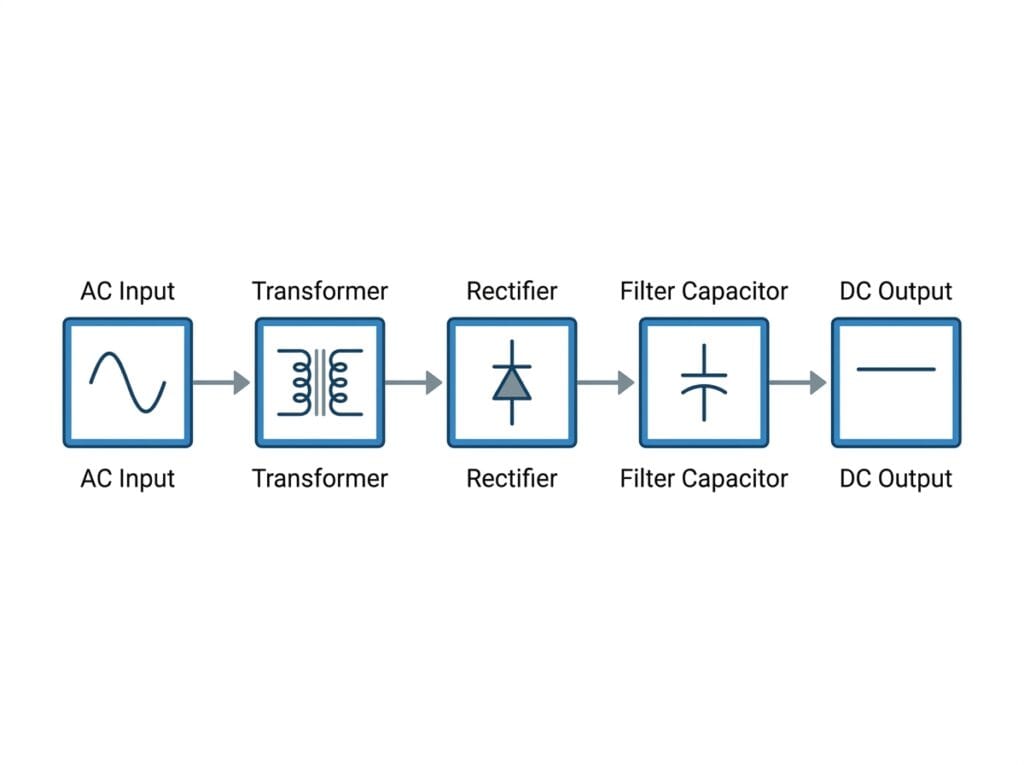
An unregulated power supply has three core components: a transformer, a rectifier, and a filter capacitor. That’s it. The transformer steps the AC input voltage down (or up) to a lower AC level. The rectifier — typically a diode bridge — converts that AC into pulsating DC. The filter capacitor smooths out the worst of the voltage ripple, leaving a DC output that’s usable but not particularly clean.
How Load Current Affects Output Voltage
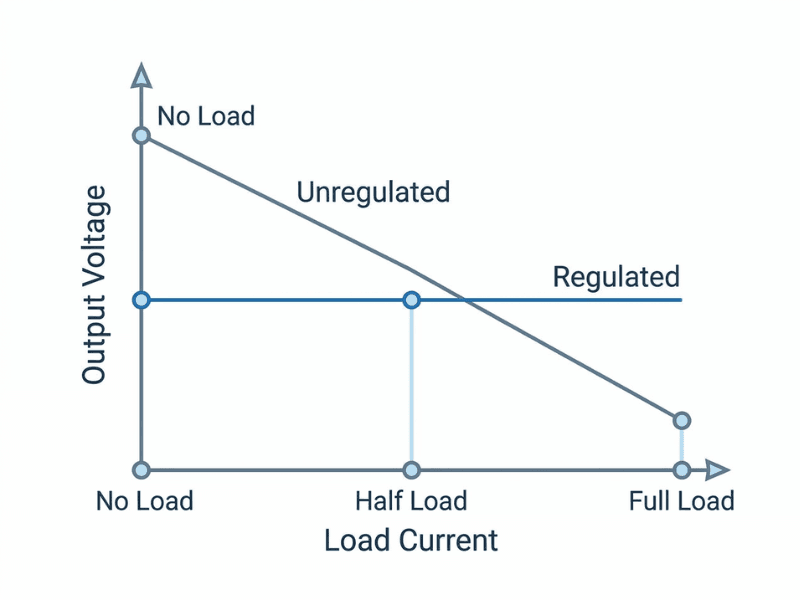
Here’s the critical behavior you need to understand. The output voltage of an unregulated supply isn’t fixed — it shifts with load current. Every supply has internal resistance from cabling, PCB traces, and transformer impedance. As the current draw increases, more voltage drops across this internal resistance, and the output voltage falls. Reduce the load, and the voltage climbs back up.
A “12V / 1A” unregulated supply illustrates this well. At full rated load of 1A, it delivers close to 12V. But at half load — say 0.5A — that same supply might measure 16V or 17V at the terminals. Overload it at 1.5A, and it may drop to 9V. According to Mastech Power Supply, the no-load output of an unregulated supply can reach nearly twice the rated voltage. That’s not a defect — it’s how these supplies are designed to behave.
Ripple and AC Interference
Even with a filter capacitor in place, unregulated supplies still pass residual AC ripple through to the output. The capacitor smooths the bulk of it, but the ripple doesn’t disappear — it rides on top of the DC signal. For a DC motor or an incandescent lamp, this is largely irrelevant. For a microcontroller or an audio amplifier, even small amounts of ripple can cause noise, instability, or data errors.
Durability and Simplicity
What unregulated supplies lack in precision, they make up for in robustness. Fewer components mean fewer failure points. They handle rugged environments well and are well-suited for applications with consistent, predictable loads. When the load barely changes, and precision isn’t required, an unregulated supply is a sound, cost-effective choice.
How Regulated Power Supplies Maintain Stability
A regulated power supply builds on the same basic architecture — transformer, rectifier, filter capacitor — but adds a voltage regulator stage. That regulator continuously samples the output voltage, compares it to a stable internal reference, and adjusts the circuit to correct any deviation. The result is an output that stays within specification regardless of changes in load current or input voltage.
Both regulated output types — linear and switching — use this same principle, but they implement it differently.
Linear Regulators
A linear regulator places a transistor between the rectified DC and the output. The transistor drops the excess voltage across its collector-emitter junction, acting like a variable resistor that adjusts in real time to maintain the target output. The feedback is provided by an op-amp that compares the output to a precision reference voltage — if the output drifts high, the transistor increases its voltage drop to compensate; if it drifts low, the transistor opens up to let more current through.
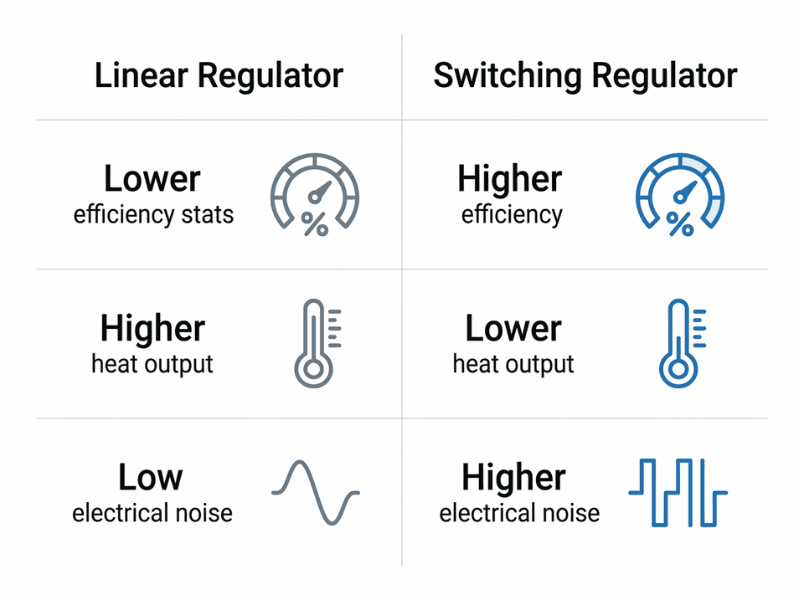
Linear regulators are simple, quiet, and produce very low ripple. They’re the right choice for laboratory instruments, audio equipment, and medical devices where electrical noise is unacceptable. The tradeoff is efficiency. A linear regulator wastes the difference between the input and output voltage as heat. According to Keysight, linear supplies can exhibit efficiencies as low as 50%, particularly when the gap between input and output voltage is large. That wasted energy becomes a thermal management problem — heat sinks, forced air cooling, or derating all add cost and complexity.
Switching Regulators
A switching regulator — also called a switch-mode power supply (SMPS) — takes a different approach. It rapidly switches the transistor on and off at high frequency, and uses pulse width modulation (PWM) to control the average energy delivered to the output. Because the switching transistor is either fully on or fully off, very little energy is wasted in the switch itself.
The result is dramatically better efficiency. A well-designed SMPS can achieve 80%-90% efficiency or higher, according to Keysight. This makes switching regulators the dominant choice for modern electronics, from laptop power adapters to industrial motor drives. They’re smaller and lighter than linear equivalents for the same power rating, and they can step voltage up as well as down — something a linear regulator cannot do.
The downside is electromagnetic noise. The high-frequency switching generates interference that can affect nearby sensitive circuits. Proper shielding, layout discipline, and filtering are required to keep this noise from becoming a problem.
Added Protection Features
Regulated power supplies — particularly SMPS designs — commonly include thermal shutdown, short-circuit protection, and overcurrent limiting. These features protect both the supply itself and the load. An unregulated supply has none of these safeguards. Overload it enough, and it will overheat without warning.
Key Differences in Performance and Heat Management
Comparing these supply types side by side in terms of performance helps clarify where each one belongs.
- Efficiency: Linear regulated supplies can run below 50% efficiency under high-input, low-output conditions. SMPS designs typically run at 80% or above. Unregulated supplies sit somewhere in between, with efficiency varying considerably by load.
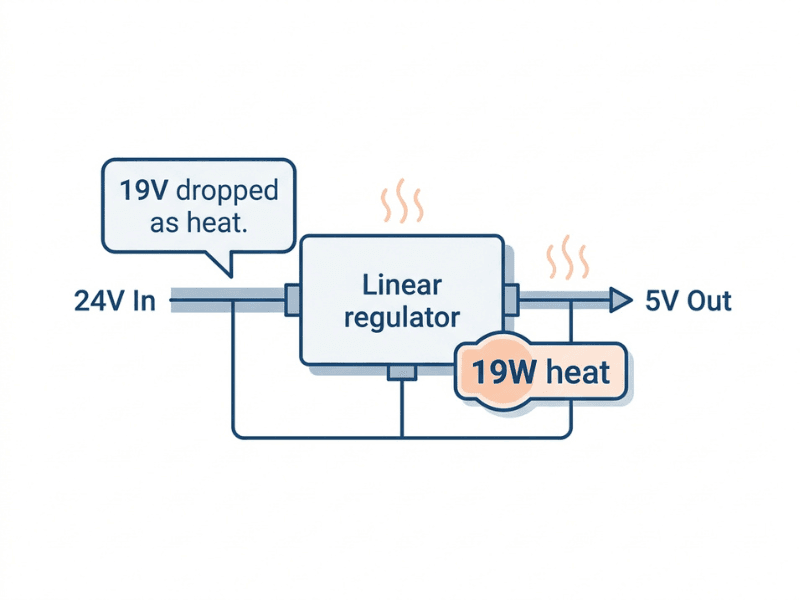
- Heat dissipation: Linear regulators dissipate excess voltage as heat — sometimes significant amounts. A 24V input feeding a 5V linear regulated output, for example, drops 19V across the regulator. At 1A of output current, that’s 19 watts of heat that has to go somewhere. In thermally constrained environments, this becomes a real engineering constraint. Switching supplies runs cooler at equivalent power levels.
- Size and weight: The bulky transformer and heat sink requirements of linear supplies make them physically larger. Switching supplies operate at much higher frequencies, which means smaller transformers and capacitors, and a smaller overall footprint.
- Electrical noise: Linear supplies and unregulated supplies are both relatively quiet. Switching supplies generate high-frequency noise that requires mitigation — filter capacitors, common-mode chokes, and careful PCB layout.
- Cost: Unregulated supplies cost the least to manufacture. Linear-regulated supplies add some cost for the regulator stage. Switching power supplies are the most complex and can cost more upfront, though their efficiency advantage reduces operating costs in high-duty-cycle applications.
Use Cases for Unregulated Power Supplies
Unregulated power supplies are genuinely useful — when matched to the right application. The key is to select a supply whose rated voltage and current closely match the load’s current draw. A significant mismatch between supply rating and actual load current leads to excessive voltage swings at the output.
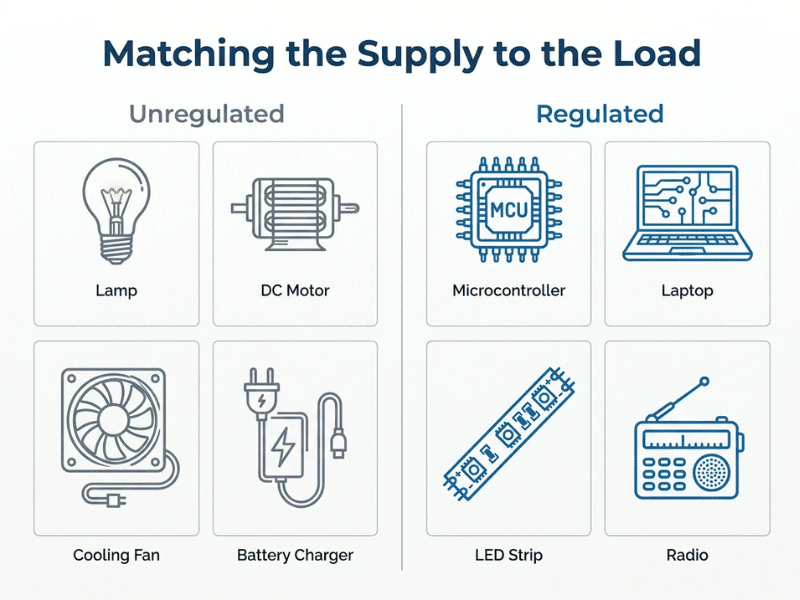
- Simple DC devices. Incandescent lamps, basic relays, and resistive heating elements are largely insensitive to minor voltage fluctuations. An unregulated supply handles these cleanly.
- DC motors and cooling fans. Motors are inductive loads that tolerate voltage variation well. Speed may shift slightly with voltage, but no damage occurs. For variable-speed applications or precise torque control, however, a regulated supply is the better call.
- Rugged environments. Where vibration, dust, or temperature extremes are factors, the simplicity of an unregulated supply is an asset. Fewer components mean less to fail.
- Battery charging. Simple battery chargers — particularly for lead-acid batteries — often use unregulated supplies. The battery’s internal resistance limits current as charge increases, providing a degree of natural regulation.
Use Cases for Regulated Power Supplies
Most modern electronics require a regulated supply. The tolerance windows for digital logic circuits are tight. A 3.3V microcontroller rail, for example, typically requires a voltage within ±5% to operate reliably. That leaves just 165 mV of margin on a 3.3V rail — a fluctuation that an unregulated supply can easily exceed during load changes.
- Microcontrollers and digital circuits. Any system running a processor, FPGA, or digital logic needs regulated power. Voltage transients can cause data corruption, reset loops, or permanent damage to semiconductor junctions.
- Computers and consumer electronics. Desktop PCs, laptops, televisions, and smartphones all rely on regulated switching supplies. Modern processors operate at core voltages below 1V with extremely tight tolerance requirements.
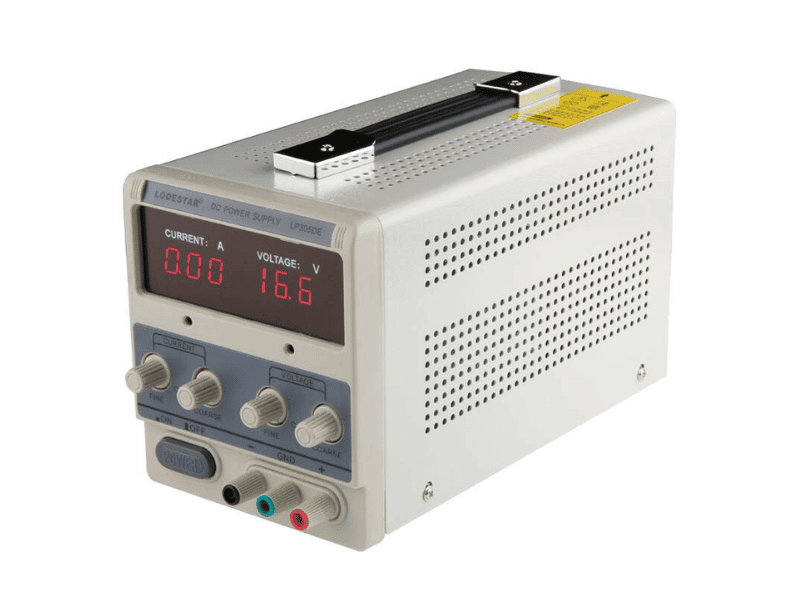
- Laboratory and medical equipment. Precision instruments need a stable, clean power source. Ripple and noise corrupt measurements. Laboratory bench supplies use linear regulation specifically because of its low-noise output.
- Wireless communication and radio equipment. RF circuits are sensitive to power supply noise. Ripple on the supply rail can appear as interference in the transmitted or received signal. Regulated — often linear regulated — supplies are standard for this reason.
- LED lighting strips. Despite being simple in appearance, LED strips require a regulated constant-voltage supply. LEDs are forward-biased diodes, and their current draw increases rapidly with voltage. An unregulated supply delivering even a volt or two above nominal can quickly burn out LEDs.
Choosing the Right Supply for Your Project
A few structured questions will guide the decision.
- What is your load’s voltage tolerance? Check the datasheet for your device’s input voltage range. If it’s ±1% or ±5%, you need a regulated supply. If it’s ±20% or wider, an unregulated supply may be adequate — provided you verify the actual output under your expected load conditions.
- Does your application care about electrical noise? Audio equipment, RF circuits, and precision analog sensors all suffer when power supply ripple bleeds into the signal chain. Use a linear regulated supply for the lowest possible noise floor. Use an SMPS only when you can manage the EMI through good layout and filtering.
- Is heat a design constraint? A linear regulator in a sealed enclosure without airflow can become a liability. Calculate the power dissipated as heat — (Vin – Vout) × Iout — and confirm your thermal budget can absorb it. If it can’t, an SMPS is the more practical solution.
- What are your ambient temperature conditions? Linear supplies dissipate more heat at elevated temperatures and may require derating. SMPS designs tend to handle higher ambient temperatures more gracefully due to their inherently lower power dissipation.
- What is your budget — and over what time horizon? An unregulated supply costs less to buy, but if it damages equipment, the replacement cost dwarfs the savings. A switching supply costs more upfront but reduces electricity costs over time in continuous-use applications. Factor both the purchase price and the operating cost into your decision.
Common Questions About Power Supplies
Can an unregulated power supply damage my electronics?
Yes. Voltage-sensitive devices — microcontrollers, computers, LEDs — can be damaged by the elevated no-load voltage of an unregulated supply, or by voltage spikes caused by sudden load changes. If a device has a tight input voltage tolerance, always use a regulated supply.
Why does my 12V unregulated supply show 16V on a multimeter?
This is normal behavior. Unregulated supplies are rated at their nominal voltage under a specific load current — typically full rated load. With little or no load connected, the output climbs toward the peak of the rectified AC waveform, which can be significantly higher than the stated rating. A “12V / 1A” unregulated supply at no load may read 16V or more. Connect the rated load, and the voltage will drop closer to 12V.
How do I measure the actual output of an unregulated supply?
Measure the voltage at the supply’s output terminals while your actual load is connected and drawing current. This gives you the real-world output your device will see. Measuring with no load attached tells you very little about operating performance.
Is it possible to add a regulator to an existing unregulated power source?
Yes. If the unregulated supply’s output is high enough — typically 2V to 3V above your target regulated voltage — you can add a linear regulator IC (such as the LM7805 or LM317) in series with the output. The regulator will hold the output steady and absorb the excess voltage as heat. This is a common approach for bench prototyping and low-current applications.
Which power supply type is better for long-term continuous use?
For continuous operation, a switching-regulated supply is generally the better choice. Its higher efficiency means lower energy consumption and less heat generation, both of which reduce thermal stress on components and extend service life. Linear-regulated supplies running at high power levels continuously generate substantial heat that degrades components over time if thermal management is inadequate. Unregulated supplies are suitable for appropriate loads but not for sensitive electronics in long-term operation.
Selecting the Best Path Forward
The regulated vs. unregulated question isn’t about which supply type is “better” — it’s about which one fits the job. Unregulated supplies are durable, affordable, and perfectly capable of resisting loads and motors with wide voltage tolerances. Regulated supplies are non-negotiable for digital circuits, sensitive analog equipment, LED lighting, and anything with tight input-voltage specifications.
Start with your load’s datasheet. Check the input voltage range, the sensitivity to ripple, and the operating conditions. If the numbers leave a margin for voltage variation and noise, an unregulated supply may serve you well and reduce cost. If they don’t, reach for a regulated supply — and then choose between linear and switching based on your noise, efficiency, and size requirements.
Getting this right at the design stage is far less expensive than diagnosing intermittent failures or replacing damaged components after the fact.