In the design and application of air quality monitoring equipment, sensor accuracy, the algorithm model, and structure design are the key points of discussion. Therefore, in the long-trem operat actual projector, the engineer will find the device stable and data consistency issues. Many problem not happen in the sensor itself, but also connect to the power supply system design.
Air quality monitoring equipment is usually placed in a fixed location, such as in residential buildings, office spaces, schools, or public buildings. Its typical characteristics is long term continuous operation and continuous networking. This type of application provides a clear requirement for a power system: stable output, low ripple, and can also withstand the transient load changes of the communication module and sensors during startup and state transitions.
From system components, the air quality monitoring equipment is usually integrated by PM2.5, CO₂、VOC sensor module, control unit, display, instruction module, and Wi-Fi or Ethernet communication module. And the wireless communication module save obvious instantaneous current peak in the stage of connection and data transmission. Furthermore, some gas sensors consume significantly more power during the preheating phase than during steady-state operation. If the power supply design is chosen according to the average power consumption, that exposure the disconnection, restart, or data anomaly in actual operation.
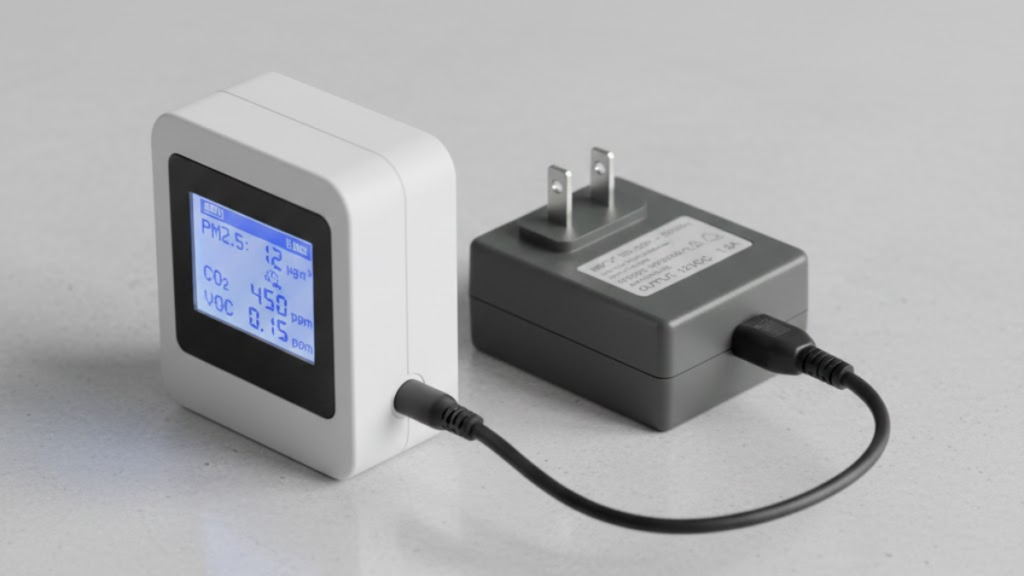
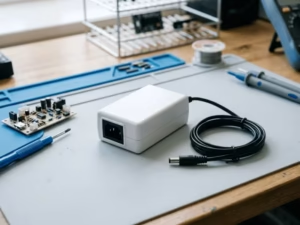
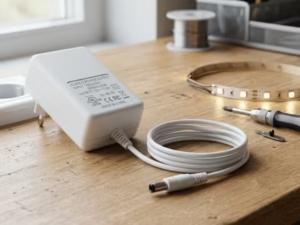
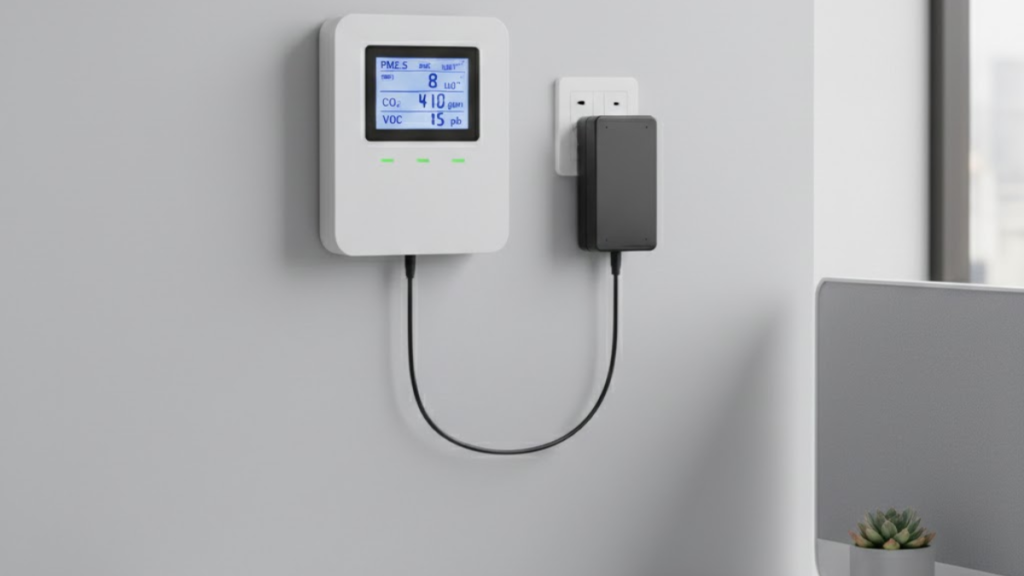
In the background of this application, that become a main solution for air quality monitoring equipment use external switching power supply. And in the structure, the external power supply and the host device are decoupled. It is useful for heat dissipation and has a reliable design that provides more stable input conditions for the device of the DC-DC transformer and filtering circuit. Compare the battery or low-power built-in power supply solution, the external power supply is more suitable for 24/7 continuous operation applications.
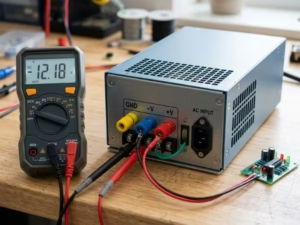
From the perspective of power configuration, the actual operating power consumption of the air quality monitoring equipment is usually in the range of 2-5W. But in the engineering design, the external power supply doesn’t need to be the lowest power consumption as a choice. Comprehensive thinking wireless module, transient surge, and power supply aging, changes in ambient temperature, and long-term reliability. Usually, 5V 2A(10W) or 12V 1A(12W) is a more rational configuration from an engineering perspective. That promise the system has an abundant power supply in all kinds of work statuses.
In addition, for the large-scale deployment or overseas market products, the safety of the external power supply and compliance are part of the system design. The external power supply have comprehensive protection mechanism and meets UL, FCC, and CE safety standards. It is not only helpful for the success of complete machine certification, but also reduces the risks of post-implementation on-site operation and maintenance.
From an engineering perspective, stable power does not directly improve a certain item index, and the effect of the reliability of the overall equipment and data reliability happens long-term and continuously. Moreover, for a manufacturer of air quality monitoring equipment and a system engineer, external power adapters are considered in system-level design considerations, which ensures long-term stable operation and high-quality data output, important basics.