When deploying IP cameras, wireless access points (APs), VoIP phones, or IoT devices, one of the most common questions for system integrators and IT managers is:
Should I use a POE adapter (injector) or a POE switch?
Both solutions deliver Power over Ethernet (POE), but they differ significantly in cost, scalability, installation, and long-term network design. This article provides a clear, engineering-focused comparison to help you choose the right option for your specific project.

What Is a POE Adapter?
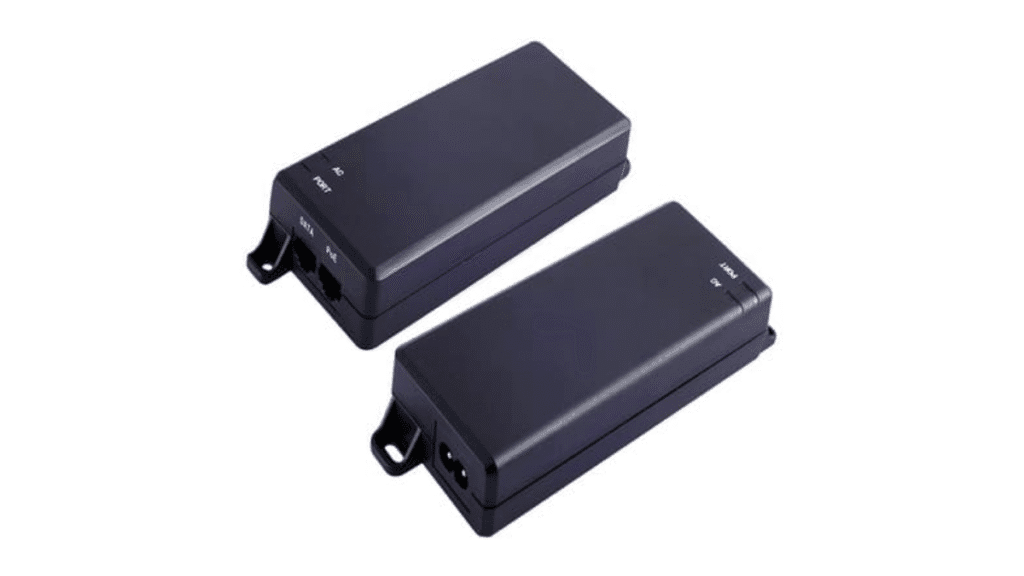
A POE adapter, also known as a POE injector, is a standalone device that adds DC power to an Ethernet cable.
How it works:
Connects between a non-POE network switch and a powered device (PD)
Injects power while passing through data
Typically powers one device per adapter
Common use cases:
Small deployments
Network upgrades without replacing existing switches
Projects requiring different power levels per device
What Is a POE Switch?
A POE switch integrates Ethernet switching and POE power delivery into a single device.
How it works:
Each POE-enabled port delivers both data and power
Centralized power distribution and management
Supports multiple devices simultaneously
Common use cases:
Medium to large networks
Structured cabling systems
Centralized IT-managed environments
POE Adapter vs POE Switch: Side-by-Side Comparison
| Feature | POE Adapter (Injector) | POE Switch |
| Power delivery | Single port | Multi-port |
| Initial cost | Lower | Higher |
| Installation | Plug-and-play | Requires rack space |
| Scalability | Modular | Limited by port count |
| Power management | Per device | Centralized |
| Maintenance | Easy replacement | Switch-level maintenance |
| Typical deployment | Small to medium | Medium to large |
When Should You Choose a POE Adapter?
A POE adapter is often the most cost-effective and flexible solution when:
1. You Are Upgrading an Existing Network
If your current switch does not support POE, adding POE adapters avoids replacing the entire switch infrastructure.
2. You Only Need to Power a Few Devices
For deployments with 1–10 POE devices, injectors are typically cheaper and easier to manage.
3. Devices Require Different Power Levels
POE adapters allow you to mix:
802.3af (15.4W)
802.3at (30W)
802.3bt (60–90W)
within the same network.
4. You Need Higher Reliability per Device
If one POE adapter fails, only a single device is affected, rather than multiple endpoints on a switch.
Recommended reading: POE Adapter Buying Guide for IP Cameras, APs & IoT Devices
When Should You Choose a POE Switch?
A POE switch becomes the better option when:
1. You Have a Large-Scale Deployment
Projects with dozens or hundreds of POE devices benefit from centralized switching and power delivery.
2. Centralized Power Management Is Required
POE switches allow:
Port-level monitoring
Remote power cycling
Network-wide power budgeting
3. Rack-Based Network Design Is Already in Place
If you already use:
Network racks
Structured cabling
UPS-backed switch rooms
then a POE switch integrates naturally.
Cost Comparison: POE Adapter vs POE Switch
| Cost Factor | POE Adapter | POE Switch |
| Hardware cost | Lower per unit | Higher upfront |
| Cabling | Minimal | Standard structured cabling |
| Maintenance | Low, modular | Higher impact if failed |
| Expansion | Add adapters as needed | May require new switch |
Key insight:
For small and growing projects, POE adapters often deliver a lower total cost of ownership (TCO).

Power Budget Considerations
POE Adapter
Dedicated power budget per device
No competition between ports
Easier to size for high-power devices
POE Switch
Shared power budget across ports
Risk of power oversubscription
Requires careful planning for high-power endpoints
For PTZ cameras, outdoor APs, or industrial devices, dedicated POE adapters reduce risk.
Reliability & Failure Impact
| Scenario | Impact |
| Adapter failure | One device offline |
| Switch failure | Multiple devices offline |
In mission-critical systems such as surveillance or industrial monitoring, this difference is often decisive.
POE Adapter vs POE Switch for Common Applications
| Application | Recommended Choice | Reason |
| Small IP camera system | POE Adapter | Low cost, flexibility |
| Enterprise WiFi network | POE Switch | Centralized management |
| Outdoor surveillance | POE Adapter | Dedicated power, surge protection |
| Industrial IoT | POE Adapter | High reliability, wide-temp |
| Smart building (large) | POE Switch | Port density and control |
Where Quankang POE Adapters Fit Best
Quankang POE adapters are designed for professional and industrial deployments where stability matters.
Key advantages:
Full IEEE 802.3af / at / bt compliance
Stable power output for high-load devices
Surge and lightning protection options
Wide temperature models available
OEM / ODM customization support
They are especially suitable for:
IP surveillance systems
Wireless AP deployments
Industrial and outdoor POE applications
Final Verdict: Which One Should You Choose?
| Project Type | Best Choice |
| Small or medium deployment | POE Adapter |
| Existing non-POE network | POE Adapter |
| Large centralized network | POE Switch |
| High-power or mission-critical devices | POE Adapter |
There is no universal winner. The right choice depends on scale, budget, reliability requirements, and power demand.
For many professional projects, a hybrid approach—using POE switches for dense areas and POE adapters for high-power or remote devices—offers the best balance.
Related Resources
POE Adapter: Complete Buying Guide for IP Cameras, APs & IoT Devices
IEEE 802.3af vs 802.3at vs 802.3bt Explained
POE vs Non-POE Power Supply: Which Is Better?
How to Choose a POE Adapter for IP Cameras
If you are planning a POE deployment and need stable, certified POE adapters, Quankang’s engineering team can help you select the optimal solution for your project.