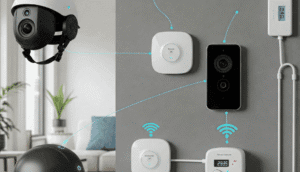
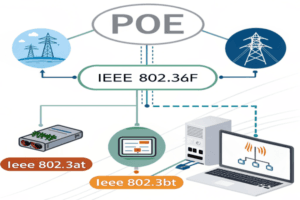
In modern IoT and smart building deployments, Power over Ethernet (POE) simplifies installation by delivering both power and data through a single Ethernet cable. This reduces wiring complexity, lowers installation costs, and supports scalable device networks.
Why Use a POE Adapter in Smart Building Systems?
Smart building systems often include:
IoT gateways for centralized data collection
Lighting and HVAC controllers
Access control and security devices
Environmental sensors (temperature, humidity, occupancy)
Using a POE adapter provides several advantages:
Simplified wiring – power and data over one cable
Centralized power management – easier monitoring and maintenance
Flexible deployment – devices can be installed in ceilings, walls, or remote locations
Compatibility with non-POE switches – allows gradual network upgrades
Key Technical Considerations for POE Adapters in IoT & Smart Buildings
1. POE Standard Compliance
Verify that the POE adapter matches the IoT gateway’s requirements:
IEEE 802.3af (PoE) – up to 15.4 W
IEEE 802.3at (PoE+) – up to 30 W
IEEE 802.3bt (PoE++) – up to 60–90 W
Incorrect standard selection can cause:
Device startup failure
Intermittent operation
Reduced device performance
Active POE adapters that negotiate power according to IEEE standards are recommended for mixed-device networks.
2. Power Requirements and Load
IoT gateways and smart building controllers may have variable power consumption:
Basic IoT devices: 5–10 W
Gateways with multiple sensors: 15–25 W
Controllers with displays or motors: 30–50 W
A suitable POE adapter should provide a margin above the maximum load to accommodate peak usage.
3. Environmental Considerations
Smart building deployments can expose devices to:
Temperature variations in ceiling or equipment rooms
Electrical noise from HVAC or lighting systems
Long cable runs across floors
POE adapters should support:
Wide operating temperature ranges
Surge protection where devices are at risk of voltage spikes
Continuous-duty operation in professional environments
4. Cable Quality and Distance
POE performance depends heavily on cabling:
Use Cat5e or Cat6 pure copper cables
Avoid CCA (copper-clad aluminum) cables
Keep cable length ≤ 100 meters to minimize voltage drop
Proper termination ensures reliable power delivery
Integration with Non-POE Devices
For non-POE IoT gateways or controllers:
Use a POE splitter to separate power and data
Ensure the splitter provides the correct DC voltage and current
This allows safe operation without modifying the device
[POE Adapter] ──> [POE Splitter] ──> [Non-POE Device]
│ ├─ Ethernet (Data)
│ └─ DC Output (5V/12V/24V)
Notes on Quankang POE Adapters (Technical Reference)
From a technical system-design perspective, POE adapters are active Power Sourcing Equipment (PSE) that deliver negotiated power to connected devices.
Quankang POE adapters are designed to:
Support IEEE 802.3af / at / bt standards
Provide stable power output suitable for IoT gateways, controllers, and smart building sensors
Integrate into structured cabling and indoor control rooms
Include options for industrial-grade environments, with surge and thermal protection
Typical applications include:
Smart building automation networks
IoT sensor and gateway deployments
Industrial Ethernet and connected systems
Selection should always be based on device power requirements, system architecture, and environmental conditions, rather than product name alone.
Common Mistakes to Avoid
Using passive POE with devices that require IEEE-compliant negotiation
Underestimating peak power requirements for gateways or controllers
Ignoring surge protection in electrical environments
Using low-quality cabling or exceeding maximum distance
These mistakes often lead to intermittent operation rather than immediate device failure.
When a POE Adapter Is the Best Choice
A POE adapter is particularly useful when:
Retrofitting IoT gateways into existing non-POE networks
Devices are installed in remote or hard-to-access locations
Individual devices require different power levels or isolation
Phased deployment is preferred
For large-scale, fully centralized networks, a POE switch may provide better management and scalability.
Related POE Reference Articles
POE Adapter vs POE Switch: Which One Should You Choose?
POE Adapter Not Working? 7 Common Problems and Solutions
POE Power Not Enough? Symptoms, Risks, and Fixes
How to Install a POE Adapter Safely (Wiring & Diagram Explained)
Final Thoughts
Using a POE adapter in IoT gateways and smart building systems simplifies deployment, reduces wiring complexity, and enables centralized power management.
By focusing on IEEE compliance, sufficient power margin, cable quality, and environmental protection, system designers and integrators can ensure stable, reliable, and scalable IoT networks for smart buildings, industrial facilities, and connected environments.