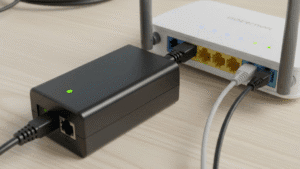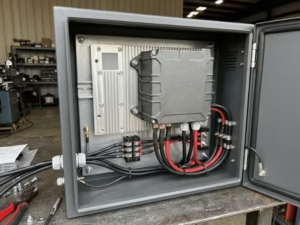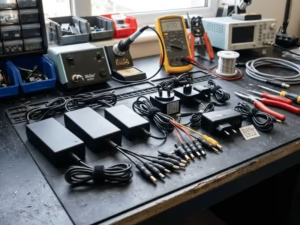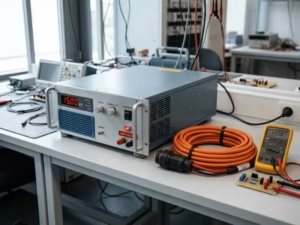
In the process of AC-DC power supply, smaller and higher power density development, the thermal design becomes a cord problem affecting the product’s reliability and lifespan. This challenge is particularly outstanding in many applications. Such as the medical power supply of a high level of safety and stability, limited volume, and usually relies on natural convection heat dissipation of the ITE power adapter, PoE adapter power density has improved rapidly, and mostly enclosed structures. Moreover, the LED driver’s power supply takes a long time to reach high temperatures. So in these applications, the AC-DC power supply is performing normally in the feature testing stage. If the capacity of structures’ heat dissipation, it may lead to the temperature rise and parameter drift or even failure in long-time operating.
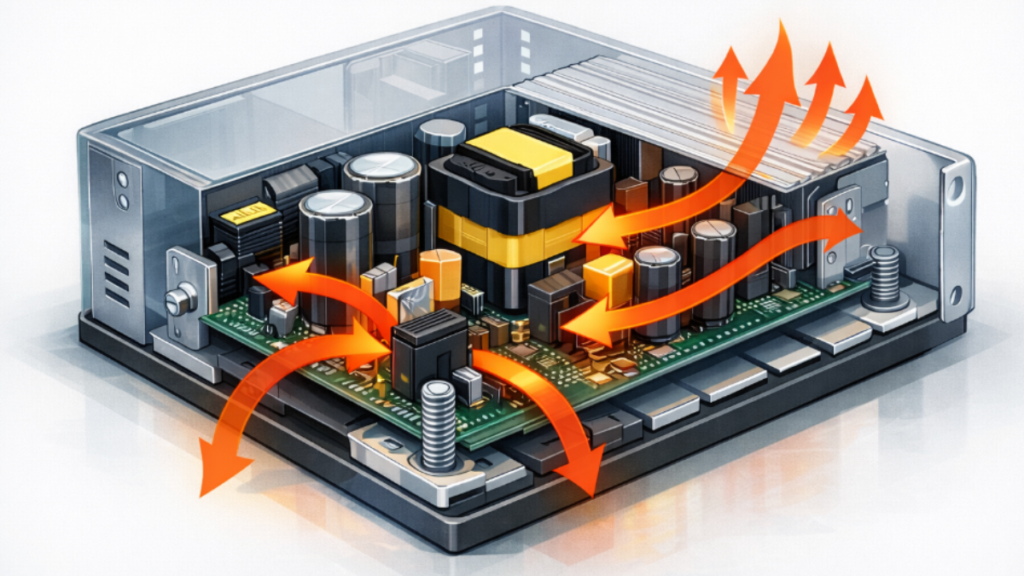
After finishing heat source analysis and PCB layout heat dissipation design, engineering practice discovers depend on the key reason for the raised temperature level is not only PCB, but the heat if affects to through reasonable structures load output. The structures of heat dissipation design depend on the PCB collect heat finally how transfer to air or shell, and prototype stage and mass production phase performance different the main sources.
In actual application, the AC-DC power supply’s structure’s heat dissipation way includes natural convection, shell conduction, and forced air cooling. In ITE power adapter and LED driver power supply, because limited of the limited volume, cost, and application that it is not deploy a large-size heat dissipation sheet or an innovative air-cooling system, and the heat mainly relies on the PCB’s natural release into the surrounding air. These types of structures are sensitive to device layout, installation direction, and enclosure ventilation conditions. When the application environment temperature increases, the heat dissipation margin will be compressed quickly.
In comparison, a PoE adapter and some medical power supplies, if the power grade more higher, the requirement of noise control, continuous operation capability, and a reliable system. It requires the structure’s heat dissipation design must be a system. These power supplies need to go through a metal shell, an internal heat dissipation structure, and an optimized thermal path design, which conducts heat stably to the external environment and does not rely on air flow.
In structural thermal design, the function of the outer casing is often underestimated. In fact, the shell is not a protective part an important heat dissipation passage. The material of the shell’s thermal conductivity, surface area, and surface treatment methods directly affect the whole device’s heat dissipation capacity. In close style LED driver power supply or PoE adapter, which reasonably uses the metal shell for heat dissipation, and is able to reduce the temperature of the key device without increasing the external heat sink solution.
Moreover, the structure itself can participate in heat dissipation. The fixing screws, metal brackets, and clamping strips can serve as auxiliary heat dissipation paths while also meeting the mechanical strength requirements. Let the PCB heat transfer to the shell or other heat dissipation area. This way of structure participates in heat dissipation usually common in medical power supplies, and helps the limited space get a stable temperature layout.
And you need to notice that the structure’s heat dissipation design must be based on the premise of electrical safety. In an AC-DC power supply, high-voltage isolation is important. So the thermal pads, insulating sheets materials are widely used for between of heat and electrical isolation. You will find in this process that, need to keep a balance between insulation performance and thermal conductivity. If insufficient contact area, the interface pressure is unreasonable, and the selection of thermal conductive materials is wrong, although the structural design may seem perfect, the actual heat dissipation effect can be significantly compromised.
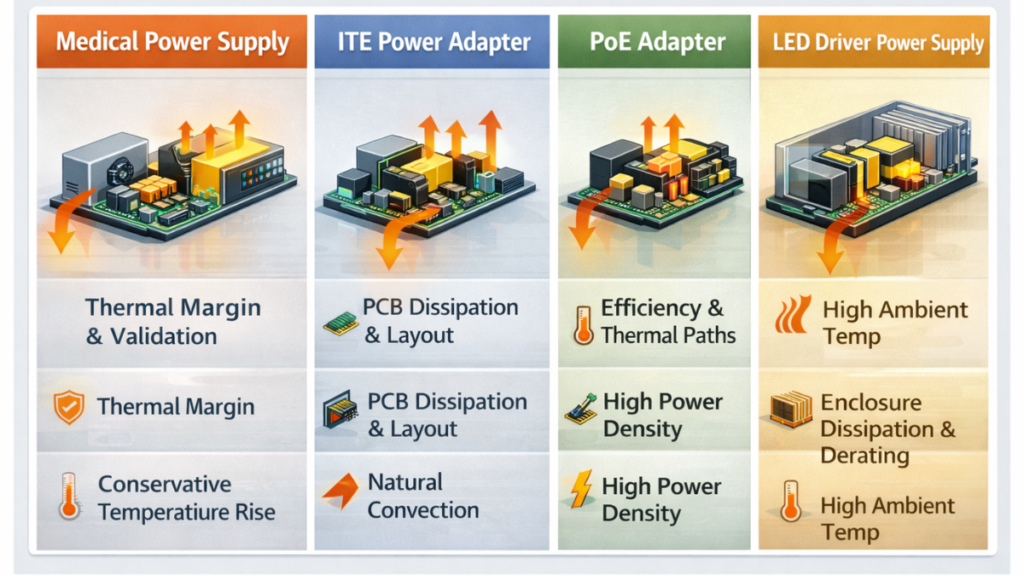
Compared to continuously strengthening structural heat dissipation, the efficiency advantage is to reduce the temperature fundamental path. From a thermal design perspective, the ideal state is not to dissipate already produced heat quickly, but to reduce the heat at the source. In the high power density of the PoE adapter and LED driver power supply, even if the efficiency improves by 1%, and may bring a temperature reduction that reduces the pressure on the shell heat dissipation and structures design.
In medical power supply and ITE power adapter, high efficiency means lower work temperature, which directly affects the long-time stability and lifespan. The selection of power devices, the choice of topology, and the appropriate setting of operating frequency. It has a decisive impact on the level of loss. Through reducing conduction losses and switching losses, optimizing magnetic properties, device design, and reasonable control of work frequency, which improves thermal performance in no increase structures complex structure solution.
But need to emphasize that the PCB thermal design and structures’ heat dissipation is not an independent part; it needs to be combined with the system layer to work. The PCB copper pouring, thermal vias, and thermal path design should provide clear and continuous heat exit for the structure’s heat dissipation. The structure design provides efficient heat connection conditions to the PCB. If the PCB heat fails to transfer to the shell, or the structures have heat dissipation capacity not combine with the PCB to provide good thermal coupling, and lead to the whole heat dissipation is wasted.
Any thermal design solution needs to be thoroughly verified to confirm its reliability in finially. The heat verify covers most unfavorable operating conditions, including high input voltage, full load operation, high environmental temperature, and unfavorable installation orientation. Through thermocouple measurement, infrared thermal imaging analysis, and long-term aging tests, which comprehensively assess the temperature status of key components such as power devices, magnetic components, and electrolytic capacitors.
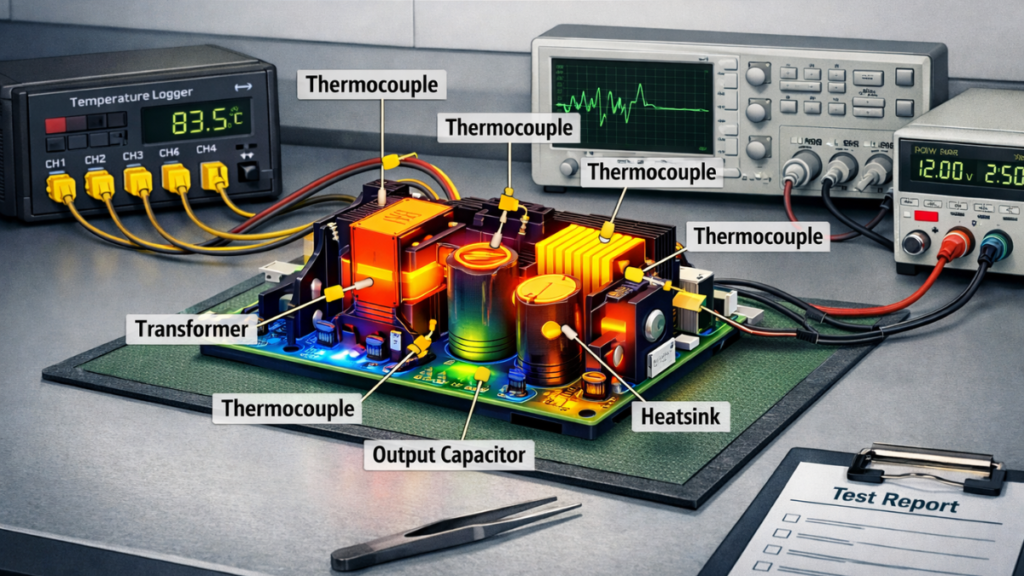
In this stage, different applications have significantly different requirements for the depth of verification. Medical power supply usually needs to be verified in a more strict environmental temperature and under continuous operating conditions, that make sure the key device has enough temperature rise margin and lifespan margin. And an ITE power adapter, PoE adapter, and LED driver power supply, for different application environments, but in the test of high-temperature aging and extreme operating conditions, also need to verify the structure’s heat dissipation if able to keep stable in long-time operation.
In all, the AC-DC power supply thermal design does not have a single optimal solution. Only structural heat dissipation, efficiency optimization, and thermal validation are considered a complete system engineering process, which medical, ITE, PoE, and LED applications achieve a balance between performance, reliability, and cost. Background of high power density continuing to increase, the thermal design capacity in the structural layer becomes the core competitiveness of high-quality AC-DC power supply.