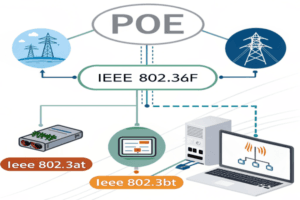
Since we have completed the selection guide for medical and ITE, it is now the turn of the PoE adapter.
PoE, which means Power over Ethernet, is not connected with a traditional DC cable but a network cable, simultaneously transmitting electricity and information.
Hardware Comparison Between PoE Adapters and Standard Adapters
Just like the other two types of adapters, when selecting a PoE power supply, you should take Power(W) and Certifications into consideration. The AC plugs they used are of a higher standard but have the same shape. The difference is what I mentioned above, that the output of the PoE adapter is RJ45(Registered Jack 45), commonly seen on routers and computers.

When we talk about the Power, PoE has its own rules:
IEEE 802.3af (PoE): Maximum power delivery of 15.4W, suitable for IP phones and basic cameras.
IEEE 802.3at (PoE+): Maximum power delivery of 30W, suitable for PTZ cameras and high-performance routers.
IEEE 802.3bt (PoE++ / 4PPoE): Maximum power delivery of 60W or 90–100W, suitable for high-power devices such as monitors and industrial controllers.
The safety standards and certifications of PoE power supply are the same as ITE’s, also IEC-62368-1 for CB and EN-62368-1 for TUV mark. But these only cover fundamental electrical safety. The real hardware difference begins once you step into the IEEE 802.3af, 802.3at, and 802.3bt requirements
These PoE standards define how the injector negotiates power, how it identifies a powered device, how much power can be delivered through the Ethernet pairs, and how the adapter must behave when cable quality is poor or the device draws beyond its allocated budget.
In short, the PoE layer has a higher standard to drive devices, and this standard needs to be stable, predictable, and resilient.
When we discuss requirements beyond the hardware level
Thermal performance also separates strong PoE designs from weak ones. Delivering 15W (802.3af) is easy. Delivering 30W (802.3at) sustainably is harder. Delivering 60W–90W (802.3bt) in a compact enclosure without throttling or shutdown is an engineering challenge.
Another critical selection factor is compatibility with Powered Device (PD) detection and classification. The IEEE protocol defines how the injector confirms that a connected device is safe to power, how it identifies Class 0–8 equipment, and how it allocates available wattage.
Cheaper injectors often oversimplify this handshake, leading to field failures where devices do not start, do not draw enough power, or reset intermittently. From a practical R&D support perspective, choosing the right PoE adapter means reducing the hidden risks that slow down deployment.
Conclusion
The selection principles do not change, but the engineering expectations become higher, and the margin for error becomes smaller. A well-designed PoE injector is not just a power source; it is a network-safe component that keeps the entire system stable.
Quankang also offers a compact PoE power lineup built around the same principles—stable IEEE negotiation, clean RJ45 performance, and distance-aware voltage delivery—so your devices can be powered up reliably without surprises. Our 24W, 35W, and 90W models are highly recommended by our clients. Just contact us to get a well-designed PoE power supply.