When deploying IP cameras, selecting the right POE adapter voltage is crucial for reliable operation. IP cameras often have specific power requirements, and using a POE adapter with incorrect voltage can result in unstable operation, reduced performance, or device failure. This article provides a technical guide on choosing between 12V and 24V POE adapters, installation considerations, and practical tips for safe and efficient deployment.

Why Voltage Matters for IP Cameras
IP cameras typically have DC input requirements, commonly 12V or 24V. The correct adapter voltage ensures:
Stable device operation
Proper functionality of IR LEDs, PTZ motors, and sensors
Long-term reliability of the camera and network
Using an adapter with insufficient or excessive voltage can lead to:
Cameras failing to power on
Intermittent reboots or connection drops
Reduced image quality or disabled features
12V vs 24V POE Adapters: Key Differences
| Feature | 12V POE Adapter | 24V POE Adapter |
|---|---|---|
| Typical Use | Indoor cameras, small PTZ or dome cameras | Outdoor cameras, high-power PTZ or IR cameras |
| Power Delivery | Suitable for lower-power devices (≤15 W) | Suitable for higher-power devices (15–30 W or more) |
| Voltage Drop Sensitivity | More sensitive over long cable runs | Better performance over longer distances |
| Peak Load Handling | Limited headroom for IR or motor operation | More capacity to handle peak power requirements |
Note: Always check the camera datasheet for voltage input requirements and maximum power consumption.
Installation Considerations
POE Standard Compliance
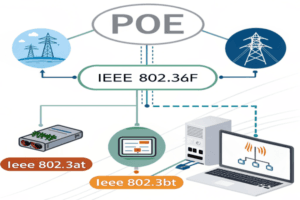
Choose an adapter that complies with IEEE 802.3af, 802.3at, or 802.3bt standards to ensure safe power negotiation. Using a standard-compliant adapter reduces the risk of overcurrent or under-power conditions.
Cable Quality and Distance
Use Cat5e or Cat6 pure copper cables.
Avoid CCA (copper-clad aluminum) cables.
Maintain cable length ≤100 meters to minimize voltage drop.
Device Power Requirements
Basic indoor cameras: 12V, ≤10 W
Outdoor IR cameras: 24V, 15–30 W
PTZ cameras: consider peak load for motors and night vision
Environmental Conditions
Outdoor deployments may require adapters with wider operating temperature ranges, surge protection, and moisture resistance.
Non-POE Cameras
Use a POE splitter to safely convert POE power to the DC voltage required by cameras that do not natively support POE.
[POE Adapter] ──> [POE Splitter] ──> [Non-POE Camera]
│ ├─ Ethernet (Data)
│ └─ DC Output (12V / 24V)
Notes on Quankang POE Adapters (Technical Reference)
From a system design perspective, POE adapters function as active Power Sourcing Equipment (PSE) that deliver negotiated power to compliant IP cameras.
Quankang POE adapters are designed to:
Support IEEE 802.3af / 802.3at / 802.3bt standards
Deliver stable 12V or 24V output for indoor and outdoor IP cameras
Integrate into structured cabling and indoor/outdoor installations
Include options for industrial-grade environments with surge and thermal protection
They are commonly used in:
Indoor and outdoor IP surveillance systems
PTZ camera networks
Industrial or campus security deployments
Selection should be based on camera voltage requirements, peak load, cable length, and environmental factors, rather than the product name alone.
Common Mistakes to Avoid
Using a 12V adapter for a camera rated for 24V (or vice versa)
Ignoring peak power requirements for IR or PTZ cameras
Using non-standard or passive POE adapters without voltage negotiation
Overlooking cable quality and length
These mistakes often cause intermittent operation rather than immediate camera failure.
When to Choose 12V vs 24V POE Adapters
12V POE adapters are suitable for low-power indoor cameras or short cable runs.
24V POE adapters are preferred for high-power cameras, long-distance cabling, and outdoor installations.
For mixed networks, an adapter that supports IEEE-compliant power negotiation ensures safe operation across multiple camera types.
Related POE Reference Articles
POE Adapter vs POE Switch: Which One Should You Choose?
POE Adapter Not Working? 7 Common Problems and Solutions
POE Power Not Enough? Symptoms, Risks, and Fixes
How to Install a POE Adapter Safely (Wiring & Diagram Explained)
Final Thoughts
Selecting the correct 12V or 24V POE adapter is essential for ensuring IP camera stability, proper functionality, and long-term reliability. By focusing on IEEE compliance, cable quality, power margin, and environmental protection, system integrators can build reliable indoor and outdoor surveillance networks.
Quankang POE adapters provide technical flexibility and compliance options, supporting stable operation across diverse camera deployments without compromising safety or system integrity.