When you are selling medical devices globally, the medical power adapter is never just a “charger.”
It is the final and most critical safety barrier between a high-voltage wall outlet and a patient who may already be in a fragile condition.
In many international projects we see, the medical device itself is technically mature, but the power adapter becomes the hidden bottleneck. A single failed compliance test can stop shipments, delay registrations, or force a last-minute redesign. At that point, even small changes may trigger retesting of the entire system.
From a market-access perspective, understanding medical power adapter standards early is not a technical detail. It is a commercial decision that directly affects time-to-market.
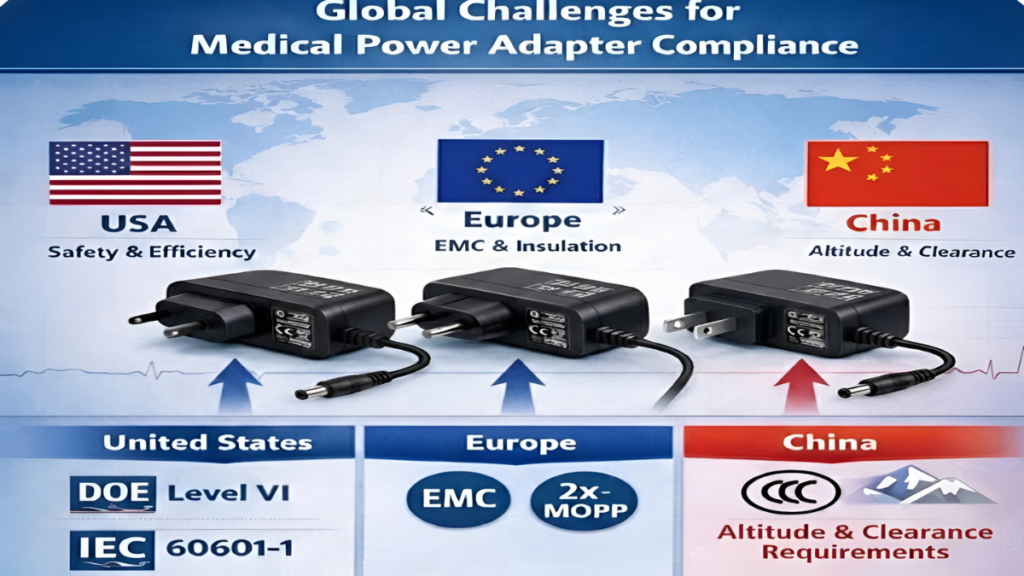
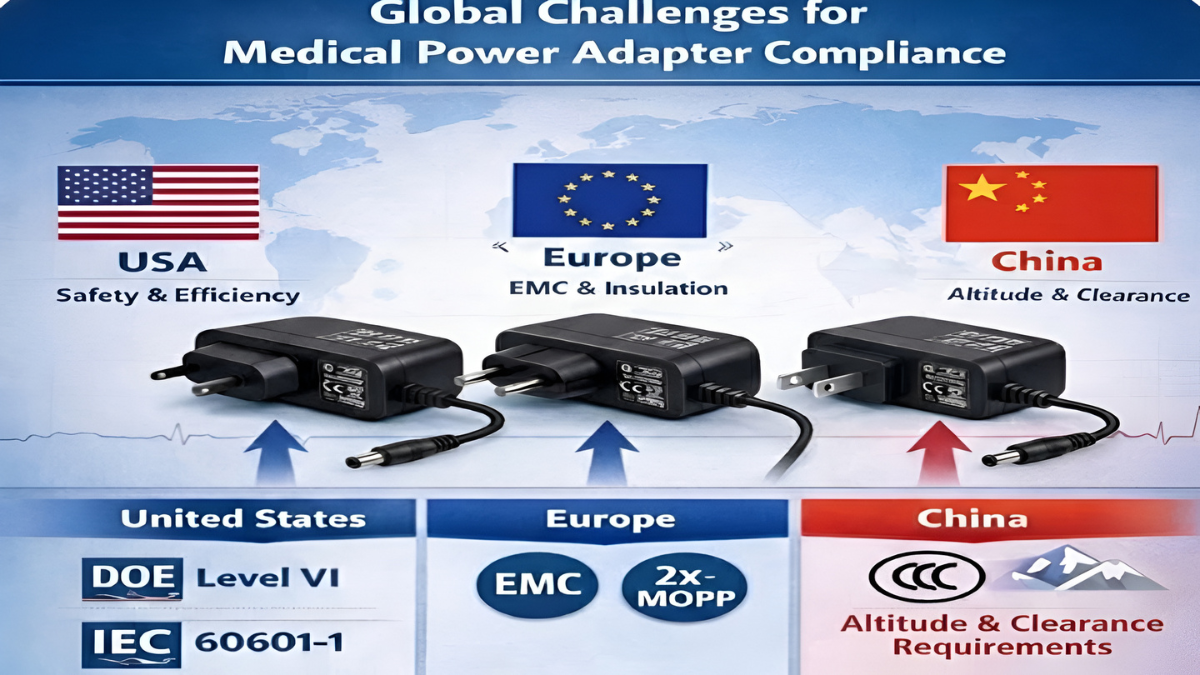
Whether your target market is the United States, Europe, or China, each region places a different kind of pressure on the power adapter design. Missing just one of these expectations can turn a “ready” product into a stalled project.
1. The USA: When Safety Must Coexist with Energy Rules
In the United States, medical devices are primarily evaluated under the IEC 60601-1 safety framework, which focuses on protecting patients and operators from electrical hazards. For medical power adapters, this means strict limits on leakage current, reinforced insulation, and fault-condition safety.
However, safety is only half of the challenge.
US market access also requires compliance with DOE Level VI energy efficiency regulations. These rules limit no-load and standby power consumption to extremely low levels. For consumer adapters, this is already demanding. For medical adapters, it becomes much harder.
The reason is simple but often underestimated: many safety-related components inside a medical power adapter naturally introduce leakage paths and parasitic losses. Y-capacitors, isolation structures, and EMI filters all work against ultra-low standby power.
In real projects, it is common to see designs that pass IEC 60601-1 comfortably but struggle to meet DOE Level VI, especially under no-load or light-load conditions. Trying to “optimize later” often leads to unstable behavior or repeated test failures.
For the US market, a medical power adapter must be designed from day one to be both extremely safe and extremely efficient. Treating these as separate goals almost always leads to delays.
2. Europe: EMC, Insulation, and Light-Load Reality
Europe requires the CE Mark, but behind that label is a combination of safety, EMC, and energy performance requirements that interact with each other in complex ways.
From an EMC perspective, medical power adapters must operate quietly. Any excessive electromagnetic noise risks interfering with nearby equipment such as patient monitors, imaging systems, or life-support devices. Passing EMC on paper is not enough; stability across different installation environments is expected.
Europe also places strong emphasis on 2xMOPP (Means of Patient Protection). This means two independent levels of insulation between the mains input and any patient-accessible parts. Even if one protective layer fails, the second must still fully protect the patient.
What many teams underestimate is how these insulation requirements affect layout, component spacing, and mechanical design. Once enclosure size and PCB dimensions are fixed, correcting insulation weaknesses can become very expensive.
In addition, new Ecodesign regulations require medical power adapters to remain efficient even when operating far below rated power, sometimes at only 10% load. This exposes weaknesses in control strategies that may look fine at full load but perform poorly in real-world standby or idle conditions.
For European market access, the power adapter must not only pass tests once, but remain compliant across a wide range of operating modes that reflect actual medical device usage.
3. China: Certification Meets Geography
China’s CCC certification adds another layer of complexity, and one that is often overlooked until late in the project: altitude.
China has many regions where medical devices operate at significantly higher elevations. At high altitude, air density is lower, which reduces dielectric strength. This increases the risk of electrical arcing across insulation gaps.
As a result, medical power adapters for the Chinese market often require larger creepage and clearance distances than designs intended only for low-altitude regions. These distances are not theoretical. They are physically measured on the PCB and within the enclosure.
A compact adapter that passes US and EU tests can still fail CCC altitude requirements. When this happens after tooling and enclosure design are frozen, the consequences are severe: redesign, retooling, and retesting.
From a global market perspective, altitude is not a “China-only” issue. It is a reminder that regional environmental assumptions must be built into the power adapter from the beginning.
Why Choosing the Right Partner Matters
Global compliance is not about collecting certificates. It is about avoiding repeated redesigns, wasted lab time, and missed market opportunities.
Many delays in international medical projects are not caused by new regulations, but by designs that were optimized for one region and then forced into another. Every regional fix adds cost, risk, and uncertainty.
At Quankang, we work with medical device teams who want to avoid this cycle. The goal is not to design for one test, but to develop medical power adapters with a global compliance mindset from the start.
By aligning safety insulation, EMC behavior, energy efficiency, and altitude considerations early, it becomes possible to follow a “test once, sell everywhere” strategy. This approach shortens development timelines and reduces the risk of late-stage surprises.
In a competitive medical market, speed to market is often more important than marginal cost savings. Choosing a power adapter partner who understands global market access can be the difference between launching on schedule and watching competitors move first.
When planning your next medical device, one question is worth asking early:
Is your power adapter only designed to pass today’s test, or to support tomorrow’s global expansion?
Contact
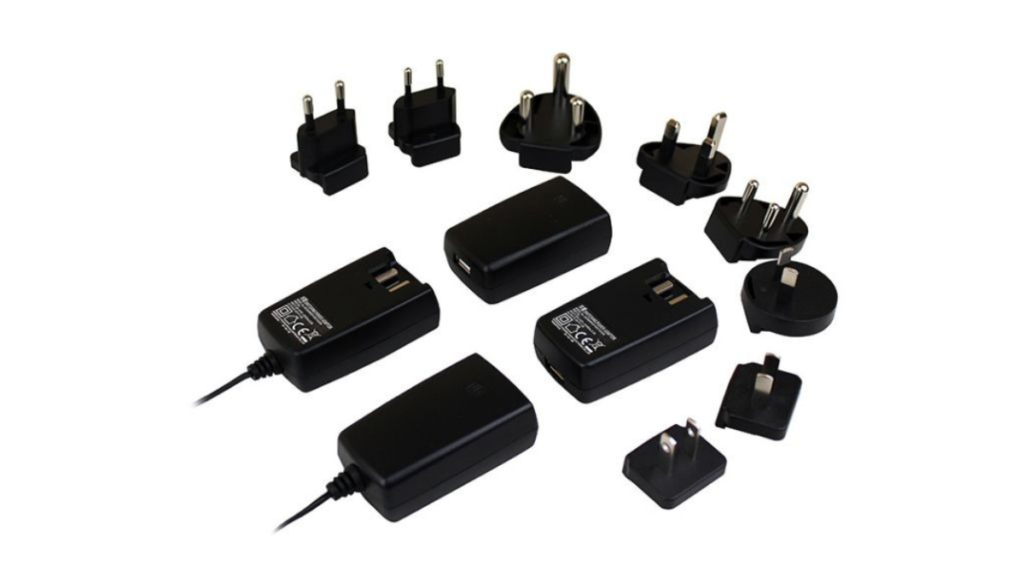
Most of Quankang‘s existing medical power adapters are designed with global market access in mind during the design phase.
They are equipped with the IEC60601-1 medical safety standard as standard, and commonly used voltage specifications usually have CE certification. They also provide interchangeable plug solutions for Europe, America, China, the UK, and Australia, making it convenient for devices to be used directly in different regional markets.
The entire product line is designed with a margin for high-altitude working conditions, and can maintain stable operation in environments up to 5000 meters high, reducing certification and application risks caused by regional differences.
Contact us to get a Global Market Access Medical power supply solution.Your Trust, Our Shield.