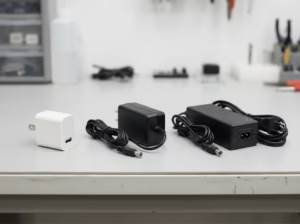
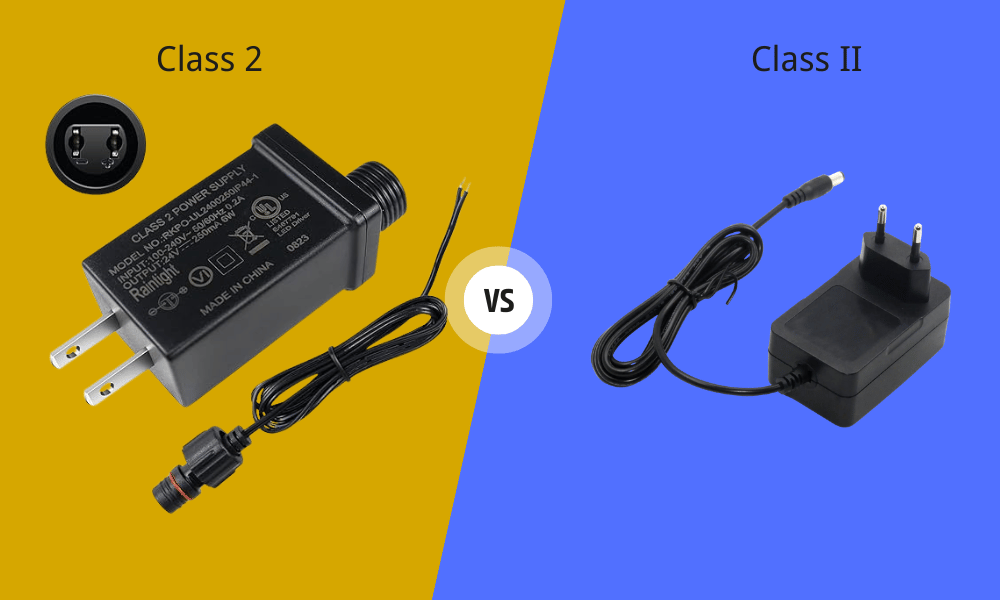
A Class 2 power supply limits its output in power, voltage, and current to reduce the risk of fire and electric shock. Class II — written with Roman numerals — is something different: it describes how a power supply is built to protect against electric shock on the input side, through double or reinforced insulation rather than a protective earth connection.
Class 2 is about output limits. Class II is about construction-based shock protection. They are not the same thing, and one does not imply the other.
What Is a Class 2 Power Supply?
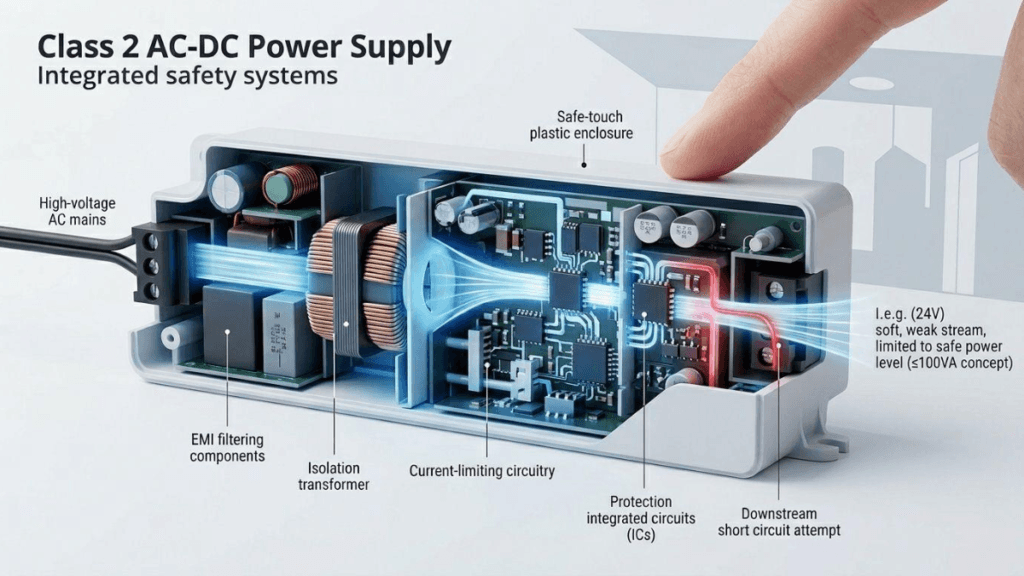
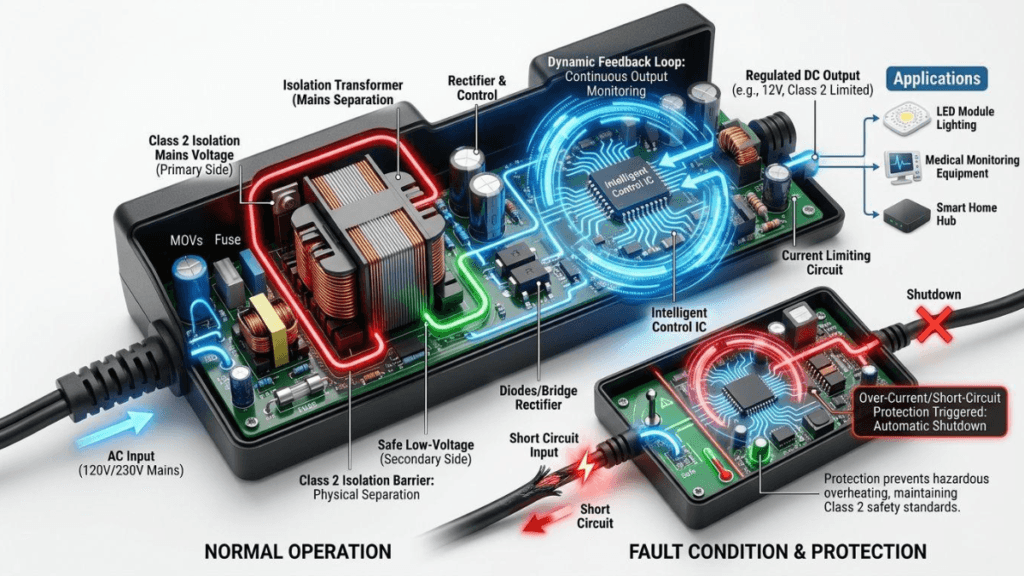
A Class 2 power supply is defined by the limits placed on its output. Rather than relying on heavy protective wiring or additional safeguards further down the circuit, the supply itself is designed to prevent output from exceeding specified thresholds. That built-in restriction is what makes it “Class 2.”
In North America, the term is most closely associated with UL 1310, where qualifying AC adapters and power supplies are classified as Class 2 power units. A related concept — the Limited Power Source (LPS) — appears in IEC 62368-1 and shares a similar safety goal, though the two are not identical. When a supply meets applicable Class 2 requirements, its output is held below defined thresholds for apparent power, open-circuit voltage, and short-circuit current. Exact figures vary by standard and operating condition, so always consult the applicable standard directly.
Output Limits That Define Class 2
The core principle is restraint. By keeping output power, voltage, and short-circuit current within defined boundaries, a Class 2 supply cannot deliver enough energy under fault conditions to readily start a fire or cause a hazardous shock. Different standards express these limits with slightly different values, but the underlying intent is consistent: constrain output to a level that is safe by design.
Why Class 2 Reduces Fire and Shock Risk
Because the output is constrained, a Class 2 supply is less able to sustain hazardous energy levels during overloads or short circuits. This reduces the risk of overheating and ignition. It also explains why conductors used in NEC Class 2 circuits may qualify for less demanding installation requirements compared to general-purpose power wiring — the protection comes from limiting energy at the source.
What Does “Class II” Mean? (And Why It’s Different)
Class II describes a method of electric shock protection on the input side of a power supply, based entirely on insulation and construction rather than a protective earth connection. To understand it clearly, it helps to first understand Class I.
Class I vs Class II Input Protection
A Class I power supply combines insulation, spacing, and a protective earth connection to protect users from electric shock. If a fault causes live voltage to appear on an accessible metal part, the protective earth path carries fault current safely away and triggers a protective device.
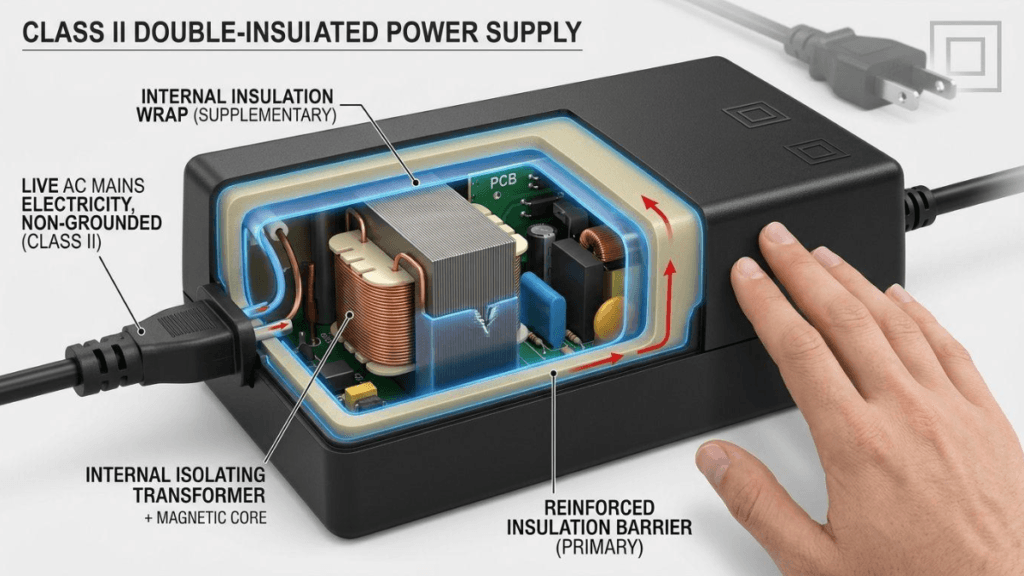
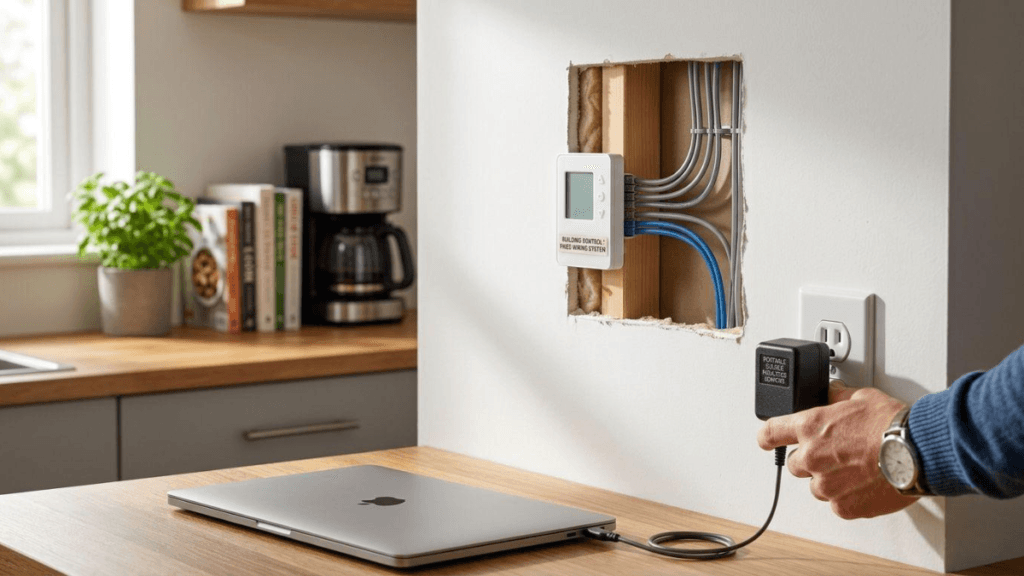
A Class II power supply does not include or rely on a protective earth connection for shock protection. Instead, protection is achieved entirely through the construction of the supply — specifically through additional insulation and spacing between live conductors and user-accessible surfaces. The absence of a ground connection is a result of this construction approach, not simply a matter of plug shape.
How Double and Reinforced Insulation Works
Class II protection uses either two independent layers of insulation (double insulation) or a single layer of reinforced insulation that provides equivalent protection between live conductors and any accessible conductive parts. Even if one barrier were to fail, the second remains, providing continued protection without dependence on an external ground. The safety relies on the integrity and quality of the insulation system itself.
Class 2 vs Class II: Quick Comparison Table
Comparison Point | Class 2 | Class II |
|---|---|---|
What it refers to | A safety classification limiting output power, voltage, and current | A construction-based method of shock protection using insulation |
Which side of the supply | Output side | Input side |
Main purpose | Reduce fire and shock risk by constraining output energy | Protect against electric shock without relying on a protective earth |
Related standards | UL 1310, NEC (Class 2 circuits), IEC 62368-1 LPS (related, not identical) | IEC and UL insulation and equipment protection classifications |
Typical features | Limited output apparent power, open-circuit voltage, and short-circuit current | Double or reinforced insulation; no protective earth connection |
Can they overlap? | Yes — a supply can satisfy both independently | Yes — a supply can satisfy both independently |
Class 2 governs output energy limits. Class II governs the construction-based approach to input-side shock protection. The two are assessed independently.
Can a Power Supply Be Both Class 2 and Class II?
Yes. A single power supply can meet both Class 2 and Class II requirements simultaneously because the two designations address different aspects of the supply.
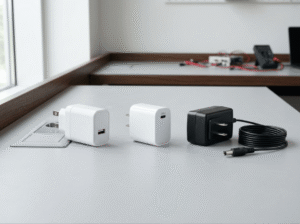
A unit can have a limited output that satisfies Class 2 requirements while also being built with double or reinforced insulation that qualifies it as Class II. The two do not conflict. Many compact external power adapters are designed to satisfy both: their output is constrained for safety, and their construction eliminates dependence on a protective earth connection.
Each designation should be verified independently. A Class 2 marking refers to output limits. A Class II marking refers to insulation-based input protection. One does not follow from the other, and both should be confirmed through the applicable documentation and certification marks.
Standards Related to Class 2 Power Supplies
Several standards address Class 2 power supplies or closely related concepts. They share similar safety goals but are not interchangeable, and their specific requirements differ.
UL 1310 and the “Class 2 Power Unit” Classification
UL 1310 is the primary North American standard for direct plug-in power units. It defines the output limits and construction requirements a supply must meet to be classified as a Class 2 power unit. The standard covers supplies intended for connection to standard branch circuits and sets the thresholds for apparent power, open-circuit voltage, and short-circuit current that define the classification.
IEC 62368-1 and Limited Power Source (LPS)
IEC 62368-1 uses the concept of a Limited Power Source (LPS) to identify power sources whose output energy is restricted to reduce hazards. The intent overlaps with Class 2, and the two are frequently compared. However, they are not identical: the specific thresholds, nameplate rating rules, and applicable conditions differ between the two standards. Treat them as closely related but distinct concepts, each requiring verification against its own standard.
NEC Class 2 Circuits and Wiring
The NEC defines Class 2 circuits as those supplied by power sources with limited energy output. Because available power is constrained, these circuits may qualify for less stringent wiring and installation requirements than general-purpose power circuits, thereby reducing both material and labor costs in low-voltage applications. Meeting UL 1310 Class 2 requirements for the supply itself is typically a prerequisite for the circuit to qualify under NEC Class 2 rules.
Where Are Class 2 Power Supplies Used?
Class 2 power supplies are common wherever limited output energy, simplified wiring, and lower installation burden are priorities.
- LED lighting and drivers. Many LED systems are designed around Class 2 power supplies because limited output supports safer installations and aligns with requirements in common lighting codes.
- Building automation and controls. Low-voltage control systems benefit from the reduced wiring requirements associated with Class 2 circuits.
- Access control. Door controllers, card readers, and related hardware typically run on limited-power supplies compatible with Class 2 requirements.
- Sensors and low-voltage devices. Distributed sensor networks draw modest power, making Class 2 supplies a practical fit.
Across these applications, constraining output energy reduces installation complexity and lowers hazard exposure.
How to Tell If a Power Supply Is Class 2
The classification is typically documented on the product label and in its accompanying technical literature.
Reading the Label and Nameplate
Start with the product label. A Class 2 supply should explicitly state its classification, along with its rated output power, voltage, and current, and may reference the applicable standard. Check the stated output ratings against your application requirements and confirm the classification marking is present — not merely implied.
Checking the Datasheet and Certification Marks
The datasheet provides the full technical picture. It should identify the applicable standard by name, list the output limits, and show certification marks from the relevant safety agency. Do not assume compliance from general product descriptions alone. If you have any doubt about whether a supply meets the requirements for your specific design or jurisdiction, confirm with the manufacturer before proceeding.
Common Mistakes and Misunderstandings
A few points in this area are frequently confused. The following clarifications address the most common ones.
- Class 2 is not Class II. Class 2 (Arabic numeral) refers to output energy limits. Class II (Roman numeral) refers to input-side shock protection by construction. The two look similar but describe entirely different attributes.
- Low voltage does not automatically mean Class 2. Class 2 classification depends on the combined limits of apparent power, open-circuit voltage, and short-circuit current. A supply with a low output voltage can still exceed Class 2 thresholds if its power or current output is not constrained as well.
- LPS is not identical to Class 2. The two concepts are closely related and share a safety goal, but their specific thresholds and rating conditions differ. Meeting one does not automatically satisfy the other.
- Class II does mean no safety requirements. Class II equipment must meet rigorous insulation and construction standards. It achieves shock protection through double or reinforced insulation rather than a protective earth — a different, construction-based approach, not a lesser one.
Frequently Asked Questions
Can a power supply be both Class 2 and Class II?
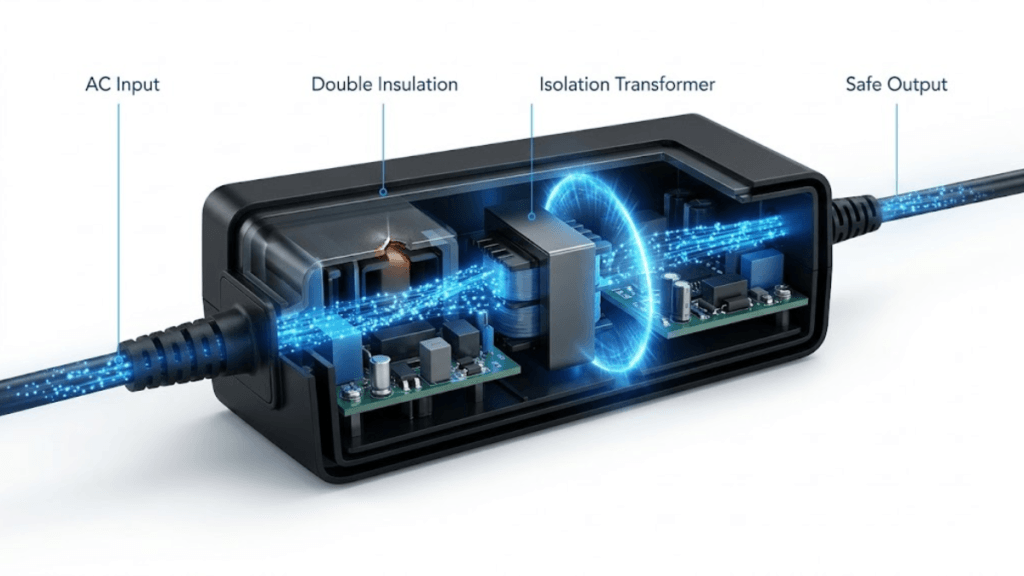
Yes. The two designations address different aspects of a supply — output energy limits (Class 2) and insulation-based input protection (Class II) — so a single unit can independently satisfy both. Confirm each separately through the applicable documentation and certification marks.
Does low voltage automatically mean a supply is Class 2?
No. Class 2 is based on limits for apparent power, open-circuit voltage, and short-circuit current — not voltage alone. A low-voltage supply can still exceed Class 2 thresholds if its power or current output is not sufficiently limited. Always verify against the full specification and the applicable standard.
What standards apply to Class 2 power supplies?
UL 1310 is the primary North American standard for Class 2 power units. The NEC defines Class 2 circuits and their associated wiring requirements. IEC 62368-1 uses the related LPS concept. These standards overlap in intent but are not identical, and each has its own specific requirements.
How do I know if my power supply is Class 2?
Check the product label for a Class 2 marking and review the output ratings. Confirm the details in the datasheet, including the applicable standard and certification marks from the relevant safety agency. Contact the manufacturer if anything is unclear before incorporating the supply into your design.
Why are Class 2 power supplies common in LED lighting?
LED systems are often designed to take advantage of Class 2 classification because limited output power aligns with common lighting code requirements and can simplify wiring installations. The lower hazard profile is also consistent with typical lighting safety goals.
Is a Class II power supply safer than a Class I supply?
Neither is inherently safer in absolute terms. Class I uses a protective earth connection, combined with insulation and spacing, to guard against electric shock. Class II achieves equivalent protection through double or reinforced insulation without a ground connection. Both are recognized methods of shock protection; the right choice depends on the application, the environment, and the requirements of the applicable standard.
Key Takeaways: Choosing the Right Power Supply
The distinction becomes clear once the two terms are treated separately. Class 2 limits output power, voltage, and current to reduce the risk of fire and electric shock. Class II achieves input-side shock protection through double or reinforced insulation, without relying on a protective earth connection. A single supply can satisfy both independently, and confirming each requires checking the label, the datasheet, and the specific applicable standard.
When selecting a power supply, match the classification to the actual requirements of your application, installation environment, and jurisdiction. Low voltage alone is not sufficient evidence of Class 2 compliance, and the absence of a ground connection is not sufficient evidence of Class II compliance. Verify output limits against the applicable standard, confirm the insulation approach and certification marks, and review the documentation carefully.
If you need help confirming whether a supply meets Class 2 requirements or suits your design’s safety needs, contact our engineering team. We can help you match the right power supply to your application, standards, and installation.